Tree comparison
Norway maple vs sugar maple: how to tell them apart
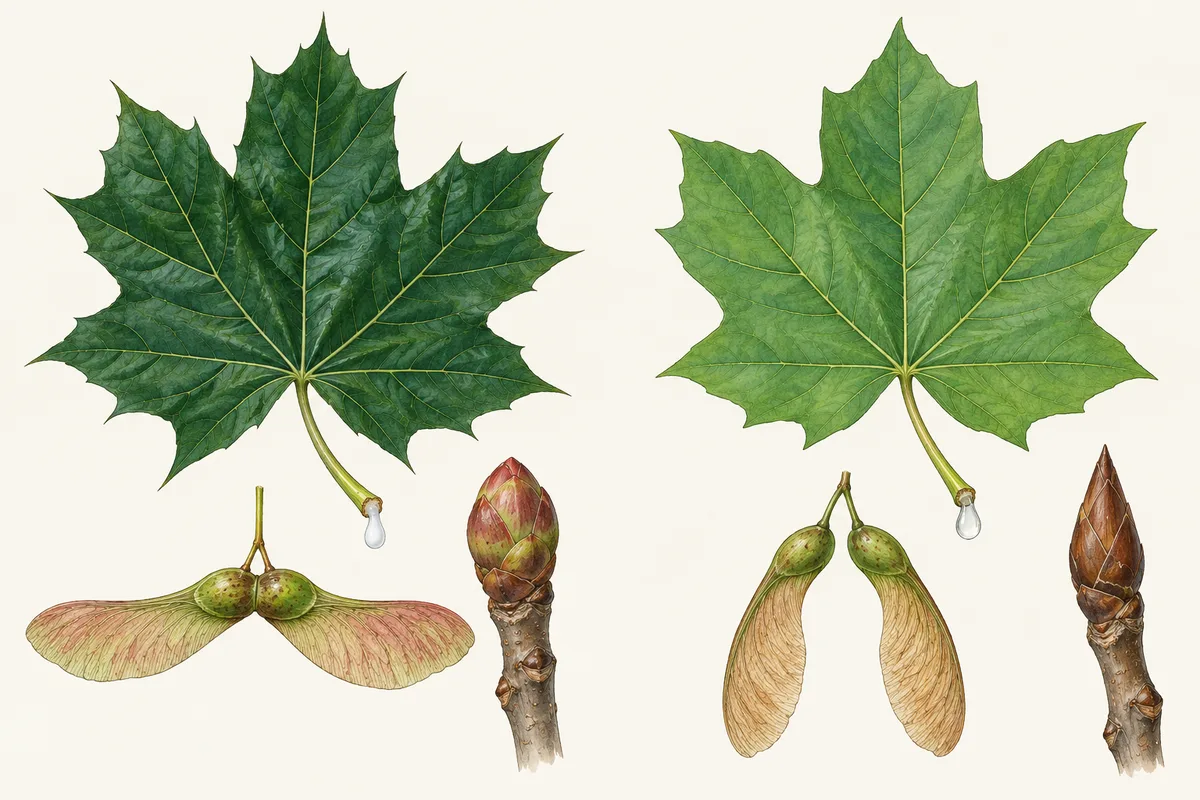
Snap a leaf stalk first. Milky sap means Norway maple; clear sap sends you on to buds, seeds and lobes.
In short
Norway maple vs sugar maple is settled by the leaf stalk: snap one off and Norway maple bleeds milky white sap, while sugar maple sap is clear. Norway maple also has 5 to 7 lobes (often 7), large turban-shaped buds that turn purple, and samaras spread almost flat; sugar maple has 5 lobes, slender sharp brown buds and horseshoe-shaped samaras.
- Milky sap from a broken leaf stalk means Norway maple. Clear sap means a native maple.
- Norway maple seeds spread like a handlebar mustache; sugar maple seeds hang down in a horseshoe.
- Norway maple holds its leaves late and turns a weak yellow; sugar maple turns yellow, orange and red.
Field marks at a glance
- Scientific name
- Acer platanoides and Acer saccharum
- Family
- Sapindaceae (soapberry family); Virginia Tech lists the older Aceraceae
- Type
- Broadleaf, deciduous
- Sap
- Norway maple: milky white sap oozes from a snapped or squeezed leaf stalk. Sugar maple: clear sap.
- Leaf lobes
- Norway maple: 5 to 7 lobes (commonly 7) with long pointed teeth, often broader than long. Sugar maple: 5 delicately rounded lobes, smooth edges between the points.
- Leaf size
- Both 3 to 6 inches long. Norway maple leaves are slightly broader, with darker green on both surfaces.
- Buds
- Norway maple: large, turban-shaped, green maturing to purple, on a stout twig. Sugar maple: brown, very sharp-pointed, tight scales, on a slender shiny twig.
- Samaras
- Norway maple: 1 1/2 to 2 inches, wings spread nearly flat. Sugar maple: about 1 inch, horseshoe-shaped, pointing downward, brown in fall.
- Flowers
- Norway maple: yellow-green, in upright rounded clusters, before or with the leaves. Sugar maple: light yellow-green, hanging on slender 1- to 3-inch stalks.
- Fall color
- Norway maple: yellow-green to yellow, late and often weak. Sugar maple: brilliant yellow to burnt orange and red.
- Origin
- Norway maple: native to Europe and Asia, invasive in much of the eastern US. Sugar maple: native to eastern North America.
Norway maple (Acer platanoides) was planted on streets and lawns across the eastern United States for generations, and from a distance it looks like the native sugar maple (Acer saccharum). The difference matters: sugar maple is a native hard maple and the classic syrup tree, while Norway maple is listed as invasive by The Morton Arboretum and Purdue Extension. One test, done in a few seconds, separates them.
The milky sap test, then three confirmations
Pick a healthy green leaf and snap the leaf stalk (petiole) near the twig, or squeeze it. Purdue Extension's article "Distinguishing Between Norway, Sugar, and Black Maples" (May 2025) states that Norway maple exudes a milky latex sap, while native maples have clear sap. Virginia Tech's Norway maple fact sheet says the same of a detached leaf. A white bead at the break means Norway maple.
Then confirm with what you can see without breaking anything:
| Feature | Norway maple | Sugar maple |
|---|---|---|
| Sap from leaf stalk | Milky white | Clear |
| Lobes | 5 to 7, commonly 7 | 5 |
| Leaf edge | Long pointed teeth | Smooth between lobe points |
| Leaf shape | Often broader than long | Slightly narrower than Norway's (Morton) |
| Winter bud | Large, turban-shaped, green to purple | Slender, brown, very sharp-pointed |
| Samaras | 1 1/2–2 in, spread nearly flat | About 1 in, horseshoe-shaped, pointing down |
| Flowers | Yellow-green, upright rounded clusters | Light yellow-green, hanging on 1–3 in stalks |
| Fall color | Yellow-green to yellow, late | Brilliant yellow to burnt orange and red |
| Bark | Gray, tight, interlacing ridges | Gray-brown, deeply furrowed |
| Size | 40–50 ft tall in landscapes (Morton), to 80 ft (Virginia Tech) | 60–75 ft (Morton), to 100 ft (Virginia Tech) |
Lobe counts and teeth are from Purdue and Virginia Tech's sugar maple fact sheet; colors and sizes from The Morton Arboretum's pages on Norway maple and sugar maple.
Leaves: lobes, teeth and color
Count the lobes on a few sun leaves. Purdue gives Norway maple 5 to 7 lobes, commonly 7, and sugar maple 5. Virginia Tech describes Norway maple lobes as having long pointed teeth, and sugar maple's as five delicately rounded lobes with an entire (smooth) margin between the points. Purdue adds that Norway maple leaves are generally broader than long, and Morton calls them slightly broader than sugar maple's.
Minnesota Wildflowers points out two more clues: Norway maple leaves are generally larger, with sharper points that are longer and more tapering, and both surfaces are darker green. Turn a leaf over: Purdue notes small hairs in the vein angles beneath a Norway maple leaf.
If the leaves are deep purple all summer, you have a Norway maple cultivar such as Crimson King, which Virginia Tech calls widely planted. The leaf color hides the shape comparison, but the milky sap is still there.
Seeds, flowers and buds
The samaras are the easiest clue to spot from the ground in summer. Purdue compares Norway maple seed pairs to a handlebar mustache, spread nearly horizontally, and sugar maple pairs to a mustache pointing downward. Virginia Tech gives 1 1/2 to 2 inches for Norway maple samaras and about 1 inch for sugar maple's, which turn brown when mature in fall. More helicopter seeds are compared in the guide to trees with helicopter seeds.
In spring, Norway maple flowers are bright yellow-green and somewhat showy, opening before the leaves, according to Virginia Tech; Morton describes them in upright, rounded clusters. Sugar maple flowers hang on slender stalks 1 to 3 inches long.
In winter, look at the end bud. Virginia Tech describes Norway maple's as large and turban-shaped, green maturing to purple, on a stout twig. Sugar maple's are brown, very sharp-pointed with tight scales, on a slender, shiny twig. The same bud test separates sugar maple from red maple, as the red maple vs sugar maple page shows.
Fall color and leaf drop
Fall gives a hint from across the street. Morton describes sugar maple fall color as brilliant yellow to burnt orange, and up to red. Norway maple ranges from yellow-green to yellow. Minnesota Wildflowers adds that Norway maple color is usually weak and that its leaves often hang on until late-season frosts before turning a drab olive brown. A maple still green while its neighbors are bare is worth a sap test. Other gold trees are sorted in trees with yellow leaves in fall.
Why it matters: an invasive look-alike
Norway maple is native to Europe and Asia, according to Morton, which finds it through much of the eastern United States, the West Coast and the northwestern states, and calls it an invasive plant. Purdue reports that it was introduced to America in the late 1700s, that George Washington reportedly bought two in 1792 for Mount Vernon, and that the Indiana Invasive Species Council found it far more shade-tolerant than sugar maple, letting it out-compete the native tree for light. Its thick canopy shades out the plants beneath.
Sugar maple, by contrast, is the tree Purdue describes as prized for its sugary sap. If you plan to tap trees, the identification has to be right first.
Tree Identifier can name either maple from one photo of a leaf or the samaras, and both species are in the app's Collection. Because a photo cannot show sap, use the snap test to confirm, then save the tree to the Tree Map so you can find your sugar maples again when the leaves are gone. The maple identification page covers silver, red, boxelder and bigleaf maple as well.
Look-alikes and how to tell them apart
Black maple (Acer nigrum)
A native hard maple with clear sap. Its leaves often look 3-lobed because the two bottom lobes are small, the sides droop as if wilting, the underside is hairy, and leaf-like stipules sit at the base of the stalk.
Red maple (Acer rubrum)
Clear sap, 3 main lobes with fine teeth along the whole edge, V-shaped notches between lobes, and blunt bright red buds in winter.
Crimson King Norway maple
Same species as Norway maple with deep purple, nearly black leaves all summer. Snap a stalk: the milky sap is the same.
What a photo can't settle
- The sap test needs a fresh, green leaf stalk. In winter, rely on buds: large purple turban buds for Norway maple, slender sharp brown ones for sugar maple.
- Lobe counts overlap: some Norway maple leaves have 5 lobes, and black maple can look 3-lobed. Check several leaves and the sap before deciding.
- Tree Identifier names one species from one photo, with no confidence score and no look-alike list. A photo cannot show sap, so confirm a Norway maple answer by snapping a stalk.
Questions people ask
How do you tell a Norway maple from a sugar maple quickly?
Pull off a leaf and look at the broken end of the stalk. Purdue Extension says Norway maple exudes a milky latex sap when the stalk is squeezed or pinched, while native maples have clear sap. In late spring and summer this takes seconds and needs no other clue.
Is Norway maple invasive?
The Morton Arboretum calls it an invasive plant and reports it invasive on the Arboretum's own grounds. Purdue Extension classes it as an invasive tree species and cites the Indiana Invasive Species Council, which notes it is far more shade-tolerant than sugar maple and can out-compete it for light.
Can you tap a Norway maple for syrup?
Purdue Extension describes sugar and black maples, the hard maples, as the ones prized for sugary sap made into maple syrup; it does not include Norway maple. Identify the tree with the milky-sap test before you tap, and check a syrup guide from your state extension service.
Is Crimson King a Norway maple?
Yes. Virginia Tech describes Crimson King as a widely planted purple, nearly black leaved variety of Norway maple, and Purdue notes it keeps its deep red color all season. Green Norway maples are the ones confused with sugar maple.
Do Norway maples and sugar maples lose their leaves at the same time?
Usually not. Minnesota Wildflowers notes that Norway maple leaves often stay on until late-season frosts and then turn a drab olive brown, with weak yellow color at best. Sugar maple colors earlier, in yellow, orange and red.
Sources
- Distinguishing Between Norway, Sugar, and Black Maples — Purdue Extension (John E. Woodmansee, May 9, 2025)
- Norway maple fact sheet — Virginia Tech Dendrology
- Sugar maple fact sheet — Virginia Tech Dendrology
- Norway maple (Acer platanoides) — The Morton Arboretum
- Sugar maple (Acer saccharum) — The Morton Arboretum
- Acer platanoides (Norway Maple) — Minnesota Wildflowers