Invasive tree profile
Buckthorn identification: common and glossy buckthorn
Two introduced shrubs have spread through woods, fencerows and wetland edges in the Midwest and Northeast. A thorn at the twig tip, the leaf arrangement and the leaf edge tell them apart.
In short
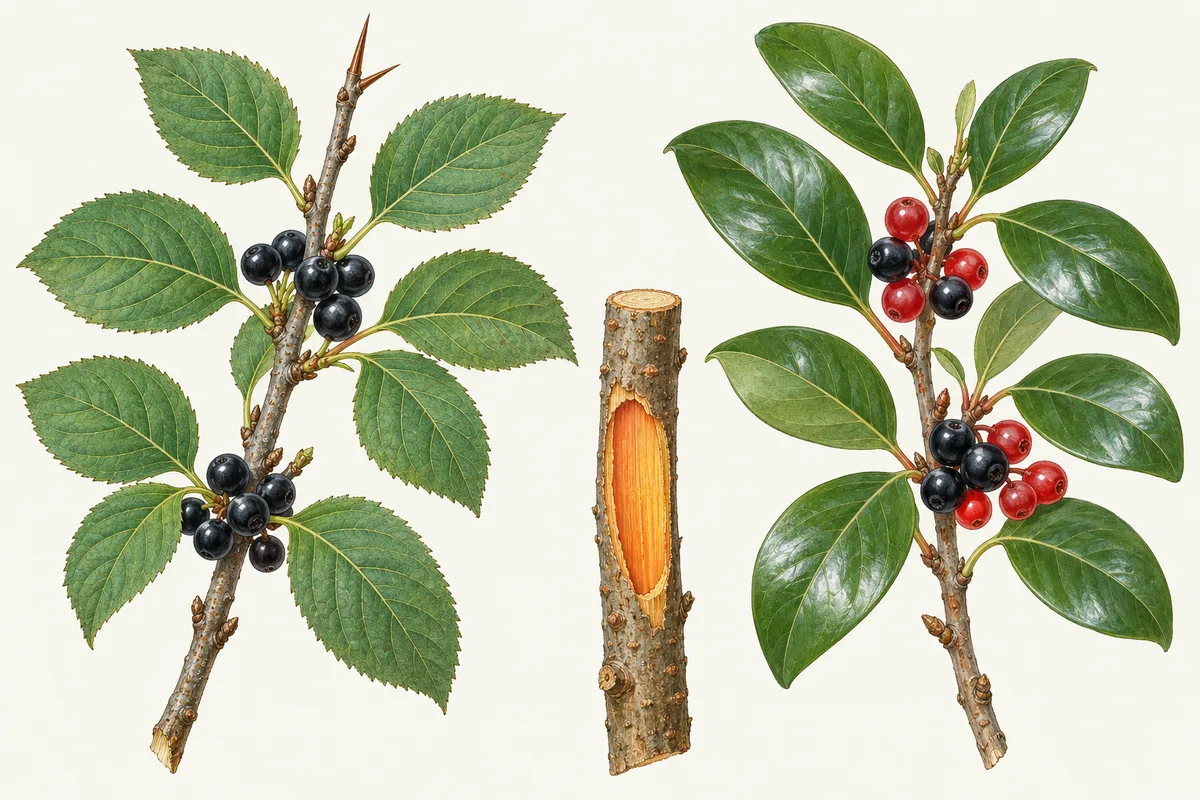
Buckthorn identification hinges on three checks. Common buckthorn has nearly opposite, finely toothed, shiny leaves 2 to 3 inches long, twigs often ending in a sharp thorn, and yellow inner bark. Glossy buckthorn has alternate leaves with smooth edges and no thorns. Both bear 1/4-inch black fruit; glossy buckthorn's turns red before black.
- A sharp thorn at the end of a twig points to common buckthorn; glossy buckthorn has no thorns.
- Scrape a twig: common buckthorn's inner bark is yellow, a quick check in winter.
- Minnesota lists both species as restricted noxious weeds and Pennsylvania as Class B noxious weeds (lists read October 21, 2026).
Field marks at a glance
- Scientific name
- Rhamnus cathartica and Frangula alnus
- Family
- Rhamnaceae (buckthorn family)
- Type
- Broadleaf, deciduous
- Common buckthorn leaves
- Opposite or nearly opposite (some alternate), oval to elliptical, 2 to 3 inches, finely toothed, dark shiny green above, much lighter below.
- Glossy buckthorn leaves
- Alternate, elliptical to obovate, 2 to 4 inches, smooth edges, shiny, veins parallel and curving to follow the leaf edge.
- Twigs
- Common: slender, reddish brown, many ending in a sharp thorn, buds scaly. Glossy: reddish brown with gray hairs, no thorns, buds naked and fuzzy.
- Fruit
- Round, about 1/4 inch. Common: shiny black when ripe in late summer, only on female plants. Glossy: red first, then black.
- Bark
- Smooth, gray to reddish brown with many lenticels; common buckthorn's turns dark gray and scaly with age and has yellow inner bark.
- Size
- Common: suckering shrub or small tree to 25 ft (Virginia Tech) or 30 ft (NC State). Glossy: upright shrub or small tree to 20 ft.
- Origin
- Introduced. NC State gives common buckthorn's native range as Europe, Africa and northern Asia and dates its introduction to North America to the early 1800s.
- Status
- Restricted noxious weeds in Minnesota; Class B noxious weeds in Pennsylvania (read October 21, 2026). Rules differ by state and province.
Common buckthorn and glossy buckthorn are introduced shrubs that now grow in woods, fencerows, fields and wetland edges across much of the Midwest, the Northeast and eastern Canada. They are easy to miss in summer, when they look like any other green shrub, and easy to spot once you know the thorn, the leaf pattern and the black fruit. Here is the order to check them in.
The three-check test: thorn, leaf pattern, inner bark
1. Look at a twig tip. On common buckthorn (Rhamnus cathartica), many twigs end in a sharp thorn (Virginia Tech, common buckthorn). Glossy buckthorn (Frangula alnus) has no thorns at all (Virginia Tech, glossy buckthorn).
2. Look at how the leaves sit. Common buckthorn's leaves are opposite or nearly opposite, in slightly offset pairs, sometimes alternate on part of the stem. They are oval to elliptical, 2 to 3 inches long, finely toothed, shiny dark green above and much lighter below. Glossy buckthorn's leaves alternate, are 2 to 4 inches long and have smooth edges; their veins run parallel and turn to follow the leaf edge near the margin.
3. Scrape the bark. Use a fingernail or knife on a twig or small stem. Virginia Tech lists the inner bark of common buckthorn as yellow, under smooth, shiny gray to reddish-brown outer bark dotted with lenticels. This test works in every season, including winter, when the leaves are gone.
If you find a thorn, near-paired toothed leaves and yellow inner bark, you have common buckthorn. Smooth-edged, alternate leaves on a thornless shrub in a wet spot point to glossy buckthorn.
Common buckthorn in detail
NC State Extension's Plant Toolbox describes common buckthorn as native to Europe, Africa and northern Asia, introduced to North America in the early 1800s and now invasive in many northeastern and midwestern states and in Canada. It grows on roadsides, fencerows, fields and pastures, but also in undisturbed riparian areas, wetland edges and ravine slopes, and it tolerates shade. Virginia Tech gives it up to 25 feet, as a large, suckering shrub or a small, low-branching tree; NC State gives up to 30 feet with crooked, thorny branches.
The flowers are small, yellow-green and four-petaled, in small clusters in spring. Plants are male or female, and only females bear fruit: round drupes about 1/4 inch across that ripen shiny black in late summer. Buds are scaly, pointed, about 1/4 inch long and pressed against the twig. Older bark turns dark gray and scaly, and on large specimens it breaks into rectangular blocks.
Common buckthorn is one of the trees on our black berries guide, which separates it from black cherry, privet and elderberry by how the fruit hangs. Its thorn-tipped twigs also put it in the thorny trees guide.
Glossy buckthorn in detail
Glossy buckthorn has also been filed as Rhamnus frangula, the name Pennsylvania still uses. Virginia Tech describes an upright shrub or small tree to about 20 feet with a spreading, open crown, slender reddish-brown twigs with gray hairs, naked tan buds with fuzz instead of scales, and smooth gray-brown bark with raised lenticels.
Its flowers are tiny, pale yellow-green and bell-shaped, in the leaf axils in late spring after the leaves open. The fruit, about 1/4 inch, ripens from red to black in late summer, so one branch can carry both colors at once; Virginia Tech describes common buckthorn's fruit simply as shiny black when ripe. Glossy buckthorn also has named cultivars: Pennsylvania exempts the cultivar 'Fine Line' from its noxious weed listing, while Minnesota lists glossy buckthorn "and all cultivars".
Invasive status, agency by agency
Buckthorn's legal status depends on where you stand: each state keeps its own noxious weed list. As read on October 21, 2026:
- Minnesota. The Minnesota Department of Agriculture lists common or European buckthorn and glossy buckthorn (and all cultivars) as restricted noxious weeds, both added in 1999. Restricted noxious weeds and their propagating parts may not be imported, sold or transported in Minnesota except by permit. The department updated the list in January 2026 and plans the next update for January 2029.
- Pennsylvania. The Pennsylvania Department of Agriculture lists common buckthorn and glossy buckthorn as Class B noxious weeds, a class for weeds that are widely established in the state and cannot feasibly be eradicated, with 'Fine Line' exempted. The department describes noxious weeds as plants that cannot be sold, transported, planted or otherwise propagated in Pennsylvania.
Our invasive trees guide compares buckthorn with other invasive trees.
Elsewhere, check your state department of agriculture or natural resources. Our Midwest tree guide covers the native trees buckthorn crowds out in the region where it is most common.
Native buckthorns that are not invasive
Not every buckthorn is a problem. Carolina buckthorn (Frangula caroliniana) is native to North America and looks much like glossy buckthorn: alternate leaves 2 to 5 inches long with veins that curve along the edge, red fruit turning black, no thorns. Its leaves carry a few fine, widely spaced teeth, its fruit is a little bigger, about 1/3 inch, and its tiny naked buds smell strongly of almond when broken (Virginia Tech, Carolina buckthorn).
In the West, cascara buckthorn (Frangula purshiana) is a native tree up to 50 feet or a shrub to 15 feet, with longer, prominently veined leaves 2 to 6 inches and black fruit 1/4 to 1/2 inch (Virginia Tech, cascara buckthorn). Virginia Tech notes that its fruit and inner bark have laxative properties.
Before removing a shrub you think is buckthorn, confirm it with the thorn, leaf and bark checks above. A photo of a leafy twig with fruit gives Tree Identifier enough to suggest a name, and the Tree Map remembers where each plant grows, which helps when you come back to a thicket later with tools.
Look-alikes and how to tell them apart
Carolina buckthorn (Frangula caroliniana)
A native of the Southeast. Its alternate leaves are 2 to 5 inches with a few fine, widely spaced teeth, its fruit is a little larger (1/3 inch), and a broken bud gives off a strong almond smell. Like glossy buckthorn it has no thorns.
Cascara buckthorn (Frangula purshiana)
A native of the Pacific Northwest. Its alternate leaves are longer, 2 to 6 inches, with prominent parallel veins and wavy or finely toothed edges, its buds are naked and rusty-hairy, and it has no thorns. It can grow into a tree up to 50 feet.
Common vs glossy buckthorn
Check three things on one branch: leaves in near-pairs and finely toothed (common) or alternate and smooth-edged (glossy); a thorn at the twig tip (common only); and fruit that is black from the start of ripening (common) or red before black (glossy).
What a photo can't settle
- NC State notes that common buckthorn hybridizes with native buckthorns, so leaf arrangement and shape can vary; a single leaf photo may not settle the species.
- Glossy buckthorn has named cultivars, such as 'Fine Line', whose form can differ from the wild plant; a photo app may name the species but not the cultivar.
- Legal status changes: the Minnesota and Pennsylvania listings here were read on October 21, 2026, and other states and provinces differ. Check your own state or provincial agency before removing or planting.
Questions people ask
How do I know if I have buckthorn?
Look for a shrub or small tree with shiny, oval leaves 2 to 3 inches long, arranged in near-pairs, and twigs that end in a sharp thorn. Scrape the bark of a twig: yellow inner bark confirms common buckthorn. In fall, female plants carry clusters of 1/4-inch black fruit.
What does young buckthorn look like?
Young plants have the same leaves as adults, oval, finely toothed and in near-pairs for common buckthorn, smooth-edged and alternate for glossy buckthorn, on slender reddish-brown stems with lenticels. Seedlings rarely show thorns or fruit yet, so check the leaf arrangement, the curving veins and the yellow inner bark.
How do you identify buckthorn in winter?
Use the twig. Common buckthorn twigs are reddish brown, often end in a sharp thorn, and carry dark, pointed, scaly buds about 1/4 inch, pressed against the twig; the inner bark is yellow. Glossy buckthorn has no thorns and naked, fuzzy tan buds. Black fruit often stays on common buckthorn into winter.
Is buckthorn illegal?
It depends on where you live. Minnesota lists common and glossy buckthorn (all cultivars) as restricted noxious weeds that may not be imported, sold or transported except by permit. Pennsylvania lists both as Class B noxious weeds, with the glossy buckthorn cultivar 'Fine Line' exempted. Both lists were read on October 21, 2026.
Are buckthorn berries poisonous?
NC State Extension describes common buckthorn as mildly toxic to humans and mammals, while birds eat the fruit and spread the seeds; the species name cathartica refers to its purging effect. Never eat buckthorn berries, or any berry identified from a photo or a web page.
Sources
- Common buckthorn fact sheet — Virginia Tech Dendrology
- Glossy buckthorn fact sheet — Virginia Tech Dendrology
- Carolina buckthorn fact sheet — Virginia Tech Dendrology
- Cascara buckthorn fact sheet — Virginia Tech Dendrology
- Rhamnus cathartica (Common Buckthorn, European Buckthorn, Purging Buckthorn) — NC State Extension, Plant Toolbox
- Minnesota Noxious Weed List — Minnesota Department of Agriculture
- Controlled Plant & Noxious Weeds Lists — Pennsylvania Department of Agriculture