Regional guide
Midwest tree identification, region by region
The Midwest has three tree regions, the northwoods, the central hardwoods and the prairie edge. Start with yours, then check leaves, bark and fruit.
In short
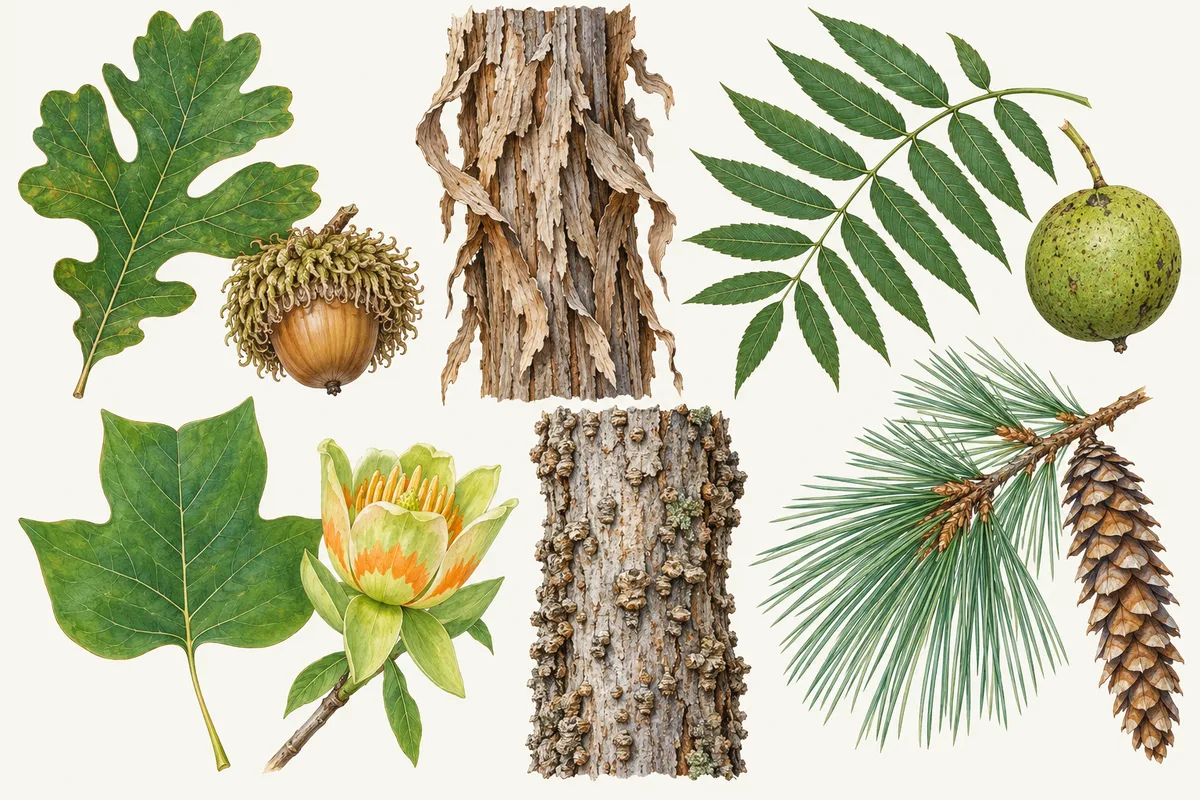
Midwest tree identification starts with the region. In the northwoods of Minnesota, Wisconsin and Michigan, learn eastern white pine (five needles per bundle), paper birch and quaking aspen. In the central hardwoods from Ohio to Missouri, oaks, shagbark hickory, black walnut and tuliptree. On the prairie edge and along rivers, bur oak with its fringed acorn cap, eastern cottonwood and hackberry with warty bark.
- Bur oak acorns sit in a fringed cap and the leaves are 4 to 10 inches long, with five to seven rounded lobes (Morton Arboretum).
- Eastern white pine is the only common Midwest pine with five needles per bundle, 3 to 6 inches long.
- Emerald ash borer was found in Illinois in 2006 and has killed millions of ash trees; D-shaped exit holes in the bark are its sign.
The Midwest is not one forest. Pines, birches and aspens cover the north of Minnesota, Wisconsin and Michigan. Oak and hickory woods run through Ohio, Indiana, Illinois and Missouri. Toward Iowa, Kansas, Nebraska and the Dakotas, trees thin out into prairie and follow the rivers. Work out which of the three you are in, then use leaves, bark and fruit. Descriptions below follow the Morton Arboretum in Illinois, the Missouri Department of Conservation field guide and UW–Madison Extension.
The Midwest trees to learn first
| Tree | Where in the Midwest | The one feature that settles it | Our page |
|---|---|---|---|
| Eastern white pine | Northwoods, planted everywhere | Five soft needles per bundle, 3 to 6 in long | Red pine vs white pine |
| Paper birch | Northwoods | Chalk-white bark that peels in sheets | Birch |
| Quaking aspen | North, and north of the prairie | Round leaves on flat stalks that tremble in wind | Poplar |
| Sugar maple | Most of the region | Five-lobed leaves in opposite pairs; orange fall color | Maple |
| Northern red and white oak | Central hardwoods | Bristle-tipped lobes (red) or rounded lobes (white) | Red oak vs white oak |
| Shagbark hickory | Central hardwoods | Gray bark peeling in long plates that curl out at the ends | Hickory |
| Black walnut | Central hardwoods, fencerows | Leaves 1 to 2 ft long, often missing the end leaflet; green husks up to 2 in | Walnut |
| Tuliptree | Ohio, Indiana, southern Illinois | Four-lobed leaf with a flat, cut-off tip | Tulip tree |
| Ohio buckeye | Western Pennsylvania to Iowa | Five to seven leaflets fanned like fingers; prickly husk | Chestnut vs buckeye |
| Flowering dogwood | Missouri, southern Midwest | Four white, notched bracts in spring; red fruit in fall | Dogwood |
| Bur oak | Prairie edge, savannas | Fringed acorn cap that covers most of the nut | Bur oak |
| Eastern cottonwood | Rivers and lowlands | Triangle leaves on flat stalks; white seed fluff | Poplar |
| Hackberry | Woods, rivers, towns | Corky warts and ridges on gray bark | Hackberry |
| Osage orange | Old hedgerows | Green fruit 4 to 5 in across; thorns; orange wood | Osage orange |
If you only learn four, learn bur oak, sugar maple, eastern cottonwood and black walnut: between them they cover the woods, the yards and the riverbanks of most of the region.
The northwoods: Minnesota, Wisconsin and Michigan
In the north of Minnesota, Wisconsin and Michigan, conifers and white-barked trees take over.
- Eastern white pine (Pinus strobus): thin, soft needles 3 to 6 in (8 to 15 cm) long in clusters of five, and slender cones up to 8 in (20 cm) with white resin tips, per the Morton Arboretum. Mature bark is dark grayish-brown with broad ridges. Red pine grows in the same woods; the red pine vs white pine page separates the two.
- Paper birch (Betula papyrifera): very white bark that peels readily, with long black lenticels and black V-shaped marks where branches join. Leaves are oval, 2 to 4 in, with double teeth. The Morton Arboretum notes it does better in northern climates and suffers in hot summers, which is why it fades out to the south.
- Quaking aspen (Populus tremuloides): oval to nearly round leaves 1 to 3 in wide on flattened stalks, so they tremble and rustle in the slightest wind. Young bark is smooth and grayish-white; older trunks are furrowed with dark patches (Morton Arboretum).
- Sugar maple (Acer saccharum): five-lobed leaves 3 to 6 in long in opposite pairs, gray-brown furrowed bark and paired winged seeds about 1 in long. Fall color runs from bright yellow to burnt orange (Morton Arboretum). It also grows well south of the northwoods.
Tamarack, a conifer that drops its needles in fall, also grows in the north; see the tamarack page.
The central hardwoods: Ohio to Missouri
Through Ohio, Indiana, Illinois, southern Iowa and Missouri, the woods are mostly broadleaf: oaks and hickories on ridges, walnuts and buckeyes on richer, wetter ground.
- Oaks: the white oak group has rounded lobes, the red oak group bristle-tipped ones. The red oak vs white oak page walks through acorns and bark.
- Shagbark hickory (Carya ovata): leaves 8 to 14 in long with five to seven toothed leaflets; gray bark that peels in long, flat plates with ends curving outward; a round nut in a thick husk that splits into four (Morton Arboretum).
- Black walnut (Juglans nigra): compound leaves 1 to 2 ft long, aromatic when crushed, often missing the end leaflet; a rounded yellow-green husk up to 2 in across; medium-brown bark with thick, interlacing ridges. The Morton Arboretum notes that all parts make juglone, a chemical toxic to many plants growing nearby.
- Tuliptree (Liriodendron tulipifera): leaves 3 to 8 in with a four-lobed, flat-tipped shape found on no other Midwest tree; tulip-like yellow-green flowers about 2 in tall, orange at the base; upright cone-shaped seed clusters that stay through winter (Morton Arboretum).
- Ohio buckeye (Aesculus glabra): opposite, palmately compound leaves with five to seven leaflets; upright clusters of yellow-green flowers; shiny brown nuts in a prickly husk. The Morton Arboretum gives its native range as western Pennsylvania to Iowa, south to Alabama and Arkansas, and says the nuts should not be eaten.
- Flowering dogwood (Cornus florida): four white, sometimes pink bracts notched at the tip around a small flower cluster; opposite, egg-shaped leaves 3 to 5 in; scarlet fruits about 1/2 in from August to November; bark in small, squarish plates. Missouri named it the state tree in 1955 (Missouri Department of Conservation).
Never eat a berry, nut, seed or pod on the strength of a web page or an app; check with a local expert.
The prairie edge and the river bottoms
West toward Iowa, Kansas, Nebraska and the Dakotas, trees cluster along rivers, in savannas and in old windbreaks.
- Bur oak (Quercus macrocarpa): the prairie oak. Leaves 4 to 10 in with five to seven rounded lobes and often a wide, fiddle-shaped end lobe; acorns under large fringed caps up to 2 in across that cover most of the nut; young twigs that can grow corky ridges; deeply furrowed dark bark. The Morton Arboretum calls it native to the eastern United States and the Great Plains.
- Eastern cottonwood (Populus deltoides): triangle-shaped leaves 2 to 5 in with a long tip, on flattened stalks 3 to 4 in long; thick, deeply furrowed ash-gray bark. Female trees release white seed fluff in early summer. It grows along streams, rivers and lowlands and reaches 75 to 100 ft (Morton Arboretum).
- Hackberry (Celtis occidentalis): bark smooth and gray when young, then covered in corky warts and ridges, the feature most people notice first. Leaves are 2 to 4 in, egg-shaped and rough; fruits about 1/3 in turn deep purple-brown and hang on through winter (Morton Arboretum).
- Osage orange (Maclura pomifera): the "hedge apple" tree of old farm hedgerows. Yellowish-green fruits 4 to 5 in across, stout half-inch thorns above the leaves, glossy leaves with smooth edges, and bright orange roots and wood. The Missouri Department of Conservation says the milky sap can irritate the skin and that the tree is native to Texas, Oklahoma and Arkansas, introduced across Missouri.
Boxelder, a maple with 3 to 5 (sometimes 7) leaflets in opposite pairs, is common along the same rivers; see the boxelder page.
Midwest yards and streets: what changed
Many Midwest streets and yards lost their ash trees. The Morton Arboretum says emerald ash borer was found in Illinois in 2006 and has since killed millions of ash trees. If you see a tree with opposite, compound leaves dying back from the top, look for D-shaped exit holes, S-shaped tunnels under cracked bark and woodpecker damage. The ash page covers how to recognize the tree itself.
Many yards also hold planted trees from outside the region. The most common trees in the US lists what Forest Service plots and city inventories count most.
Free Midwest tree guides
Checked on October 21, 2026, UW–Madison Extension's tree identification page recommends:
- Forest Trees of Wisconsin: How to Know Them (Wisconsin DNR, 2006), available as a PDF.
- The Wisconsin Urban Tree Guide (Wisconsin DNR, 2019) for planted street and yard trees.
- Dichotomous keys from UW–Stevens Point and the UW–Green Bay Herbarium for native forest trees.
- Michigan Trees by Burton V. Barnes and Warren H. Wagner (revised 2004), a book covering the Great Lakes region.
The Missouri Department of Conservation's online field guide adds a page per tree, with Missouri distribution notes.
In the field, a photo can give a fast first answer: Tree Identifier names a tree from one picture of a leaf, the bark, a flower or a fruit, and its follow-up chat can answer a question such as "is this bur oak or white oak?". It shows no confidence score, so check the result against the feature in the table above. The app's Collection includes sugar maple, black walnut, eastern cottonwood, eastern white pine and paper birch, and its Tree Map keeps each find you locate.
What a photo can't settle
- Yards and streets across the Midwest are full of planted cultivars, such as thornless honeylocust or ornamental pears, that a native-tree list does not cover.
- Oaks hybridize, so a single leaf from a red-oak-group or white-oak-group tree may not settle the species; check acorns and bark too.
- Ash trees killed by emerald ash borer lose their leaves first; a photo of bare, dead branches alone rarely names the tree.
Questions people ask
What trees are native to the Midwest?
Oaks (bur, white and northern red), sugar maple, shagbark hickory, black walnut, eastern cottonwood, hackberry, Ohio buckeye and tuliptree in the south and center; eastern white pine, paper birch and quaking aspen in the north. The Morton Arboretum lists all of these as native to the Chicago region, where north and south meet.
How do I tell a bur oak from a white oak?
Look at the acorn first. Bur oak acorns sit in a large, fringed cap that covers most of the nut, and the cap can reach 2 inches across. Bur oak leaves are 4 to 10 inches long and often have a wide, fiddle-shaped end lobe. Young bur oak twigs can also carry corky ridges.
What Midwest tree has warty bark?
Hackberry. The Morton Arboretum describes its bark as smooth and gray when young, then developing corky warts and ridges with age. The leaves are 2 to 4 inches long and rough to the touch, and small purple-brown fruits about 1/3 inch across stay on the tree through winter.
Why are so many ash trees dead in the Midwest?
Emerald ash borer, an invasive beetle. The Morton Arboretum says it was found in Illinois in 2006 and has killed millions of ash trees since. Signs include dieback from the top of the crown, D-shaped exit holes in the bark, S-shaped tunnels under cracked bark and heavy woodpecker damage.
Is there a free Midwest tree identification book?
Forest Trees of Wisconsin: How to Know Them (Wisconsin DNR, 2006) is available as a free PDF, and the Missouri Department of Conservation runs a free online field guide with a page per tree. UW–Madison Extension also recommends Michigan Trees by Barnes and Wagner (2004) for the Great Lakes region.
Sources
- Tree identification — University of Wisconsin–Madison Division of Extension, Forestry
- Bur oak — The Morton Arboretum
- Eastern white pine — The Morton Arboretum
- Black walnut — The Morton Arboretum
- Hackberry — The Morton Arboretum
- Emerald ash borer — The Morton Arboretum
- Flowering Dogwood (Field Guide) — Missouri Department of Conservation
- Osage Orange (Field Guide) — Missouri Department of Conservation