Tree profile
Hackberry tree identification: warty bark, lopsided leaves
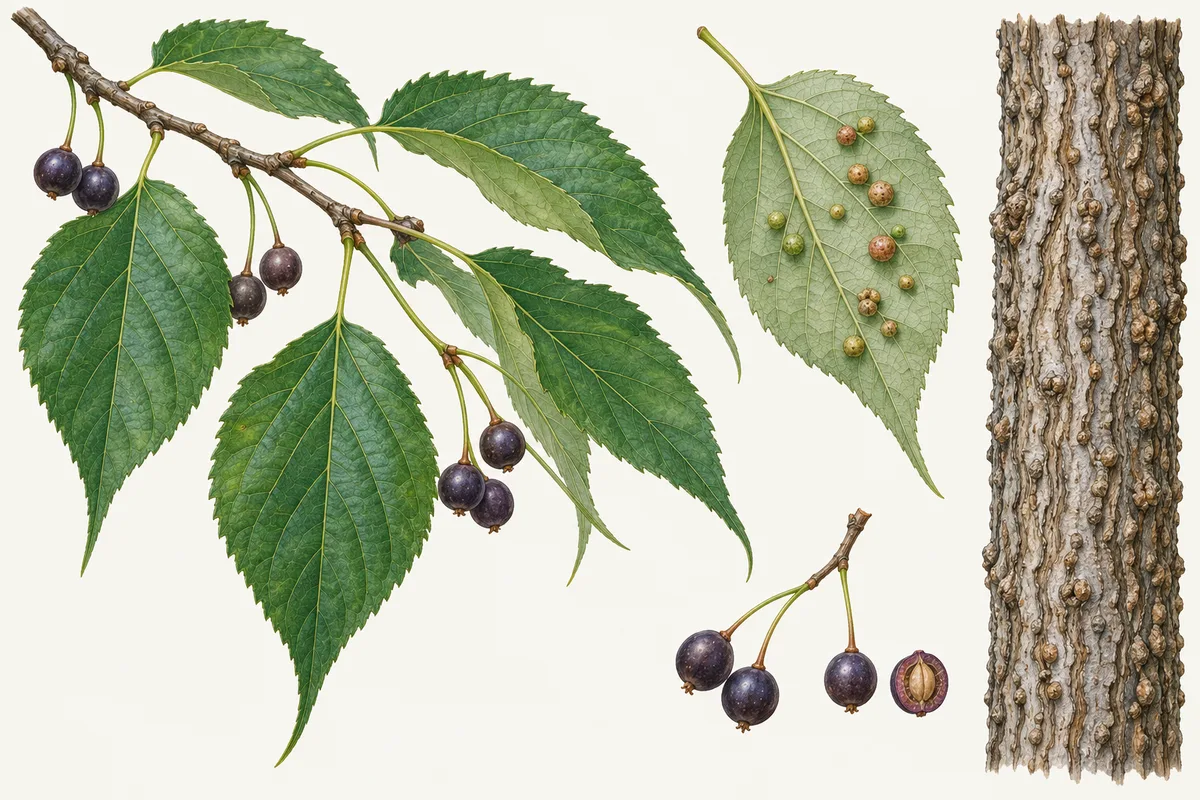
Corky warts and ridges on gray bark, a toothed leaf with an uneven base and three veins from it, and pea-sized fruit that ripens dark purple. Then range and habitat sort hackberry from sugarberry.
In short
For hackberry tree identification, start with the bark: gray and smooth at first, it soon carries corky warts that join into rough, irregular corky ridges. Then check a leaf: alternate, toothed, 2 to 5 inches long, with a lopsided base and three main veins starting from it, often dotted with small nipple galls. The fruit is a round drupe about 1/4 to 3/8 inch that ripens dark purple in fall.
- Corky warts on the trunk are the hackberry giveaway; few other eastern trees have them.
- Elm also has a lopsided leaf base, but hackberry has three main veins from the base and a round fruit, not a papery wafer.
- In the South, sugarberry is the twin: narrower leaves with few teeth and warty bark without ridges, on bottomland.
Field marks at a glance
- Scientific name
- Celtis occidentalis
- Family
- Cannabaceae (hemp family); older references file it in the elm family, Ulmaceae
- Type
- Broadleaf, deciduous
- Bark
- Smooth and gray-brown when young, soon with corky warts that later merge into rough, irregular corky ridges. The most reliable single mark.
- Leaves
- Alternate, simple, ovate, 2 to 5 inches (5 to 13 cm) long, toothed, with a long pointed tip and a lopsided base. Three main veins start at the base. Often rough above, paler and slightly fuzzy below.
- Galls
- Small round nipple galls on the leaf underside, made by a tiny psyllid insect; so common that many leaves carry them.
- Fruit
- Round drupe 1/4 to 3/8 inch (6 to 8 mm), orange-red ripening to dark red or purple in September and October, on a slender stalk; often stays on the tree through winter.
- Twigs
- Slender, zigzag, light red-brown with pale lenticels; no true end bud. Side buds small, triangular and pressed against the twig. Pith often chambered at the nodes.
- Witches' broom
- Dense, rosette-like clusters of twigs in the crown, caused by a mite and a powdery mildew. Conspicuous in winter and a good clue from a distance.
- Size
- Usually 40 to 60 ft (12 to 18 m) tall and wide, up to about 130 ft (40 m) on the best sites; wide, spreading crown.
- Range
- Southern New England and New York west through southern Ontario to the Dakotas, south to northwestern Texas, Arkansas, Tennessee and North Carolina, with outliers in Quebec, Manitoba and Wyoming.
Hackberry is the tree with warty bark: a tough, widespread native of the central and eastern United States and southern Canada, found on river bottoms, bluffs and city streets. Its botanical name is Celtis occidentalis. Bark, leaf and fruit each carry a field mark, and the leaves often carry a fourth clue that nobody planted: small round galls.
How to identify a hackberry: bark, leaf base and fruit
1. The warty, corky bark. Start at the trunk. Virginia Tech's hackberry fact sheet describes bark that is smooth and gray-brown when young but soon develops corky warts, which later become rough, corky, irregular ridges. Raised, spongy-looking bumps on a gray trunk are rare among eastern trees, so this one feature often settles it. Our guide to identifying trees by bark shows how hackberry fits among the other bark types.
2. The lopsided, three-veined leaf. Hackberry leaves are alternate, ovate, 2 to 5 inches long, toothed, with a long pointed tip. One side of the base sits lower than the other, and three main veins start from the base. Virginia Tech notes the surface may be slightly rough, green above and paler and somewhat fuzzy below.
3. The small round fruit. In fall the tree carries pea-sized drupes on slender stalks. The USDA Forest Service's Silvics of North America gives 6 to 8 mm (1/4 to 1/3 inch), dark red to purple when ripe, ripening in September and October and often staying on the tree through winter. Birds take many of them: the Silvics lists cedar waxwings, robins, mockingbirds, quail, wild turkey and others. Never eat a berry, nut, seed or pod on the strength of a web page or an app; check with a local expert.
4. The galls. Turn a leaf over. Small round bumps on the underside are hackberry nipple galls. Nebraska Extension (May 2024) describes round green pouches caused by a tiny psyllid and calls them very common on hackberries. A leaf with the right shape and these galls is close to a positive identification.
Tree Identifier can name a hackberry from one photo of the bark or of a leaf. It gives one name with no confidence score and no list of look-alikes, so check the three veins at the leaf base before you accept "elm".
Hackberry vs elm, sugarberry and mulberry
| Tree | Leaf base and veins | Leaf edge | Bark | Fruit |
|---|---|---|---|---|
| Hackberry | Lopsided; three main veins from the base | Toothed most of the way round | Corky warts and ridges | Round drupe, dark purple, fall |
| Sugarberry | Lopsided; three veins converge at base | Toothed on the upper half or less, or smooth | Corky warts, no ridges | Round drupe, orange-red to purple, fall |
| American elm | Lopsided; straight parallel side veins | Doubly toothed | Ridged and furrowed, no warts | Flat papery wafer, spring |
| Mulberry | Often even; mixed leaf shapes | Toothed, often lobed | Orange-brown tones | Blackberry-like cluster, early summer |
Elm is the classic confusion, because both have a lopsided leaf base and the older books put both in one family. Our elm page covers the elms in detail; the three-vein base, the warty bark and the round fruit point to hackberry.
Sugarberry (Celtis laevigata) is the Southern twin. Virginia Tech's sugarberry fact sheet gives leaves 2 to 5 inches long and 1 to 2 inches wide, toothed only on the upper half or less, and gray, mostly smooth bark with corky warts that, unlike hackberry's, does not form ridges. The USDA Forest Service adds that where the two overlap in the South they are hard to tell apart, and that hackberry is generally an upland tree, sugarberry a bottomland one.
Mulberry shares the toothed leaves and the rough feel but mixes unlobed, mitten-shaped and three-lobed leaves on one tree, and a snapped leaf stalk bleeds milky sap. See the mulberry page.
Where hackberry grows
The USDA Forest Service maps hackberry from southern New England and central New York west through southern Ontario to the Dakotas, with outliers in southern Quebec, western Ontario, southern Manitoba and southeastern Wyoming. To the south it reaches western Nebraska, northeastern Colorado and northwestern Texas, then east through Arkansas, Tennessee and North Carolina, with scattered stands in Mississippi, Alabama and Georgia.
It is mainly a bottomland tree but also grows on slopes, bluffs and limestone outcrops, and tolerates drought; the Forest Service notes it does poorly where the water table stays permanently high. The NC State Extension profile lists USDA hardiness zones 3a to 9b and a usual size of 40 to 60 feet tall and wide. Because it is also planted, a hackberry in a city may grow far from any wild population; Virginia Tech notes that planting may extend its range.
Hackberry in winter and in the city
Hackberry is one of the easier trees to name without leaves.
- Bark: the corky warts and ridges show all year.
- Fruit: dark purple drupes often hang on into winter, per the USDA Forest Service.
- Witches' broom: dense, rosette-like clusters of twigs at branch tips. The Forest Service attributes them to an eriophyid mite together with a powdery mildew, and NC State says they do little harm but look unsightly.
- Twigs: slender and zigzag, with small triangular buds pressed flat against the twig and no true end bud (Virginia Tech).
In summer, the leaves themselves feed caterpillars. NC State lists hackberry as a larval host of the hackberry emperor and question mark butterflies, and the Forest Service notes four gall-making psyllids attack the tree without serious damage. For more trees to name from twigs, buds and bark, see winter tree identification. If you find a hackberry in summer and want to check its fruit or galls again in fall, Tree Identifier's Tree Map keeps each identification you save with its location.
Look-alikes and how to tell them apart
Sugarberry (Celtis laevigata)
Sugarberry leaves are narrower and longer-tipped, toothed only on the upper half or not at all, and its bark is mostly smooth with corky warts but no ridges. It grows on Southern bottomlands; hackberry is more often upland.
American elm (Ulmus americana)
Elm leaves are lopsided at the base too, but doubly toothed with straight, parallel side veins and no three-vein base. Elm bark is ridged and furrowed without corky warts, and its fruit is a flat, papery wafer in spring.
Mulberry (Morus rubra, M. alba)
Mulberry leaves are toothed and often lobed, with mitten-shaped and three-lobed leaves on one tree, and a snapped leaf stalk bleeds milky sap. The fruit is a blackberry-like cluster, not a single pea-sized drupe.
Netleaf hackberry and dwarf hackberry (Celtis reticulata, C. tenuifolia)
Virginia Tech lists dwarf hackberry as a hackberry look-alike and netleaf hackberry as a sugarberry look-alike. All share the warty bark and three-veined leaf, so check a regional guide for the Celtis species that grow where you are.
What a photo can't settle
- Hackberry and sugarberry overlap and can be very hard to separate in the South, and intermediate trees occur; a photo may name the genus, Celtis, without settling the species.
- Young hackberry bark can be almost smooth before the warts form, so a photo of a sapling trunk alone may not be enough; add a leaf with its base visible.
- Galls and witches' broom are strong clues but are made by insects, mites and fungi, not the tree; a tree without them can still be a hackberry.
Questions people ask
What are the bumps on hackberry leaves?
Hackberry nipple galls. Nebraska Extension describes them as round green pouches on the underside of the leaf, caused by a tiny psyllid insect, and very common. NC State says they do not harm the tree but can disfigure the leaves, and Nebraska Extension recommends no control.
Is a hackberry an elm?
No. Hackberry is genus Celtis, now placed in the hemp family, Cannabaceae, according to NC State Extension; older references such as the USDA Silvics file it in the elm family. Its leaf has a lopsided base like an elm's, but three main veins start from it, and the bark carries corky warts.
How do you tell hackberry from sugarberry?
Look at leaves, bark and site. Sugarberry leaves are narrower and toothed only on the upper half or not at all; hackberry leaves are toothed most of the way round. Sugarberry bark has warts but no ridges. The USDA Forest Service notes hackberry is generally upland and sugarberry bottomland, and the two are hard to separate where they overlap.
What does hackberry bark look like?
Smooth and gray-brown on young stems, then dotted with corky warts that grow and merge into rough, irregular corky ridges, per Virginia Tech. On old trunks the ridges can look like stacked, spongy plates. The warts often show even on branches and young trunks.
Are hackberry berries edible?
This page does not give edibility advice. Never eat a berry, nut, seed or pod on the strength of a web page or an app; check with a local expert. For identification, the fruit is a single round drupe 1/4 to 3/8 inch, dark red to purple in fall, around one hard stone.
Sources
- Hackberry fact sheet — Virginia Tech Dendrology
- Sugarberry fact sheet — Virginia Tech Dendrology
- Hackberry (Celtis occidentalis), Silvics of North America — USDA Forest Service
- Celtis occidentalis (American Hackberry) — NC State Extension Gardener Plant Toolbox
- Common Tree Galls — Nebraska Extension in Lancaster County (S. Browning, May 2024)
Keep reading
- Tree profileElms (Ulmus): how to identify an elm tree
- Field guideTree bark identification: seven bark types and the trees that have them
- Tree profileMulberry (Morus): how to identify it
- Winter field guideWinter tree identification, from buds to bark
- Clue guideWhich tree has black berries? Sort it by leaf and cluster