Tree profile
Bur oak (Quercus macrocarpa): how to identify it
A leaf pinched almost in half, the biggest acorn of any native oak under a shaggy fringed cap, and twigs with corky wings. The prairie oak of the US and Canada, checked in that order.
In short
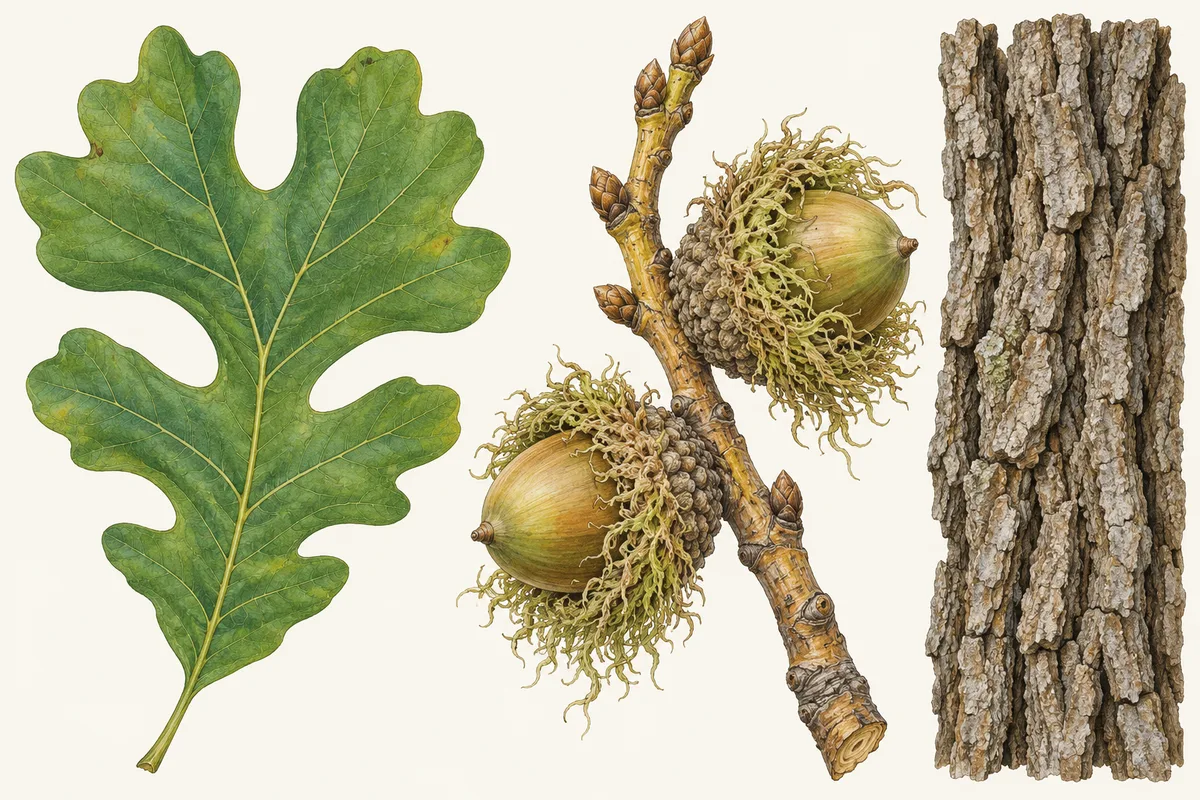
Bur oak tree identification starts with the leaf: 6 to 12 inches long, wider near the tip, with two middle sinuses that cut almost to the midrib, nearly splitting it in half. Confirm with the acorn, about 1 1/2 inches long and half or more enclosed in a warty cap with a long fringe on its rim, and with stout yellow-brown twigs that often carry corky ridges.
- Rounded lobes with no bristle tips put bur oak in the white oak group; the deep pinch in the middle of the leaf sets it apart from white oak.
- The fringed, mossy-looking acorn cap is the single best mark, and gives the tree its other name, mossycup oak.
- Northern trees, including those in Canada, have acorns about half the size of southern ones, so judge the cap, not the size.
Field marks at a glance
- Scientific name
- Quercus macrocarpa
- Family
- Fagaceae (beech family)
- Type
- Broadleaf, deciduous
- Leaves
- Alternate, simple, 6 to 12 inches (15 to 30 cm) long, widest above the middle. Two middle sinuses nearly reach the midrib, so the leaf looks waisted: a broad, wavy-toothed upper half over a few short, rounded lower lobes. Lobes have no bristle tips. Shiny green above, paler and fuzzy below.
- Acorns
- The largest of any native oak: about 1 1/2 inches long in Virginia Tech's description, 20 to 30 mm in Canada (NRCan). The warty cap encloses half or more of the nut and ends in a long fringe of pointed scales. Ripens in one season, dropping August to November.
- Twigs and buds
- Stout, yellow-brown, somewhat hairy twigs, often with corky ridges. End buds small, rounded and slightly hairy, surrounded by thread-like stipules.
- Bark
- Ashy gray to brown and scaly, becoming deeply furrowed, with thick, vertical ridges on old trunks.
- Form and size
- In good forests 80 to 100 ft tall with a long clear trunk; in the open a wide, spreading crown, 70 to 80 ft tall and as wide. Much smaller at the northern edge of its range: NRCan gives up to 15 m (about 50 ft) in Canada.
- Native range
- Eastern US and the Great Plains: south to Texas, east to Pennsylvania and Connecticut. In Canada from southern New Brunswick and Quebec west through Ontario to southern Manitoba and southeastern Saskatchewan.
- Habitat
- Prairie edges, oak savannas, bluffs and river bottomlands. One of the most drought-resistant North American oaks; thick bark lets large trees survive grass fires.
- Fall color
- Yellow-brown; the leaves do not turn bright red.
Bur oak (Quercus macrocarpa) is the oak of the prairie edge: the broad, rugged tree of Midwest savannas, Great Plains river valleys and the southern Canadian Prairies. It belongs to the white oak group, so its lobes have no bristle tips, and three marks make it one of the easiest oaks to name: a leaf pinched almost in half, a shaggy fringed acorn cap, and corky ridges on the twigs. Never eat a berry, nut, seed or pod on the strength of a web page or an app; check with a local expert.
How to identify a bur oak, step by step
Work through these in order. The descriptions are from Virginia Tech Dendrology's bur oak fact sheet unless another source is named.
- Lobe tips. Feel the edge of a leaf. Bur oak lobes are rounded, with no bristle tips, which puts it in the white oak group. Bristles would mean a red oak group tree such as northern red oak.
- The waist. Hold the leaf up. Bur oak leaves are 6 to 12 inches long and widest toward the tip, and the two middle sinuses cut almost to the midrib, so the leaf looks nearly split into a broad, toothed upper half and a narrower, lobed lower half. The Morton Arboretum calls the end lobe "fiddle-shaped."
- The acorn cap. This settles it. The cap is warty, encloses the bottom half of the acorn or more, and ends in a long fringe of pointed scales around the rim, like a mossy collar. The caps of white, post and overcup oak, its usual look-alikes, have no fringe.
- Twigs. Bur oak twigs are stout and yellow-brown, often with corky ridges or wings along them. Thread-like stipules often surround the small, rounded end buds.
- Bark and shape. Old trunks are ashy gray to brown, scaly and deeply ridged. Open-grown trees become very wide and spreading.
In winter, corky twigs and fallen acorn caps under the tree are often enough on their own. If you cannot reach a leaf, a photo of an acorn with its cap gives Tree Identifier the clearest clue, and its follow-up chat can answer a question such as how bur oak differs from white oak.
Bur oak acorns: big, fringed, and smaller in the north
The USDA Forest Service's Silvics of North America says bur oak has the largest acorns of all native oaks. Virginia Tech gives about 1 1/2 inches in length; the Morton Arboretum describes acorns about 2 inches across under a cap that covers most of the nut.
Size depends on where the tree grows. The Forest Service describes a northern form (var. olivaeformis) whose acorns are about half the size of the southern form's, and Natural Resources Canada's Trees of Canada fact sheet gives 20 to 30 mm (about 3/4 to 1 1/4 inches) for Canadian trees. A small acorn does not rule bur oak out; the fringe is the mark to check.
Other acorn facts from the Forest Service:
- Acorns ripen in a single season and drop from August to November.
- Trees start bearing at about 35 years, bear best from 75 to 150, and can still bear at about 400.
- Good crops come every 2 to 3 years, with light or no crops between.
- Red squirrels, white-tailed deer, wood ducks, mice and other rodents eat them.
Bur oak vs white oak and other look-alikes
| Oak | Leaf | Acorn cap | Twigs |
|---|---|---|---|
| Bur oak | 6–12 in, two middle sinuses nearly to the midrib | Covers half or more, long fringe | Stout, yellow-brown, often corky |
| White oak | 4–7 in, 7–10 even, finger-like lobes | Warty bowl over about 1/4, no fringe | Red-brown, hairless, often shiny |
| Overcup oak | 6–10 in, variable lobes, white and fuzzy below | Covers almost all the nut, no fringe | Slender, gray, smooth |
| Post oak | 6–10 in, 5 lobes, middle two square (a cross) | Bowl over 1/3–1/2, no fringe | Gray or tawny, many lenticels |
Leaf and cap figures are from Virginia Tech's fact sheets for bur, white, overcup and post oak. White oak is the look-alike most people meet, and the white oak page has its full profile. The Forest Service notes that the white oak × bur oak hybrid, Bebb oak, is the most frequent white oak hybrid, so a tree with a mild waist and a faint fringe may be a cross. For every group and species side by side, see the oak identification page.
Where bur oak grows, in the US and Canada
The Forest Service describes bur oak as widely distributed in the eastern United States and the Great Plains. In Canada it runs from southern New Brunswick and southern Quebec west through Ontario to southern Manitoba and extreme southeastern Saskatchewan. In the US it reaches south to North Dakota, South Dakota, Nebraska, Oklahoma and Texas, east to Pennsylvania and Connecticut, with stands in Louisiana and Alabama.
It is a tree of edges and open ground:
- Savannas. The Forest Service calls it the major tree of oak savannas, the "oak openings" of the prairie-forest transition in Wisconsin, Minnesota, Iowa and Illinois.
- Prairie. In the west it is a pioneer that moves into grassland, on prairie edges and bluffs, where the northwest of its range gets as little as 15 inches (380 mm) of precipitation a year.
- River bottoms. It is an important bottomland tree, especially on the Missouri River floodplain, though it does not survive permanent flooding.
- Northern limit. NRCan lists shallow soils over granite bedrock at the northern edge of the range, where trees stay small: up to 15 m tall and 60 cm across.
The Morton Arboretum lists it for USDA hardiness zones 3 to 8 and notes that it tolerates drought, clay and alkaline soils. The Midwest tree identification guide places it among the trees of the prairie edge.
Why bur oak lasts
Drought and fire. The Forest Service calls bur oak one of the most drought-resistant North American oaks. Its thick bark protects large trees from grass fires: in Minnesota's Big Woods, big bur oaks survived repeated burning that killed less fire-tolerant neighbors.
Age and size. Mature trees on good sites are commonly 36 to 48 inches (91 to 122 cm) in diameter and live 200 to 300 years. The Forest Service reports a record of 170 feet (52 m) tall and 84 inches (213 cm) in diameter in the lower Ohio Valley.
Health. The Morton Arboretum names oak wilt as a serious disease of oaks and reports bur oak blight in isolated areas of Illinois; it advises pruning in the dormant season. Diagnosis is outside this page: ask a certified arborist about a sick tree.
Bur oak is not one of the oaks in Tree Identifier's 138-species Collection, but you can still photograph one for a name, and the Tree Map keeps the location of every find, so a big savanna oak is easy to find again in acorn season.
Look-alikes and how to tell them apart
White oak (Quercus alba)
White oak's leaf is shorter, 4 to 7 inches, with 7 to 10 fairly even, finger-like lobes and no deep pinch in the middle. Its acorn cap is a warty bowl covering only about a quarter of the nut, with no fringe. The two hybridize (Bebb oak), so check several leaves and acorns.
Overcup oak (Quercus lyrata)
Overcup oak's acorn is also almost hidden in its cap, but the cap is warty with no fringe on the rim. Its leaf, 6 to 10 inches, is white and fuzzy beneath, and its twigs are slender, gray and smooth, without bur oak's corky ridges. It is a southern bottomland tree.
Post oak (Quercus stellata)
Post oak's leaf has five lobes, the middle two squared off so the leaf forms a cross. Its acorn is small, 1/2 to 2/3 inch, in a plain bowl covering a third to half of the nut, with no fringe.
What a photo can't settle
- Bur oak hybridizes with at least nine oaks, including white, swamp white, post, chinkapin and English oak (USDA Forest Service). Hybrids can show a fringe on the cap with a white oak leaf, or the reverse.
- Leaf shape varies a lot: Natural Resources Canada notes that some bur oak leaves look like white oak's, with 7 to 9 deep lobes. Check several leaves and an acorn.
- A photo app, Tree Identifier included, gives one name with no confidence score. A photo of an acorn with its cap is worth more than a photo of the bark for this species.
Questions people ask
What is the difference between bur oak and white oak?
Look at the acorn cap first: bur oak's covers half or more of the nut and has a long fringe; white oak's is a plain warty bowl over about a quarter. Bur oak's leaf is longer, 6 to 12 inches, and pinched nearly in half in the middle; white oak's is 4 to 7 inches with even, finger-like lobes.
Is it spelled bur oak or burr oak?
Both spellings are used for Quercus macrocarpa. The USDA Forest Service, Virginia Tech, the Morton Arboretum and Natural Resources Canada all write "bur oak". Other names are mossycup oak and, in French, chêne à gros fruits.
How long do bur oaks live?
A long time. The USDA Forest Service gives 200 to 300 years for mature trees on good sites and says bur oak can still bear acorns at about 400 years. Natural Resources Canada gives a maximum of about 200 years for trees in Canada.
How fast does a bur oak grow?
Slowly. The Morton Arboretum lists its growth as moderate to slow, and the USDA Forest Service reports slow diameter growth in Iowa: about 3 to 5.6 cm per 10 years depending on tree size. It does not bear acorns until about 35 years old.
Sources
- Bur oak fact sheet — Virginia Tech Dendrology
- Bur Oak (Quercus macrocarpa), Silvics of North America — USDA Forest Service
- Bur oak (Quercus macrocarpa) — The Morton Arboretum
- Bur oak (Quercus macrocarpa), Trees of Canada — Natural Resources Canada, Canadian Forest Service
- White oak fact sheet — Virginia Tech Dendrology
- Overcup oak fact sheet — Virginia Tech Dendrology
- Post oak fact sheet — Virginia Tech Dendrology