Tree profile
Northern red oak (Quercus rubra): how to identify it
Bristle-tipped lobes, a flat beret of an acorn cap and bark striped with flat-topped ridges. Here is the order to check them in, and how to rule out the other red oaks.
In short
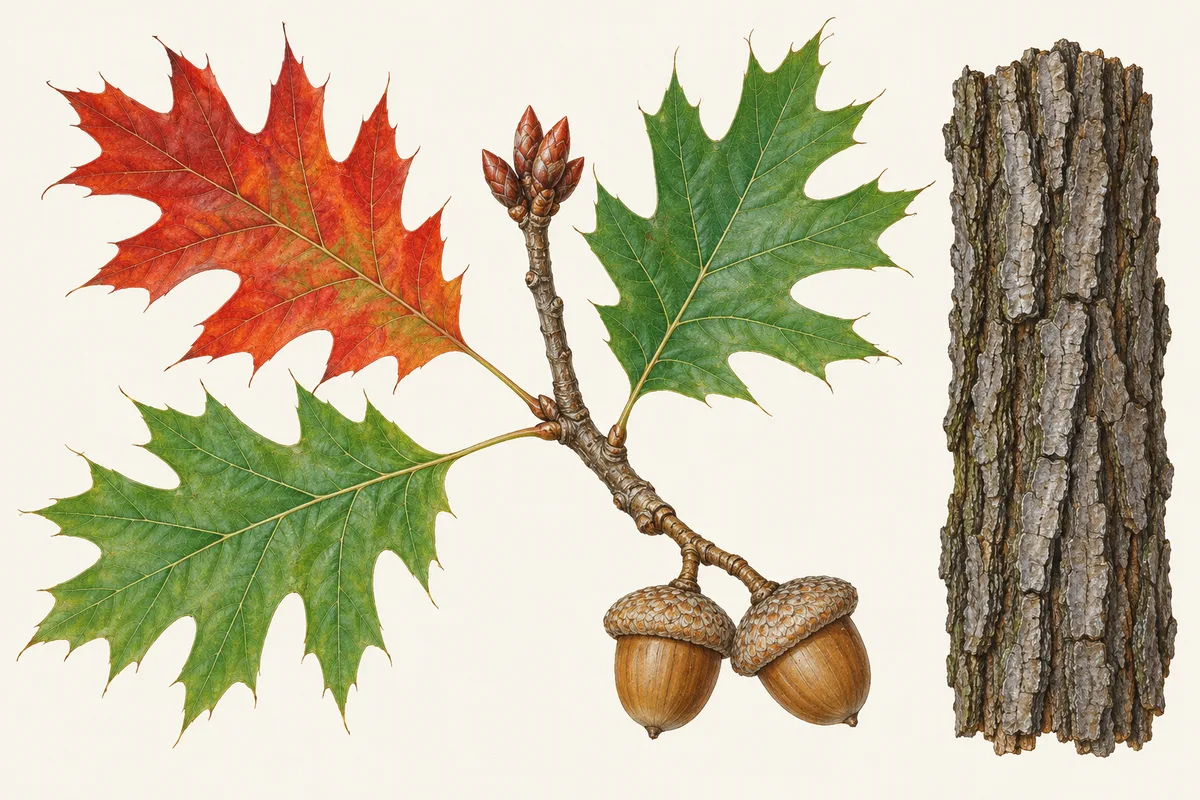
Red oak tree identification starts with the leaf: 5 to 8 inches long, with 7 to 11 bristle-tipped lobes and sinuses that reach only a third to halfway to the midvein. Confirm with the acorn, 3/4 to 1 inch long under a flat, beret-like cap covering a quarter or less of the nut, and with dark bark marked by wide, flat-topped ridges that look like ski tracks.
- Bristle tips on the lobes put the tree in the red oak group; shallow sinuses (a third to half the way in) point to northern red oak rather than pin or scarlet oak.
- The acorn cap is flat and thin, like a beret, and covers a quarter of the nut or less.
- Black, scarlet, pin and southern red oak are the usual look-alikes; buds and acorn caps separate them.
Field marks at a glance
- Scientific name
- Quercus rubra
- Family
- Fagaceae (beech family)
- Type
- Broadleaf, deciduous
- Leaves
- Alternate, simple, 5 to 8 inches (13 to 20 cm) long, oblong, with 7 to 11 bristle-tipped lobes; sinuses reach a third to half of the way to the midvein. Dull green to blue-green above, paler below; the shape is very uniform.
- Acorns
- Nearly round, 3/4 to 1 inch (2 to 2.5 cm) long. The cap is flat and thick, like a beret, covering about a quarter of the nut or less. Takes two growing seasons to mature.
- Bark
- Smooth and grayish on young stems; on older trunks dark gray with wide, flat-topped ridges and shallow furrows, the pattern Virginia Tech likens to ski tracks.
- Twigs and buds
- Stout, red-brown, hairless twigs. End buds clustered, large and conical, with mostly hairless red-brown scales, sometimes a little frosty fuzz.
- Flowers
- Yellow-green male catkins 2 to 4 inches long hang from the twigs in spring as the leaves open; female flowers are tiny spikes in the leaf axils.
- Form and size
- Usually 65 to 98 ft (20 to 30 m) tall in good forest stands, up to 90 ft per Virginia Tech; 60 to 75 ft tall and as wide in landscapes. Open-grown trees have a short trunk and a round crown.
- Native range
- Eastern North America: Nova Scotia, Prince Edward Island, New Brunswick and Quebec's Gaspé west through Ontario to Minnesota and eastern Nebraska, south to Oklahoma, Georgia and North Carolina.
- Fall color
- Russet red to bright red; spring leaves open pinkish red.
"Red oak" usually means northern red oak (Quercus rubra), one of the most common big trees of eastern North America and a frequent street and park tree. It also names a whole group of oaks that share bristle-tipped lobes, so the job is two steps: confirm the tree is in the red oak group, then confirm it is northern red oak and not black, scarlet, pin or southern red oak. Never eat a berry, nut, seed or pod on the strength of a web page or an app; check with a local expert.
How to identify a red oak, step by step
Work in this order. Leaf measurements and bud and bark descriptions are from Virginia Tech Dendrology's northern red oak fact sheet.
- Lobe tips. Pick a few leaves from the sunny side of the crown and run a thumb along the edge. Each lobe of a red oak ends in a short, sharp bristle. Rounded lobes with no bristle mean a white oak group tree instead: see red oak vs white oak.
- Sinus depth. On northern red oak the notches between lobes reach only a third to half of the way to the midvein, and the leaf, 5 to 8 inches long with 7 to 11 lobes, has a very uniform outline. Notches that cut almost to the midvein point to pin or scarlet oak.
- Acorn cap. Look under the tree in fall. Northern red oak's acorn is 3/4 to 1 inch long and nearly round, under a flat, thick cap that sits on top like a beret and covers a quarter of the nut or less. Deep bowl-shaped caps belong to other species.
- Bark. On a mature trunk, look for wide, flat-topped ridges separated by shallow furrows, running up the tree like ski tracks. Young stems are smooth and gray.
- Buds. In winter, the twig tips carry a cluster of large, conical, red-brown end buds, mostly hairless. Fuzzy, buff-colored buds mean black oak.
Two of those checks are usually enough: bristle tips plus shallow sinuses, or bristle tips plus a beret cap. Tree Identifier can put a name on a photo of a leaf, an acorn or the bark, which helps when the lowest branches are out of reach; then use the steps above to check that name.
Red oak through the seasons
Spring. The Morton Arboretum's northern red oak page describes new leaves emerging pinkish red before turning dark green. At the same time, yellow-green male catkins 2 to 4 inches long hang from the twigs.
Summer. This is the time for the acorn-age test. Red oak group acorns take two growing seasons to mature, so a summer twig carries two sizes: this year's tiny acorns near the tip and last year's, almost full size, farther back. A white oak group tree carries only one size.
Fall. The USDA Forest Service's Silvics of North America gives late August to late October for the acorns to ripen. Leaves turn russet red to bright red, per the Morton Arboretum, which is why northern red oak shows up in lists of trees with red leaves in fall.
Winter. Bark and buds carry the identification. Fallen leaves and old acorn caps under the tree usually confirm it.
Northern red oak vs the other red oaks
The bristle test puts a tree in the red oak group but does not settle the species. Virginia Tech lists cherrybark, black, scarlet and Shumard oak as look-alikes; pin and southern red oak cause the same trouble in yards and parks. The figures below are from Virginia Tech's fact sheets for black oak, scarlet oak, pin oak and southern red oak.
| Oak | Leaf | Acorn and cap | Settles it |
|---|---|---|---|
| Northern red oak | 5–8 in, 7–11 lobes, sinuses 1/3–1/2 to the midvein | 3/4–1 in, flat beret covering 1/4 or less | Ski-track bark ridges; hairless red-brown buds |
| Black oak | 4–10 in, mostly 5–7 lobes, slightly hairy below | 1/2–3/4 in, bowl of loose fuzzy scales covering 1/3–1/2 | Buff, fuzzy, angled buds; yellow-orange inner bark |
| Scarlet oak | 3–7 in, very deep sinuses, glossy | 1/2–1 in, cap covers about 1/2 | Rings at the acorn tip; swollen trunk base |
| Pin oak | 3–6 in, 5–9 lobes, sinuses nearly to the midrib | About 1/2 in, thin saucer cap | Pyramid shape, drooping lower branches |
| Southern red oak | 5–9 in, 3 shallow lobes or 5–7 deeper ones, fuzzy below | About 1/2 in, cap under 1/3 | Leaf shape and fuzzy underside |
Pin oak has its own page, pin oak, with the pin vs scarlet comparison in more detail. For every oak group and an acorn table covering both groups, start from the oak identification page.
Where red oak grows
The Forest Service calls northern red oak "the only native oak extending northeast to Nova Scotia." Its range runs from Cape Breton Island, Prince Edward Island, New Brunswick and Quebec's Gaspé Peninsula west through Ontario, and in the United States from Minnesota and eastern Nebraska south to Oklahoma, with the southern edge in Georgia and North Carolina and outlying stands in Louisiana and Mississippi.
It grows on many soils and slopes and often forms pure stands. The best sites, per the Forest Service, are deep, well-drained loams on lower slopes facing north or east. The Morton Arboretum lists it for USDA hardiness zones 3 to 7 and notes that it tolerates clay, dry sites, salt and air pollution, but that leaves yellow (chlorosis) on high-pH soils.
In Canada, the red oak is Prince Edward Island's official provincial tree, according to Canadian Heritage. Virginia Tech notes that planting may extend the range, so a range map alone cannot rule a tree in or out.
Why red oak matters
Wildlife. The Forest Service calls the acorns an important food for squirrels, deer, turkey, mice, voles and other mammals and birds. Trees begin bearing at about 25 years, produce heavily from about 50, and have good crops every 2 to 5 years.
Growth and size. It is one of the faster-growing oaks. Mature forest trees are commonly 65 to 98 feet (20 to 30 m) tall and 24 to 36 inches (61 to 91 cm) in diameter. The tree age calculator gives a rough age from the trunk's circumference.
Oak wilt. The Forest Service describes oak wilt as a potentially serious disease of northern red oak that can kill a tree in the year it is infected; the Morton Arboretum advises pruning oaks only in the dormant season. Tree health is outside this page, so ask a certified arborist about a sick tree.
Northern red oak is one of the oaks in Tree Identifier's Collection, the 138-species catalog that fills in as you identify trees, and the Tree Map keeps the spot of each located find so you can come back for the acorns or the fall color.
Look-alikes and how to tell them apart
Black oak (Quercus velutina)
Check the end buds: black oak's are 1/4 to 1/2 inch long, buff-colored, fuzzy and angled; northern red oak's are red-brown and mostly hairless. Black oak bark turns nearly black with horizontal breaks, and its inner bark is yellow-orange. Its acorn cap is a bowl with loose, fuzzy scales covering a third to half of the nut.
Scarlet oak (Quercus coccinea)
Scarlet oak leaves are glossy with very deep sinuses, nearly C-shaped. The acorn cap covers about half the nut and the nut's tip often shows concentric rings. Northern red oak's sinuses stop a third to halfway in, and its cap is a shallow beret.
Pin oak (Quercus palustris)
Pin oak's leaf is smaller, 3 to 6 inches, with 5 to 9 lobes and sinuses nearly to the midrib. Its acorn is only about 1/2 inch with a thin saucer cap. The tree is a narrow pyramid with drooping lower branches and bark that stays smooth for years.
Southern red oak (Quercus falcata)
Southern red oak leaves are fuzzy beneath and come in two forms, 3 shallow lobes (common on young trees) or 5 to 7 deeper lobes; its acorn is about 1/2 inch. Northern red oak leaves are hairless below, evenly lobed and its acorn is 3/4 to 1 inch.
What a photo can't settle
- Northern red oak hybridizes with other red oaks, among them northern pin oak and blackjack oak (USDA Forest Service). A hybrid can mix the leaf and acorn marks on this page.
- Shade leaves and leaves on young sprouts are often shallow-lobed and atypical; judge sinus depth on sunlit leaves from the outer crown.
- A photo app, Tree Identifier included, returns one name with no confidence score and no list of alternatives. Inside the red oak group, check the buds and an acorn cap before you settle on a species.
Questions people ask
What does a red oak leaf look like?
A northern red oak leaf is 5 to 8 inches long and oblong, with 7 to 11 lobes that each end in a fine bristle. The notches between lobes go only a third to halfway to the center vein, so the leaf looks fuller than a pin or scarlet oak leaf. It is dull green above and paler below.
Is red oak the same as northern red oak?
Usually, yes. "Red oak" on its own most often means northern red oak, Quercus rubra. It is also the name of the whole red oak group, which includes black, scarlet, pin, Shumard and southern red oak, all with bristle-tipped lobes and acorns that take two seasons to ripen.
How fast does a red oak grow?
Faster than most oaks. The Morton Arboretum rates its growth as moderate and calls it one of the faster-growing oaks for home landscapes. The USDA Forest Service gives an average diameter growth of about 0.2 inch (5 mm) a year in the Central States, up to about 0.4 inch on good Appalachian sites.
When does a red oak produce acorns?
According to the USDA Forest Service, northern red oak starts bearing acorns at about 25 years old but does not produce them abundantly until about 50. Good crops come every 2 to 5 years, and the acorns ripen from late August to late October in their second season.
Sources
- Northern red oak fact sheet — Virginia Tech Dendrology
- Northern Red Oak (Quercus rubra), Silvics of North America — USDA Forest Service
- Northern red oak (Quercus rubra) — The Morton Arboretum
- Black oak fact sheet — Virginia Tech Dendrology
- Scarlet oak fact sheet — Virginia Tech Dendrology
- Southern red oak fact sheet — Virginia Tech Dendrology
- Prince Edward Island's provincial symbols — Canadian Heritage, Government of Canada
Keep reading
- Tree profileOak trees (Quercus): how to identify them
- Tree comparisonRed oak vs white oak trees: how to tell the living trees apart
- Tree profilePin oak (Quercus palustris): how to identify it
- Tree profileWhite oak (Quercus alba): how to identify it
- Clue guideWhich trees have red leaves in fall? Sort them by leaf shape