Tree profile
Pin oak (Quercus palustris): how to identify it
A narrow pyramid with lower branches that sweep down, leaves cut almost to the midrib, and acorns no bigger than a marble. Here is how to separate it from northern red and scarlet oak.
In short
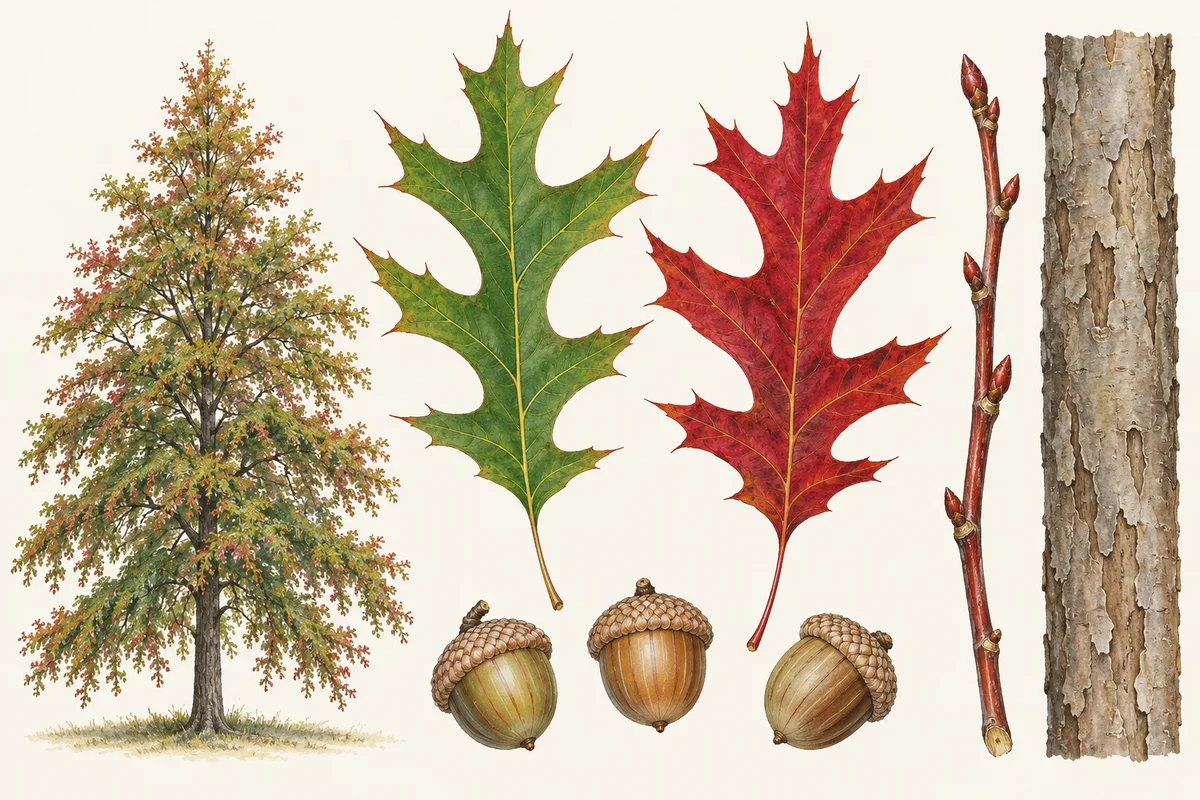
Pin oak tree identification starts with the shape: a pyramid-shaped crown whose lower branches droop, middle branches stand out level and upper branches rise. Then check the leaf, 3 to 6 inches long with 5 to 9 bristle-tipped lobes and U-shaped sinuses cut nearly to the midrib, and the acorn, only about 1/2 inch long under a thin, saucer-like cap.
- The silhouette is the fastest mark: drooping lower limbs, level middle limbs, rising upper limbs.
- Northern red oak's sinuses stop a third to halfway in; pin oak's reach almost to the midrib.
- Scarlet oak is the hardest look-alike: check the acorn cap (thin saucer on pin oak, half the nut on scarlet) and the buds.
Field marks at a glance
- Scientific name
- Quercus palustris
- Family
- Fagaceae (beech family)
- Type
- Broadleaf, deciduous
- Form
- Medium-sized and strongly pyramidal: lower branches droop, middle branches grow at right angles to the trunk, upper branches rise. Many small, stiff branchlets give a spiny look. Older trees become more oval.
- Leaves
- Alternate, simple, 3 to 6 inches (8 to 15 cm) long, with 5 to 9 bristle-tipped lobes and deep U-shaped sinuses nearly reaching the midrib. Glossy bright green above, paler below, with small tufts of hair in the vein angles.
- Acorns
- Small, about 1/2 inch (1 to 1.3 cm), nearly round, often striped. Thin, saucer-like cap with red-brown scales covering about a quarter to a third of the nut. Matures in two seasons.
- Bark
- Gray-brown, tight and thin; stays smooth for many years, then develops shallow ridges and fissures.
- Twigs and buds
- Slender, red-brown, quite shiny. End buds small, pointed and chestnut brown, clustered at the tip.
- Size
- Usually 60 to 70 ft tall and 40 to 50 ft wide in landscapes; 80 to 90 ft in good bottomland stands, rarely 120 ft.
- Native range
- Southwestern New England west to extreme southern Ontario, south to Missouri and northeastern Oklahoma, east to Virginia. Widely planted as a street and yard tree.
- Fall and winter
- Dark red to russet in fall where the soil suits it; young trees and the lower branches of older ones hold dead leaves through winter.
Pin oak (Quercus palustris) is a widely planted oak in American towns: the neat, pyramid-shaped tree on lawns, streets and school grounds, with its lowest branches sweeping toward the ground. It belongs to the red oak group, so its lobes end in bristles, and the job is to separate it from northern red, scarlet and Hill's oak, which share that mark. Never eat a berry, nut, seed or pod on the strength of a web page or an app; check with a local expert.
How to identify a pin oak, step by step
Check these in order. Descriptions are from Virginia Tech Dendrology's pin oak fact sheet unless another source is named.
- Step back and look at the shape. Pin oak is very pyramidal. Its lower branches hang down, its middle branches stick straight out from the trunk, and its upper branches rise. Many short, stiff branchlets give it a spiny look. NC State Extension notes that old trees become more rounded and oval.
- Lobe tips. Feel the leaf edge. Each lobe ends in a bristle, so the tree is in the red oak group.
- Sinus depth. The leaf is 3 to 6 inches long with 5 to 9 lobes, and the U-shaped sinuses between them cut nearly to the midrib, leaving the leaf mostly gaps. On a northern red oak, the sinuses stop a third to halfway in.
- Acorn. Pin oak's acorn is small, about 1/2 inch, round, often with faint stripes, under a thin, saucer-like cap with red-brown scales. NC State Extension's plant profile says the cap covers a quarter to a third of the nut.
- Bark. Gray-brown, tight and thin, staying smooth for many years before it develops shallow ridges.
The silhouette plus the deep sinuses usually settle it. If the branches are out of reach, a photo of a fallen leaf or an acorn gives Tree Identifier something to work with, and its follow-up chat can answer a question such as how pin oak differs from scarlet oak.
Pin oak vs red oak vs scarlet oak
These three are the classic confusion in the red oak group. Pin oak and scarlet oak both have deeply cut leaves; northern red oak is the common big oak they get compared with. Figures are from Virginia Tech's fact sheets for pin oak, scarlet oak and northern red oak.
| Mark | Pin oak | Scarlet oak | Northern red oak |
|---|---|---|---|
| Leaf | 3–6 in, 5–9 lobes, sinuses nearly to the midrib | 3–7 in, very deep sinuses, glossy | 5–8 in, 7–11 lobes, sinuses 1/3–1/2 to the midvein |
| Acorn | About 1/2 in, thin saucer cap | 1/2–1 in, cap covers about half; rings at the tip | 3/4–1 in, flat beret cap over 1/4 or less |
| End buds | Small, pointed, chestnut brown | Plump, angled, hairy on the upper half | Large, conical, mostly hairless |
| Bark | Smooth gray-brown for years | Gray-brown, later broad ridges near the base | Wide, flat-topped ridges like ski tracks |
| Shape | Neat pyramid, lower limbs droop | Irregular crown, many dead branches, swollen trunk base | Round crown in the open |
The acorn is the most reliable single test between pin and scarlet oak. For the whole group and an acorn table covering both oak groups, see the oak identification page.
Through the year: chlorosis, red leaves and winter leaves
Summer. On alkaline, high-pH soil, pin oak leaves often turn yellow between the veins. The Morton Arboretum calls this chlorosis a severe problem on this tree and no longer recommends pin oak for high-pH sites. The USDA Forest Service adds that chlorosis is not a problem in natural stands on acidic soil. Yellowed leaves on a pyramid-shaped oak are a hint in themselves.
Fall. NC State describes fall color as dark red to russet; the Morton Arboretum adds that the color shows only where chlorosis is absent. Pin oak is one of the oaks in the guide to trees with red leaves in fall.
Winter. Young trees and the lower branches of older ones hold their dead leaves through winter, according to NC State. A small oak still covered in brown leaves in January, with a pyramid shape, is worth checking for pin oak marks. The twigs are slender and shiny, with small, pointed, chestnut-brown end buds.
Where pin oak grows, wild and planted
The USDA Forest Service's Silvics of North America gives a native range from southwestern New England west to extreme southern Ontario, south to Missouri and northeastern Oklahoma, and east to Virginia. In the wild it grows on level, poorly drained floodplain and river-bottom soils with a lot of clay, and on wet upland flats. Those sites usually flood in the dormant season but rarely while the tree is growing; trees survive one season of growing-season flooding but die after 2 or 3 years of it.
Planted pin oaks are far more widespread. The Forest Service says the tree transplants well, grows fast and has a symmetrical crown and good fall color, which is why it is commonly planted as a shade or ornamental tree. The Morton Arboretum lists it for USDA hardiness zones 4 to 8, at 60 to 70 feet tall and 40 to 50 feet wide.
Why pin oak matters
Ducks. The Forest Service calls pin oak acorns an important food for mallards and wood ducks during fall migration. Pin oak is a main tree of greentree reservoirs, bottomland stands flooded in fall and winter to draw migrating ducks. Trees start producing acorns at about 20 years in stands.
The name. Pin oak does not prune itself. Its dead lower branches stay on for years and leave small knots in the lumber, which the Forest Service gives as the source of the common name.
Health and safety. NC State lists pin oak as toxic to horses. Oak wilt also affects pin oak, per the Morton Arboretum, which advises pruning oaks only in the dormant season; ask a certified arborist about a sick tree.
Pin oak is not one of the oaks in Tree Identifier's 138-species Collection. You can still photograph one for a name, and the Tree Map keeps the place of each located find.
Look-alikes and how to tell them apart
Scarlet oak (Quercus coccinea)
Scarlet oak's acorn cap covers about half the nut and the nut's tip often shows concentric rings; pin oak's thin saucer covers a third or less. Scarlet oak buds are plump with fine hairs on the upper half; pin oak's are small and hairless. Scarlet oak has an irregular crown and a swollen trunk base, not a neat pyramid.
Northern red oak (Quercus rubra)
Northern red oak's leaf is bigger, 5 to 8 inches, with sinuses reaching only a third to halfway to the midvein, and its acorn is 3/4 to 1 inch under a flat beret cap. Its mature bark has wide, flat-topped ridges like ski tracks, not pin oak's smooth gray.
Hill's oak, or northern pin oak (Quercus ellipsoidalis)
Almost identical leaves. Hill's oak's acorn is slightly longer, 1/2 to 3/4 inch, with a cap covering about a third. It grows on dry uplands and does not yellow on alkaline soil; pin oak grows on wet ground and often yellows (chlorosis) on alkaline soil.
Black oak (Quercus velutina)
Black oak's leaves are larger, 4 to 10 inches, and its buds are 1/4 to 1/2 inch, buff-colored, fuzzy and angled. The bark turns thick and nearly black with yellow-orange inner bark. Pin oak's bark stays smooth and gray-brown.
What a photo can't settle
- Pin oak hybridizes with Shumard, black, willow, northern red and scarlet oak (USDA Forest Service); a hybrid can blur the leaf and acorn marks.
- Pin oak and Hill's oak (northern pin oak) are hard to separate from leaves alone. Habitat and acorns help; a regional expert or herbarium settles a doubtful tree.
- A photo app, Tree Identifier included, returns one name with no confidence score and no list of alternatives. For a pin oak vs scarlet oak call, photograph an acorn with its cap as well as a leaf.
Questions people ask
Is pin oak a red oak or a white oak?
A red oak. Pin oak's lobes end in bristle tips and its acorns take two seasons to mature, the two marks of the red oak group. It is a different species from northern red oak, though the two can hybridize, according to the USDA Forest Service.
Why is it called pin oak?
The USDA Forest Service links the name to its branches: pin oak does not shed its dead lower branches, which persist for many years and leave small knots in the lumber.
Why are my pin oak's leaves turning yellow?
On alkaline (high-pH) soil, pin oak often develops chlorosis, a yellowing of the leaves. The Morton Arboretum calls it a severe problem on this tree and no longer recommends it for high-pH sites. Natural stands on acidic soil rarely show it. Ask a certified arborist about a specific tree.
Does a pin oak keep its leaves in winter?
Partly. NC State Extension notes that young pin oaks, and the lower branches of older ones, hold dead brown leaves through winter. The tree is still deciduous: the leaves are dead and fall by spring.
Sources
- Pin oak fact sheet — Virginia Tech Dendrology
- Pin Oak (Quercus palustris), Silvics of North America — USDA Forest Service
- Pin oak (Quercus palustris) — The Morton Arboretum
- Quercus palustris (Pin Oak) — NC State Extension, North Carolina Extension Gardener Plant Toolbox
- Scarlet oak fact sheet — Virginia Tech Dendrology
- Hill's oak (Quercus ellipsoidalis) — The Morton Arboretum
Keep reading
- Tree profileNorthern red oak (Quercus rubra): how to identify it
- Tree profileOak trees (Quercus): how to identify them
- Tree comparisonRed oak vs white oak trees: how to tell the living trees apart
- Clue guideWhich trees have red leaves in fall? Sort them by leaf shape
- Winter field guideWinter tree identification, from buds to bark