Also in Français
Tree comparison
Red pine vs white pine: how to tell them apart, with jack pine
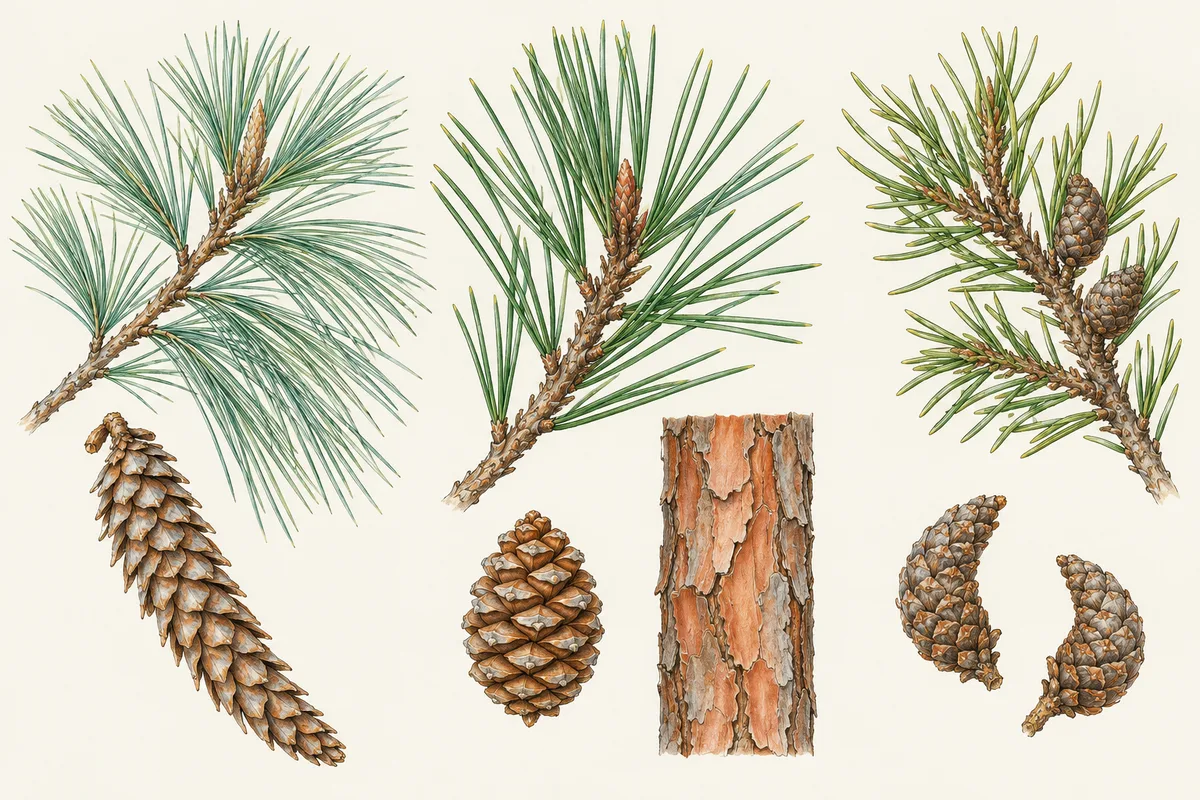
Five soft needles or two that snap. Then the cone and the bark. Jack pine, the third pine of the same forests, has two short needles and curved cones.
In short
Red pine vs white pine is settled by one needle bundle. Eastern white pine has five soft, flexible needles per bundle, 5 to 15 cm long, and long hanging cones 8 to 20 cm. Red pine has two stiff needles, 10 to 16 cm, that snap cleanly in half when bent, and egg-shaped cones 4 to 7 cm. Jack pine also has two needles, but they are short, 2 to 4 cm.
- Five needles per bundle: white pine. Two long needles that break in half when bent: red pine. Two short needles: jack pine.
- Red pine is also called Norway pine, and it is Minnesota's state tree; eastern white pine is Ontario's official tree.
- Red pine bark is reddish to pinkish in broad, flat scaly plates; old white pine bark is dark greyish-brown with deep furrows.
Field marks at a glance
- Scientific name
- Pinus resinosa and Pinus strobus
- Family
- Pinaceae (pine family)
- Type
- Conifer, evergreen
- Needles per bundle
- Eastern white pine: 5. Red pine: 2. Jack pine: 2.
- Needle length
- White pine: 5–15 cm. Red pine: 10–16 cm. Jack pine: 2–4 cm (all NRCan).
- Needle feel
- White pine: slender, soft and flexible, bluish-green with white lines. Red pine: straight, brittle, breaking in half when bent, shiny dark green. Jack pine: stiff, sharp, spread apart, light yellowish-green.
- Cones
- White pine: cylindrical, hanging, 8–20 cm, on a 2 cm stalk. Red pine: egg-shaped, almost stalkless, 4–7 cm, no prickles. Jack pine: 3–7 cm, lopsided and often curved, usually closed for 10–20 years.
- Bark
- White pine: thin and smooth when young, later dark greyish-brown with broad ridges and deep furrows. Red pine: reddish to pinkish, in broad, flat, scaly plates. Jack pine: flaky, then dark brown irregular plates.
- Size
- White pine: to 30 m, occasionally larger, and to 200 years or more. Red pine: to 25 m and 200 years. Jack pine: to 20 m and 150 years (NRCan).
- Habitat
- Red pine: sand plains, rock outcrops, low-fertility sites. White pine: dry sandy soils and rocky ridges to sphagnum bogs; best on moist sandy loam. Jack pine: coarse sands, shallow soils, rock, permafrost.
- Other names
- Red pine: Norway pine. Eastern white pine: Weymouth pine (as a synonym in NRCan's French factsheet). Jack pine: pin gris in Quebec French.
Red pine and eastern white pine grow side by side in eastern Canada, where NRCan gives red pine's range as southeastern Manitoba to Newfoundland, and red pine often grows mixed with white pine, jack pine and aspens. Two quick checks separate all three: count the needles in one bundle, then bend a needle. The cone and the bark confirm. Measurements are from Natural Resources Canada (NRCan) factsheets.
Red pine vs white pine vs jack pine, side by side
Pull a bundle from the middle of a branch, not the tip, and count. Rows below come from NRCan's factsheets for red pine, eastern white pine and jack pine.
| Feature | Eastern white pine | Red pine | Jack pine |
|---|---|---|---|
| Needles per bundle | 5 | 2 | 2 |
| Needle length | 5–15 cm | 10–16 cm | 2–4 cm |
| Needle feel | Slender, soft, flexible | Straight, brittle: breaks in half when bent | Stiff, sharp, spread apart |
| Needle colour | Bluish-green with lines of white dots | Shiny dark green | Light yellowish-green |
| Bundle sheath | Falls off in the first season | Persistent | Persistent |
| Cone | Cylindrical, hanging, 8–20 cm, 2 cm stalk | Egg-shaped, almost stalkless, 4–7 cm | Lopsided, straight or curved, 3–7 cm |
| Cone behaviour | Sheds seed and falls soon after ripening | Opens in autumn, falls the next year | Usually stays closed 10–20 years until fire or heat |
| Bark | Smooth and greyish-green young; dark greyish-brown, deep furrows old | Reddish to pinkish, broad flat scaly plates | Flaky, then dark brown irregular plates |
| Height | To 30 m, occasionally more | To 25 m | To 20 m |
| Typical site | Dry sand and rocky ridges to bogs; best on moist sandy loam | Sand plains, rock outcrops, low-fertility sites | Coarse sand, shallow soils, rock, permafrost |
Ontario's ministry gives slightly different needle ranges for its own trees: six to twelve centimetres for white pine and 10 to 16 cm for red pine, in its Common trees page.
Needles first: count, then bend
Count. Five needles per bundle means eastern white pine. Two means red pine or jack pine. The papery sheath at the base of the bundle helps too: on white pine it falls away during the first season, so older bundles look bare at the base; on red and jack pine it stays.
Bend. The snap test is the fastest way to confirm red pine. NRCan describes red pine needles as "straight, brittle (breaking in half when bent)". Take a full, healthy needle and fold it between your fingers: a red pine needle breaks cleanly; a white pine needle is flexible and soft, and a jack pine needle is short and stiff.
Measure. Length separates the two-needle pines at a glance. Red pine needles run 10 to 16 cm, jack pine needles 2 to 4 cm. A pine with two needles about the length of your finger is red pine; two needles shorter than your thumb, jack pine.
Cones and bark confirm it
Cones. Eastern white pine cones are long, slim and hanging, 8 to 20 cm, with 50 to 80 thin scales that lack prickles; they shed their seed and drop soon after ripening. Red pine cones are small eggs, 4 to 7 cm, almost without a stalk, and also prickle-free; they open in autumn and fall the following year, sometimes leaving a few basal scales on the branch. Jack pine cones are lopsided, straight or curved inward, point forward along the branch, sit in clusters of two or three, and usually stay closed and attached for 10 to 20 years, held shut by resin until a fire's heat opens them.
Bark. Red pine has the colour in its name: NRCan describes the bark as reddish to pinkish, in broad, flat, scaly plates. Eastern white pine starts thin, smooth and greyish-green and becomes dark greyish-brown with broad scaly ridges 2 to 5 cm thick separated by deep furrows. Jack pine bark is thin and flaky, then dark brown in irregular plates.
Shape. Old white pines carry a few long, stout branches at right angles to the trunk, often swept to one side by the prevailing wind, and a broadly oval, flat-topped crown. Red pine keeps a straight trunk that drops its dead branches early, with foliage crowded toward the branch tips. Jack pine on poor ground often looks unkempt, with long branches and some dead ones.
Norway pine, Minnesota and Ontario's tree
Norway pine is red pine. NRCan lists it as a synonym of Pinus resinosa, and the Minnesota Secretary of State gives 1953 as the year the Norway pine became Minnesota's state tree, describing needles four to six inches (10 to 15 cm) long in pairs and stout cones about two inches (5 cm) long. It is a North American tree, not a European one.
Eastern white pine is Ontario's tree. Canadian Heritage's Ontario page gives May 1, 1984 as its adoption date and calls it the province's tallest tree, able to live more than 250 years. In Ontario's managed forest zone, white pine leads about 978,000 ha of forest and red pine about 282,000 ha, while jack pine leads 5.5 million ha, the province's third most common tree.
For the full set of Canadian and US pines by bundle count, see the pine guide; to rule out spruce and fir first, see spruce vs fir and the conifer identification key. The Ontario tree guide places all three pines by forest region.
Red pine vs white pine wood, in brief
Many searches for "red pine vs white pine" are about lumber, and the trees' wood differs. NRCan describes eastern white pine wood as soft, light and moderately strong, creamy-white to yellow, straight-grained and easily worked, used for patterns, doors, mouldings, trim, panelling and furniture. Red pine wood is relatively light and moderately hard, pale brown to reddish-brown, used for poles, pilings and structural timber. Jack pine goes to general construction, pulp, railway ties and poles.
If a pine is out of reach, a photo of a fallen needle bundle or a cone is enough for Tree Identifier to suggest a name, and eastern white pine is one of the 138 species in the app's Collection. Count the needles yourself before you trust the answer.
Look-alikes and how to tell them apart
Jack pine (Pinus banksiana)
Two needles like red pine, but only 2 to 4 cm long, stiff and spread apart, and the cones are lopsided, straight or curved inward, and stay closed for years. Red pine needles are four times longer and snap when bent.
Scots pine (Pinus sylvestris)
A planted European two-needle pine. Virginia Tech Dendrology gives stout, twisted, blue-green needles only 4 to 8 cm (1.5 to 3 in) long and orange, peeling bark in the upper crown; red pine needles are 10 to 16 cm and dark green.
Austrian pine (Pinus nigra)
Also two long needles, 10 to 15 cm (4 to 6 in), but thick and dark green, and its cones carry a very short prickle on each scale, according to Virginia Tech Dendrology; red pine cones have none.
What a photo can't settle
- The snap test is for fresh needles from the tree: dry needles picked up from the ground can break whatever the species, so test several living, full-length needles.
- Planted two-needle pines from Europe (Scots, Austrian) overlap with red pine in yards and windbreaks; a single photo of foliage may not separate them, but the cone and bark do.
- Tree Identifier gives one name from one photo with no confidence score or look-alike list, so count a bundle yourself before trusting a pine name.
Questions people ask
What is the difference between red pine and white pine?
Count the needles in one bundle: five on eastern white pine, two on red pine. White pine needles are soft and flexible; red pine needles are stiff and snap in half when bent. White pine cones are long and hanging, 8 to 20 cm; red pine cones are egg-shaped, 4 to 7 cm.
Is Norway pine the same as red pine?
Yes. Norway pine is another name for red pine (Pinus resinosa), listed as a synonym by Natural Resources Canada. Minnesota adopted the Norway pine as its state tree in 1953. Despite the name, it is a North American tree: NRCan maps it from southeastern Manitoba to Newfoundland.
How do you tell jack pine from red pine?
Both have two needles per bundle. Jack pine needles are 2 to 4 cm long, stiff and spread apart; red pine needles are 10 to 16 cm and snap when bent. Jack pine cones are lopsided, often curved and stay closed for 10 to 20 years; red pine cones open in autumn and fall the next year.
Which pine is Ontario's provincial tree?
The eastern white pine (Pinus strobus), adopted on May 1, 1984, according to Canadian Heritage, which calls it the province's tallest tree. Ontario's ministry describes it as common throughout central and southern Ontario, with soft needles in bunches of five.
Which is more common in Ontario, red pine or white pine?
White pine. Ontario's Forest resources of Ontario 2021 gives about 978,000 ha of the managed forest zone with white pine as lead species, against about 282,000 ha for red pine. Jack pine, at 5.5 million ha, is far more common than both.
Sources
- Red pine factsheet — Natural Resources Canada, Trees, insects and diseases of Canada's forests
- Eastern white pine factsheet — Natural Resources Canada, Trees, insects and diseases of Canada's forests
- Jack pine factsheet — Natural Resources Canada, Trees, insects and diseases of Canada's forests
- State Tree: Norway Pine — Minnesota Secretary of State
- Ontario: provincial symbols — Canadian Heritage, Government of Canada
- Common trees, Forest resources of Ontario 2021 — Ontario Ministry of Natural Resources (ontario.ca)
- Scots pine fact sheet — Virginia Tech Dendrology
- Austrian pine fact sheet — Virginia Tech Dendrology