Tree profile
Chinese tallow tree (Triadica sebifera): how to identify it
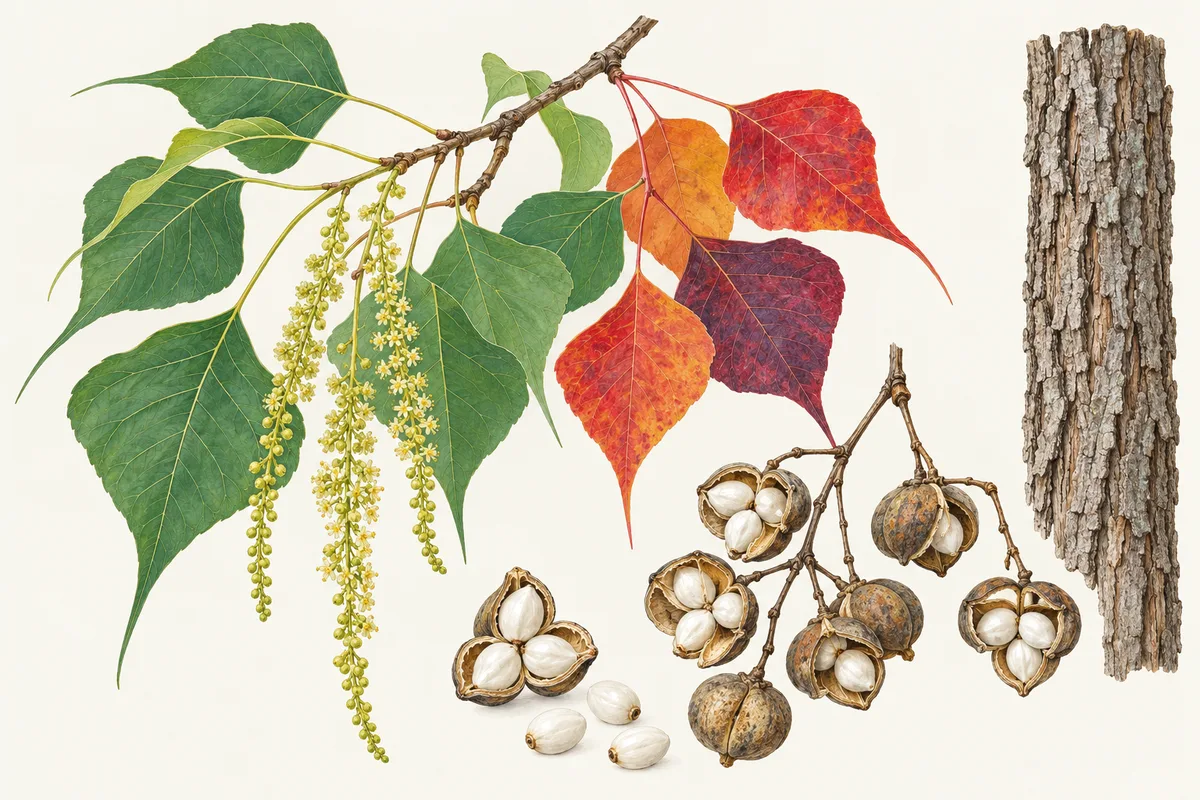
The popcorn tree of the South. A smooth-edged leaf that narrows to a long point, milky sap, and white waxy seeds that hang on through winter.
In short
Chinese tallow tree identification starts with the leaf: alternate, hairless, smooth-edged, broadly rounded at the base and drawn out to a long slender point, on a stalk 1 to 2 inches long with two small glands at the top. Snap it and milky sap appears. In fall, three-lobed capsules split to show three white, waxy seeds that look like popcorn.
- Smooth-edged, long-pointed leaf + milky sap + two glands where the stalk meets the blade = Chinese tallow.
- White, waxy, popcorn-like seeds in clusters from fall into winter are the easiest sign from a distance.
- Florida, Louisiana, Mississippi and Texas list it as a state noxious weed; NC State lists the fruits and leaves as poisonous: never eat any part.
Field marks at a glance
- Scientific name
- Triadica sebifera (syn. Sapium sebiferum)
- Family
- Euphorbiaceae (spurge family)
- Type
- Broadleaf, deciduous
- Leaves
- Alternate, simple, hairless, smooth-edged, 1 to 3 inches long, broadly rounded or heart-shaped at the base and tapering to a long, slender point. Medium to dark green with conspicuous yellow veins.
- Leaf stalk
- 1 to 2 inches long, with two small glands at the top, where it meets the blade.
- Sap
- Milky white sap from any damaged part, as in other members of the spurge family.
- Flowers
- Yellowish, petal-less, on drooping, catkin-like spikes up to about 8 inches long, in spring.
- Fruit and seeds
- Three-lobed capsule 1/2 to 3/4 inch, green turning brown to almost black; splits to show three white, waxy seeds that resemble popcorn and often stay on the tree through winter.
- Bark
- Dark brown to reddish, gnarled and fissured, peeling in narrow vertical strips as it ages.
- Fall color
- Red, yellow or purple; often fiery red in the Southeast.
- Size
- Usually 30 to 40 feet tall with a crown as wide; can exceed 50 feet.
- Range in the US
- Native to China, Japan and Korea. Naturalized from North Carolina south through Florida and west into Texas, northwest into Arkansas; NC State also lists California.
Chinese tallow (Triadica sebifera), also called the popcorn tree, is one of the most widespread invasive trees of the US South. It was brought from Asia as a seed oil crop and planted as an ornamental for its fall color and white seeds, and it has escaped into forests, floodplains and coastal prairies. Three features identify it on any leaf you can reach: the shape, the sap and two tiny glands.
How to identify a Chinese tallow tree: leaf, sap, glands
1. Read the leaf shape. NC State's Chinese tallow profile describes alternate, simple, hairless leaves with a smooth, untoothed edge, heart-shaped to ovate, with a long pointed tip, medium to dark green above, lighter below, and conspicuous yellow veins. UF/IFAS's Natural Area Weeds: Chinese Tallow gives the blade as 1 to 2.5 inches wide, with a broadly rounded base that tapers to a slender point, on a stalk 1 to 2 inches long.
2. Snap a leaf stalk. All parts of the tree bleed milky white sap when damaged (NC State), as members of the spurge family do. Wash your hands afterwards and keep the sap away from eyes and mouth.
3. Look where the stalk meets the blade. Chinese tallow carries two small glands at the top of the leaf stalk (NC State).
If all three line up, you have a Chinese tallow. In fall and winter, a fourth sign shows from across a yard: clusters of white, waxy seeds. UF/IFAS describes a three-lobed capsule about half an inch wide that turns brown and splits to reveal three dull white seeds, which often stay on the tree through winter and resemble popcorn. NC State gives the capsule as 1/2 to 3/4 inch, ripening from green to brown or almost black, with seeds ripening in late summer to early fall.
Flowers, fall color, bark and size
Flowers. In spring, Chinese tallow hangs yellow, drooping, catkin-like spikes up to about 8 inches long (UF/IFAS; NC State). The flowers have no petals; male flowers crowd the upper part of each spike and a few female flowers sit at its base (NC State).
Fall color. The Mississippi State and USGS fact sheet, published by University of Arkansas Extension, describes bright green summer foliage often turning fiery red in fall; NC State lists red, yellow and purple. A roadside tree turning red in a southern wetland, with white seeds appearing as the leaves drop, is a strong Chinese tallow candidate. The trees with red leaves in fall guide covers the native trees that turn red at the same time. The southern tree identification guide covers the native trees it grows among.
Bark. Dark brown to reddish, gnarled and fissured, thickening with age and peeling in narrow vertical strips (NC State).
Size. The Mississippi State and USGS sheet gives 30 to 40 feet, sometimes over 50 feet; UF/IFAS says it commonly grows to 30 feet. In the Southeast it is deciduous, though the same sheet calls it deciduous to evergreen across its range.
Chinese tallow vs redbud, chinaberry and poplar
Three trees get mistaken for it. The leaf and the fruit separate them; the milky sap and stalk glands confirm Chinese tallow.
| Tree | Leaf | Fruit |
|---|---|---|
| Chinese tallow | Single, smooth-edged, 1–3 in, long-pointed tip, two glands on the stalk, milky sap | White waxy seeds, fall to winter |
| Eastern redbud | Single, smooth-edged heart, 3–6 in | Flat brown pods 2–4 in |
| Chinaberry | Twice-compound, 12–24 in, toothed leaflets | Wrinkled yellow berries, about 1/2 in |
| Eastern cottonwood | Single, triangular, toothed, flattened stalk | Cottony seed in early summer |
Eastern redbud. NC State's redbud profile describes heart-shaped leaves with smooth, entire margins and flat pods about 2 to 4 inches long that may persist through winter. Its leaves are larger than a tallow's 1 to 3 inches, and its fruit is a pod, not a seed cluster. The redbud page covers it in full, and the heart-shaped leaves guide sorts the other trees with heart-shaped leaves.
Chinaberry. Another southern invasive, often searched alongside Chinese tallow. NC State's chinaberry profile describes twice-pinnate leaves 12 to 24 inches long with toothed leaflets up to 2.75 inches, lavender flowers, and wrinkled yellow fruit 0.4 to 0.5 inch that lasts through winter. One look at the leaf settles it: Chinese tallow leaves are single blades, never divided.
Eastern cottonwood. A young cottonwood's triangular leaf can resemble a tallow leaf, but cottonwood leaves have toothed edges and a stalk flattened from side to side (see the poplar page). Chinese tallow leaves have smooth edges, two glands at the top of the stalk, and milky sap.
Where it grows, its status and the never-eat rule
Chinese tallow is native to China, Japan and Korea (Mississippi State and USGS). UF/IFAS says it was introduced before 1800: Benjamin Franklin sent seeds to Georgia in 1772, and André Michaux noted it spreading into coastal forests as early as 1803. It is now naturalized from North Carolina south through central Florida, west into Texas and northwest into Arkansas, and in Florida it is found in almost every county (UF/IFAS). The Mississippi State and USGS sheet notes that it has turned coastal prairies in southern Texas into closed-canopy forest within 10 years, and that a tree produces around 100,000 seeds on average.
Status, attributed to each source:
- Florida: on the Florida Department of Agriculture and Consumer Services Noxious Weed List since 1998, and a Florida Invasive Species Council Category 1 species (UF/IFAS).
- Florida, Louisiana, Mississippi and Texas: listed as a state noxious weed, though not a federal noxious weed (Mississippi State and USGS fact sheet).
- North Carolina: listed as invasive by the NC Invasive Plant Council (NC State), which also lists it as invasive in Florida, Arkansas, California, Oklahoma, Texas and Georgia.
Never eat any part. NC State lists the fruits and leaves as poisonous, with nausea and vomiting as symptoms, and the Mississippi State and USGS sheet says the white fruit is thought to be poisonous. If a person or a pet swallows seeds or leaves, call a poison control center or a veterinarian. For the other invasive trees of the South, see the invasive trees guide.
Using a photo to confirm it
Tree Identifier names a tree from one photo of the whole tree, a leaf, the bark, the flowers or the fruit. For Chinese tallow, photograph a leaf flat with its stalk visible, and in fall a seed cluster; together they rule out redbud and poplar. The app shows no confidence score and no look-alike list, so check its answer against the sap and gland tests above. Its Toxicology tool gives AI-written notes for people, dogs and cats, and the follow-up chat can answer questions such as how to tell tallow from chinaberry. Chinese tallow is not among the 138 species in the app's Collection; save the spot on the Tree Map if you plan to report it to your state's invasive-species program.
Look-alikes and how to tell them apart
Eastern redbud (Cercis canadensis)
Redbud leaves are also smooth-edged and heart-shaped, but 3 to 6 inches long, and NC State does not describe the milky sap or stalk glands of Chinese tallow. Redbud carries flat brown pods 2 to 4 inches long, not white popcorn seeds.
Chinaberry (Melia azedarach)
Chinaberry has huge twice-compound leaves 12 to 24 inches long made of many toothed leaflets, and wrinkled yellow berries about half an inch across. Chinese tallow has single, untoothed leaves and white waxy seeds.
Eastern cottonwood and other poplars (Populus)
Cottonwood leaves are triangular too, but their edges are toothed and the leaf stalk is flattened from side to side, so the leaves flutter. Chinese tallow leaves have no teeth, two glands at the top of the stalk, and milky sap.
What a photo can't settle
- Leaf shape varies from heart-shaped to diamond-like and rounded, so a single leaf photo can be confused with a redbud or a poplar. Photograph the leaf stalk glands, the sap and, in fall, the seeds.
- Sources give different introduction dates: UF/IFAS cites seeds sent by Benjamin Franklin in 1772, while the Mississippi State and USGS fact sheet gives an introduction around 1850 as a seed oil crop.
- Noxious-weed listings change. A photo app cannot tell you what your state requires; check with your state agriculture department or extension office.
Questions people ask
Is Chinese tallow the same as the popcorn tree?
Yes. Popcorn tree is a common name for Chinese tallow, Triadica sebifera, given for its white, waxy seeds that look like popped corn once the capsules split in fall. Older books call it Sapium sebiferum.
What does a Chinese tallow tree look like?
A tree usually 30 to 40 feet tall with smooth-edged leaves that taper to a long point, yellow drooping flower spikes in spring, red to yellow leaves in fall, and clusters of white seeds that hang on through winter. Any broken leaf or twig bleeds milky sap.
Is Chinese tallow poisonous?
NC State lists the fruits and leaves as the poisonous parts, with nausea and vomiting as symptoms, and the Mississippi State and USGS fact sheet says the white fruit is thought to be poisonous. Never eat any part, and contact a poison control center or a veterinarian if a person or pet swallows some.
Is Chinese tallow invasive?
Yes, according to several agencies. It is a state noxious weed in Florida, Louisiana, Mississippi and Texas, per a Mississippi State and USGS fact sheet; in Florida it has been on the state Noxious Weed List since 1998 and is a Florida Invasive Species Council Category 1 species (UF/IFAS).
How do you tell Chinese tallow from a redbud?
Both have smooth, heart-shaped leaves. Snap a leaf: Chinese tallow bleeds milky sap and has two tiny glands at the top of the stalk. Redbud leaves are larger, 3 to 6 inches. In fall, redbud carries flat brown pods while Chinese tallow carries white popcorn-like seeds.
Sources
- Triadica sebifera (Chinese tallow tree, Popcorn Tree) — NC State Extension, North Carolina Extension Gardener Plant Toolbox
- Natural Area Weeds: Chinese Tallow (SS-AGR-45/AG148) — UF/IFAS Extension (K. A. Langeland and S. F. Enloe)
- Chinese Tallowtree (Rights of Way fact sheet) — University of Arkansas Cooperative Extension Service (Mississippi State University and USGS authors)
- Melia azedarach (Chinaberry) — NC State Extension, North Carolina Extension Gardener Plant Toolbox
- Cercis canadensis (Eastern redbud) — NC State Extension, North Carolina Extension Gardener Plant Toolbox
Keep reading
- Clue guideTrees with heart-shaped leaves, and how to tell them apart
- Clue guideWhich trees have red leaves in fall? Sort them by leaf shape
- Tree profileRedbud tree (Cercis canadensis): how to identify it
- Tree profilePoplars, cottonwoods and aspens (Populus): how to identify them
- Invasive tree profileTree of heaven (Ailanthus altissima): how to identify it