Regional guide
Southern tree identification for the Southeast US
Pines, evergreen oaks, swamp trees and palms set the South apart. Sort them by habitat first, then check needles, leaves and fruit.
In short
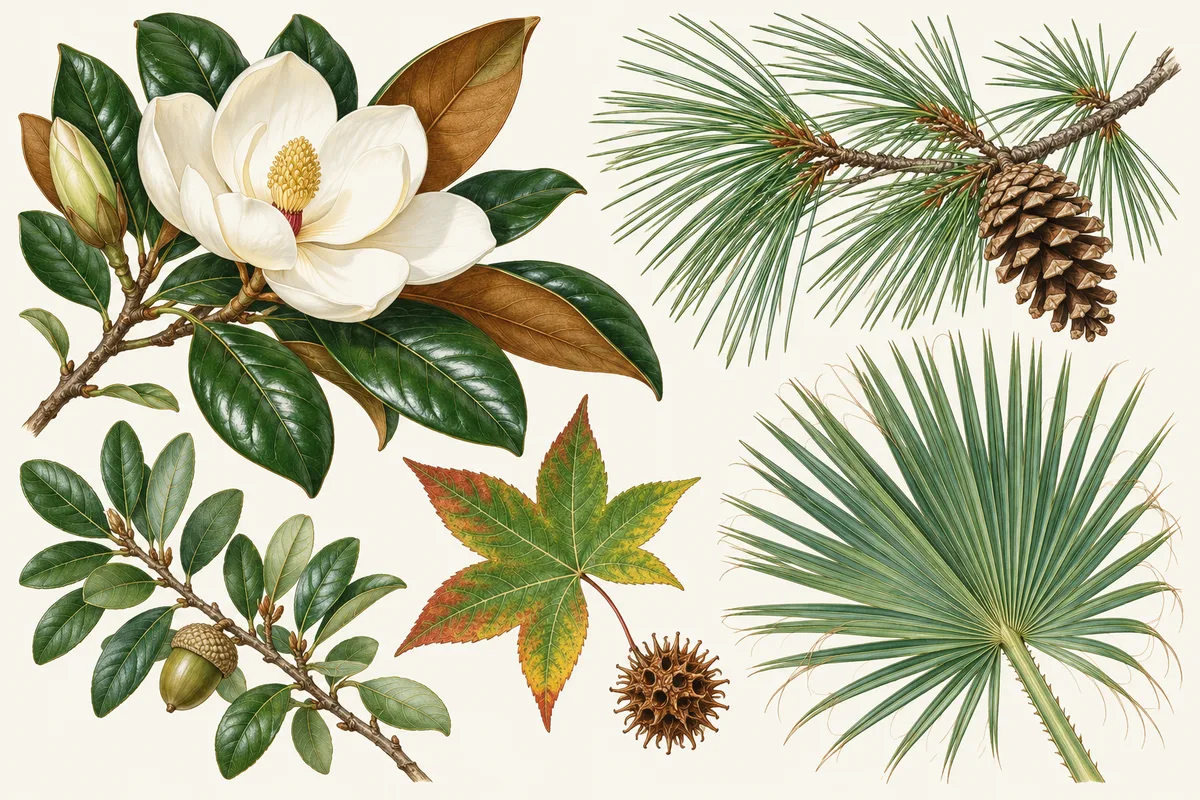
Southern tree identification starts with the pines, then the evergreens. Count needles and measure cones: longleaf pine has needles 6 to 12 inches long and cones up to 15 inches, while loblolly has 6 to 10 inch needles and spiny 3 to 6 inch cones. Live oak keeps small, smooth-edged leaves into winter, southern magnolia has leathery leaves with rusty undersides, and baldcypress grows "knees" in swamps.
- Longleaf pine cones are 6 to 15 inches long, the largest of any pine in eastern North America (NC State Extension).
- Live oak leaves are 2 to 5 inches long with mostly smooth edges and stay on the tree until new leaves push them off.
- Baldcypress looks like an evergreen in summer but drops its needles, still attached to small branchlets, in fall.
The South is not one forest. Pine flatwoods and sandhills cover the coastal plain from Virginia to Texas, swamps and river bottoms hold baldcypress and tupelo, and the Piedmont and uplands mix pines with oaks, sweetgum and tuliptree. Work out which habitat you are standing in, then use needles, leaves and fruit. Measurements below come from the NC State Extension Plant Toolbox, which covers the native trees of the Southeast species by species. If you are in the Appalachian mountains, the trees change again with elevation; see Appalachian tree identification.
The southern trees to learn first
| Tree | Where in the Southeast | The feature that settles it | Our page |
|---|---|---|---|
| Longleaf pine | Sandhills and flatwoods, Virginia to Texas | Needles 6 to 12 in, three per bundle; cones 6 to 15 in | Pine |
| Loblolly pine | Almost everywhere, planted widely | Needles 6 to 10 in, three per bundle; spiny cones 3 to 6 in | Pine |
| Slash pine | Coastal plain, North Carolina to Texas | Needles 5 to 11 in, two or three per bundle | Pine |
| Live oak | Coastal plain, Virginia to Texas | Small, thick, smooth-edged leaves kept all winter; huge spreading limbs | Live oak |
| Southern magnolia | Bottomlands, yards, streets | Leathery leaves 5 to 10 in with rusty-brown undersides; white flowers 8 to 12 in | Magnolia |
| Baldcypress | Swamps, rivers, lake edges | Flat, feathery needles that drop in fall; knees around the trunk | Bald cypress |
| Sweetgum | Woods, old fields, yards | Star-shaped leaves; spiky brown balls 1 to 3 in | Sweetgum |
| Cabbage palm | Coastal Carolinas to Florida | Fan leaves about 5 ft long; trunk often wrapped in leaf "boots" | Palm |
If you only learn four, learn loblolly pine, live oak, southern magnolia and sweetgum: between them they cover the woods, the yards and the streets of most of the region.
Southern pines: count the needles, then measure
Pines are the backbone of southern forests. Pull one needle bundle (fascicle) from a branch, count the needles and lay them along a ruler, then find a cone.
- Longleaf pine (Pinus palustris): needles 6 to 12 inches long, three per bundle, pliable and drooping. Cones are 6 to 15 inches long, which NC State Extension calls the largest of any pine in eastern North America. Seedlings sit in a "grass stage" for about their first five years: a fountain of needles at ground level with almost no stem. Native from Virginia west to Texas and south to Florida, 60 to 120 feet tall.
- Loblolly pine (Pinus taeda): three needles per bundle, 6 to 10 inches long, with sheaths about 1 inch long. Cones are 3 to 6 inches, with a sharp spine on each scale, in groups of one to three. Mature bark breaks into broad, flat, scaly red-brown plates (NC State Extension).
- Slash pine (Pinus elliottii): two or three needles per bundle, 5 to 11 inches long and dark blue-green. Cones are 3 to 6 inches, light reddish-brown, single or in pairs. Native from North Carolina to Texas, most common toward Florida and the Gulf (NC State Extension).
Needle lengths overlap, so a cone settles more than a needle. A cone longer than your hand points to longleaf; a small cone with sharp prickles points to loblolly. The pine page covers pines from other regions.
The evergreen broadleaves: live oak and southern magnolia
Broadleaf trees that stay green all winter are a sign you are in the South.
- Live oak (Quercus virginiana): thick leaves 2 to 5 inches long, shiny on top and pale with gray hairs underneath, mostly with smooth edges (young shoots can show teeth). NC State Extension explains it is not a true evergreen: it keeps its leaves until new ones push them off in spring. Acorns are 3/4 to 1 inch, egg-shaped, on long stalks. The tree rarely tops 50 feet but spreads 40 to 100 feet wide, often hung with Spanish moss. It grows on the coastal plain from southeastern Virginia to Florida and west to eastern Texas.
- Southern magnolia (Magnolia grandiflora): leathery leaves 5 to 10 inches long, glossy dark green above and pale green to rusty-brown and felted below. Fragrant, creamy white flowers 8 to 12 inches across open mostly in May and June. In fall the cone-like fruit, 3 to 5 inches long, splits to show rose-red seeds hanging on threads (NC State Extension). Native in bottomlands from North Carolina to Florida and Texas, and planted far beyond.
Turn a magnolia leaf over: the rusty, felt-like fuzz underneath is the quickest check. The live oak page separates live oak from other evergreen oaks, and the magnolia page covers the deciduous magnolias too.
Swamps, rivers and the coast
Wet ground has its own trees.
- Baldcypress (Taxodium distichum): flat needles 1/4 to 3/4 inch long that line up in one plane along slender branchlets, like a feather. It is a conifer that drops its needles in fall, branchlets and all, hence "bald." Near water, knobby conical "knees" rise from the roots. Round, wrinkled cones are 3/4 to 1 inch across; young bark peels in long reddish-brown strips; old trunks flare at the base. Native from Delaware to Florida and west to Texas (NC State Extension).
- Cabbage palm or sabal palmetto (Sabal palmetto): fan-shaped leaves about 5 feet long on 2 to 7 foot stalks, a straight trunk with no true bark, often covered in old leaf bases called "boots," and small black fruit under 1 inch in fall. It grows 12 to 35 feet tall. In North Carolina it grows wild only in Brunswick County; it becomes common southward (NC State Extension).
Black gum (tupelo) also grows in southern wet woods; see the black gum page.
The Piedmont and upland hardwoods
Away from the coast, broadleaf trees mix with the pines.
- Sweetgum (Liquidambar styraciflua): star-shaped leaves with five to seven deep, pointed lobes, turning yellow, orange, purple and red in fall. Spiky brown fruit balls 1 to 3 inches across hang through winter. Twigs may grow two to four corky wings after their second year. It reaches 60 to 100 feet (NC State Extension).
- Oaks: the white oak group has rounded lobes, the red oak group bristle-tipped ones; the red oak vs white oak page walks through acorns and bark.
- Tuliptree, flowering dogwood and redbud: four-lobed, flat-tipped tuliptree leaves; white dogwood bracts and pink redbud flowers in spring. See the tulip tree, dogwood and redbud pages.
Never eat a berry, nut, seed or pod on the strength of a web page or an app; check with a local expert.
Using a photo in the South
In a pine stand, needles and cones are often out of reach. Pick up a fallen cone and a needle bundle from the ground and photograph them on your palm for scale. Tree Identifier names a tree from one photo of a leaf, needles, bark, flower or fruit, and its follow-up chat can answer a question such as "is this longleaf or loblolly pine?". It shows no confidence score, so check the answer against the feature in the table above. The app's Collection includes southern magnolia, live oak, baldcypress, sweetgum, cabbage palm, black gum and flowering dogwood, and the Tree Map remembers where you found each tree. Planted trees such as Bradford pear and Chinese tallow have spread into southern fields and woods; the invasive trees guide covers them. For what grows in yards and streets nationwide, see the most common trees in the US.
What a photo can't settle
- Southern yards are full of planted trees from other regions and continents, such as crape myrtle and Bradford pear, that a native-tree list does not cover.
- Southern pines hybridize and overlap in needle length, so a single needle bundle may not settle loblolly vs slash pine; check the cone and the habitat too.
- Oaks in the Southeast vary leaf by leaf, even on one tree; a photo of a single leaf rarely names the species.
Questions people ask
How do I identify a loblolly pine?
NC State Extension lists loblolly as native to the Southeast and growing in the coastal plain, Piedmont and mountains of North Carolina. Look for needles 6 to 10 inches long in bundles of three and cones 3 to 6 inches long with sharp spines on the scales.
How do I tell longleaf pine from loblolly pine?
Both carry three needles per bundle, so measure. Longleaf needles reach 6 to 12 inches and its cones 6 to 15 inches; loblolly needles are 6 to 10 inches and its cones only 3 to 6 inches. Young longleaf also spends its first years in a grass stage, a tuft of needles with almost no trunk.
Is live oak really evergreen?
Not quite. NC State Extension says live oak is not a true evergreen but keeps its leaves until the new ones begin to leaf out in spring, so it looks evergreen all winter. Its leaves are thick, 2 to 5 inches long, shiny on top and pale and hairy underneath.
What southern tree has spiky balls?
Sweetgum. Its fruit is a spiky brown ball 1 to 3 inches across that hangs on long stalks and litters yards in winter. The leaves are star-shaped, with five to seven pointed lobes, and twigs can carry corky wings after their second year.
What are the knobs sticking out of the water around southern trees?
Those are baldcypress knees, knobby conical roots that grow when the tree stands in or near water. NC State Extension notes they may help bring oxygen to roots in waterlogged mud. The tree itself has flat, feathery needles that drop in fall.
Sources
- Pinus palustris (Longleaf Pine) — NC State Extension Gardener Plant Toolbox
- Pinus taeda (Loblolly Pine) — NC State Extension Gardener Plant Toolbox
- Pinus elliottii (Slash Pine) — NC State Extension Gardener Plant Toolbox
- Quercus virginiana (Live Oak) — NC State Extension Gardener Plant Toolbox
- Magnolia grandiflora (Southern Magnolia) — NC State Extension Gardener Plant Toolbox
- Taxodium distichum (Baldcypress) — NC State Extension Gardener Plant Toolbox
- Sabal palmetto (Cabbage Palmetto) — NC State Extension Gardener Plant Toolbox
- Liquidambar styraciflua (Sweetgum) — NC State Extension Gardener Plant Toolbox
Keep reading
- Tree profileLive oak (Quercus virginiana): how to identify it
- Tree profileMagnolia tree identification: southern magnolia and its relatives
- Tree profileBald cypress (Taxodium distichum): how to identify it
- Tree profilePines (Pinus): how to identify a pine tree
- Data guideThe most common trees in the US, by number of trees