Regional guide
Appalachian tree identification, from the peaks down to the coves
In the central and southern Appalachians, elevation and slope sort the trees before leaves do: know whether you stand on a peak, in a moist cove or on a dry ridge.
In short
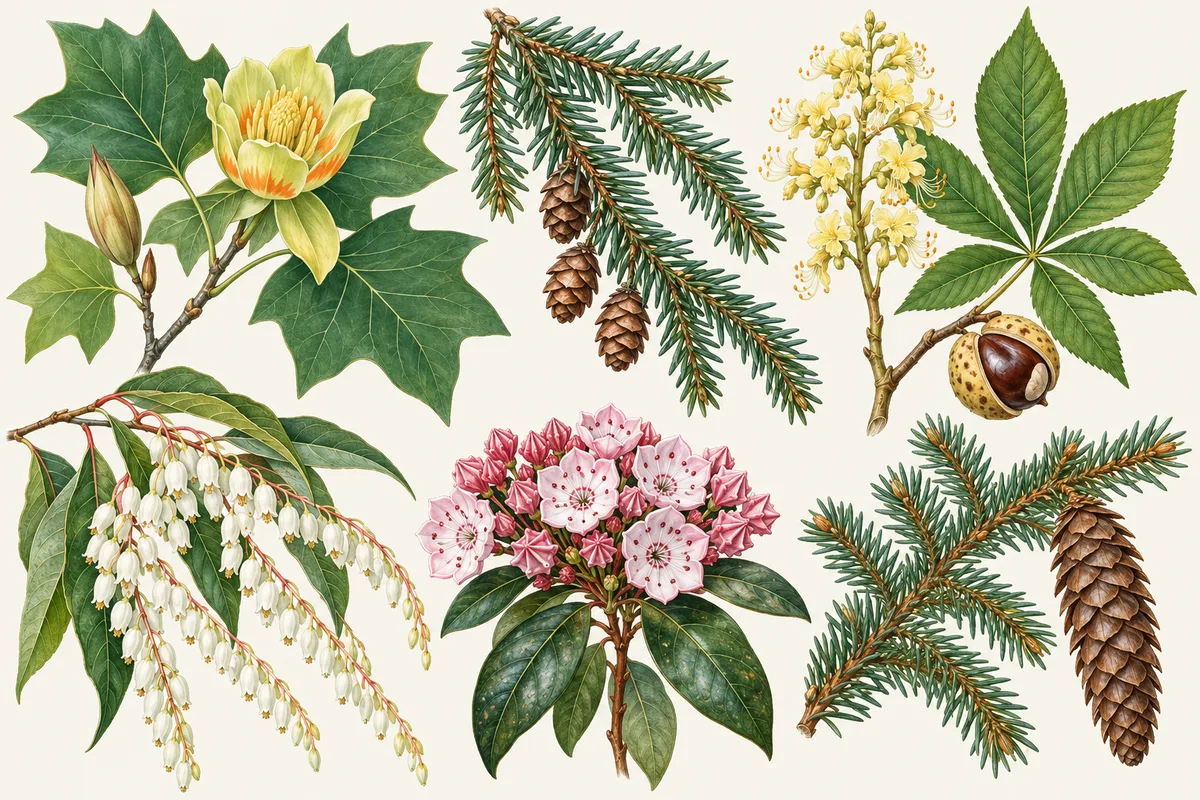
Appalachian tree identification starts with where you stand. Above about 5,500 feet, a fir with cone bracts much longer than the scales is Fraser fir, often mixed with red spruce. In moist coves, look for yellow buckeye, tulip tree and eastern hemlock. On dry, rocky ridges, chestnut oak has 4 to 8 inch coarsely toothed leaves, and Table Mountain pine carries cones with hooked spines.
- Great Smoky Mountains National Park counts 100 native trees among more than 2,200 plant species.
- Fraser fir grows only at high elevations in southwestern Virginia, western North Carolina and eastern Tennessee, mostly above 5,500 feet (USDA Forest Service).
- Sourwood leaves taste sour and its white, bell-shaped flowers hang in 4 to 8 inch sprays in June and July (NC State).
Appalachian tree identification is easier once you notice that the trees change with elevation and with how wet the slope is. This guide covers the central and southern Appalachians, from Pennsylvania and West Virginia to the Great Smoky Mountains, where the National Park Service counts 100 native trees in one park. For the northern end of the range, see New England tree identification.
Know your zone: peak, cove or ridge
| Where you are | Trees to check first | Quick test |
|---|---|---|
| High peaks, roughly 4,500 ft and up | Red spruce, Fraser fir | Fir: cones stand upright, bracts longer than scales. Spruce: hanging cones, 1.3–1.5 in |
| Moist coves and stream valleys | Yellow buckeye, tulip tree, eastern hemlock | Buckeye: leaves divided like a hand. Tulip tree: four-lobed leaf with a square tip |
| Mid slopes and summer woods | Sourwood | Sour-tasting leaves, sprays of white bell flowers in June and July |
| Dry, rocky ridgetops | Chestnut oak, Table Mountain pine | Oak: thick, deeply ridged bark. Pine: 2 needles per bundle, cones with hooked spines |
Figures come from the USDA Forest Service silvics accounts and NC State Extension, read on 21 October 2026. The bands are approximate: north-facing slopes and protected coves bring high-elevation trees lower.
High peaks: Fraser fir and red spruce
On the highest summits, the dark conifer forest is spruce and fir. The USDA Forest Service says Fraser fir grows only at high elevations in southwestern Virginia, western North Carolina and eastern Tennessee, as low as 4,500 feet on north slopes but mostly above 5,500 feet, and in nearly pure stands above 6,300 feet; it reaches 6,684 feet on Mount Mitchell. Its upright cones are 1.4 to 2.4 inches long, and the test that separates it from balsam fir is the bracts: strongly bent back and much longer than the cone scales. The fir page compares Fraser fir with the other true firs.
Red spruce comes in lower. According to the Forest Service red spruce account, it grows from about 4,500 feet in the southern Appalachians, mixing with hardwoods and eastern hemlock up to about 5,000 feet; in West Virginia spruce-fir stands start as low as 3,200 feet. Its cones hang down, are 1.3 to 1.5 inches long and light reddish brown, with rigid rounded scales. Hanging cones mean spruce, upright cones mean fir: the spruce vs fir page adds the needle tests.
Many dead gray firs on the peaks are the work of the balsam woolly adelgid, found on Mount Mitchell in 1957. The Forest Service reports mortality rising from 11,000 trees in 1958 to about 1.75 million by 1970.
Moist coves: yellow buckeye, tulip tree and hemlock
Sheltered coves hold the richest hardwood forests in the mountains. Yellow buckeye is one of the trees to learn there. The Forest Service gives yellow or yellowish-white flowers from April to June and a rounded, leathery, three-parted capsule 2 to 3 inches long. In the Great Smoky Mountains it grows from 1,500 to 6,100 feet, most commonly between 4,000 and 5,000 feet. The Forest Service reports that the young shoots and seeds contain a poisonous glucoside harmful to animals: never eat buckeye nuts, and do not confuse them with chestnuts. The chestnut vs buckeye page separates the two by leaf and husk.
Tulip tree, with its four-lobed leaf cut square across the tip, is the tall straight trunk of cove forests; the tulip tree page covers its flowers and seeds. Eastern hemlock lines cool streams, with short flat needles carrying two white lines underneath. The National Park Service lists it as threatened by the hemlock woolly adelgid, an introduced insect. Eastern hophornbeam, one of the trees called ironwood, keeps to north slopes, protected lower slopes, ravines and coves in the Smokies (USDA Forest Service); the ironwood page covers its shreddy bark and hop-like fruit.
Summer flowers and red fall color: sourwood
Sourwood is a small tree of mountain slopes that most hikers notice twice a year. NC State Extension describes glossy leaves 3 to 6 inches long with a sour taste, waxy white bell-shaped flowers in drooping sprays 4 to 8 inches long in June and July, and fall color that is typically crimson red. The dry seed capsules turn silver-gray in September and October and stay on after the leaves drop. The bark is red-brown, with deep furrows between flat ridges. Sourwood grows from Pennsylvania to northern Florida, west to Ohio and Louisiana. The sourwood page covers it through the year.
Dry ridges: chestnut oak and Table Mountain pine
On rocky ridgetops the forest thins to oaks and pines. Chestnut oak is the oak of these ridges. NC State describes oval leaves 4 to 8 inches long, coarsely toothed rather than lobed, gray-green and hairy beneath, and thick dark reddish-brown bark with deep, broad ridges, the thickest of the native oaks. Its acorns are 1 to 1.5 inches long, with a cup covering about a third of the nut.
Table Mountain pine is an Appalachian native of dry, rocky slopes. NC State gives stiff, twisted, yellow-green needles in bundles of two, about 1.5 to 2.5 inches long, and glossy, knobby cones 2.5 to 3 inches long, each scale tipped with a hooked spine, often in clusters of three or four that stay on the branch for years. NC State lists pitch pine and Virginia pine as the trees most often confused with it.
The chestnut that is mostly gone
American chestnut once grew across these ridges, but the National Park Service says it has almost completely disappeared from the Smokies because of chestnut blight. Most chestnuts you find today are planted Chinese chestnuts. The American Chestnut Foundation separates them by the leaf: American chestnut leaves are long and narrow, thin and papery, with large teeth whose bristles curve inward like a breaking wave, a sharply tapered base and hairless twigs; Chinese chestnut leaves are oval, thick and waxy, with a rounded base and hairy twigs and veins.
Using a photo on the trail
Cell service is patchy in the mountains, and Tree Identifier needs an internet connection to identify a photo, so take the pictures on the trail and identify them later from your library. One photo per tree works best: the whole leaf, a cone or the bark. Tulip tree, eastern hemlock and eastern white pine are among the species in the app's Collection, and the Tree Map remembers where a find was located. The app shows no confidence score or list of alternatives, so check its answer against the zone table above.
What a photo can't settle
- Elevation bands vary with slope, aspect and latitude; the figures here come from the Great Smoky Mountains and nearby ranges and shift lower farther north.
- American and Chinese chestnuts and their hybrids can be hard to separate in a photo; the leaf, twig, bud and bur together settle it.
- Red spruce and Fraser fir look alike from a distance. A cone, or needles seen up close, makes the call.
Questions people ask
What trees grow on top of the Appalachian Mountains?
In the southern Appalachians, the highest peaks carry spruce-fir forest: red spruce from about 4,500 feet and Fraser fir mostly above 5,500 feet, according to the USDA Forest Service. Above about 6,300 feet Fraser fir forms nearly pure stands, as on Mount Mitchell.
Are there still American chestnut trees in the Appalachians?
Very few large ones. The National Park Service says the American chestnut has almost completely disappeared from the Smokies because of chestnut blight. Most chestnuts you meet are planted Chinese chestnuts; The American Chestnut Foundation separates them by leaf shape, teeth and hairs.
What is the difference between Fraser fir and balsam fir?
The cone. The USDA Forest Service says Fraser fir cone bracts are strongly bent back and much longer than the scales, while balsam fir bracts are shorter than the scales or only rarely slightly longer. Range helps too: Fraser fir grows wild only in the southern Appalachians.
Which Appalachian tree has a sour taste?
Sourwood. NC State notes the glossy leaves, 3 to 6 inches long, taste sour, which gave the tree its name. It also has white bell-shaped flowers in summer and crimson fall color.
Sources
- Plants (Great Smoky Mountains National Park) — National Park Service
- Fraser Fir (Silvics of North America) — USDA Forest Service
- Red Spruce (Silvics of North America) — USDA Forest Service
- Yellow Buckeye (Silvics of North America) — USDA Forest Service
- Oxydendrum arboreum (sourwood) — North Carolina Extension Gardener Plant Toolbox, NC State University
- Quercus montana (chestnut oak) — North Carolina Extension Gardener Plant Toolbox, NC State University
- Pinus pungens (Table Mountain pine) — North Carolina Extension Gardener Plant Toolbox, NC State University
- Identification: Chinese and American chestnuts — The American Chestnut Foundation
Keep reading
- Tree profileTulip tree (Liriodendron tulipifera): tulip poplar and yellow-poplar
- Tree profileHemlock trees (Tsuga): how to identify them
- Tree comparisonChestnut vs buckeye: chestnut tree identification
- Tree comparisonSpruce vs fir: how to tell them apart
- Regional guideNew England tree identification, north to south