Regional guide
New England tree identification, north to south
Maine, New Hampshire, Vermont, Massachusetts, Connecticut and Rhode Island share one tree list, but the north and the south of the region grow different woods.
In short
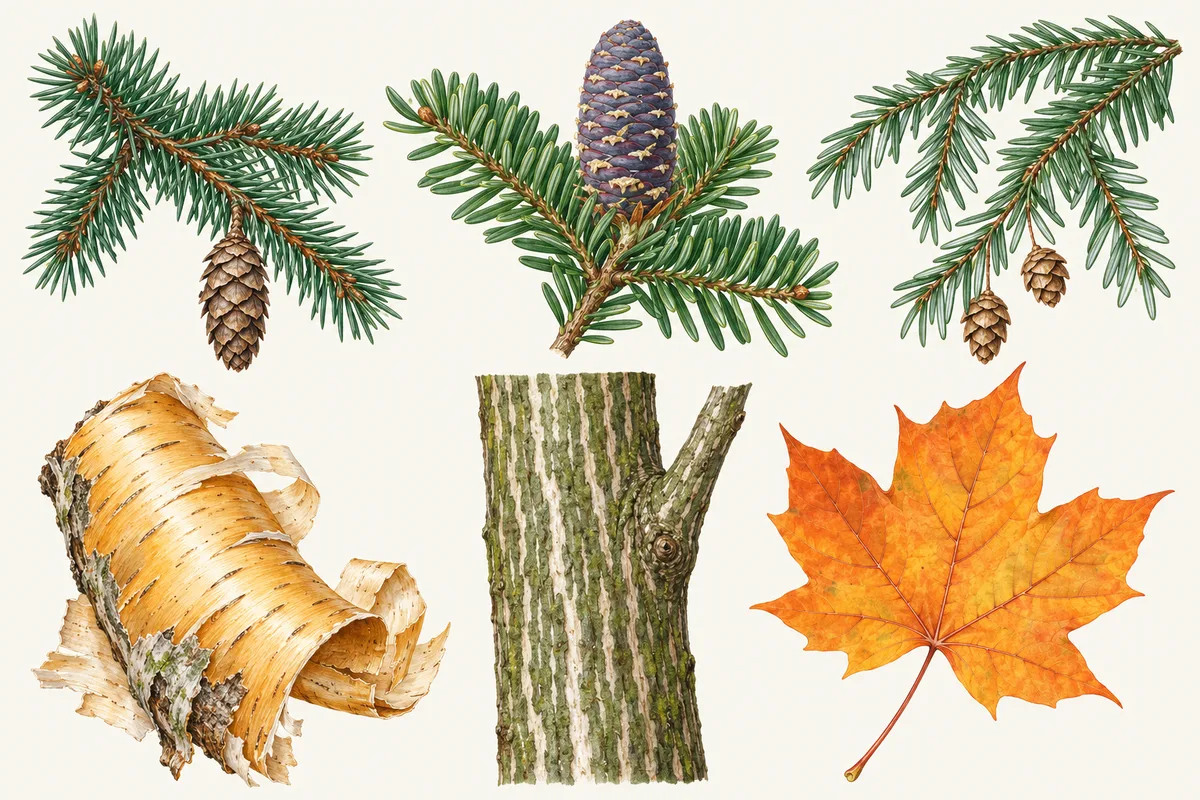
New England tree identification starts with branching: UNH Extension notes that most native trees have alternate branches, and only maples, ashes and dogwoods are opposite. In the northern forest, learn red spruce, balsam fir, yellow and paper birch, sugar maple and American beech. In southern New England, oaks, hickories, eastern white pine and eastern hemlock, whose flat needles carry two white lines underneath.
- UNH Extension counts 86 native tree species in New Hampshire alone, counting trees that reach at least 20 feet.
- Yellow birch has shiny golden to silvery peeling bark, and a scratched twig smells of wintergreen (Native Plant Trust).
- Eastern hemlock grows in all six New England states and is under growing threat from the hemlock woolly adelgid.
New England's trees change from north to south. Northern Maine, New Hampshire and Vermont grow a cold forest of spruce, fir, birch, maple and beech. Southern New England, from Massachusetts to Connecticut and Rhode Island, grows oaks, hickories, pines and hemlock. Start by checking how the branches are set, then use bark, needles and leaves. The descriptions below follow UNH Extension, the Native Plant Trust's Go Botany and the Virginia Tech Dendrology fact sheets.
The New England trees to learn first
| Tree | Where in New England | The one feature that settles it | Our page |
|---|---|---|---|
| Red spruce | North, mountains, cold pockets | Short needles you can roll, no stalk; finely hairy twigs | Spruce vs fir |
| Balsam fir | North, all six states | Flat needles; resin blisters on smooth bark; upright cones | Spruce vs fir |
| Eastern hemlock | All six states | Flat 1/2-inch needles with two white lines below; tiny cones | Hemlock |
| Eastern white pine | All six states | Five soft needles per bundle, 3 to 6 in long | Red pine vs white pine |
| Paper birch | North and mountains | Chalk-white bark peeling in sheets | Birch |
| Yellow birch | Nearly throughout | Golden to silvery peeling bark; wintergreen twig | Birch |
| Sugar maple | Most of the region | Five-lobed opposite leaves; orange to red in fall | Red vs sugar maple |
| Red maple | Everywhere, wet and dry | Opposite leaves with three main lobes; red in fall | Red vs sugar maple |
| Striped maple | Cool forest understory | Green bark with vertical white stripes | Maple |
| American beech | All six states | Smooth, light-gray bark; leaves held into winter | Beech |
| Northern red and white oak | South, and valleys northward | Bristle-tipped lobes (red) or rounded lobes (white) | Red oak vs white oak |
| Shagbark hickory | Southern New England | Bark in long plates curling out at the ends | Hickory |
If you only learn four, learn eastern white pine, eastern hemlock, red maple and yellow birch: you will meet all four in almost any New England wood.
First check: opposite or alternate branches
UNH Extension's identification tips start from a distance and with the branches: "Most native New Hampshire trees are alternately branched." The few with opposite branches and buds follow the memory word MADHORSE: maple, ash, dogwood and horse chestnut, the last one not native. Because branches grow from buds, the buds show the same pattern, which makes this test work in winter too.
So if the twigs come off in pairs, you are almost certainly looking at a maple, an ash or a dogwood. Lobed leaves mean maple; compound leaves with five or more leaflets mean ash; smooth-edged leaves with veins curving toward the tip mean dogwood. Everything else, from birches to oaks to cherries, is alternate. The winter tree identification guide continues with buds and bark when the leaves are down.
The northern forest: Maine, New Hampshire and Vermont
In the north and in the mountains, conifers mix with birch, maple and beech.
- Red spruce (Picea rubens): single needles that can be rolled between the fingers, without a stalk, on twigs with fine hairs and no waxy bloom; cones longer than wide, with woody scales. Go Botany says it grows best in cool, moist climates, at higher elevations and in cold pockets, and is absent from Rhode Island (Native Plant Trust). Black spruce has dull needles with a bloom and some gland-tipped twig hairs; white spruce has hairless twigs.
- Balsam fir (Abies balsamea): flat needles that will not roll, no stalk, small resin blisters on the bark and cones that stand upright on the branches (Native Plant Trust). The spruce vs fir guide covers the general difference.
- Yellow birch (Betula alleghaniensis): shiny golden to silvery bark that peels off easily or hangs from the trunk, and young twigs that smell of wintergreen when scratched, a trait black (sweet) birch shares. Go Botany places it nearly throughout the region in forests and swamps (Native Plant Trust).
- Paper birch (Betula papyrifera): very white bark peeling readily, with black V-shaped marks where branches join and oval, double-toothed leaves 2 to 4 in (Morton Arboretum). New Hampshire's list also includes gray birch and heart-leaved paper birch; the birch guide separates the white-barked ones.
- Sugar maple (Acer saccharum): five-lobed leaves 3 to 6 in, gray-brown furrowed bark, paired winged seeds about 1 in long; yellow to burnt-orange fall color (Morton Arboretum).
- American beech (Fagus grandifolia): thin, exceptionally smooth light-gray bark; long, narrow buds 8 to 19 mm (1/3 to 3/4 in) with shingled scales; toothed leaves 60 to 120 mm (2 1/2 to 4 3/4 in) long that turn golden-brown and often hang on into winter; small nuts in a spiny husk. Go Botany notes a Nectria fungus that blisters the bark of mature trees (Native Plant Trust).
- Striped maple (Acer pensylvanicum), also called moosewood: a small understory tree with vertical white stripes on greenish-brown bark and broad, three-pointed leaves (Native Plant Trust).
Never eat a berry, nut, seed or pod on the strength of a web page or an app; check with a local expert.
Southern New England: Massachusetts, Connecticut and Rhode Island
South of the mountains, and up the larger river valleys, the woods turn to oak, hickory, pine and hemlock.
- Eastern hemlock (Tsuga canadensis): flat needles about 1/2 in (10 to 20 mm) long, mostly in two rows, each with a tiny stalk and two white lines of stomata underneath; ovoid light-brown cones about 3/4 in; a drooping top shoot. Broken bark shows purple streaks (Virginia Tech Dendrology). Go Botany records it in all six states and notes it is "increasingly under threat from the hemlock woolly adelgid" (Native Plant Trust).
- Eastern white pine (Pinus strobus): soft needles 3 to 6 in in bundles of five, slender cones up to 8 in with white resin tips, and dark gray-brown, deeply furrowed bark on old trees (Morton Arboretum). New England's other common pines, red and pitch pine, both appear on New Hampshire's native list; the red pine vs white pine page separates the first two.
- Oaks: northern red, white, black, scarlet and swamp white oak all appear on UNH's list. The red oak vs white oak page sorts any oak into its group by the lobes and acorns.
- Hickories: shagbark, pignut and bitternut. Shagbark is the easy one, with gray bark that peels in long, flat plates curving out at the ends and leaves of five to seven leaflets (Morton Arboretum).
- Red maple (Acer rubrum): leaves with three main lobes in opposite pairs, bright red buds in late winter, and small red flower clusters before the leaves open in spring. UNH lists it as native; the red maple vs sugar maple page tells the two apart.
Two conifers mark wet and sandy ground near the coast: Atlantic white-cedar in swamps and pitch pine on sandy soils, both on UNH's native list.
Free New England tree guides
Checked on October 21, 2026:
- Go Botany, from the Native Plant Trust in Framingham, Massachusetts. A free website covering more than 3,000 New England plants, with a Simple Key for over 1,200 common native and naturalized species and a species page for each tree with state-by-state presence.
- Forest Trees of Maine, Maine Forest Service. First published in 1908; the Centennial Edition of 2008 is free to download, and Digital Maine lists it as having no US copyright.
- List of New Hampshire Native Trees, UNH Extension. A free list of 86 species with Latin names, split into softwoods and hardwoods. The Extension's publications page also recommends Elbert Little's Audubon field guide to eastern trees and Petrides' A Field Guide to Eastern Trees.
Leaf-peeping season is the easiest time to start: the trees with red leaves in fall guide names the maples, oaks and others behind the colors.
In the woods, a photo can give a quick first answer: Tree Identifier names a tree from one picture of a needle spray, a leaf, the bark or a cone, and its follow-up chat can answer a question such as "is this red spruce or balsam fir?". It shows no confidence score, so check the result against the feature in the table above. The app's Collection includes eastern hemlock, eastern white pine, sugar maple, red maple, paper birch and American beech, and its Tree Map keeps each find you locate.
What a photo can't settle
- Red, black and white spruce look alike; separating them can take hairs on the twig and a hand lens, more than one photo shows.
- Hawthorns and serviceberries come in many New England species that even botanists separate with keys; expect a genus name, not a species, from a photo.
- Gardens and town greens hold many planted trees, such as Norway maple, that a native list does not cover.
Questions people ask
How many native trees are there in New England?
There is no single regional count. UNH Extension's list gives 86 native tree species for New Hampshire, defined as species native to part of the state that reach at least 20 feet and at least sometimes grow on a single stem. It notes the number is hard to fix because some are usually shrubs and about a dozen are rare.
How do I tell yellow birch from paper birch?
Check the bark color and scratch a twig. Yellow birch bark is shiny golden to silvery and peels or hangs off in strips, and a scratched young twig smells of wintergreen. Paper birch bark is chalk-white, peels in sheets and shows black marks where branches join.
How do I tell red spruce from balsam fir?
Roll a needle between your fingers. Red spruce needles are rounded or flattened on one side, can be rolled, and sit on the twig without a stalk. Balsam fir needles are flat and will not roll, the bark carries small resin blisters, and the cones stand upright on the branches instead of hanging.
What is the striped tree in New England woods?
Usually striped maple, also called moosewood or goosefoot maple. The Native Plant Trust describes conspicuous vertical white stripes on greenish-brown bark and broad, three-pointed leaves. It grows as a small understory tree in cool forests across all six states.
Is there a free New England tree identification guide?
Yes. The Native Plant Trust's Go Botany site is free and covers more than 3,000 New England plants, with a Simple Key for over 1,200 common species. The Maine Forest Service's Forest Trees of Maine (Centennial Edition, 2008) is also free to download.
Sources
- List of New Hampshire Native Trees — University of New Hampshire Cooperative Extension
- A Partial Listing of Publications on Tree and Shrub Identification — University of New Hampshire Cooperative Extension
- Picea rubens (red spruce), Go Botany — Native Plant Trust
- Betula alleghaniensis (yellow birch), Go Botany — Native Plant Trust
- Tsuga canadensis (eastern hemlock), Go Botany — Native Plant Trust
- Eastern hemlock fact sheet — Virginia Tech Dendrology
- Forest Trees of Maine, 2008 (Centennial Edition) — Maine Forest Service, via Digital Maine
- Eastern white pine — The Morton Arboretum
Keep reading
- Tree profileBirches (Betula): how to identify a birch tree
- Tree comparisonSpruce vs fir: how to tell them apart
- Tree comparisonRed maple vs sugar maple: how to tell them apart
- Clue guideWhich trees have red leaves in fall? Sort them by leaf shape
- Winter field guideWinter tree identification, from buds to bark