Also in Français
Tree profile
Hemlock trees (Tsuga): how to identify them
A conifer with short flat needles, small cones and a nodding top. It shares a name with poison hemlock, a weed of the carrot family, and nothing else.
In short
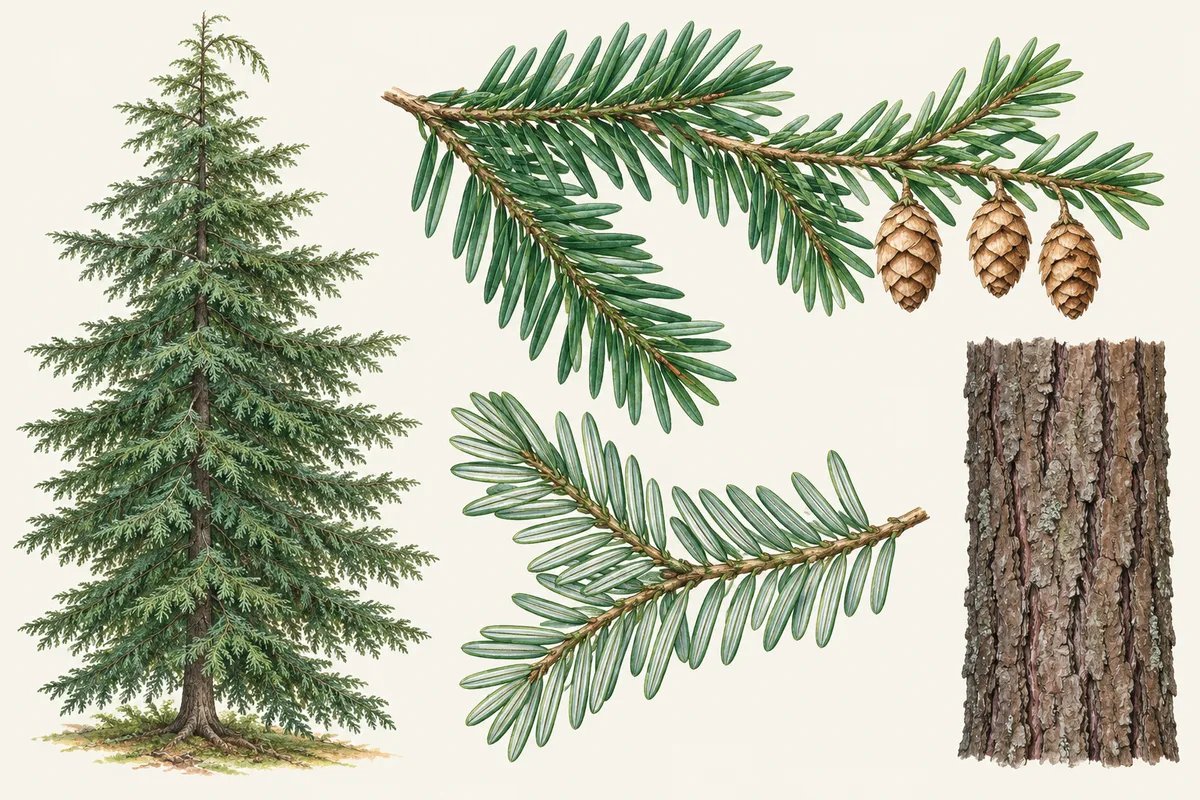
Hemlock tree identification rests on three marks: flat needles only about 1/2 inch (10 to 20 mm) long, with two white lines underneath and a few tiny needles lying along the top of the twig; small hanging cones about 3/4 inch long; and a leader that droops at the very top of the tree. Eastern hemlock grows in the East, western hemlock on the Pacific Coast.
- Turn a sprig over: two white lines under each short flat needle, plus small needles lying on top of the twig, point to a hemlock.
- Hemlock cones are the smallest of the common conifers: about 3/4 inch on eastern hemlock and about 1 inch on western hemlock.
- The hemlock tree is a conifer in the pine family; poison hemlock (Conium maculatum) is an unrelated herb with umbrella-shaped clusters of white flowers.
Field marks at a glance
- Scientific name
- Tsuga canadensis and Tsuga heterophylla
- Family
- Pinaceae (pine family)
- Type
- Conifer, evergreen
- Needles
- Flat, single, about 1/2 in (10 to 20 mm) on eastern hemlock, 1/4 to 3/4 in on western hemlock. Shiny green above, two white lines beneath. Mostly in two rows, with a few shorter needles on top of the twig.
- Cones
- Small and hanging: eastern hemlock about 3/4 in (12 to 20 mm), egg-shaped with a few thin rounded scales; western hemlock about 1 in, reddish brown. Stay on the tree into the next season.
- Top of the tree
- The leader (the topmost shoot) droops to one side; the crown is dense and conical with fine branches.
- Twigs and buds
- Twigs slender, flexible, hairy on eastern hemlock, in flat sprays. Buds very small, about 2 mm.
- Bark
- Scaly when young; on old trees deeply furrowed with broad, flat-topped ridges. Cut or broken bark shows purple streaks.
- Size and age
- Eastern: over 100 ft (30 m), record age 988 years. Western: 165 to 200 ft (50 to 61 m) is not uncommon, maximum reported 259 ft (79 m).
- Range
- Eastern hemlock: from Nova Scotia and southern Quebec west to Wisconsin, south in the Appalachians to Georgia and Alabama. Western hemlock: Pacific Coast from Alaska to northern California, inland to Idaho and Montana.
- Other names
- Eastern: Canada hemlock, hemlock spruce; French pruche du Canada. Western: Pacific hemlock, west coast hemlock.
Hemlocks (Tsuga) are shade-tolerant conifers with fine, soft foliage: short flat needles, tiny cones and a top that nods to one side. Two species cover most of what people meet: eastern hemlock from the Maritimes to the southern Appalachians, and western hemlock on the Pacific Coast. Neither has anything to do with poison hemlock, a herb that shares the name.
How to identify a hemlock tree: needles, cones, top
1. Turn a sprig over. Natural Resources Canada's eastern hemlock factsheet describes flat, slightly tapered needles 10 to 20 mm long (about 1/2 inch), with fine teeth and a blunt, rounded or notched tip. The upper side is shiny green; the underside is whitish, with two lines of white dots either side of the midvein and a clear green margin. The needles stand in two rows, with a few shorter needles lying along the top of the twig. Look for those small upside needles first: they are easy to see with the sprig in your hand.
2. Look for the cones. Hemlock cones are small and easy to overlook. Virginia Tech's eastern hemlock fact sheet gives them as egg-shaped, light brown and about 3/4 inch long, with rounded scales, maturing in early fall. NRCan adds that they hang on slender hairy stalks 2 to 3 mm long and stay on the tree into the following season, so you can find them in winter too.
3. Look up at the top. Virginia Tech describes a dense conical crown with fine branches and a drooping terminal shoot. From a distance, a conifer whose topmost shoot bends over like a fishing rod is worth checking for hemlock first.
Confirm with the bark if you can. Young bark is scaly; old trunks are deeply furrowed with broad, flat-topped ridges (NRCan), and cut or broken bark shows distinct purple streaks (Virginia Tech).
Eastern hemlock
Eastern hemlock (Tsuga canadensis) is also called Canada hemlock and hemlock spruce, and in Québec pruche du Canada. The USDA Forest Service's Silvics of North America maps it from Nova Scotia, New Brunswick and extreme southern Quebec west through south-central Ontario and northern Michigan to the western third of Wisconsin, with outliers in northeastern Minnesota. In the United States it grows throughout New England, New York, Pennsylvania and the Middle Atlantic States, and south along the Appalachians into northern Georgia and Alabama.
It is a slow, long-lived tree. Typical old stands carry trees approaching 400 years, 35 to 40 inches across and over 100 feet (30 m) tall, and the record age is reported as 988 years (Silvics). NRCan calls it very shade-tolerant: small trees can wait in closed stands for decades. NRCan says it needs a cool, moist site and grows in pure stands or with yellow birch, eastern white pine, red spruce, sugar maple and American beech (NRCan).
The closely related Carolina hemlock (Tsuga caroliniana) is limited to Appalachian slopes from Virginia and West Virginia into Georgia, inside eastern hemlock's range (Silvics). If you are in those mountains, a single sprig may not separate the two.
Western and mountain hemlock
Western hemlock (Tsuga heterophylla), also called Pacific hemlock, is a much bigger tree. The Forest Service's western hemlock silvics gives heights of 165 to 200 feet (50 to 61 m) as not uncommon on good sites, a maximum of 259 feet (79 m), and a recorded age of over 700 years. It grows along the Coast Ranges from central California north to the Kenai Peninsula in Alaska, on the Cascades in Oregon and Washington, and inland on the west side of the Continental Divide in Idaho and Montana, north to Prince George, British Columbia.
Virginia Tech's western hemlock fact sheet gives flat needles 1/4 to 3/4 inch with two white bands beneath, and egg-shaped reddish-brown cones about 1 inch long; the Forest Service gives 0.75 to 1.25 inches. On the Pacific Coast it grows beside Douglas-fir, western redcedar and Sitka spruce; the Pacific Northwest tree guide sorts them zone by zone. Western redcedar carries tiny scale-like leaves instead of flat needles; the cedar page covers it with the other trees called cedar.
Higher up, mountain hemlock (Tsuga mertensiana) looks different. NRCan's mountain hemlock factsheet describes blunt needles 20 to 30 mm long, rounded in cross-section and bluish-green on both sides, crowded around the twig, and cylindrical cones 30 to 80 mm long. It grows in subalpine forests at 750 to 1,800 m (about 2,500 to 5,900 ft) and becomes a low, spreading shrub on exposed ridges.
Hemlock tree vs poison hemlock
"Hemlock" is two unrelated plants, and the confusion matters because one of them is dangerous.
- Hemlock tree (Tsuga): an evergreen conifer in the pine family, with needles and woody cones. NRCan and the Forest Service file it with the other conifers.
- Poison hemlock (Conium maculatum): a weed, not a tree. Penn State Extension's poison hemlock page describes a biennial that forms a low rosette of leaves in its first year and a stem up to 6 feet tall in its second, with very distinctive purple spots on the stem and small white flowers in umbrella-like clusters from June into August. It states that all parts of poison hemlock are toxic to humans and other animals.
If the plant has needles and cones, it is not poison hemlock. If it is a soft-stemmed plant with purple-spotted stems and white umbrella-like flower clusters, keep away from it and do not handle it to identify it. Never eat any part of either plant on the strength of a web page or an app; for a plant a child or pet has swallowed, call a poison center.
Hemlock vs yew, fir and spruce
Short flat needles in two rows also belong to yews and firs, so check the underside and the fruit. NC State Extension's English yew profile describes needles dark green above and yellowish-green beneath, and a red, fleshy, cup-shaped aril around the seed instead of a cone; it also rates the yew as highly poisonous. Hemlock needles have two white lines beneath, and the tree bears small brown cones. The yew page covers the yews in detail.
Douglas-fir, the hemlock's neighbor in western forests, has longer needles, 3/4 to 1 1/4 inches, and cones 3 to 4 inches long; the Douglas-fir page shows its three-pointed cone bracts. Spruces have four-sided needles on woody pegs, and the spruce page sorts the species.
In Tree Identifier, a photo of the underside of a sprig with a cone attached gives the most to work with. Eastern hemlock is among the 138 species in the app's Collection. The app shows no confidence score and no look-alike list, so check a hemlock answer against the white lines and the cone size above, and use the follow-up chat to ask how it differs from the yew or fir next to it.
Look-alikes and how to tell them apart
Yew (Taxus)
Turn the sprig over: yew needles are yellowish-green beneath with no white lines, and a yew carries red fleshy cups instead of woody cones. Hemlock needles show two white lines and the tree bears small brown cones.
Douglas-fir (Pseudotsuga menziesii)
Measure a needle. Douglas-fir needles are 3/4 to 1 1/4 inches and its hanging cones 3 to 4 inches, with three-pointed bracts sticking out between the scales. Hemlock needles are about 1/2 inch and its cones under 1 1/4 inches.
Mountain hemlock (Tsuga mertensiana)
Its needles are bluish-green on both sides, rounded in cross-section and crowded all around the twig, not in flat rows, and its cones are longer, 1 1/4 to 3 in (30 to 80 mm). It grows in subalpine forests of the West.
Poison hemlock (Conium maculatum)
Not a tree at all: a biennial herb up to 6 ft tall, with purple-spotted stems and small white flowers in umbrella-like clusters from June to August. If it has needles and cones, it is not poison hemlock.
What a photo can't settle
- Eastern and Carolina hemlock overlap in the southern Appalachians, and a single sprig photo may not separate them; check the cone and ask a local expert.
- Young western hemlock, grand fir and Pacific yew all have short flat needles, so a photo of one sprig can be ambiguous. Show the needle underside and, if possible, a cone.
- Tree health is out of scope here: a thinning or graying hemlock needs a certified arborist or your state forestry agency, not a photo app.
Questions people ask
Is a hemlock tree the same as poison hemlock?
No. The hemlock tree (Tsuga) is an evergreen conifer in the pine family with needles and cones. Poison hemlock (Conium maculatum) is a biennial herb up to 6 feet tall with purple-spotted stems and white umbrella-shaped flower clusters. Penn State Extension states that all parts of poison hemlock are toxic to humans and other animals.
Is a hemlock tree poisonous?
The famous poison is the herb poison hemlock, not the tree. That does not make any part of a hemlock tree food: never eat or chew needles, bark or cones from any tree on the strength of a web page or an app, and ask a local expert or poison center about any plant a child or pet has swallowed.
What does a hemlock tree look like?
A dense, cone-shaped evergreen with fine, often sweeping branches and a top shoot that droops to one side. Up close, the needles are short and flat, about half an inch, with two white lines beneath, and small brown cones about 3/4 inch long hang from the twig tips.
How do you tell a hemlock from a spruce?
Roll a needle between your fingers. A spruce needle is four-sided, rolls easily and sits on a woody peg. A hemlock needle is flat, about 1/2 inch, with two white lines beneath. Hemlock cones are small and egg-shaped, about 3/4 inch, with a few thin rounded scales.
How do you tell eastern hemlock from western hemlock?
Mostly by where you are: eastern hemlock grows from the Maritimes and the Great Lakes to the southern Appalachians, western hemlock along the Pacific Coast and in the northern Rockies. Western hemlock is the bigger tree, often 165 to 200 feet, and its cones are slightly longer, about 1 inch against 3/4 inch.
Sources
- Eastern hemlock (Tsuga canadensis), Trees, insects and diseases of Canada's forests — Natural Resources Canada, Canadian Forest Service
- Eastern hemlock fact sheet — Virginia Tech Dendrology
- Eastern Hemlock, Silvics of North America — USDA Forest Service
- Western Hemlock, Silvics of North America — USDA Forest Service
- Western hemlock fact sheet — Virginia Tech Dendrology
- Mountain hemlock (Tsuga mertensiana), Trees, insects and diseases of Canada's forests — Natural Resources Canada, Canadian Forest Service
- Poison Hemlock — Penn State Extension
- Taxus baccata (English yew) — NC State Extension, North Carolina Extension Gardener Plant Toolbox
Keep reading
- Tree profileDouglas-fir (Pseudotsuga menziesii): how to identify it
- Tree profileYew (Taxus): how to identify it
- Tree profileSpruce trees (Picea): how to identify the species
- Field guideConifer identification: three questions about the needles, then the cone
- Regional guideTrees of the Pacific Northwest, by region