Tree profile
Douglas-fir (Pseudotsuga menziesii): how to identify it
Not a true fir, not a spruce and not a hemlock. Look for the three-pointed bracts that stick out of every cone scale, then confirm with the buds and needles.
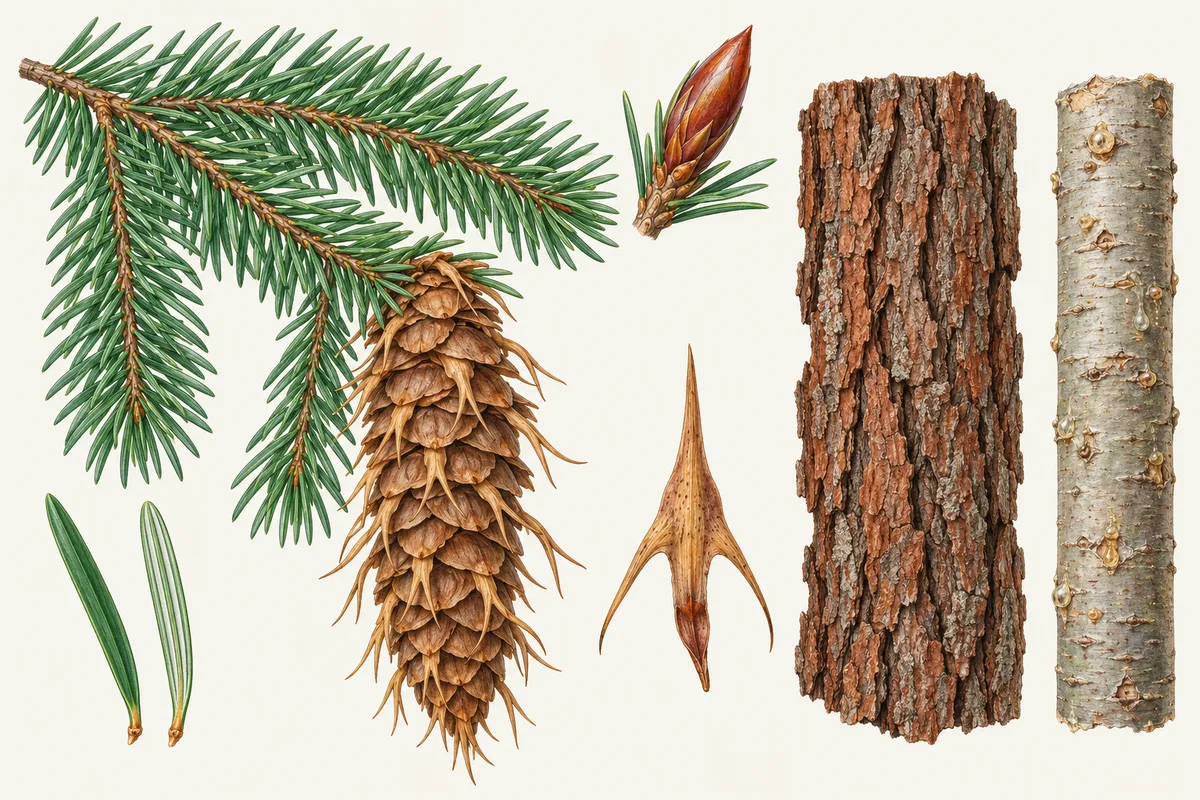
In short
Douglas fir identification starts with the cone: 3 to 4 inches (8 to 10 cm) long, hanging, with a three-pointed bract poking out beyond every scale, like the back half of a mouse. Then check two more marks: single, soft, fragrant needles 3/4 to 1 1/4 inches long with no woody peg, and long, sharp-pointed, red-brown buds at the twig tips.
- A hanging cone with three-pointed bracts sticking out between the scales is the one mark to look for first.
- Douglas-fir is not a true fir: its cones hang and fall whole, while true fir cones stand upright and fall apart on the branch.
- Two varieties: coast Douglas-fir (green, the giant of the Pacific Coast) and Rocky Mountain Douglas-fir (bluish, smaller, in the interior mountains).
Field marks at a glance
- Scientific name
- Pseudotsuga menziesii
- Family
- Pinaceae (pine family)
- Type
- Conifer, evergreen
- Cones
- Hanging, 3 to 4 in (8 to 10 cm) long, with rounded scales and three-lobed bracts sticking out beyond each scale. Mature in late summer and fall whole.
- Needles
- Single, flat, soft, 3/4 to 1 1/4 in (2 to 3 cm) long, yellow-green to blue-green, very fragrant when crushed. No woody peg and no suction-cup base.
- Buds
- Long, sharp-pointed and shiny red-brown, up to about 3/8 in (10 mm) on Rocky Mountain trees. Hemlock buds, by contrast, are very small.
- Bark
- Smooth and gray with resin blisters on young stems; on old trees thick, red-brown, with broad ridges and deep furrows. Up to 30 cm (12 in) thick on Rocky Mountain trees.
- Form and size
- Pyramidal crown and a straight trunk. Old-growth coast trees commonly reach 250 ft (76 m); the tallest on record measured 330 ft (100.5 m). Interior trees reach 100 to 120 ft (30 to 37 m).
- Range
- Western North America from about 55° N in British Columbia south along the Pacific Coast Ranges to California and along the Rocky Mountains into central Mexico.
- Varieties
- Coast Douglas-fir (var. menziesii), green, faster-growing and larger; Rocky Mountain or blue Douglas-fir (var. glauca), bluish-green, hardier to cold.
- Other names
- Red-fir, Oregon-pine, Douglas-spruce. French (Canada): douglas bleu for the Rocky Mountain variety.
Douglas-fir (Pseudotsuga menziesii) is the big conifer of western North America, from the rain forests of the Pacific Coast to the dry slopes of the Rocky Mountains. Its name causes most of the confusion: it is not a fir, and its other names (Oregon-pine, Douglas-spruce) did not help. One feature identifies it at a glance, the cone, and two more confirm it on a twig.
How to identify a Douglas-fir: cone, buds, needles
1. Find a cone. Look on the ground under the tree first. Douglas-fir cones hang from the branches and fall whole, so they collect under the crown. Virginia Tech's Douglas-fir fact sheet gives them as 3 to 4 inches long with rounded scales, and the mark that settles it: three-lobed bracts extending past every cone scale, which it says "resemble mouse posteriors." That is why they are often called mouse tails: two hind legs and a tail poking out from under each scale. The USDA Forest Service's Silvics of North America gives 8 to 10 cm for mature cones and notes that the bracts turn brown when the seeds are ripe.
2. Look at the buds. At the tip of each twig, Douglas-fir carries long, sharp-pointed, red-brown buds (Virginia Tech). Natural Resources Canada's Rocky Mountain Douglas-fir factsheet describes the end bud as narrowly conical, up to 10 mm (about 3/8 in), with many shiny reddish-brown scales. This is the best test when no cone is in reach: the eastern hemlock, by comparison, has very small buds (Virginia Tech).
3. Pull a needle. Douglas-fir needles grow singly and are flat, soft and very fragrant when crushed, 3/4 to 1 1/4 inches long, yellow-green to blue-green (Virginia Tech). The base matters more than the color. Virginia Tech's one-line test: the needles "lack woody pegs or suction cups." A spruce leaves a woody peg on the twig, a true fir leaves a round flat scar; a Douglas-fir leaves neither.
If all three line up, you have a Douglas-fir. Bark confirms it on old trees: smooth and gray on young stems, then thick and red-brown with broad ridges and deep furrows (Virginia Tech).
Coast and Rocky Mountain Douglas-fir
The Forest Service recognizes two varieties, and which one you meet depends on where you stand.
Coast Douglas-fir (var. menziesii) is the green variety. It grows faster and becomes much larger. Old-growth trees commonly reach 250 feet (76 m) tall and 60 to 72 inches (150 to 180 cm) across, and the tallest on record, near Little Rock, Washington, measured 330 feet (100.5 m) (Silvics). Ages over 500 years are not uncommon on the coast, some trees have passed 1,000, and the oldest authenticated tree was slightly more than 1,400 years old when it was cut.
Rocky Mountain or blue Douglas-fir (var. glauca) is the interior variety: more shade tolerant and more cold hardy, according to the Forest Service. NRCan describes its needles as distinctly bluish-green, often sharp-pointed, kept on the tree for 5 to 8 years, and its cones as under 8 cm with bracts usually bent back. It grows to 40 m (130 ft) and 300 years in Canada, in colder, drier mountains than the coast variety, with principal branches that are more ascending. Interior trees typically reach 100 to 120 feet in 200 to 300 years (Silvics).
The range is an upside-down V. The Forest Service maps the shorter arm along the Pacific Coast Ranges for about 1,367 miles (2,200 km), south to about 34° 44' N in California, and the longer arm along the Rocky Mountains for nearly 2,800 miles (4,500 km), into central Mexico. The northern tip is near 55° N in British Columbia. Planted Douglas-firs grow well outside this range, so a tree in a park far from the West can still be one; Virginia Tech notes the range may be expanded by planting.
For the forests where it grows with western hemlock, western redcedar and Sitka spruce, the Pacific Northwest tree guide sorts the region's trees by zone.
Douglas-fir vs true fir, hemlock and spruce
Three groups get confused with Douglas-fir. The cone separates all of them; the needles work when the cones are out of reach.
| Tree | Cones | Needles |
|---|---|---|
| Douglas-fir | Hang, 3–4 in, fall whole, three-pointed bracts stick out | 3/4–1 1/4 in, flat, no peg and no suction cup |
| True firs (Abies) | Stand upright, crumble on the branch | Flat, round suction-cup base leaves a smooth scar |
| Western hemlock | Hang, about 1 in, no bracts showing | 1/4–3/4 in, flat, two white bands beneath |
| Spruces (Picea) | Hang, often fall whole, no bracts showing | Four-sided, on woody pegs that stay on the twig |
True firs. Ohio State University Extension's Is It Pine, Spruce, or Fir? describes fir cones that "remain upright or erect" and break apart around a central stalk that stays on the tree, so whole fir cones are rarely found on the ground. A fir needle has a round base like a "suction-cup tipped dart." A whole cone under the tree, with bracts poking out, rules out a true fir. The spruce vs fir guide runs the same tests on balsam and Fraser fir.
Western hemlock. Virginia Tech's western hemlock fact sheet lists Douglas-fir's closest look-alike as having flat needles only 1/4 to 3/4 inch long with two white bands beneath, and egg-shaped cones about 1 inch long. The hemlock page covers it in full.
Spruces. Spruce needles are four-sided and sit on short woody pegs, and spruce cones hang and often fall intact (Ohio State), which is why a Douglas-fir cone gets mistaken for one. Turn the cone over: spruce scales are thin and nothing sticks out between them.
Douglas-fir as a Christmas tree and in the yard
On a tree lot, a cut Douglas-fir has no cones, so use the needles and buds: soft, fragrant single needles with no peg, and sharp red-brown buds at the tips. Compare with a Fraser or balsam fir beside it, whose needles leave a flat round scar when pulled (Ohio State).
In a yard or park, the cone remains the easiest proof. Look under the tree after late summer, when cones mature (Virginia Tech) and start to drop. One cone with mouse tails is enough.
Tree Identifier names a tree from one photo, and Douglas-fir is among the 138 species in the app's Collection. The best photo is a fallen cone held in your hand with the bracts visible, or a twig tip showing the bud. The app shows no confidence score and no look-alike list, so check a Douglas-fir answer against the cone and bud tests above, and ask the follow-up chat if you need to tell coast from Rocky Mountain trees. For the other needle trees, the conifer identification key sorts pines, spruces, firs, hemlocks and larches with three questions.
Look-alikes and how to tell them apart
True firs, such as grand, white or noble fir (Abies)
Fir cones stand upright on the top branches and crumble on the tree, so whole cones are rarely on the ground. A pulled fir needle leaves a flat round scar from its suction-cup base. Douglas-fir cones hang, fall whole and show three-pointed bracts.
Western hemlock (Tsuga heterophylla)
Hemlock needles are shorter, 1/4 to 3/4 in, of mixed lengths, with two white bands beneath, and its cones are only about 1 in long with no bracts showing. Douglas-fir needles are longer and the cones are three to four times bigger.
Spruces, such as Sitka or Engelmann spruce (Picea)
Spruce needles are four-sided, roll between your fingers and sit on woody pegs that stay on the twig. Spruce cones hang like a Douglas-fir's but have thin scales and no bracts sticking out.
What a photo can't settle
- Douglas-fir cones grow high in the crown. Without a cone on the ground, a young tree's needles can be mistaken for a hemlock's or a fir's; photograph a twig tip with its bud, not just the foliage.
- Rocky Mountain Douglas-fir needles are often sharp-pointed and bluish (Natural Resources Canada), while Virginia Tech describes blunt tips, so needle feel varies by variety and is not a safe single test.
- Bigcone Douglas-fir of southern California is a separate species with much larger cones; this page covers Pseudotsuga menziesii only.
Questions people ask
Is a Douglas-fir a true fir?
No. Douglas-fir has its own genus, Pseudotsuga, separate from the true firs (Abies). Its needles lack a fir's suction-cup base, its cones hang and fall whole instead of standing upright and crumbling, and its buds are long and sharp-pointed. The Forest Service lists Douglas-spruce and Oregon-pine among its other names, which show how often it has been misfiled.
What do Douglas-fir cones look like?
Hanging cones 3 to 4 inches (8 to 10 cm) long with rounded scales. Between the scales, three-lobed bracts stick out; Virginia Tech compares them to the back half of a mouse, which is why people call them mouse tails. The bracts turn brown when the seeds are ripe in late summer.
How do you identify a Douglas-fir by its bark?
Young stems are smooth and gray, with resin blisters. Older trunks turn thick and red-brown, with broad ridges and deep furrows; Natural Resources Canada gives up to 30 cm (12 in) of bark on Rocky Mountain trees. Bark alone is not enough, so look for a fallen cone near the trunk.
How tall do Douglas-firs grow?
The USDA Forest Service gives old-growth coast trees as commonly 250 feet (76 m) tall and 60 to 72 inches across, with a record of 330 feet (100.5 m) near Little Rock, Washington. Interior trees typically reach 100 to 120 feet (30 to 37 m) in 200 to 300 years.
How old can a Douglas-fir get?
On the coast, ages over 500 years are not uncommon and some trees have passed 1,000, according to the Forest Service; the oldest authenticated tree was slightly more than 1,400 years old when cut. Interior trees rarely live beyond 400 years.
Sources
- Douglas-fir fact sheet — Virginia Tech Dendrology
- Douglas-Fir, Silvics of North America — USDA Forest Service
- Rocky Mountain Douglas-fir (Pseudotsuga menziesii var. glauca), Trees, insects and diseases of Canada's forests — Natural Resources Canada, Canadian Forest Service
- Is It Pine, Spruce, or Fir? (Fact Sheet ANR-80) — The Ohio State University Extension (CFAES)
- Western hemlock fact sheet — Virginia Tech Dendrology
Keep reading
- Tree comparisonSpruce vs fir: how to tell them apart
- Tree profileHemlock trees (Tsuga): how to identify them
- Tree profileSpruce trees (Picea): how to identify the species
- Field guideConifer identification: three questions about the needles, then the cone
- Regional guideTrees of the Pacific Northwest, by region