Tree profile
Spruce trees (Picea): how to identify the species
First make sure it is a spruce, then name it. Needle length, twig hairs, cone size and where you stand narrow seven common spruces down to one.
In short
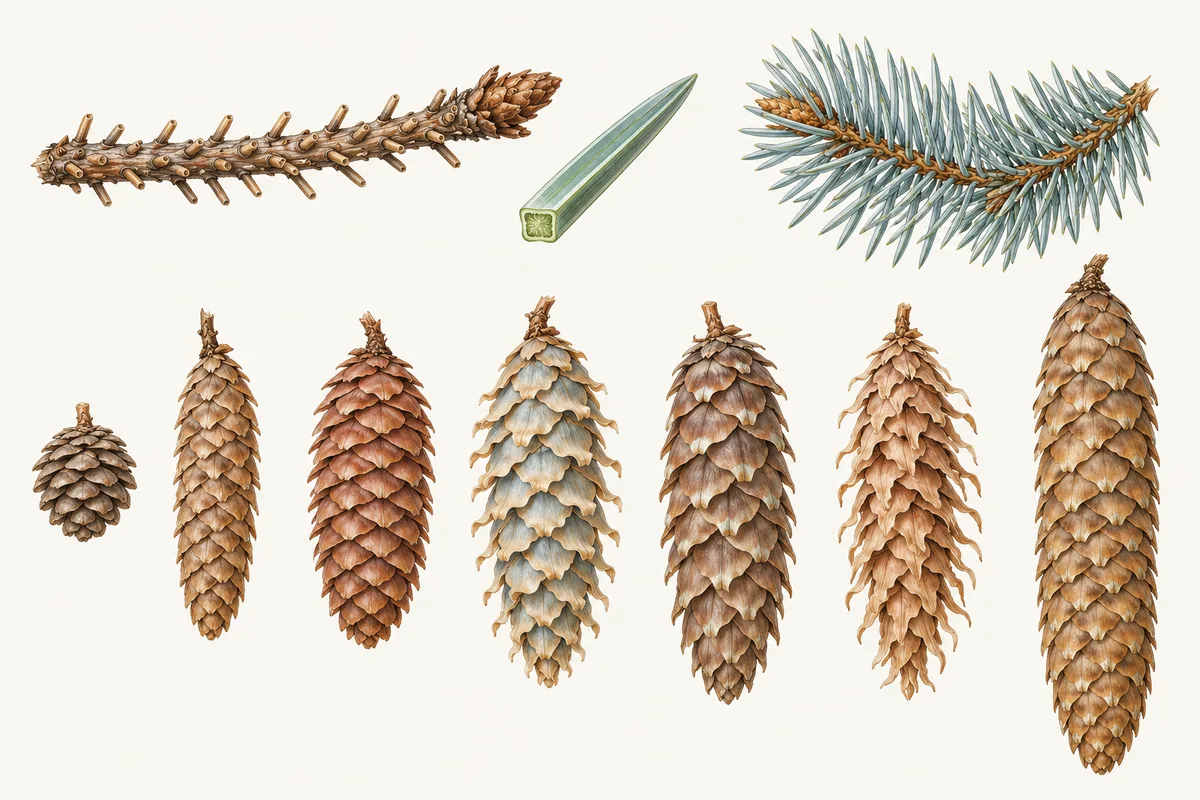
Spruce tree identification has two steps. First confirm the genus: single, stiff, four-sided needles that roll between your fingers, each on a small woody peg, and cones that hang down and fall whole. Then name the species by needle length (1/4 to 1 1/4 inch), hairy or hairless twigs, and cone size, from 1-inch black spruce cones to 6-inch Norway spruce cones.
- A bare twig covered in small woody pegs, rough to the touch, comes from a spruce.
- Cone size sorts spruces fast: black spruce about 1 in, white and red 1 1/4 to 2 1/4 in, Sitka up to 4 in, Norway 4 to 6 in.
- Where you are narrows the list: black, white and red spruce in the East and North, Engelmann and blue spruce in the Rockies, Sitka on the Pacific Coast, Norway spruce wherever it was planted.
Field marks at a glance
- Scientific name
- Picea
- Family
- Pinaceae (pine family)
- Type
- Conifer, evergreen
- Needles
- Single, stiff, usually four-sided and easy to roll between the fingers. Kept on the tree for 4 to 10 years. Sitka spruce is the exception, with flattened, very sharp needles.
- Needle attachment
- Each needle sits on a short woody peg that stays on the twig when the needle falls, so old twigs feel rough.
- Cones
- Hang down from the branch, with thin scales that stay attached; the whole cone often falls intact. From about 1 in (black spruce) to 6 in (Norway spruce).
- Bark
- Thin and scaly on most species, gray-brown to reddish-brown; Sitka and Engelmann spruce break into large, loose scales.
- Form
- Conical crown on a single straight trunk. Black spruce is narrow and spire-like; Norway spruce has drooping branchlets.
- North American natives
- White, black and red spruce in the East and North; Engelmann and blue spruce in the Rocky Mountains; Sitka spruce on the Pacific Coast.
- Planted spruces
- Norway spruce (from Europe) and blue spruce (outside its Rocky Mountain range) are widely planted in yards and parks.
- In the app's Collection
- Norway spruce (Picea abies) and Colorado blue spruce (Picea pungens).
Spruces (Picea) are the stiff-needled, cone-shaped evergreens of the northern forest, the Rocky Mountains and the Pacific Coast,, and two of them, Norway spruce and blue spruce, are planted widely in yards and parks. Identifying one is a two-step job: first prove it is a spruce, then name the species. This page covers seven: the six native species most people meet, plus Norway spruce, the European tree planted almost everywhere.
Step 1: confirm it is a spruce
Three checks, all from the ground.
Roll a needle. Ohio State University Extension's fact sheet Is It Pine, Spruce, or Fir? describes spruce needles as single, with a distinctive square (four-sided) shape. Roll one between your thumb and finger: it turns easily. A flat fir needle will not.
Look at the twig. Each spruce needle grows from a short woody peg. When needles fall, after 4 to 10 years on the tree (Ohio State), the pegs stay behind, so an older bare section of twig feels like a file. Pull one needle on a younger twig to see the peg it leaves.
Find a cone. Spruce cones hang down from the branch, their scales stay attached, and the whole cone often falls to the ground intact after the seeds are shed (Ohio State). Fir cones stand upright and crumble on the tree. If you are unsure between the two, the spruce vs fir guide runs all four tests in detail.
One exception to remember: Sitka spruce needles are flattened and keeled below (NRCan), so they roll less easily, but they still sit on woody pegs and the cones still hang.
Step 2: name the species
Measure one needle, check whether the youngest twig is hairy, and measure a cone. Then use where you are.
| Spruce | Needles | Twigs | Cones | Where |
|---|---|---|---|---|
| Black (P. mariana) | 1/4–1/2 in, blunt, blue-green | Fine hairs | About 1 in, egg-shaped, the smallest | Boreal Canada, bogs, northern US |
| White (P. glauca) | 15–22 mm (5/8–7/8 in), smell bad when crushed | Hairless, shiny | 3–6 cm (1 1/4–2 1/4 in), slender | All of Canada except the Pacific Coast |
| Red (P. rubens) | 10–16 mm, curved, shiny yellow-green | Shiny yellow-orange, hairy | 3–5 cm, chocolate-brown | Maritimes and Appalachians |
| Norway (P. abies) | 1/2–1 in, sharp, shiny deep green | Hairless, orange-brown | 4–6 in, the largest | Planted, from Europe |
| Blue (P. pungens) | Often bluish to silvery from wax | — | 1.8–4.2 in | Central and southern Rockies; planted widely |
| Engelmann (P. engelmannii) | 15–25 mm, bluish, flexible, aromatic | Somewhat hairy | 3–7 cm | Rocky Mountain slopes, interior BC |
| Sitka (P. sitchensis) | 20–30 mm, flattened, sharp | Hairless | 5–10 cm (2–4 in), thin wavy scales | Pacific Coast fog belt |
Sources for each row are in the sections below.
Spruces of the North and East: black, white and red
Black spruce. Virginia Tech's black spruce fact sheet gives needles 1/4 to 1/2 inch, four-sided, light blue-green with slightly blunt tips, on brown twigs with fine hairs. Its egg-shaped cones, about 1 inch long, are the smallest of the spruce cones. It is a small to medium tree up to 70 feet with a very narrow, spire-like crown, the shape you see across northern bogs.
White spruce. Natural Resources Canada's white spruce factsheet gives stiff, straight needles 15 to 22 mm, pointed but not sharp, with lines of white dots on all sides and an unpleasant odor when crushed, which is why its synonyms include cat spruce and skunk spruce. Twigs are hairless and shiny; cones are slender, cylindrical and blunt-tipped, 3 to 6 cm. It grows throughout Canada except the Pacific Coast, up to 25 m (82 ft) and 200 years, and in eastern Canada it colonizes abandoned farmland (NRCan).
Red spruce. NRCan's red spruce factsheet describes curved, blunt-pointed needles 10 to 16 mm long, shiny yellowish-green and pointing forward, often pressed close to the twig. Twigs are shiny yellow to yellowish-orange, and the cones are 3 to 5 cm and rich chocolate-brown. It grows in the Maritime provinces and south along the Appalachian Mountains, uncommonly in Ontario and Quebec, on cool, moist uplands with eastern hemlock, balsam fir and yellow birch. The Canada tree guide lists the conifers around it by region.
Spruces of the West: blue, Engelmann and Sitka
Blue spruce. The USDA Forest Service's blue spruce silvics places it in the central and southern Rocky Mountains, in Wyoming, Idaho, Utah, Arizona, New Mexico and Colorado, at 6,000 to 10,000 feet. Some trees have glaucous, bluish or silvery-gray foliage from surface waxes, intensifying with age, but color varies even among trees from the same seed source. Cones measured 4.5 to 10.7 cm (1.8 to 4.2 in) in northern Colorado. It is widely planted as an ornamental in the United States and Europe, with at least 38 named cultivars, so most blue spruces people photograph are in yards, not mountains. Other names: Colorado blue spruce, Colorado spruce, silver spruce.
Engelmann spruce. NRCan's Engelmann spruce factsheet describes bluish-green needles 15 to 25 mm, curved, somewhat flexible and aromatic, on somewhat hairy twigs, and shiny cylindrical cones 3 to 7 cm. Bark breaks into large, loose scales; newly exposed bark is silvery-white. It grows on mountain slopes at 1,000 to 2,000 m (3,300 to 6,600 ft) in interior British Columbia, Alberta and south into the United States, often at the alpine tree line.
Sitka spruce. NRCan's Sitka spruce factsheet gives flattened, sharp-pointed needles 20 to 30 mm that stick out at right angles from the twig, and cones 5 to 10 cm with thin, brittle, loose scales whose edges are wavy and irregularly toothed. It is a giant, up to 55 m (180 ft) and 700 to 800 years, in the Pacific fog belt from coastal Alaska and British Columbia south into the United States, and along inlets and streams up to about 150 km inland. The Douglas-fir and hemlock pages cover its neighbors in the coastal forest.
Norway spruce and spruces in yards
Norway spruce is the European spruce planted across North America. Virginia Tech's Norway spruce fact sheet gives stiff, four-angled needles 1/2 to 1 inch, shiny deep green with a sharp tip, on hairless, shiny orange-brown twigs, and very large cylindrical cones, 4 to 6 inches long and chestnut brown. The best long-distance mark is the branchlets, which often droop from horizontal or upswept branches. It can exceed 120 feet and may seed into the landscape where it is planted.
In a yard, the choice is usually between Norway spruce and blue spruce. A tree with long hanging branchlets and big cones is a Norway spruce; a tree with bluish, waxy needles and shorter cones is usually a blue spruce, though green blue spruces exist.
Tree Identifier names a tree from one photo, and both Norway spruce and Colorado blue spruce are among the 138 species in the app's Collection. Photograph a twig with needles and, if you can, a cone held in your hand. The app gives one name with no confidence score and no look-alike list, so check the result against the needle, twig and cone table above, and use the follow-up chat for questions such as whether a dwarf garden spruce is a cultivar. For the other evergreens, the conifer identification key sorts pines, firs, hemlocks and larches.
Look-alikes and how to tell them apart
Firs (Abies)
Fir needles are flat and soft, will not roll, and leave a smooth round scar from their suction-cup base. Fir cones stand upright and fall apart on the branch. A spruce needle rolls, leaves a peg, and its cone hangs.
Douglas-fir (Pseudotsuga menziesii)
Its needles are soft and flat with no peg, its buds are long and sharp-pointed, and its hanging cones have three-pointed bracts sticking out between the scales. Spruce cones have no bracts showing.
Hemlocks (Tsuga)
Hemlock needles are flat, about 1/2 inch, with two white lines beneath, and the top shoot of the tree droops. Spruce needles are four-sided on most species and sit on woody pegs.
What a photo can't settle
- Young spruces that have not yet produced cones lose the most useful species clue; measure needles on several twigs and check twig hairs with a hand lens.
- Planted spruces include many cultivars (at least 38 named for blue spruce alone), with dwarf, weeping or unusually colored forms that do not match the wild species descriptions.
- Cones grow high on tall trees; without a fallen cone, red, black and white spruce can be hard to separate from a photo of foliage alone.
Questions people ask
How do you identify a spruce tree?
Pull off a needle and roll it between your fingers. A spruce needle is stiff and four-sided, so it rolls, and it leaves a small woody peg on the twig. Then look for cones: spruce cones hang down and often fall whole, so you can usually pick one up under the tree.
Which spruce has the biggest cones?
Of the seven on this page, Norway spruce: Virginia Tech gives its cones as 4 to 6 inches long. Sitka spruce follows at 5 to 10 cm (2 to 4 in), and black spruce has the smallest, about 1 inch. A big cone under a planted spruce in a park is usually a Norway spruce cone.
What is the difference between white spruce and black spruce?
Look at the twig and the cone. White spruce twigs are hairless, its needles 15 to 22 mm and unpleasant-smelling when crushed, and its cones slender, 3 to 6 cm. Black spruce twigs carry fine hairs, its needles are 1/4 to 1/2 inch, and its egg-shaped cones about 1 inch are the smallest of the spruces.
How do you identify a Norway spruce?
By its very large cones, 4 to 6 inches long and chestnut brown, and by its branchlets, which often hang down from horizontal or upswept branches. The needles are shiny deep green, 1/2 to 1 inch, with sharp tips. Norway spruce is native to Europe and planted widely in North America.
Why is a blue spruce not always blue?
The blue color comes from surface waxes on the needles and is under strong genetic control. The USDA Forest Service notes there is no consistency in blue color from any one seed source, so seed-grown trees vary from green to silvery blue, and the color intensifies as the tree ages.
Sources
- Is It Pine, Spruce, or Fir? (Fact Sheet ANR-80) — The Ohio State University Extension (CFAES)
- White spruce (Picea glauca), Trees, insects and diseases of Canada's forests — Natural Resources Canada, Canadian Forest Service
- Red spruce (Picea rubens), Trees, insects and diseases of Canada's forests — Natural Resources Canada, Canadian Forest Service
- Black spruce fact sheet — Virginia Tech Dendrology
- Norway spruce fact sheet — Virginia Tech Dendrology
- Blue Spruce, Silvics of North America — USDA Forest Service
- Engelmann spruce (Picea engelmannii), Trees, insects and diseases of Canada's forests — Natural Resources Canada, Canadian Forest Service
- Sitka spruce (Picea sitchensis), Trees, insects and diseases of Canada's forests — Natural Resources Canada, Canadian Forest Service
Keep reading
- Tree comparisonSpruce vs fir: how to tell them apart
- Tree profileDouglas-fir (Pseudotsuga menziesii): how to identify it
- Tree profileHemlock trees (Tsuga): how to identify them
- Field guideConifer identification: three questions about the needles, then the cone
- Canada field guideTree identification in Canada, region by region