Tree profile
Ironwood tree identification: hophornbeam and musclewood
In eastern North America, "ironwood" names two small understory trees of the birch family. The bark settles which one you have in a few seconds.
In short
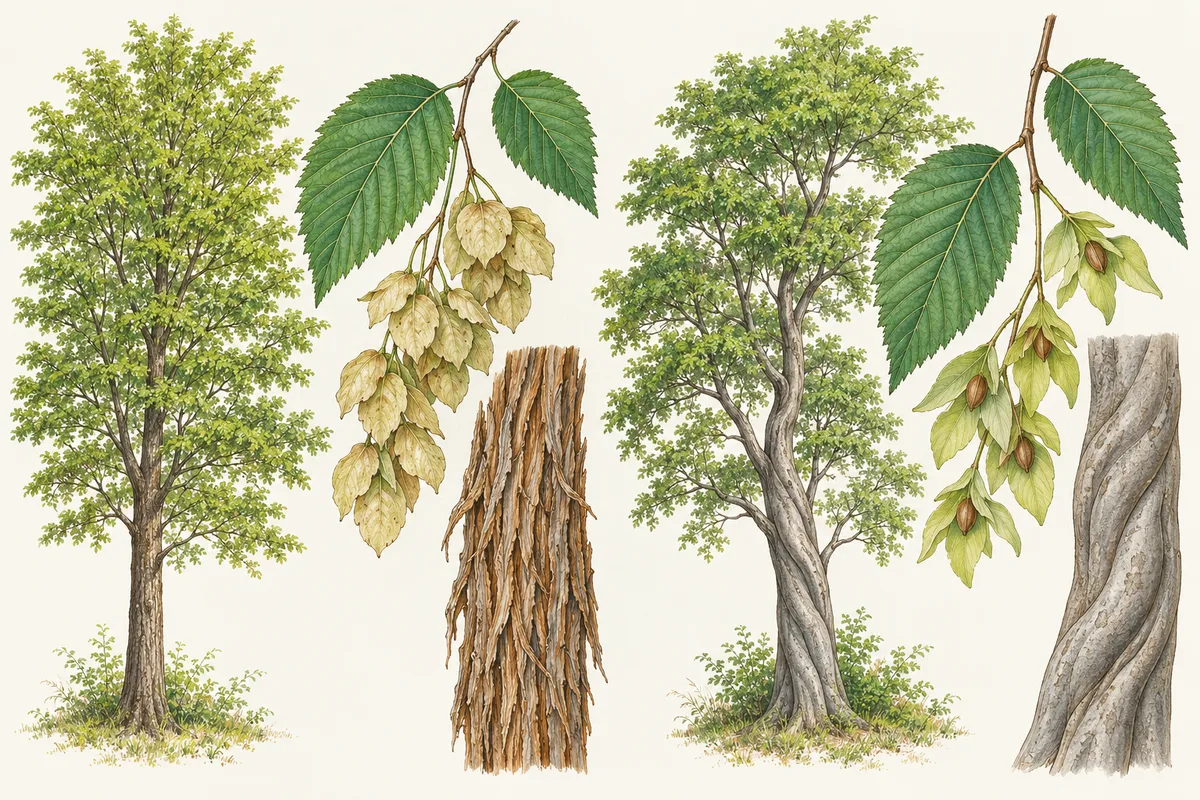
Ironwood tree identification starts with the bark, because the name covers two trees. Eastern hophornbeam (Ostrya virginiana) has gray-brown bark that breaks into narrow, shreddy vertical strips and bears hop-like clusters of papery sacs. American hornbeam, or musclewood (Carpinus caroliniana), has smooth, blue-gray bark over a fluted, muscle-like trunk and hangs nutlets on three-lobed leafy bracts. Both have doubly toothed leaves.
- Shreddy, strip-like bark and fruit like hops: eastern hophornbeam. Smooth, fluted, blue-gray bark and 3-lobed bracts: American hornbeam (musclewood).
- Both are small understory trees, usually 20 to 40 feet, with alternate, doubly toothed leaves 2 to 5 inches long, so the leaf alone rarely settles it.
- In the Sonoran Desert, ironwood means a third, unrelated tree: desert ironwood, a thorny legume with pink pea flowers.
Field marks at a glance
- Scientific name
- Ostrya virginiana and Carpinus caroliniana
- Family
- Betulaceae (birch family)
- Type
- Broadleaf, deciduous
- Bark
- Hophornbeam: gray-brown, breaking into long, narrow, shreddy vertical strips on mature trunks; smooth and reddish brown with lenticels when young. Musclewood: smooth, thin, blue-gray bark over a fluted, sinewy trunk at every age.
- Fruit
- Hophornbeam: drooping clusters of papery, inflated sacs that look like hops, each sac about 0.8 inch (20 mm) long around a nutlet about 0.3 inch. Musclewood: small nutlets, each on a three-lobed leafy bract 1 to 1½ inches long, in hanging clusters.
- Leaves
- Both alternate, simple, oval to egg-shaped with a pointed tip and a doubly toothed edge. Hophornbeam 2 to 5 inches (Morton Arboretum) to 3 to 6 inches (NC State), stalk hairy. Musclewood 2½ to 5 inches, smooth, dull bluish green.
- Fall color
- Hophornbeam: plain yellow, often dropping early. Musclewood: yellow to orange-red, sometimes burgundy, one of its garden selling points.
- Catkins
- Hophornbeam's red-brown male catkins, 1/2 to 1 inch long, sit on the twigs all winter in clusters of three. Musclewood's male catkins (1 to 2½ inches) open in spring.
- Size and form
- Hophornbeam: usually under 40 feet with one trunk; up to 50 to 60 feet in east Texas and south Arkansas. Musclewood: 20 to 30 feet, often several stems, as wide as tall.
- Habitat
- Hophornbeam: dry, rocky slopes and upland hardwood forests, shade tolerant. Musclewood: moist soils, stream banks and river bottoms, as an understory tree.
- Range
- Both eastern North America. Hophornbeam from the Maritimes west to southeastern Manitoba, the Black Hills and northeastern Wyoming, south to Texas, Florida and the mountains of Central America. Musclewood from eastern Canada to Minnesota, Texas and Florida.
"Ironwood" is a name, not a species. In the woods of the eastern United States and Canada it is used for two small trees of the birch family that grow under taller oaks and maples: eastern hophornbeam and American hornbeam, also called musclewood. They look alike at leaf level and very different at trunk level, so the fastest way to sort them is to look at the bark first.
The fastest checks: bark, then fruit
- Look at the trunk. Shreddy gray-brown bark in narrow vertical strips that look as if you could peel them off with a fingernail means eastern hophornbeam (Ostrya virginiana). The Morton Arboretum describes the bark as forming long vertical shredding strips. Smooth, tight, blue-gray bark stretched over a trunk that ripples like a flexed arm means American hornbeam (Carpinus caroliniana). NC State Extension calls it "smooth, tight, thin and bluish-gray stretched over an irregularly ridged trunk".
- Look for fruit, summer to winter. Hophornbeam hangs drooping clusters of pale, papery sacs that look like hops; each sac holds one hard nutlet. Musclewood hangs clusters of small nutlets, each sitting on an open, three-lobed leafy bract about 1 to 1½ inches long.
- Check a leaf. Both have alternate, oval leaves with a pointed tip and a doubly toothed edge (big teeth carrying smaller teeth). Hophornbeam leaves have a hairy stalk; musclewood leaves are smooth and dull bluish green. This step confirms the birch family more than it separates the two.
- Check the setting. Musclewood favors wet ground: stream banks, river bottoms and floodplain forests. Hophornbeam is more often on dry, rocky slopes and upland ridges.
If the bark and the fruit agree, you are done. Most people who search for ironwood have one of these two trees in front of them.
Eastern hophornbeam (Ostrya virginiana)
Eastern hophornbeam is the tree most field guides list first under "ironwood". The USDA Forest Service's Silvics of North America gives its other common names as American hophornbeam, hornbeam, leverwood and ironwood, and says it "produces an extremely hard wood".
Size. Usually less than 40 feet (12 m) tall and under 12 inches (30 cm) across, though trees reach 50 to 60 feet in east Texas and south Arkansas. The largest recorded, in Michigan in 1976, was 73 feet tall with a 36-inch trunk (Forest Service).
Bark. Smooth and reddish brown with lenticels on young trees, then grayish brown and broken into loose, narrow, scaly plates and strips. NC State calls it "showy, shaggy bark".
Leaves. Simple and alternate, oval to lance-shaped, doubly toothed, 2 to 5 inches long according to the Morton Arboretum and 3 to 6 inches according to NC State, with a hairy stalk. Fall color is a plain yellow.
Fruit. The female catkins become hop-like clusters that persist from summer into winter. The Forest Service measures each nut at about 0.3 inch (7 mm) inside an inflated sac about 0.8 inch (20 mm) long, which helps the wind carry it.
Winter clue. NC State notes that the red-brown male catkins, 1/2 to 1 inch long, form in clusters of three and stay on the twigs through winter. Small, stiff catkins on bare twigs plus shreddy bark is a strong winter combination. For other trees that carry catkins, see trees with catkins.
Range. The Forest Service maps it across most of the eastern half of the United States, from the Maritime provinces west to southeastern Manitoba, out to the Black Hills of South Dakota and northeastern Wyoming, and south through the mountains of Mexico to Honduras and El Salvador. It is shade tolerant and common under sugar maple and American beech in the North and in mixed hardwood and pine forests in the South. The Forest Service calls mesic sites throughout the Appalachians the most favorable; the Appalachian tree identification guide covers the trees it grows with there.
American hornbeam, or musclewood (Carpinus caroliniana)
NC State lists its common names as American hornbeam, blue beech, ironwood, musclewood and water beech. Each of them describes something you can see: the blue-gray beech-like bark, the muscled trunk, the wet places it grows.
Size and form. 20 to 30 feet tall and often as wide, short and stubby, with one trunk or several. Both NC State and the Morton Arboretum give a slow growth rate.
Bark and trunk. The giveaway. Thin, smooth, slate- to blue-gray bark, with long sinewy ridges running up a fluted trunk. It stays smooth at every age; it never becomes shreddy or furrowed.
Leaves. 2½ to 5 inches long, doubly toothed with a pointed tip, dull bluish green above and paler below, without hairs. The Morton Arboretum notes new leaves emerging reddish purple and turning yellow to orange-red in fall.
Fruit. A small nutlet about 1/3 inch long, attached to a three-lobed green bract 1 to 1½ inches long with the middle lobe widest. The Morton Arboretum compares the bract to an umbrella; the clusters turn from light green to yellow and the nutlets mature in October.
Habitat and range. Moist soil along streams, rivers and in floodplain forests, as an understory tree. NC State lists it across 34 eastern states and DC, from Maine and Minnesota to Florida and Texas, and in eastern Canada.
The Old World cousin, European hornbeam, is common in Britain as a hedge and woodland tree; the beech vs hornbeam page compares it with beech, the tree it is most often confused with.
Hophornbeam and musclewood side by side
| Feature | Eastern hophornbeam | American hornbeam (musclewood) |
|---|---|---|
| Bark | Gray-brown, shreddy vertical strips | Smooth, thin, blue-gray |
| Trunk | Round, usually single | Fluted, muscle-like, often several stems |
| Fruit | Hop-like clusters of papery sacs | Nutlets on 3-lobed leafy bracts |
| Leaf stalk | Hairy | Smooth |
| Fall color | Plain yellow, early drop | Yellow to orange-red |
| Typical site | Dry, rocky upland slopes | Wet stream banks and bottoms |
| Height | Usually under 40 ft | 20 to 30 ft |
For other trees with smooth gray trunks, including beech, red maple and yellowwood, see the guide to trees with smooth gray bark. For shreddy bark, the bark identification guide compares hophornbeam with shagbark hickory and silver maple.
Desert ironwood: a different tree with the same name
In the Sonoran Desert of the southwestern United States and northwestern Mexico, "ironwood" means desert ironwood (Olneya tesota), a legume unrelated to the two eastern trees. The University of Arizona's Desert Legume Program describes it as 20 to 30 feet tall with an irregular canopy, short paired spines at the twig nodes, finely hairy gray-green leaves of 6 to 16 small leaflets, and pale dusty pink pea-like flowers in late April and May, though not every year. Its wood is so dense it does not float. If your "ironwood" has thorns and grows in the Sonoran Desert, it is this one.
When a photo helps
Tree Identifier names a tree from one photo, and for ironwood the trunk is the best picture: shreddy strips or a smooth fluted trunk carry more information than a leaf. A cluster of hop-like fruit or three-lobed bracts is the second-best shot. Neither eastern hophornbeam nor American hornbeam is in the app's 138-species Collection, so the result goes to your History and Wild Discoveries. The app shows no confidence score or list of look-alikes, so check its answer against the bark test above. In winter, when the leaves are gone, the winter tree identification guide explains how to read buds and catkins, and Tree Identifier's follow-up chat can answer questions such as how the bark of a young hophornbeam changes with age.
Look-alikes and how to tell them apart
American beech (Fagus grandifolia)
Beech bark is smooth and gray like musclewood's, but the trunk is round, not fluted, and grows into a large tree. Beech leaves are singly toothed with straight parallel veins, and its buds are long and cigar-shaped.
European hornbeam (Carpinus betulus)
A planted Eurasian relative of musclewood with the same smooth gray trunk and 3-lobed bracts. Away from a garden, park or street planting, a wild streamside tree in eastern North America is almost always the native musclewood.
Elm (Ulmus)
Elm leaves are doubly toothed too, but the leaf base is clearly lopsided, the fruit is a flat, round, papery wafer, and the bark is ridged rather than shreddy or smooth and fluted.
Birch (Betula)
Young birch bark has horizontal lenticels like a young hophornbeam, but birches peel in horizontal papery sheets or curls, and their fruit is an upright or hanging cylindrical catkin that crumbles, not a cluster of sacs or bracts.
What a photo can't settle
- Both trees have similar doubly toothed leaves, so a photo of a single leaf may not separate them; a photo of the trunk or the fruit is far more useful.
- Young hophornbeams have smooth bark before it turns shreddy, so a sapling's trunk can look like musclewood's; check for fruit or the winter catkins.
- Neither eastern hophornbeam nor American hornbeam is in Tree Identifier's 138-species Collection (European hornbeam is), so a correct answer lands in History and Wild Discoveries.
Questions people ask
What does an ironwood tree look like?
In the eastern US and Canada it is a small understory tree, usually 20 to 40 feet, with doubly toothed oval leaves. If the bark is shreddy in narrow vertical strips and the fruit looks like hops, it is eastern hophornbeam. If the bark is smooth, blue-gray and fluted like flexed muscle, it is American hornbeam.
What is the difference between hophornbeam and hornbeam?
Bark and fruit. Hophornbeam (Ostrya) has shreddy gray-brown bark and fruit in papery, inflated sacs like hops. Hornbeam (Carpinus) has smooth, fluted gray bark and nutlets on open, three-lobed leafy bracts. Both are in the birch family and both are called ironwood.
Why is it called ironwood?
For the wood. The USDA Forest Service says eastern hophornbeam produces an extremely hard wood, and NC State notes it was used for sleigh runners, tool handles and fence posts.
Is ironwood the same as musclewood?
Sometimes. Musclewood is American hornbeam, which many people also call ironwood or blue beech. But eastern hophornbeam is called ironwood too, so the name alone does not tell you which tree someone means.
Is desert ironwood related to eastern ironwood?
No. Desert ironwood (Olneya tesota) is a legume of the Sonoran Desert in the southwestern US and northwestern Mexico, with short paired spines, small gray-green leaflets and pale pink pea flowers in late spring. It shares only the name, earned by its very dense wood.
Sources
- Eastern Hophornbeam, Silvics of North America — USDA Forest Service
- Ostrya virginiana (American Hop-hornbeam, Ironwood) — North Carolina Extension Gardener Plant Toolbox, NC State University
- Carpinus caroliniana (American Hornbeam, Musclewood, Ironwood) — North Carolina Extension Gardener Plant Toolbox, NC State University
- Ironwood (Ostrya virginiana) — The Morton Arboretum
- American hornbeam (Carpinus caroliniana) — The Morton Arboretum
- Olneya tesota — Desert Legume Program, University of Arizona
Keep reading
- Tree comparisonHornbeam vs beech: how to tell them apart
- Clue guideWhich tree has smooth gray bark? Sort it by trunk size, shape and leaf
- Field guideTree bark identification: seven bark types and the trees that have them
- Tree profileBirches (Betula): how to identify a birch tree
- Winter field guideWinter tree identification, from buds to bark