Clue guide
Which tree has catkins? Check the month, the leaf and what comes after
Catkins are dangling spikes of tiny flowers, and a handful of tree families carry them. The month they open, the leaf and the fruit that follows tell them apart.
In short
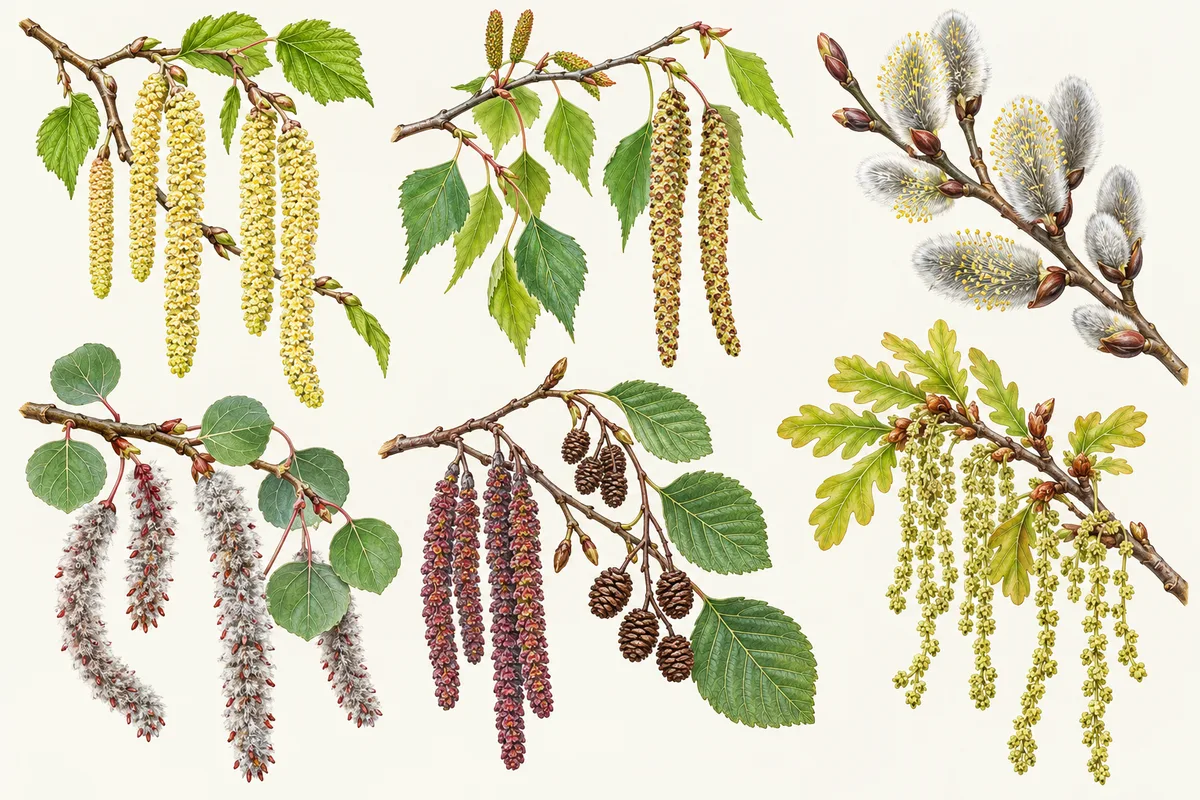
A tree with catkins is usually a hazel (yellow catkins from mid-February, before the leaves, then nuts in late summer), an alder (catkins with small woody cones that stay all year), a birch, a willow (silky gray pussy-willow catkins before the leaves) or a poplar. Catkins that open with the leaves in April and May belong to oaks, walnuts and hophornbeam.
- Small woody cones beside the catkins mean alder: Woodland Trust says the cones stay on the tree all year.
- Catkins plus nuts in late summer mean hazel; catkins plus a husked nut that stains your hands in October mean black walnut.
- Catkins that drop in heaps in spring under a big tree with lobed leaves are oak pollen catkins; they are flowers that have finished, not a sign of disease.
A tree with catkins belongs to a short list of families: birches, alders, hazels and hornbeams, willows and poplars, oaks and chestnuts, and walnuts and hickories. Catkins are dangling or upright spikes of tiny flowers without showy petals, many of them pollinated by wind. The month they open, the leaf and the fruit that follows sort out almost every case.
Catkin trees by month, leaf and fruit
| Tree | Catkins | When | Leaf | What follows |
|---|---|---|---|---|
| Hazel (Corylus avellana) | Yellow "lambs' tails" in clusters, before the leaves | From mid-February | Round to oval, doubly toothed, hairy | Nuts in late summer |
| Alder (Alnus glutinosa) | Yellow, hanging, 2–6 cm | February–April | Racquet-shaped, tip rounded or notched | Small woody cones that stay all year |
| Pussy willow (Salix discolor) | Silky gray, before the leaves, separate male and female plants | Late winter to spring | 3–4 in, gray-green underneath | Small capsules |
| Eastern cottonwood (Populus deltoides) | 2–4.5 in, red (male) or green (female), separate trees | March–April, before the leaves | Triangular, 3–6 in, curved teeth | Seeds with silky white hairs |
| Silver birch (Betula pendula) | Long yellow-brown male catkins in 2s to 4s; short green upright female | April–May | Small, triangular, toothed | Female catkins turn crimson, tiny winged seeds in autumn |
| Northern red oak (Quercus rubra) | Drooping yellowish-green, 2–4 in | April–May | 7–11 shallow lobes with bristle tips | Acorns |
| Black walnut (Juglans nigra) | Yellow-green, single, 2.5–5.5 in | April–May | Compound, 15–23 leaflets | Nut in a staining green husk, October |
| American hophornbeam (Ostrya virginiana) | Red-brown, 1/2–1 in, in 3s, visible all winter | Open in April | Birch-like, doubly toothed | Hop-like clusters of papery sacs |
Data come from the Woodland Trust (hazel, alder, silver birch) and NC State Extension (pussy willow, eastern cottonwood, northern red oak, black walnut, hophornbeam), read on 21 October 2026.
Late winter, before the leaves: hazel and alder
The first catkins of the year belong to hazel and alder, and they open on bare branches.
Hazel is a shrub or small tree, about 8 m tall when left uncut. The Woodland Trust describes yellow male catkins, the "lambs' tails", hanging in clusters from mid-February before the leaves, with tiny bud-like female flowers marked by red styles on the same tree. Small green catkins already show in autumn, ready for the next year. The nuts ripen in late summer, and the leaves are round to oval, doubly toothed, hairy and pointed at the tip. The hazel page covers the planted hazels and the American hazelnut.
Alder is the answer to "tree with catkins and small cones". The Woodland Trust describes hanging male catkins 2 to 6 cm long that turn yellow and open between February and April, and female catkins that start as small red ovals, turn green and then brown and woody after pollination. Those tiny cone-like fruits stay on the tree all year, so an alder shows last year's cones beside this year's catkins. The leaves are 3 to 9 cm long, racquet-shaped, with a rounded or notched tip, never pointed. Alder grows by rivers, ponds and wet woods; see the alder page for the North American species.
Silky catkins and separate sexes: willows and poplars
Willows and poplars carry male and female catkins on separate trees, which is why one tree in a row may shed cotton in summer and its neighbor never does.
Pussy willow is the willow most people notice. NC State describes silky gray male flowers in spring before the leaves emerge, on separate male and female plants, and alternate leaves 3 to 4 inches long with a gray-green underside, on a shrub or small tree 10 to 20 feet tall. The willow page sorts the tree willows by leaf and bark.
Eastern cottonwood is the poplar of North American river bottoms. NC State describes catkins 2 to 4.5 inches long emerging in March and April before the leaves, with red stamens on male trees and green ovaries with yellow stigmas on female trees. In summer the female catkins split and release seeds with silky white hairs. The leaves are triangular, 3 to 6 inches long, with coarse, curved teeth, and the tree reaches 75 to 100 feet. That cotton is covered on the white fluff page.
Spring, with the leaves: birch, oak and walnut
Silver birch opens its catkins from April to May. The Woodland Trust describes long, yellow-brown male catkins hanging in groups of two to four at the shoot tips, and short, bright green female catkins standing upright. After pollination the female catkins thicken and turn dark crimson, then break up in autumn into masses of tiny seeds. White bark and small, triangular, toothed leaves confirm it; the birch page covers the North American birches.
Oaks are the source of the heaps of stringy catkins on driveways in spring. NC State describes northern red oak's male flowers as drooping yellowish-green catkins about 2 to 4 inches long, blooming from April to May, while the female flowers are tiny, about 1/8 inch, and become acorns. The leaves have 7 to 11 shallow lobes with bristle-tipped teeth. Other oaks carry similar catkins; the oak page separates the red and white oak groups.
Black walnut answers "tree with catkins and nuts" in the eastern US. NC State describes single yellow-green male catkins 2.5 to 5.5 inches long on last year's wood from April to May, compound leaves 12 to 24 inches long with 15 to 23 leaflets, and a nut 1 to 3 inches across inside a yellow-green husk that heavily stains skin and clothing, ripening in October. Its range runs from northeastern Canada west to North Dakota and south to Texas and Florida.
Catkins all winter: hophornbeam
A small understory tree with short catkins visible all winter is likely an American hophornbeam. NC State describes preformed male catkins 1/2 to 1 inch long in clusters of three that hang on through winter and open in April, birch-like doubly toothed leaves, and fruit in drooping clusters of papery sacs that look like hops and persist from summer through winter. Mature bark breaks into loose, scaly, grayish-brown plates. It grows 20 to 35 feet tall in dry, rocky woods from Nova Scotia and Manitoba south to Florida and Texas. Its cousin the hornbeam has smooth, fluted bark; the beech and hornbeam page explains the difference. The ironwood page separates it from musclewood.
Using a photo
Catkins alone are a weak clue in a photo, because related species carry near-identical ones. Include a leaf, a stretch of bark or last year's fruit, such as alder cones or hazel husks. Tree Identifier names a plant from one photo, and alder, silver birch, hazel, eastern cottonwood, black walnut and northern red oak are among the species in its Collection. It shows no confidence score or list of alternatives, so check the result against the month and fruit columns above. The follow-up chat under each result can answer questions such as why a willow has no catkins, and the Tree Map remembers where you found a tree so you can go back for its leaves after the catkins fall.
What a photo can't settle
- Catkins of related species, such as the many willows and poplars, look alike in a photo; the leaf and bark narrow it further.
- Catkins last only a few weeks on many trees. Outside that window, use the leaf, the bark and the fruit instead.
- Catkin pollen is a common seasonal allergy trigger, but no page or app can diagnose an allergy; ask a doctor.
Questions people ask
What tree has catkins in February?
In the UK, Ireland and milder parts of North America, usually hazel or alder. The Woodland Trust says hazel's yellow catkins hang in clusters from mid-February, before the leaves, and alder's catkins open between February and April next to last year's small woody cones. Pussy willow follows in late winter and early spring.
What tree has catkins and nuts?
Hazel, if the tree is small, the catkins open from mid-February and the nuts ripen in late summer. Black walnut, if the tree is large with feather-like leaves of 15 to 23 leaflets and the nut sits in a green husk that stains skin, ripening in October. Oaks also carry catkins, and their nut is the acorn.
What tree has catkins and triangular leaves?
Eastern cottonwood. NC State describes triangular leaves 3 to 6 inches long with curved teeth, and catkins 2 to 4.5 inches long in March and April before the leaves, on separate male and female trees. Female catkins later release seeds with silky white hairs, the cotton of cottonwood.
What is the crossword answer for 'tree with catkins'?
The common answers are ALDER, BIRCH and HAZEL (5 letters), and WILLOW, POPLAR and WALNUT (6 letters). Check the crossing letters: every one of them is a tree that carries catkins.
Why are catkins falling from my tree?
Male catkins drop once they have shed their pollen. Oaks are the usual source of heaps in spring: NC State describes northern red oak's male flowers as drooping yellowish-green catkins 2 to 4 inches long, blooming from April to May. They are spent flowers, not a sign that the tree is sick.
Sources
- Hazel (Corylus avellana) — Woodland Trust
- Alder (Alnus glutinosa) — Woodland Trust
- Silver birch (Betula pendula) — Woodland Trust
- Salix discolor (pussy willow) — North Carolina Extension Gardener Plant Toolbox, NC State University
- Populus deltoides (eastern cottonwood) — North Carolina Extension Gardener Plant Toolbox, NC State University
- Quercus rubra (northern red oak) — North Carolina Extension Gardener Plant Toolbox, NC State University
- Juglans nigra (black walnut) — North Carolina Extension Gardener Plant Toolbox, NC State University
- Ostrya virginiana (American hophornbeam) — North Carolina Extension Gardener Plant Toolbox, NC State University
Keep reading
- Tree profileHazel (Corylus avellana): how to identify it
- Tree profileAlder (Alnus): how to identify it
- Tree profileBirches (Betula): how to identify a birch tree
- Tree profileWillow trees (Salix): how to identify them
- Clue guideWhich tree sheds white fluff? Sort it by month, leaf and where the fluff sits