Clue guide
Which tree sheds white fluff? Sort it by month, leaf and where the fluff sits
White fluff drifting in late spring is almost always poplar or willow seed. Check the month, the leaf stalk and whether the fluff floats, hangs in flowers or sticks to the bark.
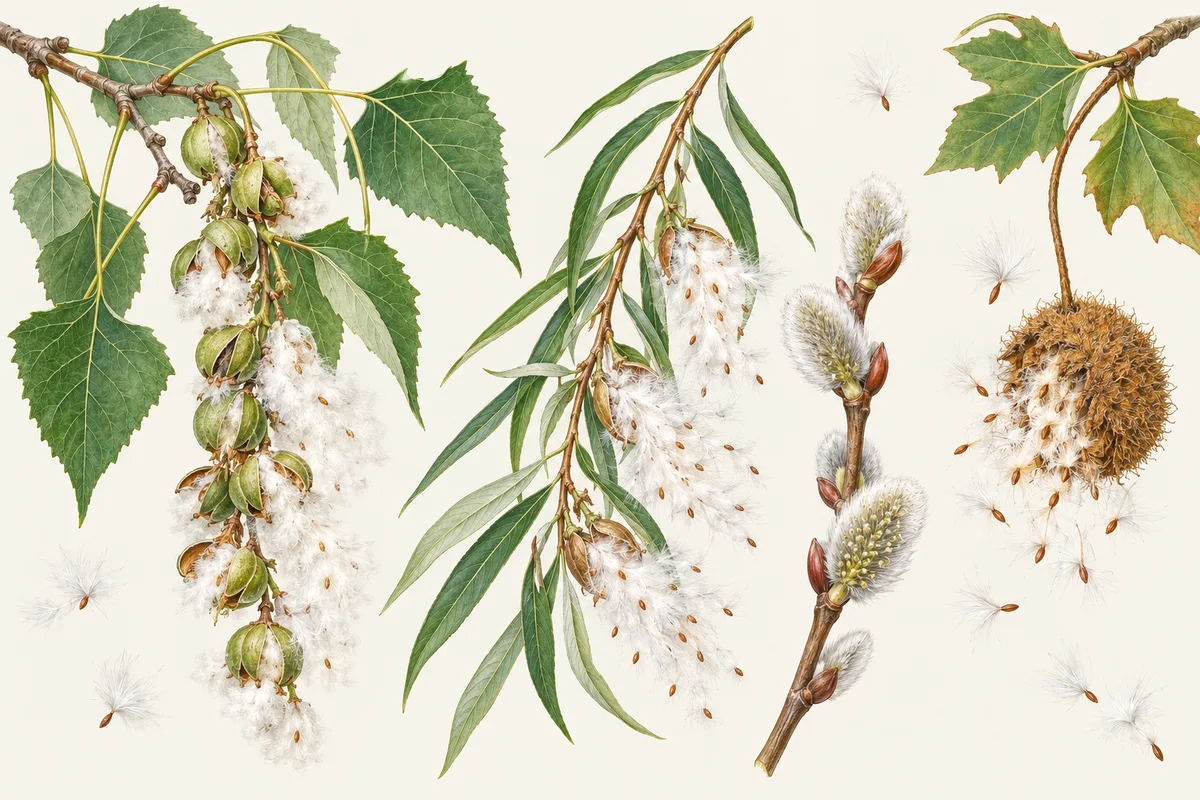
In short
A tree with white fluff in late spring or early summer is most often an eastern cottonwood or another poplar: female trees release seeds wrapped in white cotton from May to mid-July. Narrow leaves point to a willow, round trembling leaves to an aspen. Fluff in fall is usually groundsel tree, and white fluff stuck to apple bark is an insect, not seed.
- Only female cottonwoods, poplars and willows shed cotton: the USDA Forest Service notes that male clones have none.
- Flat leaf stalk and triangular or round leaf: poplar, cottonwood or aspen. Long, narrow leaf: willow.
- Fluff glued to the trunk or around pruning cuts on apple is usually woolly aphid wax, which the RHS says is often mistaken for a fungus.
White fluff floating down a street in late spring looks like snow, and most people's first guess, cottonwood, is usually right. But willows, aspens, other poplars and a few warm-climate trees shed fluff too, and some white fluff is not seed at all. Three checks sort it: the month, the leaf, and whether the fluff floats free, sits in flowers or clings to the bark. Never eat a berry, nut, seed or pod on the strength of a web page or an app; check with a local expert.
White fluff by month and leaf
| Tree | When the fluff appears | The leaf or clue that settles it | Our page |
|---|---|---|---|
| Eastern cottonwood (Populus deltoides) | May to mid-July | Triangular leaf on a flattened stalk; huge tree near water | Poplar |
| Quaking aspen (Populus tremuloides) | Early summer | Small round leaf that trembles; smooth whitish bark | Poplar |
| Black poplar (Populus nigra) | Late summer (UK) | Rare wild native in Britain; only female trees fluff | Poplar |
| Black willow (Salix nigra) | Midsummer | Long, narrow leaf 3 to 6 in (8–15 cm) | Willow |
| White and weeping willows (Salix alba, S. babylonica) | After the early-spring catkins | Narrow silvery leaf; drooping twigs on weeping willow | Willow |
| Pussy willow (Salix discolor) | Early spring | Silvery fuzzy catkins before the leaves | Willow |
| American sycamore, London plane (Platanus) | Late winter to spring | Seed balls breaking apart; patchy bark | Sycamore |
| Groundsel tree (Baccharis halimifolia) | September to November | Gray-green toothed leaves; coastal shrub | none yet |
| Silk-floss tree (Ceiba speciosa) | Cool season, after flowering | Thick green trunk with spines; pear-shaped pods | none yet |
| American fringetree (Chionanthus virginicus) | April to May | Fluffy white flowers, not seed | White flowers |
| Woolly aphid on apple | April to October | Wax stuck to bark and pruning cuts | none |
Months and features come from the USDA Forest Service, Virginia Tech, NC State Extension, UF/IFAS, the Morton Arboretum, the Woodland Trust and the RHS pages linked below.
Late spring and early summer: cottonwood and the other poplars
If the air is full of cotton between May and July, look for a tall poplar. The USDA Forest Service's Silvics of North America says eastern cottonwood flowers from February to April before the leaves, then disperses seed from May through mid-July in the South and June through mid-July in the North. The seed is carried by wind with the "cotton" attached, often several hundred feet, and seeds that fall in water can travel much farther. The same source calls eastern cottonwood one of the tallest species east of the Rocky Mountains.
The leaf confirms it: triangular, coarsely toothed, on a stalk flattened from side to side, so it rattles in the wind. Only female trees make cotton. The Forest Service gives a sex ratio of about 1 to 1 and notes that male clones, which have none of the "objectionable cotton", are the ones preferred for planting, which is why one cottonwood on a street fluffs and its neighbour does not.
Quaking aspen sheds the same kind of fluff in smaller amounts. NC State's aspen profile describes female catkins up to 4 inches (10 cm) long splitting open in summer, each capsule holding 4 to 10 tiny seeds embedded in cottony hairs, spread by wind or water. Its leaf is nearly round and trembles on a flat stalk, and the bark is smooth and pale. In Canada the "trembling aspen fluff" search is the same tree. The poplar page separates cottonwood, aspens, Lombardy and white poplar.
Narrow leaves: willows
If the fluff comes from a tree with long, narrow leaves near water, it is a willow. The Virginia Tech black willow sheet describes lance-shaped leaves 3 to 6 inches long with finely toothed edges, catkins in early summer, and cone-shaped capsules full of small, cottony seeds that split open in midsummer. Black willow bark is brown to gray-black with thick, scaly ridges, unlike the smooth pale bark of an aspen.
Willows are also male or female. The Woodland Trust's white willow page explains that female catkins lengthen into small capsules holding minute seeds in white down, which the wind carries away. White willow leaves look paler than most willows because of silvery hairs underneath. Weeping willows produce the same down where the trees are female; the willow page covers how to tell the common willows apart.
Fluffy buds in March are a different thing. The Morton Arboretum describes pussy willow catkins about an inch long, fuzzy and silvery gray, opening before the leaves in early to mid spring. These are flowers; the cotton comes weeks later.
Seed balls that break into fluff: sycamore and London plane
A fuzzy brown debris of tiny seeds under a big tree with patchy bark in late winter or spring comes from sycamore seed balls. Virginia Tech's sycamore sheet describes a round cluster of achenes hanging on a stalk 3 to 6 inches long, maturing in November and dispersing in late winter. The Woodland Trust's London plane page says the fruits break up slowly over winter, each seed carrying stiff hairs that help wind dispersal. That fluff is short and brownish compared with cottonwood's white drifts. See sycamore for the leaf and bark.
White fluff in fall and in warm climates
Groundsel tree. On the coast of the eastern US, a shrub or small tree turning white in autumn is likely Baccharis halimifolia. NC State's groundsel tree profile describes frilly white seed plumes on female plants from September to November, dispersed by wind, on a plant 5 to 12 feet (1.5–3.7 m) tall with gray-green, coarsely toothed leaves 1 to 3 inches long, found in salt marshes, sandy places and wet disturbed sites.
Silk-floss tree. In south Florida and southern California, white floss hanging from a tree with a thick, spiny, green trunk is Ceiba speciosa. The UF/IFAS fact sheet describes pink and white flowers in fall and winter, followed by woody, pear-shaped capsules about 8 inches long filled with silky, white, kapok-like floss and pea-like seeds, on trees reaching 50 feet in USDA zones 10A to 11. Its relative the kapok tree (Ceiba pentandra) is in Tree Identifier's Collection.
White fluff in the UK
"Tree that sheds white fluff" in Britain usually means a poplar or a willow. The Woodland Trust's black poplar page says fertilised female catkins develop into fluffy, cotton-like seeds that fall in late summer, and that only about 600 of Britain's roughly 7,000 wild native black poplars are female, so a fluffing poplar on a British street is more likely a planted poplar than a wild native black poplar. London planes add their own hairy seed as the fruits break up over winter.
Fluffy flowers and fluff stuck to the bark
Two searches look like seed fluff but are not. Fluffy white flowers in April or May on a small tree with long, fringe-like petals belong to American fringetree, which NC State's fringetree profile describes as clusters 4 to 8 inches long with creamy white petals; the white flowers guide covers the other white-blossomed trees.
Fluff glued to the bark is usually an insect. The RHS describes woolly aphid as a white, waxy fluff over dark brown to black aphids, often mistaken for a fungus, found only on apple, cotoneaster and pyracantha, from about April to October, often around old pruning cuts. Diagnosing it is outside this guide; a local extension office can confirm the insect.
Using a photo
Fluff itself says little about the tree. Photograph a leaf with its stalk, or the whole tree with its open catkins, and Tree Identifier names it from that one photo; eastern cottonwood, black poplar, white willow, weeping willow and American sycamore are in its Collection. It shows no confidence score or alternatives, so check the answer against the month and the leaf in the table above. The follow-up chat under a result can tell you when that species sheds seed, and the Tree Map remembers where the fluffy tree stands for next year.
What a photo can't settle
- Cotton in the air may come from a tree out of sight; follow it upwind and check which nearby tree has open seed capsules before naming it.
- Poplar hybrids and planted clones can't always be named to species from a photo; poplar or cottonwood is often as far as a picture goes.
- White fluff on bark, needles or leaves can be insects or fungus. Naming the insect or judging the tree's health is a job for an extension office or arborist, not a tree ID photo.
Questions people ask
What tree drops white fluff in May and June?
Usually an eastern cottonwood. The USDA Forest Service gives seed dispersal from May through mid-July in the South and June through mid-July in the North, with the cotton carrying seed several hundred feet. Aspens, other poplars and willows shed similar cottony seed around the same time.
Why does only one cottonwood on my street make fluff?
Cottonwoods, poplars and willows have male and female trees, and only females make seed and cotton. The USDA Forest Service puts the cottonwood sex ratio at about 1 to 1 and notes that male clones, with none of the cotton, are the ones preferred for planting.
What tree has white fluff in the fall?
In coastal areas of the eastern US, a shrubby groundsel tree. NC State Extension describes frilly white, wind-dispersed seed plumes on female plants from September to November. In south Florida and southern California, a silk-floss tree's woody pods split in the cool season to show white floss.
What is the white fluffy stuff on my apple tree branches?
If it is stuck to the bark rather than floating, it is probably woolly aphid. The RHS describes a white, waxy fluff over dark aphids, found only on apple, cotoneaster and pyracantha, from about April to October, often around old pruning cuts. Tree health is outside this guide; ask a local extension office.
What tree has white fluffy buds in early spring?
A pussy willow. The Morton Arboretum describes its catkins as about an inch long, fuzzy and silvery gray, opening before the leaves in early to mid spring. These are flowers, not seed fluff, and they come weeks before any willow cotton.
Sources
- Eastern cottonwood (Populus deltoides), Silvics of North America — USDA Forest Service
- Black willow fact sheet — Virginia Tech Dendrology
- Populus tremuloides (quaking aspen) — North Carolina Extension Gardener Plant Toolbox, NC State University
- Baccharis halimifolia (groundsel tree) — North Carolina Extension Gardener Plant Toolbox, NC State University
- Ceiba speciosa: silk-floss tree (ENH321) — UF/IFAS Extension
- Black poplar (Populus nigra subsp. betulifolia) — Woodland Trust
- White willow (Salix alba) — Woodland Trust
- Woolly aphid — Royal Horticultural Society
Keep reading
- Tree profilePoplars, cottonwoods and aspens (Populus): how to identify them
- Tree profileWillow trees (Salix): how to identify them
- Tree profileSycamore tree: the British maple and the American plane tree
- Field guideTree seed identification: from acorn, pod or samara to the tree
- Clue guideWhich tree has white flowers? Start with the month