Clue guide
Which tree has smooth gray bark? Sort it by trunk size, shape and leaf
Ask whether the trunk is big or small, round or fluted, then read the leaf. Smooth gray bark that stays smooth on a large trunk is rare, and that alone narrows the list fast.
In short
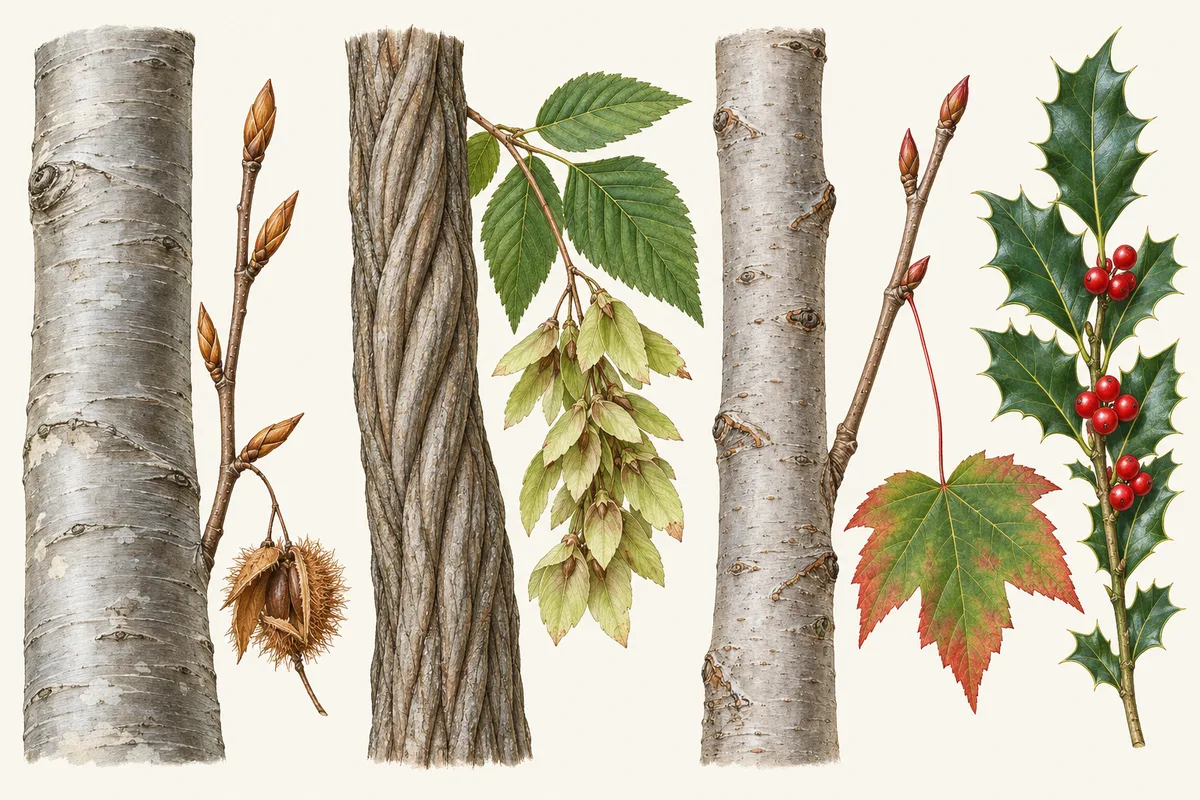
A tree with smooth gray bark on a large trunk is most often a beech: American and European beech keep thin, smooth gray bark even when old. A small tree with smooth, bluish-gray bark over a fluted, muscle-like trunk is a hornbeam. A young red maple is smooth and light gray before its bark breaks into plates, and an evergreen with spiny leaves is American holly.
- Big trunk, still smooth: beech. Small, fluted trunk: hornbeam. Smooth only while young: red maple, tulip tree, hackberry.
- Beech leaves have straight parallel veins and long, slender, pointed buds; hornbeam leaves are doubly toothed with short buds.
- Gray bark with white vertical stripes on a small understory tree is striped maple.
Smooth gray bark is a strong clue because few trees keep it once the trunk is thick. Most trees start smooth and break into ridges, plates or scales as they age, so the first question is how big the trunk is. Then look at its shape, round or fluted, and finally at a leaf or bud. Never eat a berry, nut, seed or pod on the strength of a web page or an app; check with a local expert.
Smooth gray-barked trees by trunk size and leaf
| Tree | Bark | The leaf or feature that settles it | Our page |
|---|---|---|---|
| American beech (Fagus grandifolia) | Smooth, thin, gray on the biggest trunks | 11–14 straight vein pairs; buds over 1 in long | Beech |
| European beech (Fagus sylvatica) | Smooth, thin, grey, slight horizontal etchings | Wavy leaf edge with hairs | Beech |
| American hornbeam (Carpinus caroliniana) | Smooth, bluish-gray over a fluted trunk | Doubly toothed leaf; nutlets on 3-lobed bracts | Beech vs hornbeam |
| European hornbeam (Carpinus betulus) | Pale grey with vertical markings | Finely toothed, furrowed leaf | Beech vs hornbeam |
| Red maple, young (Acer rubrum) | Smooth, light gray; plated when old | Opposite, 3–5 lobed, red in fall | Maple |
| Japanese maple (Acer palmatum) | Older branches gray | 5–9 deep lobes, small tree | Maple |
| Striped maple (Acer pensylvanicum) | Gray-green with white vertical stripes | Goose-foot, 3-lobed leaf | Maple |
| American yellowwood (Cladrastis kentukea) | Smooth gray, light gray and pebbly when old | 7–9 leaflets; hanging white flowers | none yet |
| American holly (Ilex opaca) | Light gray-white, smooth, often lichen-splotched | Evergreen, spiny leaves; red berries | Holly |
| Tulip tree, young (Liriodendron tulipifera) | Smooth light gray-green | Four-lobed leaf with a cut-off tip | Tulip tree |
| Hackberry, young (Celtis occidentalis) | Smooth gray-brown, soon with corky warts | The warts themselves | none yet |
| Rowan (Sorbus aucuparia, UK) | Smooth, silvery grey | 5–8 pairs of toothed leaflets | Rowan |
Bark and leaf data come from Virginia Tech Dendrology, NC State Extension, the Morton Arboretum and the Woodland Trust pages linked in the sections below.
Large trunk, still smooth: the beeches
If a trunk as thick as a barrel is still smooth and gray, it is almost certainly a beech. The Virginia Tech American beech sheet describes bark that is smooth, thin and gray "even on the largest stems", on a tree up to 100 feet (30 m) tall. Leaves are 2½ to 5½ inches long with 11 to 14 pairs of straight veins, and the twigs are slender and zigzag with long, slender buds about ¾ inch long. The Morton Arboretum calls the bark silvery gray, gives buds over 1 inch long and sharply pointed, and notes that dried leaves stay on the tree well into winter, so a smooth gray tree still holding pale brown leaves in January is a strong beech signal.
European beech is planted in American parks and is the common big beech of Britain and Europe. The Woodland Trust's common beech page describes bark that is smooth, thin and grey, often with slight horizontal etchings, oval leaves with a wavy, hairy edge, reddish-brown torpedo-shaped buds with a criss-cross pattern, and trees growing to more than 40 m (130 ft). The beech page separates American and European beech.
Small and fluted: the hornbeams
A small tree with smooth gray bark stretched over a trunk that ripples like flexed muscle is a hornbeam. NC State's American hornbeam profile describes smooth, tight, thin, bluish-gray bark over an irregularly ridged, heavily fluted trunk, which is why it is called musclewood, ironwood or blue beech. It grows 20 to 30 feet (6–9 m) tall in eastern North America, with doubly toothed leaves 2½ to 5 inches long and small ribbed nutlets carried on three-lobed leafy bracts.
European hornbeam is the British and European version. The Woodland Trust's hornbeam page describes pale grey bark with vertical markings, a short, twisted trunk that ridges with age, and leaves smaller and more deeply furrowed than beech, with finely toothed rather than wavy edges. Winter buds are shorter than beech's, slightly curved and pressed to the twig. The beech vs hornbeam page sets the two side by side.
Smooth only while young: maples, tulip tree and hackberry
Many trees are smooth and gray for their first decades, then change. Red maple is the common one: NC State's red maple profile describes young bark as smooth and light gray, while old trunks turn thick, dark gray and break into large plate-like scales separated by vertical ridges. Opposite leaves with three to five lobes and brilliant red, orange or yellow fall color confirm it. Japanese maple stays small, 15 to 25 feet; NC State notes that young stems are green to reddish brown and older branches take on a gray cast. Striped maple, a small tree or large shrub up to 30 feet, is smooth gray-green with prominent white lengthwise stripes when young, according to Virginia Tech.
Tulip tree starts smooth and light gray-green, then develops flat-topped ridges with white furrows in a diamond pattern, per NC State. Hackberry is smooth and gray-brown when young but soon grows corky individual warts, says Virginia Tech, so warts on gray bark settle it.
Smooth gray bark with flowers or berries: yellowwood and holly
American yellowwood is a medium tree, 30 to 45 feet, planted for its hanging white flowers. NC State's yellowwood profile describes smooth gray bark that turns light gray and pebbly on older trunks, compound leaves 8 to 12 inches long with 7 to 9 leaflets, and fragrant white flower clusters up to 12 inches long in late spring. Smooth gray bark plus compound leaves rules out beech and hornbeam at once.
American holly is the evergreen with smooth gray bark. NC State's holly profile describes light gray-white, smooth bark that may be splotched with red or tan lichens or warty, evergreen leaves with long, sharp, evenly spaced spines, and red or orange berry-like fruit on female trees from September through February. It can reach 40 to 60 feet.
In the UK and Europe
In Britain, smooth grey bark on a big tree is beech; on a smaller, twisted, ridged trunk it is hornbeam. The other common smooth grey trunk is rowan: the Woodland Trust's rowan page describes smooth, silvery grey bark on a tree up to 15 m, with alternate pinnate leaves of 5 to 8 pairs of long, oval, toothed leaflets. The rowan page covers its berries and look-alikes. For every other bark type, see the bark identification guide.
Using a photo
Smooth bark gives a photo app little texture to work with, and young trunks of many species look alike. Photograph the bark at chest height, then a leaf or a winter bud if you can reach one. Tree Identifier names a tree from one photo, and American beech, European beech, European hornbeam, red maple, Japanese maple, and tulip tree are in its Collection. It shows no confidence score or alternatives, so check the answer against the trunk size and leaf in the table above, and use the follow-up chat to ask how that species' bark changes with age. For white rather than gray bark, see trees with white bark.
What a photo can't settle
- Many trees have smooth gray bark when young, so a bark photo of a small trunk rarely settles the species; add a leaf or a bud.
- Lichens, algae and moss change bark color; a gray trunk can look green or white in a photo.
- Disease can deform smooth beech bark. Judging tree health is outside this guide.
Questions people ask
What is the five-letter tree with smooth gray bark?
Beech fits, and it is the textbook example: Virginia Tech describes American beech bark as smooth, thin and gray even on the largest stems, and the Woodland Trust describes European beech bark as smooth, thin and grey with slight horizontal etchings.
What large tree has smooth gray bark?
A beech. American beech reaches about 100 feet and European beech more than 130 feet (40 m), and both keep smooth gray bark at full size. Most other smooth-barked trees, such as red maple and tulip tree, become ridged or plated once the trunk is thick.
What small tree has smooth gray bark?
American hornbeam (musclewood), 20 to 30 feet tall, with smooth, bluish-gray bark over a fluted trunk. Other small candidates are American holly (evergreen, spiny leaves), Japanese maple (gray older branches), striped maple (gray-green with white stripes) and, in Britain, rowan (smooth and silvery grey).
Which maple has smooth gray bark?
Red maple while it is young: NC State Extension describes young bark as smooth and light gray, becoming thick, dark gray and plated on old trunks. Japanese maple branches take on a gray cast with age. Striped maple is smooth gray-green with white stripes.
What tree has smooth gray bark and nuts?
Beech. Virginia Tech describes triangular, shiny brown beech nuts in pairs inside a woody husk covered with spines, and the Woodland Trust describes European beech nuts in prickly four-lobed cases. Hornbeam bears small ribbed nutlets on three-lobed leafy bracts instead.
Sources
- American beech fact sheet — Virginia Tech Dendrology
- American beech — The Morton Arboretum
- Carpinus caroliniana (American hornbeam) — North Carolina Extension Gardener Plant Toolbox, NC State University
- Common beech (Fagus sylvatica) — Woodland Trust
- Hornbeam (Carpinus betulus) — Woodland Trust
- Acer rubrum (red maple) — North Carolina Extension Gardener Plant Toolbox, NC State University
- Cladrastis kentukea (American yellowwood) — North Carolina Extension Gardener Plant Toolbox, NC State University
- Ilex opaca (American holly) — North Carolina Extension Gardener Plant Toolbox, NC State University
Keep reading
- Tree profileBeech (Fagus): how to identify a beech tree
- Tree comparisonHornbeam vs beech: how to tell them apart
- Field guideTree bark identification: seven bark types and the trees that have them
- Clue guideWhich tree has white bark? Sort it by peel, leaf and region
- Tree profileMaple trees (Acer): how to identify them