Tree profile
Holly tree (Ilex): how to identify American and English holly
Leathery evergreen leaves with spiny teeth, smooth gray bark and red berries on female trees only. The leaf's shine and the spacing of its spines tell you which holly you have.
In short
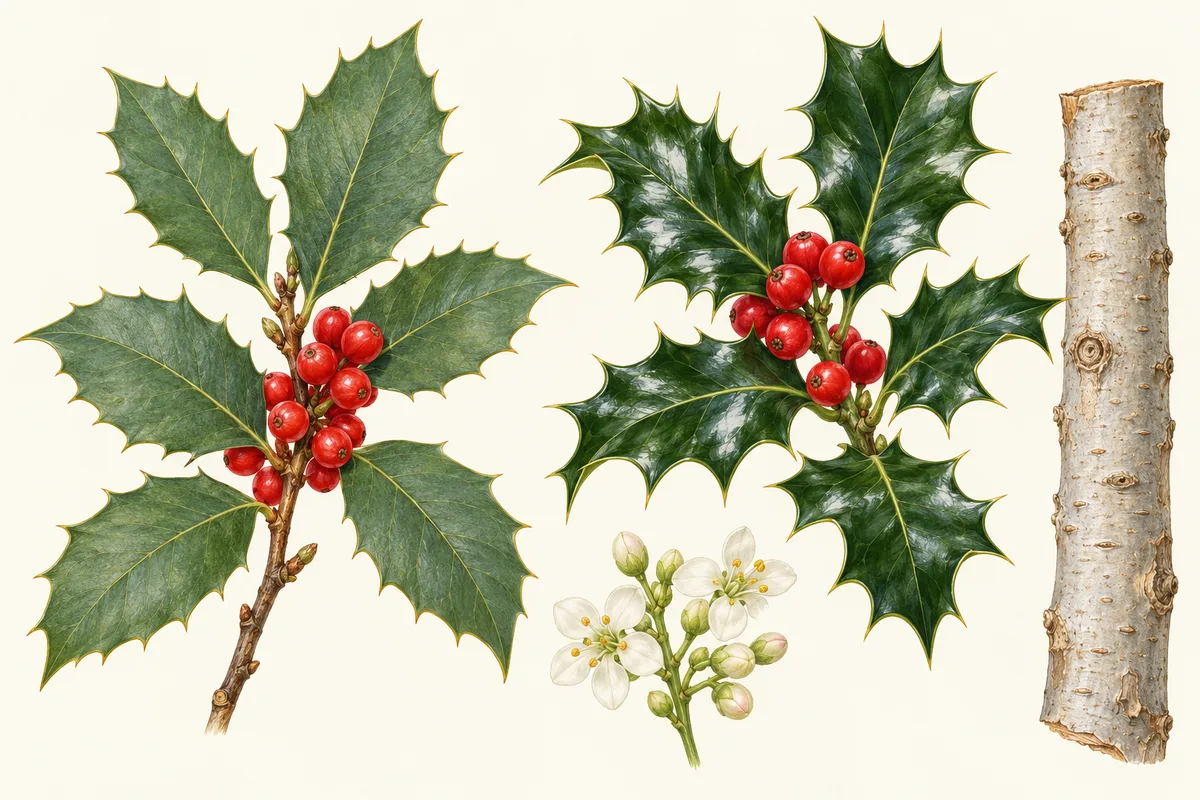
Holly tree identification starts with the leaves: thick, leathery, evergreen and alternate, with sharp spiny teeth on the edge. Then check the bark, which stays smooth and light gray for decades, and the fruit, red berry-like drupes about 1/4 inch across that hang on female trees through winter. Dull leaves with evenly spaced spines mean American holly; glossy, wavy leaves mean English holly.
- Evergreen, leathery, spiny-toothed leaves plus smooth gray bark: that combination makes a tree a holly in almost every North American and British setting.
- Only female hollies carry berries, so a bare holly next to a heavily fruiting one is usually a male, not a different species.
- American holly leaves are dull on top with evenly spaced spines; English holly leaves are glossy and wavy, and old English hollies grow many smooth-edged leaves near the top.
Field marks at a glance
- Scientific name
- Ilex spp. (Ilex opaca, Ilex aquifolium)
- Family
- Aquifoliaceae (holly family)
- Type
- Broadleaf, evergreen
- Leaves
- Alternate, simple, thick and leathery, evergreen, with spiny teeth on the margin. American holly 2 to 4 inches long, dull green above; English holly 1 to 3 inches, glossy, dark green and wavy.
- Spines
- American holly: long, sharp spines evenly spaced along the edge. English holly: spines on young plants and low branches, while older trees and upper-crown leaves are often smooth-edged.
- Bark
- Smooth, thin and light gray to gray-white, often blotched with lichens or dotted with small warts; it stays smooth on old trunks.
- Flowers
- Small, white to greenish-white, four petals, in spring (April to June). Male flowers in small clusters; female flowers single or in twos and threes, on separate trees.
- Fruit
- Berry-like drupes about 1/4 to 1/2 inch (6 to 12 mm), bright red, sometimes orange or yellow, on female trees only; American holly's persist from September into February.
- Male and female
- Hollies are dioecious: each tree is male or female, and a female fruits only when a male grows close enough to pollinate it.
- Size
- American holly usually 15 to 60 feet (5 to 18 m), with a 99-foot national champion in South Carolina; English holly 30 to 50 feet in the US, up to 15 m (49 ft) in Britain.
- Range
- American holly: native from coastal Massachusetts south to central Florida, west to eastern Texas and southeastern Missouri. English holly: native to Europe, North Africa and western Asia; planted and naturalized in the Pacific Northwest.
Hollies are the evergreen trees and shrubs of the genus Ilex whose spiny, leathery leaves and red winter berries turn up on holiday cards on both sides of the Atlantic. In the eastern United States the wild tree is American holly, Ilex opaca. In Britain, Ireland and most of Europe it is common holly, Ilex aquifolium, which Americans call English holly and which gardeners plant across the Pacific Northwest. Three checks name the genus; two more tell the two big hollies apart.
Never eat a berry, nut, seed or pod on the strength of a web page or an app; check with a local expert.
How to recognize a holly in three checks
1. Thick, spiny, evergreen leaves. Holly leaves are alternate, simple and leathery, and they stay green all winter. The edge carries sharp, spiny teeth. The NC State Extension profile of American holly gives leaves 2 to 4 inches long, oblong to elliptic, dull dark green, with long, sharp spines spaced evenly along the margin. Run a finger along the edge: a holly leaf pricks.
2. Smooth, light gray bark. Holly bark stays thin and smooth for decades. NC State describes it as light gray-white, sometimes splotched with red or tan lichens or warty. The Woodland Trust's holly profile describes the same smooth, thin bark with small brown "warts" on English holly. A smooth gray trunk under an evergreen crown of spiny leaves is close to proof in a North American or British wood.
3. Red berries on some trees only. The fruits are small, round, berry-like drupes, usually bright red. Hollies are dioecious: every tree is either male or female. Only females fruit, and only when a male grows close enough to pollinate them. Two hollies of the same size side by side, one covered in berries and one bare, are usually a female and a male.
Tree Identifier can name a holly from one photo of a leafy branch, the berries or the bark. It does not show a confidence score or a list of look-alikes, so check the leaf edge and the leaf's shine yourself before you accept the name.
American holly or English holly
| Feature | American holly (Ilex opaca) | English holly (Ilex aquifolium) |
|---|---|---|
| Leaf surface | Dull, matte dark green | Glossy, dark green, often wavy |
| Leaf size | 2–4 in (5–10 cm) | 1–3 in (2.5–7.5 cm) |
| Spines | Long, sharp, evenly spaced | Strong on young plants and low branches; upper leaves of old trees often smooth-edged |
| Fruit season | Ripens September–December, often persists into February | Ripens August–October, can persist through winter |
| Native range | Eastern and southeastern United States | Europe, North Africa, western Asia |
The American holly column follows NC State and the USDA Forest Service; the English holly column follows NC State's English holly profile and the Woodland Trust. The shine is the fastest test. American holly leaves look matte even when wet, while English holly leaves reflect light like varnish. Gardens, though, are full of hybrids and cultivars, so a planted holly with in-between leaves may be neither species.
American holly in the wild
American holly is a tree of the humid Southeast. The USDA Forest Service's Silvics of North America traces its range from the maritime forests of Massachusetts along the coast to Delaware, then south to mid-peninsular Florida and west to eastern Texas and southeastern Missouri. It grows from sandy Atlantic beaches to thin mountain soils up to about 3,000 feet (915 m), and the largest trees stand in rich coastal-plain bottomlands.
- Size: coastal trees at Sandy Hook, New Jersey, are typically 15 to 30 feet (4.6 to 9.1 m); the national champion in Congaree Swamp, South Carolina, is 99 feet (30.2 m).
- Flowers: from April in the South to June at the northern limit.
- Fruit: round to slightly oval, 1/4 to 1/2 inch (6 to 12 mm), bright red, orange or occasionally yellow, ripening September through December and often lasting all winter unless birds take them.
- Leaves: each leaf stays on the tree until the spring of its third year, and spiny and spineless leaves can grow on the same plant.
English holly in Britain and in the Pacific Northwest
In Britain and Ireland holly is simply "holly", a native tree of woods and hedges. The Woodland Trust describes mature trees up to 15 m (49 ft) that can live 300 years, glossy oval leaves, and a habit that surprises many people: younger plants usually have spiny leaves, while older plants and the leaves high in the crown are more often smooth. White four-petaled flowers open from early spring to the start of summer, and scarlet berries on female trees can last through winter. Our guide to UK native trees puts holly among the other native species.
In North America English holly is a garden tree that has escaped. NC State lists introduced populations in British Columbia, Ontario and several US states, and lists it as invasive in Oregon, California and Alaska. The Washington State Noxious Weed Control Board listed English holly as a Class C noxious weed in 2025 and describes it as a shrub that can reach about 30 feet and dominate forest understories. A holly seedling in a Seattle or Portland woodland is almost always English holly.
Other hollies and the trees mistaken for them
Not every holly is spiny, and not every spiny evergreen is a holly.
- Yaupon (Ilex vomitoria) is the small-leaved holly of the Southeast and Texas. NC State's yaupon profile gives leaves about 1 to 1.5 inches long with round teeth and no spines, on a 10 to 20 foot shrubby tree with clusters of 1/4 inch red fruit.
- Possumhaw is a deciduous holly: red berries on bare branches in winter. Our page on trees with red berries compares them with hawthorn, crabapple and dogwood.
- Oregon grape in the Pacific Northwest has holly-like spiny leaflets but yellow flowers and blue-black berries.
- Yew keeps red fruit through the winter too, but it has flat needles. See the yew page.
Holly in winter
Holly is one of the easiest trees to name in winter, when its green crown stands out in a bare wood. Our winter tree identification guide covers the deciduous trees around it. If you find a female tree full of berries and want to come back to it, Tree Identifier's Tree Map keeps each identification you save with its location, and the History tab keeps the photo and the result.
The ASPCA lists holly as toxic to dogs, cats and horses, naming saponins and listing vomiting, diarrhea and depression as signs. If a pet or child may have eaten berries, call a poison control service or your veterinarian. Tree Identifier's Toxicology tool gives AI-written notes on people, dogs and cats, but it is not a substitute for that call.
Look-alikes and how to tell them apart
Yaupon (Ilex vomitoria)
Yaupon is a holly too, but its leaves are small, about 1 to 1.5 inches, oval and finely round-toothed with no spines. It is usually a 10 to 20 foot shrubby tree of the Southeast and Texas, with clusters of 1/4 inch red berries.
Oregon grape (Mahonia aquifolium)
Its spiny leaflets sit on a compound leaf, and its flowers are yellow and its berries blue to black. The Washington weed board notes that holly's leaf spines alternate up and down, while Oregon grape's all point out or up.
English yew (Taxus baccata)
Yew is also an evergreen with red fruit in winter, but it has flat needles in two rows, not broad spiny leaves, and its red fruit is an open cup around one seed.
What a photo can't settle
- A photo can tell a holly from other evergreens, but the many garden hybrids and cultivars, including blue hollies and variegated forms, are rarely separable to cultivar from one picture.
- Whether a holly is male or female can only be settled from its flowers in spring or its berries in fall and winter; a leaf photo cannot show it.
- Spininess changes with age and shade on the same tree, so photograph several leaves from low and high branches before comparing species.
Questions people ask
Why does my holly tree have no berries?
Most likely it is a male. Hollies are dioecious: male and female flowers grow on separate trees, and only females bear fruit. A female also needs a male nearby to pollinate it, so a lone female holly can stay bare too.
How do I tell American holly from English holly?
Look at the top of a leaf in good light. American holly leaves are dull green with long, evenly spaced spines. English holly leaves are glossy, darker and wavy, and on older trees many upper leaves have smooth edges with few or no spines.
Are holly berries poisonous?
The ASPCA lists holly as toxic to dogs, cats and horses, with vomiting, diarrhea and depression as signs, and NC State names the fruit as the poisonous part. Never eat a berry, nut, seed or pod on the strength of a web page or an app; check with a local expert.
Is English holly invasive?
In parts of the West, yes. NC State lists it as invasive in Oregon, California and Alaska, and Washington listed English holly as a Class C noxious weed in 2025. In Britain and Ireland it is a native tree.
Do holly trees lose their leaves?
American and English holly are evergreen. The USDA Forest Service notes that American holly leaves stay on until the spring of their third year, so old leaves drop in spring as new ones open. Possumhaw is a deciduous holly that loses its leaves in fall.
Sources
- American Holly (Ilex opaca), Silvics of North America — USDA Forest Service
- Ilex opaca (American Holly) — NC State Extension Gardener Plant Toolbox
- Ilex aquifolium (English Holly) — NC State Extension Gardener Plant Toolbox
- Ilex vomitoria (Yaupon Holly) — NC State Extension Gardener Plant Toolbox
- Holly (Ilex aquifolium) — Woodland Trust
- English holly — Washington State Noxious Weed Control Board
- Holly — ASPCA Animal Poison Control