Tree profile
Fir (Abies): how to identify a fir tree
First confirm a true fir with three checks on the cones, needles and twig. Then use the needles, cone bracts and range to name the species.
In short
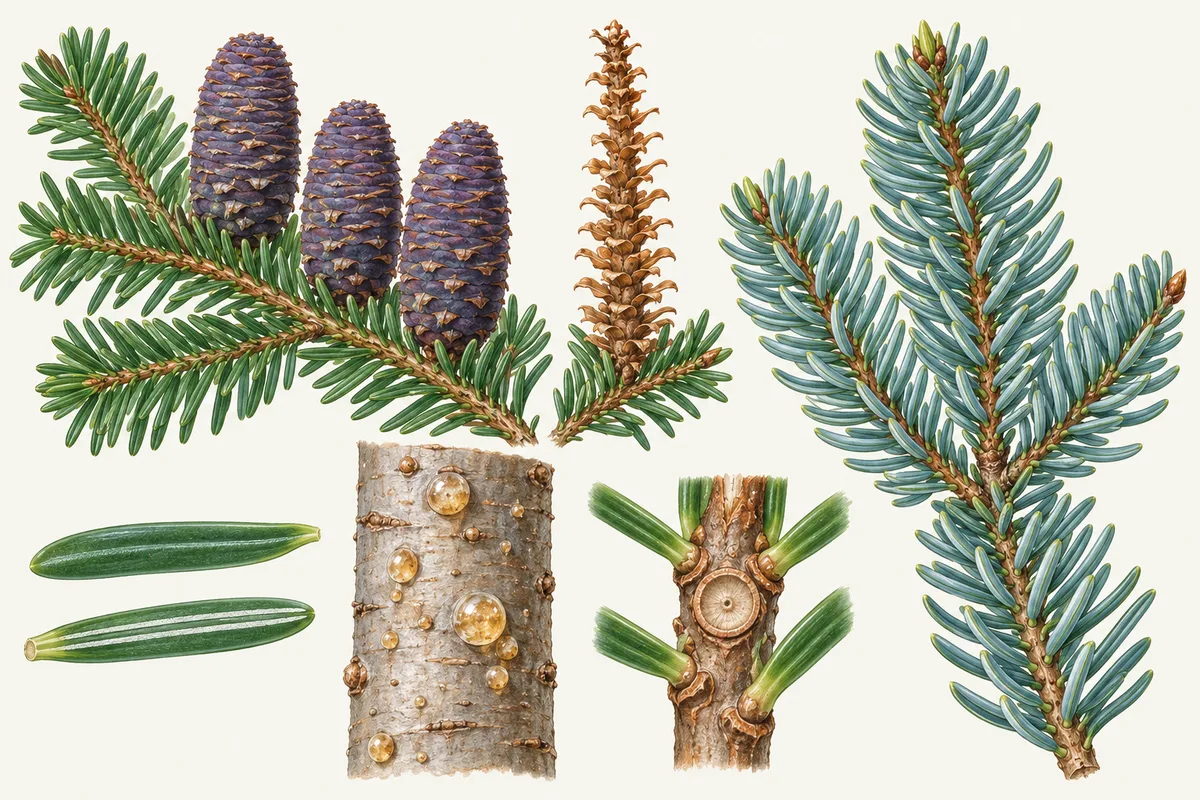
Fir tree identification starts with the cones: true firs carry them upright on the top branches, and they fall apart on the tree, leaving bare spikes, so whole fir cones are rare on the ground. Then check the needles: single, flat and soft, each leaving a round, flat scar when pulled off. Young bark is smooth with resin blisters. The species comes from needle length and colour, cone bracts and range.
- Upright cones that crumble on the branch, flat needles that leave round scars, and resin-blistered young bark: that is a true fir (Abies).
- Douglas-fir is not a true fir: its cones hang and fall whole.
- Bracts that stick out and fold down over the cone scales point to Fraser, noble or European silver fir; hidden bracts point to balsam fir.
Field marks at a glance
- Scientific name
- Abies
- Family
- Pinaceae (pine family)
- Type
- Conifer, evergreen
- Cones
- Upright on the upper branches, barrel-shaped or cylindrical, 4 to 16 cm depending on species. They fall apart on the tree and leave a spike-like central axis.
- Needles
- Single, flat and soft, often with two white bands beneath. Rounded or notched tips on many species. Often spread in two rows along the twig.
- Leaf scars
- A pulled needle leaves a round, flat scar on a smooth twig, with no woody peg (spruce) and no bundle (pine).
- Bark
- Smooth and grey on young trees, with raised resin blisters; breaks into scales, plates or furrows with age.
- Buds
- Small and rounded; often resinous, as on balsam fir (about 5 mm, NRCan).
- Form
- Narrow, regular cone shape tapering to a spire-like top on balsam and subalpine fir; rounded or flat-topped crowns on old western giants.
- Where in North America
- Balsam fir in the North and East; Fraser fir high in the southern Appalachians; white, grand, noble and subalpine fir in the West.
- In Europe and Britain
- European silver fir is native to the mountains of central and southern Europe; Nordmann fir comes from the Caucasus and Turkey.
Fir is the conifer of the Christmas tree lot and the high mountains: balsam fir across the North, Fraser fir in the southern Appalachians, white, grand, noble and subalpine fir in the West, and European silver fir and Nordmann fir in Europe and British gardens. All belong to one genus, Abies. Three checks confirm a true fir; the needles, the cone bracts and where the tree grows then name it.
How to identify a fir tree: cones, needles, twig, bark
1. Look up for the cones. True firs carry their cones upright on the top branches, standing like candles. Natural Resources Canada's balsam fir factsheet describes them as erect and barrel-shaped, 4 to 10 cm long. When they ripen, they fall apart on the tree: the USDA Forest Service's subalpine fir silvics says the scales fall away with the winged seeds, leaving a spike-like central axis. A tree with upright cones, or with bare spikes standing on its top branches, is a fir.
2. Pull a needle. Fir needles grow singly, flat and soft. Pulled off, they leave round, flat scars on the twig, as Virginia Tech's fact sheets for white fir and noble fir describe. A bare fir twig feels smooth; a spruce twig feels rough with woody pegs. On many firs the needles spread in two rows, like the teeth of a comb, and carry two whitish bands underneath.
3. Check the bark of a young tree. Smooth grey bark with raised resin blisters is a fir trait. NRCan describes balsam fir bark as smooth with raised resin blisters when young, breaking into irregular scales with age.
4. Watch out for Douglas-fir. It shares the name but not the genus. Its cones hang and fall whole, with three-pointed bracts sticking out; the Douglas-fir page covers it. For the tests side by side against spruce, see the spruce vs fir guide.
Naming the fir: a species table
Once you know it is a fir, the species usually comes from four things: needle length and colour, needle arrangement, the cone bracts and where you are.
| Fir | Needles | Cones | Where |
|---|---|---|---|
| Balsam (Abies balsamea) | 15–25 mm, shiny dark green, rounded or notched tip, two rows | 4–10 cm, greyish-brown, bracts hidden | Central and eastern Canada, northern US |
| Fraser (A. fraseri) | About 1 in, shiny dark green, silvery white beneath | About 2.5 in, purple-brown, bracts curl down over scales | High southern Appalachians |
| White (A. concolor) | 2–3 in, silvery blue-green on both sides, curving upward | 3–5 1/2 in, yellow-green to purple | Western mountains, Colorado to Oregon and California |
| Grand (A. grandis) | 3/4–2 in, dark yellow-green, two white bands beneath, flat two rows | 2–4 in, green to purplish green | Pacific Northwest, Idaho, southern BC |
| Noble (A. procera) | About 1 in, bluish-white bloom, hockey-stick curve | 4–6 in, bracts turn down and almost cover the scales | Cascades of Washington and Oregon |
| Subalpine (A. lasiocarpa) | Use the crown: long, narrow spire with a spike-like tip | Indigo blue when they open | Rocky Mountains and western mountains to Yukon |
| European silver (A. alba) | 15–30 mm, notched, two rows on shaded shoots | 10–16 cm, bracts stick out and fold back | Mountains of central and southern Europe |
| Nordmann (A. nordmanniana) | 20–30 mm, glossy dark green, densely set, pointing forward | About 15 cm, red-brown | Caucasus and northern Turkey |
Figures for balsam fir are from NRCan, Fraser fir from NC State Extension, white, grand and noble fir from Virginia Tech, subalpine fir from the USDA Forest Service and the two European firs from the Gymnosperm Database.
Firs of the East: balsam and Fraser fir
Balsam fir is the fir of the northern forest. NRCan gives needles 15 to 25 mm long, rounded or notched at the tip, arranged in two ranks with the upper ones shorter, shiny dark green above with 10 to 12 lines of white dots beneath. Buds are broadly egg-shaped, resinous and about 5 mm long. The tree reaches up to 25 m and, grown in a forest, tapers to a spire-like top.
Fraser fir looks much like it, and the bracts separate them. NC State Extension's Fraser fir profile describes upright purple-brown cones about 2.5 inches long, with yellow-green bracts whose tips curl downward, "unlike the short bracts on balsam fir cone that are hidden by the scales." Needles are flat, about 1 inch long, shiny dark green above and silvery white beneath. In the wild it grows only in the Appalachian Mountains of southwestern North Carolina, Virginia and Tennessee, at 4,000 to 6,700 feet, often with red spruce. It is farmed in North Carolina as a Christmas tree.
Firs of the West: white, grand, noble and subalpine fir
White fir has the longest and palest needles of the common firs: 2 to 3 inches, flat, silvery blue-green on both surfaces, standing out from the twig and often curving upward, with a citrus smell when crushed (Virginia Tech). Old trees have thick, ashy grey bark with deep furrows.
Grand fir has the flattest sprays. Virginia Tech's grand fir fact sheet describes needles 3/4 to 2 inches long, dark yellow-green with two white bands beneath, spread in two neat ranks, especially low in the crown, with rounded or notched tips. Cones are 2 to 4 inches, barrel-shaped, green to purplish green. It grows 150 to 200 feet tall, with a long, narrow crown that becomes rounded or flat-topped.
Noble fir has a needle you can feel: about 1 inch long, four-angled, with a bluish-white bloom and a curve at the base that Virginia Tech compares to a hockey stick. Its cones, 4 to 6 inches, are the giveaway: the bracts are longer than the scales and turn down, almost covering the whole cone.
Subalpine fir is the narrow spire near timberline. The USDA Forest Service describes a long, narrow, conical crown ending in a conspicuous spike-like point, and cones that are indigo blue when they open. Its range runs from Arizona and New Mexico north to the Yukon. In southern Colorado and the Southwest, corkbark fir, a variety, has whitish corky bark that sets it apart. The Pacific Northwest tree guide sorts the western firs by forest zone.
Firs in Europe and British gardens: silver fir and Nordmann fir
For readers in Britain and Europe, two firs are worth knowing first. European silver fir grows wild in the mountains of central and southern Europe at 300 to 1,950 m, according to the Gymnosperm Database's Abies alba page. Its needles are 15 to 30 mm with notched or rounded tips, set in two rows on shaded shoots, with pale bands beneath. Its twigs carry fine blackish hairs, and its cylindrical cones, 10 to 16 cm, show bracts that stick out and fold back.
Nordmann fir comes from the western Caucasus and northern Turkey. The Gymnosperm Database's Abies nordmanniana page gives needles 20 to 30 mm long, lustrous dark green above with two white bands beneath, densely set and pointing forward, buds that are not resinous, and red-brown cones about 15 cm long.
Photographing a fir
Fir cones sit at the very top of the tree and break up in early autumn, so most of the year you work from needles. Photograph a twig from above and below, so the needle arrangement and the white bands both show. Tree Identifier names a tree from one photo, and European silver fir is among the 138 species in the app's Collection. The app shows no confidence score and no look-alike list, so check its answer against the cone and needle tests above, and use the follow-up chat to ask about the fir species in your region. The conifer identification key sorts firs from pines, spruces, hemlocks and larches in three questions.
Look-alikes and how to tell them apart
Spruces (Picea)
Spruce needles are four-sided, roll between your fingers and sit on woody pegs that stay on the twig, so a bare spruce twig is rough. Spruce cones hang down and fall whole.
Douglas-fir (Pseudotsuga menziesii)
Hanging cones 3 to 4 inches long with three-pointed bracts sticking out, which fall whole, and long, sharp, red-brown buds. True fir cones stand upright and crumble on the branch.
Hemlocks (Tsuga)
Hemlock needles are shorter, 1/4 to 3/4 inch on western hemlock, and the cones are small, hanging and only about 1 inch long. Fir cones stand upright and are several times bigger.
What a photo can't settle
- Fir cones grow at the very top of the tree and break up in early autumn, so for much of the year you identify from needles alone. A close photo of a twig, top and underside, works better than a photo of the whole tree.
- Christmas trees are cut young and sold without cones, and one lot can sell several firs side by side. Needle length and the white bands help, but the tag is often the quickest answer.
- Needle form varies within a species across its range (the USDA Forest Service notes this for white fir), and garden cultivars vary in needle colour, so treat colour as a clue, not proof.
Questions people ask
How can you tell a fir tree from a spruce?
Pull off a needle. A fir needle is flat, will not roll between your fingers, and leaves a round, flat scar on a smooth twig. A spruce needle is four-sided, rolls easily and leaves a woody peg behind. Fir cones stand upright and fall apart on the branch; spruce cones hang and drop whole.
Why are there no fir cones on the ground?
Fir cones disintegrate on the tree. When they are ripe, the scales fall away with the winged seeds and leave a spike-like central axis standing on the branch, as the USDA Forest Service describes for subalpine fir. Under a fir you find loose scales and seeds, rarely a whole cone.
What is the difference between balsam fir and Fraser fir?
The cone bracts. On Fraser fir, long bracts curl downward over the cone scales; on balsam fir, short bracts are hidden by the scales (NC State Extension). Range helps too: Fraser fir grows wild only at high elevations in the southern Appalachians, balsam fir across the North.
Which fir has blue needles?
White fir and noble fir. Virginia Tech describes white fir needles as silvery blue-green on both surfaces, 2 to 3 inches long and often curving upward, and noble fir needles as about 1 inch long with a bluish-white bloom and a hockey-stick curve at the base.
Is a Douglas-fir a fir?
No. Douglas-fir belongs to its own genus, Pseudotsuga. Its cones hang down and fall whole, with three-pointed bracts sticking out between the scales, and its buds are long and sharp-pointed. True firs (Abies) have upright cones that fall apart on the branch.
Sources
- Balsam fir (Abies balsamea), Trees, insects and diseases of Canada's forests — Natural Resources Canada, Canadian Forest Service
- Abies fraseri (Fraser fir) — NC State Extension, North Carolina Extension Gardener Plant Toolbox
- White fir fact sheet — Virginia Tech Dendrology
- Noble fir fact sheet — Virginia Tech Dendrology
- Grand fir fact sheet — Virginia Tech Dendrology
- Subalpine Fir, Silvics of North America — USDA Forest Service
- Abies alba — The Gymnosperm Database
- Abies nordmanniana — The Gymnosperm Database
Keep reading
- Tree comparisonSpruce vs fir: how to tell them apart
- Tree profileDouglas-fir (Pseudotsuga menziesii): how to identify it
- Tree profileSpruce trees (Picea): how to identify the species
- Tree profileHemlock trees (Tsuga): how to identify them
- Field guideConifer identification: three questions about the needles, then the cone