Tree profile
Sourwood tree (Oxydendrum arboreum): how to identify it
A small Appalachian tree that blooms in midsummer, hangs strings of silver capsules into winter and turns crimson in fall, with leaves that taste sour.
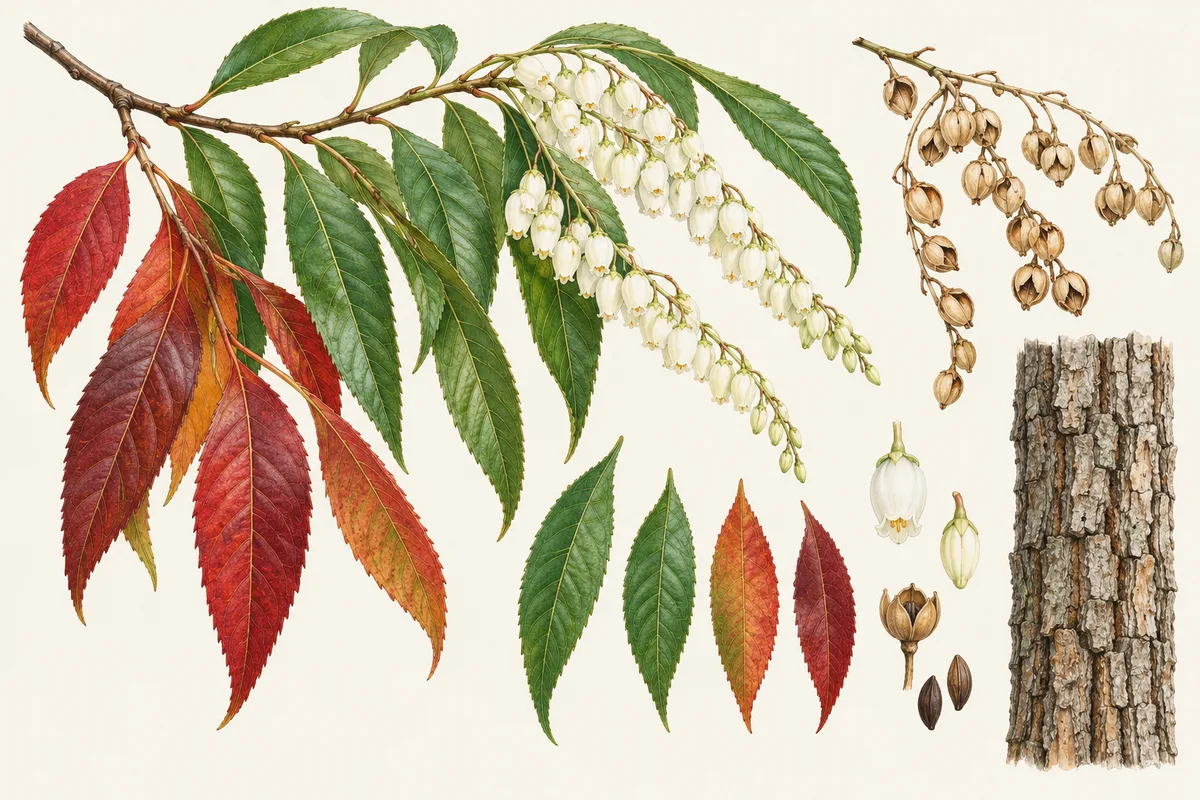
In short
For sourwood tree identification, look for glossy, finely toothed leaves 3 to 7 inches long that taste sour when chewed, drooping one-sided sprays of small white bell flowers 4 to 8 inches long in June to August, and strings of five-part capsules that turn silver-gray in September and stay into winter. Fall color is usually crimson, and old bark is deeply furrowed into scaly, blocky ridges.
- Sourwood is one of the last eastern trees to flower: the USDA Forest Service gives late June through August.
- The flower stalks stay on the tree as long, curved fingers of silver-gray capsules into winter, a clue in every season.
- It is a small understory tree, usually 20 to 50 feet, often with a leaning trunk and an irregular crown.
Field marks at a glance
- Scientific name
- Oxydendrum arboreum
- Family
- Ericaceae (heath or blueberry family)
- Type
- Broadleaf, deciduous
- Leaves
- Alternate, simple, elliptic to lance-shaped, 3 to 7 inches long, glossy green above and paler below, edges very finely toothed; a chewed leaf tastes noticeably sour.
- Flowers
- White, waxy, urn-shaped bells about 1/4 inch, on slender, drooping, one-sided sprays 4 to 8 inches long at the branch tips, late June to August.
- Fruit
- Dry, five-part capsules 1/3 to 1/2 inch, held along the old flower stalks; they ripen silver-gray in September and October and hang on into winter.
- Fall color
- Crimson to red or reddish purple, sometimes yellow or purple.
- Bark
- Gray to grayish brown, thick, with deep furrows and scaly ridges that break into rectangular blocks on old trunks.
- Twigs
- Olive green turning red, with tiny, round buds that are almost invisible; first-year shoots are often bright red.
- Size
- Usually 20 to 50 ft (6 to 15 m) tall and 8 to 12 in across; 20 to 30 ft in gardens. Often a leaning trunk and an irregular crown.
- Range
- Southwestern Pennsylvania and southern Ohio and Indiana south to the Gulf coast and southeastern Louisiana, east to the Atlantic from southern Virginia to central North Carolina; largest in the Great Smoky Mountains.
Sourwood is a small tree of the southern Appalachians and the Southeast that is easy to walk past in spring and hard to miss from July on. When almost every other tree has finished flowering, it hangs long, curved sprays of tiny white bells from its branch tips. The sprays then turn into strings of silver-gray capsules that stay on through fall, when the leaves go crimson. It belongs to the blueberry family, and it is the source of sourwood honey.
How to identify a sourwood tree
Check these features in order; three matches settle it.
1. Leaves: glossy, finely toothed, sour. Virginia Tech's sourwood fact sheet describes alternate, simple leaves, elliptic to lance-shaped, 4 to 7 inches long, with very finely toothed edges and slight fuzz along the midrib underneath. NC State's Plant Toolbox gives 3 to 6 inches and compares them to a peach leaf. The teeth are so fine that you may need to run a fingernail along the edge to feel them.
2. Flowers: drooping white fingers in midsummer. The flowers are white, waxy and urn-shaped, about 1/4 inch long, like lily-of-the-valley bells. They line one side of slender, drooping sprays 4 to 8 inches long, grouped at the ends of the branches (NC State). The USDA Forest Service's Silvics of North America gives a flowering season from late June through August.
3. Fruit: strings of silver capsules. After flowering, each bell becomes a dry, five-part capsule 1/3 to 1/2 inch long. They ripen silver-gray in September and October and stay on the curved stalks into winter, releasing tiny seeds a few at a time. This is the clue that works in fall and winter, when the flowers are long gone.
4. Fall color: crimson. NC State describes fall color as crimson to red or reddish purple, sometimes yellow or purple. A red crown hung with pale seed strings is close to unique.
5. Bark and form. Virginia Tech describes grayish-brown, very thick bark with deep furrows and scaly ridges that often break into rectangular patches. The tree usually has crooked branches and an irregular crown, and in the open its trunk is short and often leans (USDA Forest Service).
When the branches are out of reach, Tree Identifier can name a sourwood from one photo of a leafy branch, a flower spray or the whole tree. It shows the common and scientific names without a confidence score or a list of look-alikes, so confirm with the flower sprays or capsules.
Sourwood through the seasons
Sourwood looks different enough from month to month that it pays to know what to expect.
| Season | What you see | Best clue |
|---|---|---|
| Spring | Glossy new leaves; twigs olive green turning red | Leaves finely toothed, slightly sour |
| June to August | White bell flowers on drooping one-sided sprays 4–8 in long | Blooms when nearly nothing else does |
| September to October | Capsules turn silver-gray; leaves turn crimson | Red crown hung with pale seed strings |
| Winter | Bare tree with curved strings of empty capsules | Persistent capsule strings, deeply furrowed bark |
Dates and sizes come from the USDA Forest Service and NC State Extension. The twig details are from Virginia Tech, which notes that sourwood's buds are small, round and nearly absent, with raised leaf scars, a quick check in winter when other trees show plump buds. For other trees named by their fall color, see fall tree identification.
Sourwood vs black gum, persimmon and black cherry
In summer, before the flowers open, sourwood shares a plain oval leaf with several eastern trees. Virginia Tech lists black gum, downy serviceberry, black cherry and common persimmon as its look-alikes.
- Black gum has smooth-edged leaves, small blue-black fruit on female trees and bark broken into thick blocks; see the black gum page for the full profile. Both turn red in fall, so check the leaf edge and the fruit.
- American persimmon has bark in small square blocks, nearly black buds and orange fruit on female trees; the persimmon page covers it.
- Black cherry also hangs white flowers in drooping clusters, but NC State's black cherry page gives late April to May, with the leaves, and the clusters become purple-black cherries. Its leaf teeth curve inward and its leaf stalk has small glands.
- Downy serviceberry flowers in early spring with strap-like petals and keeps smooth gray bark.
Timing is the shortcut: a tree in white flower in July in the southern Appalachians is very likely a sourwood. For other trees that bloom white, see the guide to trees with white flowers.
Where sourwood grows
The USDA Forest Service gives a native range from southwestern Pennsylvania and southern Ohio and Indiana, south to southeastern Louisiana and the Gulf coast, west to western Kentucky and Tennessee, and east to the Atlantic coast from southern Virginia to central North Carolina. Sourwood reaches its largest size on the western slopes of the Great Smoky Mountains in Tennessee, and it grows up to about 5,000 feet in the central Appalachians. For other trees of the mountains, see the Appalachian tree identification guide.
It is a tree of the forest understory: the Forest Service describes it as shade-tolerant, staying under taller trees from seedling to maturity, with a slender trunk and small crown in dense stands. It generally avoids limestone soils and sprouts freely from stumps after cutting. NC State lists it in every region of North Carolina, though rarer on the low coastal floodplains.
Outside its range, sourwood is planted as an ornamental for its summer flowers and fall color. NC State gives USDA hardiness zones 5 to 9 and a garden size of 20 to 30 feet tall and 10 to 15 feet wide, with slow growth.
Sourwood honey, wood and names
The USDA Forest Service notes that sourwood flowers are an important honey source in some areas and that sourwood honey is marketed locally; NC State calls it rich and popular. The wood is heavy but of little timber value, used for handles, fuel and pulp.
The names all point to the leaf. NC State lists lily-of-the-valley tree, sorrel tree and sourwood, and older botanical names (Andromeda arborea, Lyonia arborea) come from its earlier placement in other genera of the same family as blueberries, Ericaceae. The leaves contain oxalic acid, which explains the sour taste (NC State).
Sourwood is not one of the 138 species in Tree Identifier's Collection, though a photo still returns a name. Saving an identification to the app's Tree Map lets you come back to the same tree in July to see it bloom, or in October for the crimson leaves described in our guide to trees with red leaves in fall.
Look-alikes and how to tell them apart
Black gum (Nyssa sylvatica)
Black gum leaves have smooth edges, not fine teeth, and do not taste sour; female trees carry small blue-black fruits instead of strings of dry silver capsules, and a sliced twig shows a chambered pith.
American persimmon (Diospyros virginiana)
Persimmon bark is cut into small square blocks like a checkerboard, its buds are nearly black, and female trees carry orange fruit 1 to 1.5 inches across. Sourwood leaves are finely toothed and its fruit is a dry capsule.
Black cherry (Prunus serotina)
Black cherry flowers in late April to May, not midsummer, and its drooping clusters become purple-black cherries. Its leaves have incurved teeth and two small glands on the leaf stalk, and mature bark turns dark and scaly.
Downy serviceberry (Amelanchier arborea)
Serviceberry blooms in early spring before or as the leaves open, with five strap-like petals, and bears small berries that ripen purple-black by June or July. Its bark stays smooth and gray, unlike sourwood's deep furrows.
What a photo can't settle
- In early summer, before the flowers, a sourwood leaf is a plain, finely toothed oval that resembles black cherry, persimmon and black gum; a single leaf photo is weak evidence without the flower sprays or capsules.
- The sour taste test is a tradition of dendrology classes; never put any plant part in your mouth unless you are sure what the tree is, and never eat a fruit, leaf or seed on the strength of a web page or an app.
Questions people ask
Why is it called sourwood?
Because the leaves taste sour. Virginia Tech's dendrology fact sheet notes a noticeably sour taste when a leaf is chewed, and NC State Extension says the leaves contain oxalic acid. NC State also lists the older common name sorrel tree.
When does sourwood bloom?
In midsummer. The USDA Forest Service gives late June through August and calls sourwood among the latest flowering trees and shrubs; NC State Extension gives June to July. By then most other eastern trees have finished flowering, so a tree covered in white sprays in July is a strong clue.
How big does a sourwood tree get?
The USDA Forest Service gives 20 to 50 feet and 8 to 12 inches in trunk diameter as usual, with the largest trees on the western slopes of the Great Smoky Mountains. NC State Extension gives 20 to 30 feet for planted trees, and Virginia Tech up to about 60 feet.
Is sourwood honey from this tree?
Yes. The USDA Forest Service describes sourwood flowers as an important honey source in some areas, with sourwood honey marketed locally, and NC State Extension notes that bees make a popular honey from the nectar.
Does sourwood grow outside the Appalachians?
Its native range reaches beyond the mountains, south to the Gulf coast and east to the Atlantic in Virginia and North Carolina, according to the USDA Forest Service. NC State lists it as hardy in USDA zones 5 to 9, so planted trees turn up farther north as ornamentals.
Sources
- Sourwood, Silvics of North America — USDA Forest Service
- Oxydendrum arboreum (Lily of the Valley Tree, Sorrel Tree, Sourwood) — North Carolina Extension Gardener Plant Toolbox, NC State University
- Sourwood (Oxydendrum arboreum) fact sheet — Virginia Tech Dendrology
- Prunus serotina (Black Cherry) — North Carolina Extension Gardener Plant Toolbox, NC State University
- Nyssa sylvatica (blackgum) — North Carolina Extension Gardener Plant Toolbox, NC State University
- Diospyros virginiana (American persimmon) — North Carolina Extension Gardener Plant Toolbox, NC State University
Keep reading
- Clue guideWhich trees have red leaves in fall? Sort them by leaf shape
- Tree profileBlack gum tree (Nyssa sylvatica): black tupelo, sour gum, pepperidge
- Tree profilePersimmon tree (Diospyros): how to identify it
- Clue guideWhich tree has white flowers? Start with the month
- Tree profileSassafras (Sassafras albidum): how to identify it