Field guide
Fall tree identification, in the order that works
Autumn color is the clue everyone sees and the least reliable one. Read the leaf, the timing and the fruit first, and use the color to confirm.
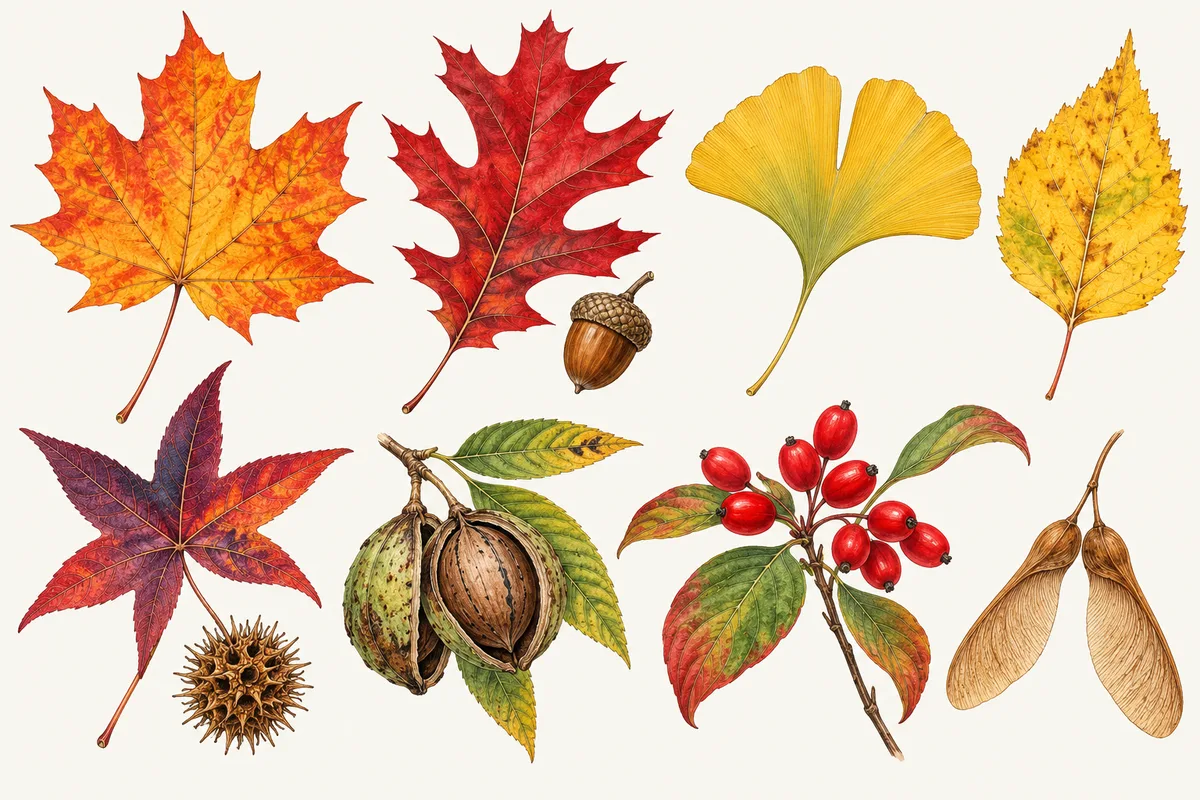
In short
For fall tree identification, read the leaf shape and arrangement first, then the timing, the fruit and the color. Sumacs and sourwood turn first and oaks last; nuts, acorns and winged seeds ripen now; and color only confirms: oaks usually go red or brown, hickories golden, dogwoods purple-red. The same species can turn different colors from tree to tree.
- Harvard Forest: red maples vary in color within a single tree and even within one leaf, so color alone rarely names a tree.
- UGA Extension: sourwood often turns and drops while most trees are still green, and oaks are usually the last to change.
- Fall is the best season for fruit: walnut and hickory husks, ash seed clusters and spindle's pink capsules all show in September and October.
Fall makes trees easier to notice and, oddly, a little harder to name: the color that catches your eye is the clue that varies most. Use it last. The leaf, the date and the fruit, all at their most visible in September and October, do most of the work. Never eat a berry, nut, seed or pod on the strength of a web page or an app; check with a local expert.
The four checks, in order
| Order | What to read | Why it works in fall | Example |
|---|---|---|---|
| 1 | Leaf shape and arrangement | Unchanged from summer; the strongest clue | Lobes with bristle tips mean a red oak; paired leaves mean a tree from the opposite-leaf list, such as maple, ash, dogwood or buckeye |
| 2 | Timing | Species turn in a broadly fixed order | Sumac and sourwood early, oaks last |
| 3 | Fruit, nuts and seeds | Most ripen in September and October | Walnut husks, hickory husks, ash seed clusters, acorns |
| 4 | Color | Confirms, rarely decides | Oaks red or brown, hickories golden, dogwoods purple-red |
Leaf first. A sugar maple leaf in orange is still a five-lobed, opposite leaf, and a red oak leaf is still alternate with bristle-tipped lobes. The leaf identification guide gives the five checks in order. If the color is the only thing you remember, the two color pages narrow it by leaf shape: trees with red leaves in fall and trees with yellow leaves in fall.
Why color is the weakest clue
The Harvard Forest account of leaf color change explains what you are looking at. All leaves lose chlorophyll through the season, faster before leaf fall. Some carotenoid pigments stay behind, which gives yellow. Red comes from anthocyanins made just before the leaves drop; Harvard Forest calls red the most common autumn color and reports that about 70 percent of its trees and shrubs produce anthocyanins. Anthocyanin mixed with chlorophyll gives brownish tones, and with carotenoids, orange.
The same page warns against trusting color. Sugar maples vary from one tree to the next, and red maples vary within a single tree and even within one leaf. A red maple can be scarlet, orange or yellow, and two sugar maples on the same street can turn a week apart. That is why this guide puts color fourth.
Timing: who turns first and who turns last
Timing is a better clue than people expect, because the order holds from year to year even when the dates shift.
- Early. UGA Extension notes that sourwood leaves often change color and fall while most other species are still green. Clemson Extension names winged and staghorn sumacs among the first to show color.
- Middle. Maples, sweetgum, black gum, sassafras and hickories. Clemson describes sweetgum giving yellow, orange, maroon and purple "regardless of the weather", black gum turning orange, sassafras mixing yellows, oranges, reds and sometimes purples, and hickories a rich golden-yellow.
- Late. UGA says oaks tend to be the last to change. Clemson adds that the larger-leaved oaks peak after the maples fade, and singles out scarlet oak as the best oak for fall color.
So a tree still green when the maples around it have dropped is often an oak, and a small tree already scarlet in early September in the Southeast may be a sourwood or a sumac.
Fruit, nuts and seeds: the fall-only clues
Many trees carry their fruit in September and October, and fruit separates trees whose leaves look alike.
Walnut and hickory. Both have alternate compound leaves that turn yellow. The husk decides. NC State describes the black walnut nut, 1 to 3 inches across, inside a yellow-green husk that does not split and stains skin and clothing, ripe in October. Shagbark hickory's husk, says NC State, is 1.5 to 2 inches across and splits into four parts when the nut is ripe, also in October. Look for walnuts and hickory husks under the tree; the seeds and nuts guide covers the rest.
Ash. White ash bears single-winged seeds up to 2 inches long in drooping clusters, ripening in fall and often staying through winter, according to NC State, on opposite, feather-like leaves of usually 7 leaflets. Paired wings instead would point to a maple.
Acorns. Any acorn means an oak, and with the leaf it often tells you the group: bristle-tipped lobes for the red oaks, rounded lobes for the white oaks.
Autumn tree identification in the UK
In Britain and Ireland, the fruit is again the best partner to the leaf.
Spindle is the most striking autumn small tree in hedges. The Woodland Trust describes shiny, finely toothed leaves that turn a rich orange-red before falling, bright pink fruits with orange seeds, and green twigs with light brown corky marks. It warns that leaves and fruit are toxic to humans. In leaf it is easily confused with dogwood, but the pink fruit settles it.
Sycamore, field maple and Norway maple all have palmate, lobed leaves and winged seeds. The Woodland Trust gives sycamore's leaves as five-lobed and 7 to 16 cm, often on red stalks on younger trees, and says its V-shaped pairs of seeds meet at a narrower angle than those of the other two maples. Fallen bunches of seeds under the tree make this an autumn test.
Fallen leaves and what is left on the tree
Leaves on the ground are easy to collect, but they travel. Pick several from directly under the crown and compare them with leaves still on the branches. Note whether a "leaf" is really one leaflet of a compound leaf: ash, walnut, hickory and locust leaves often break apart as they fall, scattering single leaflets that look like whole simple leaves.
Late in the season, trees that still hold dry brown leaves after the others are bare are worth a look too; the winter tree identification guide picks up from there with buds and twigs.
Using a photo in fall
A photo of one typical leaf, plus a nut, acorn or seed cluster if there is one, gives the best lead; a wide shot of a colorful crown gives the least. Tree Identifier names a tree from one photo, and sugar, red and Norway maple, sweetgum, black gum, ginkgo, sassafras, tulip tree and several oaks are among the species in its Collection. It shows no confidence score and no list of alternatives, so check the answer against the leaf and fruit clues above. The Tree Map in Tree Identifier keeps the spot, so you can return in spring to see the flowers and confirm the name.
What a photo can't settle
- Fall color varies with weather, soil and the individual tree, so a color match is never proof of a species.
- Fallen leaves blow in from neighboring trees. Match a leaf on the ground to leaves still on the crown before naming the tree.
- No page or app can tell you a fall nut, berry or seed is safe to eat. Treat any identification as a name to check with a local expert.
Questions people ask
Can you identify a tree by its fall color?
Only roughly. Color narrows the list: oaks usually go red or brown, hickories golden-yellow, dogwoods purple-red. But Harvard Forest notes that sugar maples vary from tree to tree and red maples vary within one tree and even one leaf. Confirm with the leaf shape, the arrangement on the twig and the fruit.
Which trees change color first in fall?
In the Southeast, UGA Extension says sourwood often changes and drops its leaves while most other trees are still green, and Clemson Extension names winged and staghorn sumacs among the first to show color. Oaks are usually the last.
Why do some trees turn red and others yellow?
Yellow and orange come from carotenoid pigments that remain when the green chlorophyll breaks down. Red comes from anthocyanins, which many trees make just before the leaves fall. Harvard Forest reports that about 70 percent of its trees and shrubs produce them, and anthocyanin over carotenoids gives orange.
How do I identify a tree from a fallen leaf?
Pick several leaves from under the tree, not just the brightest one, and check that they match the crown above. Note the shape, lobes, teeth and whether it is one blade or a leaflet of a compound leaf. Then look for nuts, acorns or winged seeds on the ground nearby.
What is a good autumn tree identification tip in the UK?
Look at the fruit as much as the leaves. Spindle shows bright pink fruit with orange seeds as its leaves turn orange-red, and sycamore's paired seeds meet at a narrower angle than those of field maple and Norway maple, as the Woodland Trust describes.
Sources
- The Process of Leaf Color Change — Harvard Forest, Harvard University
- Water, weather and species control the fall leaf show (Tripp Williams, 21 November 2012) — University of Georgia Cooperative Extension
- Native Trees for Fall Color (Paul Thompson, 28 October 2021) — Clemson Cooperative Extension, Home & Garden Information Center
- Juglans nigra (black walnut) — North Carolina Extension Gardener Plant Toolbox, NC State University
- Carya ovata (shagbark hickory) — North Carolina Extension Gardener Plant Toolbox, NC State University
- Fraxinus americana (white ash) — North Carolina Extension Gardener Plant Toolbox, NC State University
- Spindle (Euonymus europaeus) — Woodland Trust
- Sycamore (Acer pseudoplatanus) — Woodland Trust
Keep reading
- Clue guideWhich trees have red leaves in fall? Sort them by leaf shape
- Clue guideWhich trees have yellow leaves in fall? Sort them by leaf shape
- Field guideHow to identify trees by their leaves
- Winter field guideWinter tree identification, from buds to bark
- Field guideTree seed identification: from acorn, pod or samara to the tree