Clue guide
Trees with opposite leaves, sorted by simple and compound
Leaves in pairs across the twig narrow a broadleaf tree to a short list. One more check, simple or compound, splits that list into groups you can name on the spot.
In short
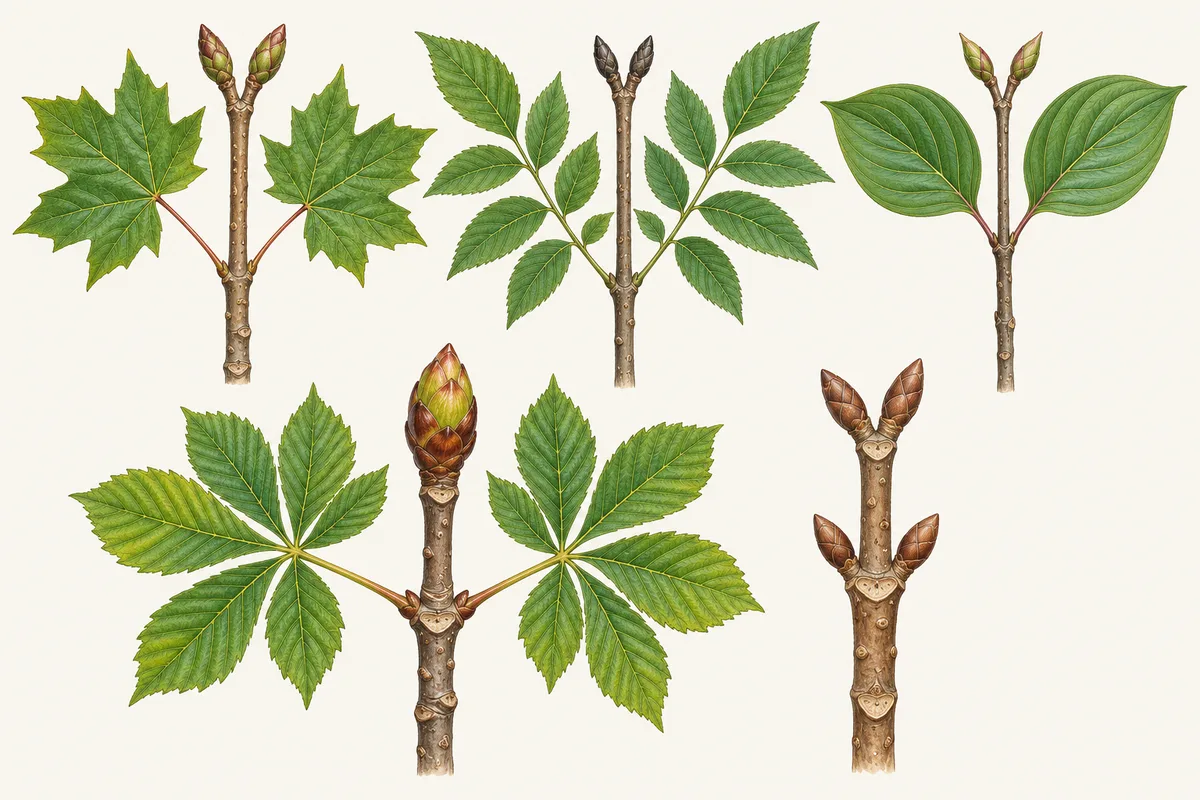
Trees with opposite leaves are mostly maples, ashes, dogwoods and buckeyes or horse chestnuts, which students remember as MAD Cap Horse. Simple, lobed leaves in pairs mean a maple; a feather-like compound leaf means an ash or boxelder; five to seven leaflets spread like a hand mean a buckeye. Huge heart-shaped leaves in pairs or threes point to catalpa or paulownia.
- Virginia Tech's dendrology primer: most tree species have alternate leaves, so a pair of leaves at the same node already cuts the list to a handful of groups.
- Opposite and simple: maples, dogwoods, catalpa, paulownia, fringetree, spindle. Opposite and compound: ashes, boxelder, buckeyes and horse chestnut, elders.
- Check three or four twigs, not one: a lost leaf or a broken shoot makes an opposite tree look alternate.
Most broadleaf trees carry one leaf at each point on the twig. A tree whose leaves come in pairs, one on each side at the same point, belongs to a much shorter list, and that list is worth learning by heart. Never eat a berry, nut, seed or pod on the strength of a web page or an app; check with a local expert. Several trees below, buckeye and spindle among them, are reported poisonous.
The opposite-leaf list at a glance
Virginia Tech's dendrology primer puts it plainly: most species have alternate leaves, and a tree with opposite leaves is very likely a maple, an ash, a dogwood, a member of the honeysuckle family (Caprifoliaceae) or a horse chestnut or buckeye. Students remember it as MAD Cap Horse. Since the primer was written, the viburnums and elders have been moved out of the honeysuckle family, but the shortcut still works in the field.
The table adds the second check, simple or compound, and the trees outside the acronym that you will meet in yards and streets.
| Leaf | Tree | What settles it | Where |
|---|---|---|---|
| Simple, palmately lobed | Maples (Acer), incl. sycamore maple and field maple in the UK | Paired winged seeds (samaras); 3 to 5 lobes with veins from one point | Across North America and Europe |
| Simple, smooth edge, curved veins | Flowering dogwood (Cornus florida) | Veins curve toward the tip; four white bracts in spring; red fruit in fall | Southeastern Canada to eastern Mexico |
| Simple, huge, heart-shaped | Northern catalpa (Catalpa speciosa) | Leaves 6–12 in, often three per node; bean-like pods up to 22 in | Central and eastern US, planted widely |
| Simple, huge, velvety | Paulownia (Paulownia tomentosa) | Hairy on both sides; violet flowers in spring; egg-shaped woody capsules | Invasive in the East |
| Simple, small, finely toothed | European spindle (Euonymus europaeus) | Pink capsules opening to orange-coated seeds in fall | Europe; naturalized in eastern North America |
| Pinnately compound, 5–9 leaflets | Ashes (Fraxinus) | Leaves 8–12 in; narrow single-winged seeds; diamond-ridged bark | Eastern North America; ash in Europe |
| Pinnately compound, 3–5 leaflets | Boxelder (Acer negundo) | Coarse, irregular leaflets; green to purplish twigs; paired samaras | The widest range of any maple |
| Palmately compound, 5–7 leaflets | Buckeyes and horse chestnut (Aesculus) | Leaflets spread like fingers; spiny or warty husk with shiny brown seeds | Ohio Valley and South; horse chestnut planted |
Leaf and fruit details are from the NC State Extension Gardener Plant Toolbox profiles cited on this page, read on 21 October 2026.
How to check that leaves are really opposite
- Find a node. A node is the point where a leaf stalk joins the twig. On an opposite tree two stalks leave the same node, facing each other.
- Check three or four twigs. Leaves get torn off by wind and insects, so a single twig can lie. Pairs repeated on every twig are the real thing.
- Look at the side branches too. Twigs grow from buds in the leaf angles, so on an opposite tree the side twigs also come off in pairs, and the whole crown looks symmetrical.
- Find the bud to rule out leaflets. The leaflets of an ash or walnut also sit in pairs along a stalk, but that is one compound leaf. The bud sits where the whole leaf meets the twig, never at the base of a leaflet. The leaf identification guide explains the leaf-versus-leaflet test in more detail.
Three or more leaves at one node is a whorl, which the catalpa often shows. Treat a whorl as a variant of opposite for this page.
Opposite and simple: maples, dogwoods and the big-leaved pair
Maples are the commonest answer. The leaf is one blade with three to five lobes, the main veins fan out from the base, and the seeds are paired wings. Red maple, sugar maple, silver maple and Norway maple in North America, and sycamore maple and field maple in the UK, all follow this pattern. The maple guide separates the species by lobes, teeth and sap.
Flowering dogwood has a smooth-edged oval leaf, and NC State gives the detail that settles it: 6 or 7 pairs of veins that curve from the base toward the tip. The leaves are about 2.5 to 6 inches long. In spring the tree carries four white, notched bracts around a button of tiny flowers, and from August to October clusters of glossy red fruit. The bark breaks into small scaly blocks with age. More on the dogwood page.
Catalpa and paulownia are the two trees with enormous paired leaves. NC State describes northern catalpa leaves as whorled or opposite, 6 to 12 inches long, with white bell-shaped flowers striped orange and purple inside and bean-like capsules up to 22 inches long. Paulownia, also called empress or princess tree, has opposite, oval to heart-shaped leaves 5 to 12 inches long with velvety hairs on both surfaces. NC State lists it as invasive in North Carolina and by the USDA National Invasive Species Information Center; its flowers are pale violet and its fruit is a woody capsule 1 to 1.5 inches long full of winged seeds. Long thin pods mean catalpa; egg-shaped capsules mean paulownia. The catalpa page covers both.
European spindle is a shrub or small tree with small, finely toothed leaves in pairs. NC State gives leaves 1 to 3 inches long and pinkish-red capsules that split to show seeds coated in orange, and reports all parts, berries included, as poisonous. It is native to Europe and western Asia and has spread into eastern Canada and the eastern US.
Opposite and compound: ashes, boxelder and buckeyes
Ashes carry a feather-like leaf. For white ash, NC State gives leaves 8 to 12 inches long with usually 7 leaflets, sometimes 5 or 9, and bark with deep furrows that form a net of diamond-shaped ridges. The seeds are single-winged samaras up to 2 inches long in hanging clusters, often still on the tree in winter. NC State no longer recommends planting ash because emerald ash borer usually kills a tree within 3 to 5 years. The ash page separates white, green and European ash.
Boxelder is the maple with a compound leaf, so people often mistake it for an ash or even for poison ivy. NC State gives usually 3 to 5 leaflets, occasionally 7, green new twigs and paired samaras that hang on into winter. Paired wings mean maple; a single wing means ash.
Buckeyes and horse chestnut have palmately compound leaves: five to seven leaflets radiating from the top of one long stalk. For Ohio buckeye, NC State describes 5 to 7 smooth leaflets and a warty or prickly leathery husk holding shiny brown seeds with a pale scar, maturing in October. It lists the seeds, leaves and bark as poisonous. The planted European horse chestnut follows the same pattern; the chestnut vs buckeye page shows why neither is a true chestnut. The compound leaves guide covers the alternate compound leaves as well.
Elders are shrubs or small trees with opposite, feather-like leaves, the "Cap" of the acronym along with the viburnums; see the elder page.
Alternate trees people mistake for opposite
- Walnuts, hickories, sumacs and black locust. Their leaflets come in pairs, but the leaves themselves are alternate. Find the bud at the leaf base and count one per node.
- Short spur shoots. On cherries, apples and ginkgo, leaves crowd on short stubby shoots and can look paired. Look at a long new shoot instead.
- Oaks. Leaves cluster near the tips of twigs, but along the twig they are alternate.
Using a photo
A photo of a twig with two or three pairs of leaves shows the arrangement; a single picked leaf does not. Tree Identifier names a tree from one photo, and red, sugar, Norway and Japanese maple, European ash, horse chestnut, flowering dogwood, southern catalpa and paulownia are among the species in its Collection. It shows no confidence score and no list of alternatives, so check the answer against the table above. If the name surprises you, the follow-up chat under the result can explain how that species differs from the one you expected. Tree Identifier's Toxicology notes are AI-written and are not a safety verdict.
What a photo can't settle
- A photo of a single leaf does not show the arrangement. Photograph a twig with at least two nodes so the pairs are visible.
- Some shrubs and garden plants are subopposite, with pairs slightly offset along the twig, and can be read either way.
- Garden cultivars of maples, dogwoods and horse chestnut can have leaves unlike the wild species; neither this page nor a photo gives the cultivar.
Questions people ask
What does MAD Cap Horse stand for?
Maple, Ash, Dogwood, Caprifoliaceae (the honeysuckle family, which in older books held the viburnums and elders) and Horse chestnut, which includes the buckeyes. Virginia Tech's dendrology primer gives it as the student shortcut for trees with opposite leaves.
What tree has opposite compound leaves?
An ash if the leaf is feather-like with usually 5 to 9 leaflets; a boxelder if there are usually 3 to 5 coarse leaflets and green twigs; a buckeye or horse chestnut if 5 to 7 leaflets spread from one point like a hand. A shrub with feather-like paired leaves is often an elder.
Are oaks opposite or alternate?
Alternate. Oaks, elms, birches, beeches, cherries, walnuts and hickories all carry one leaf per node. If the leaves come in pairs, you can set all of them aside.
Is catalpa opposite or whorled?
Both, and sources differ on which to call it. NC State lists northern catalpa leaves as whorled or opposite: often three leaves meet at one node, sometimes two. Either way, the huge heart-shaped leaves and long bean-like pods settle it.
How do I tell opposite leaves in winter?
Look at the buds and the leaf scars. Buds form where each leaf met the twig, so on an opposite tree they also sit in pairs, and so do the side twigs. The winter tree identification guide covers the bud shapes that then separate maple from ash.
Sources
- Basics of Tree ID: Arrangement — Virginia Tech Dendrology
- Fraxinus americana (white ash) — North Carolina Extension Gardener Plant Toolbox, NC State University
- Acer negundo (boxelder) — North Carolina Extension Gardener Plant Toolbox, NC State University
- Aesculus glabra (Ohio buckeye) — North Carolina Extension Gardener Plant Toolbox, NC State University
- Cornus florida (flowering dogwood) — North Carolina Extension Gardener Plant Toolbox, NC State University
- Catalpa speciosa (northern catalpa) — North Carolina Extension Gardener Plant Toolbox, NC State University
- Paulownia tomentosa (empress tree) — North Carolina Extension Gardener Plant Toolbox, NC State University
- Euonymus europaeus (European spindle tree) — North Carolina Extension Gardener Plant Toolbox, NC State University