Clue guide
Which tree has compound leaves? Count the leaflets, then check the twig
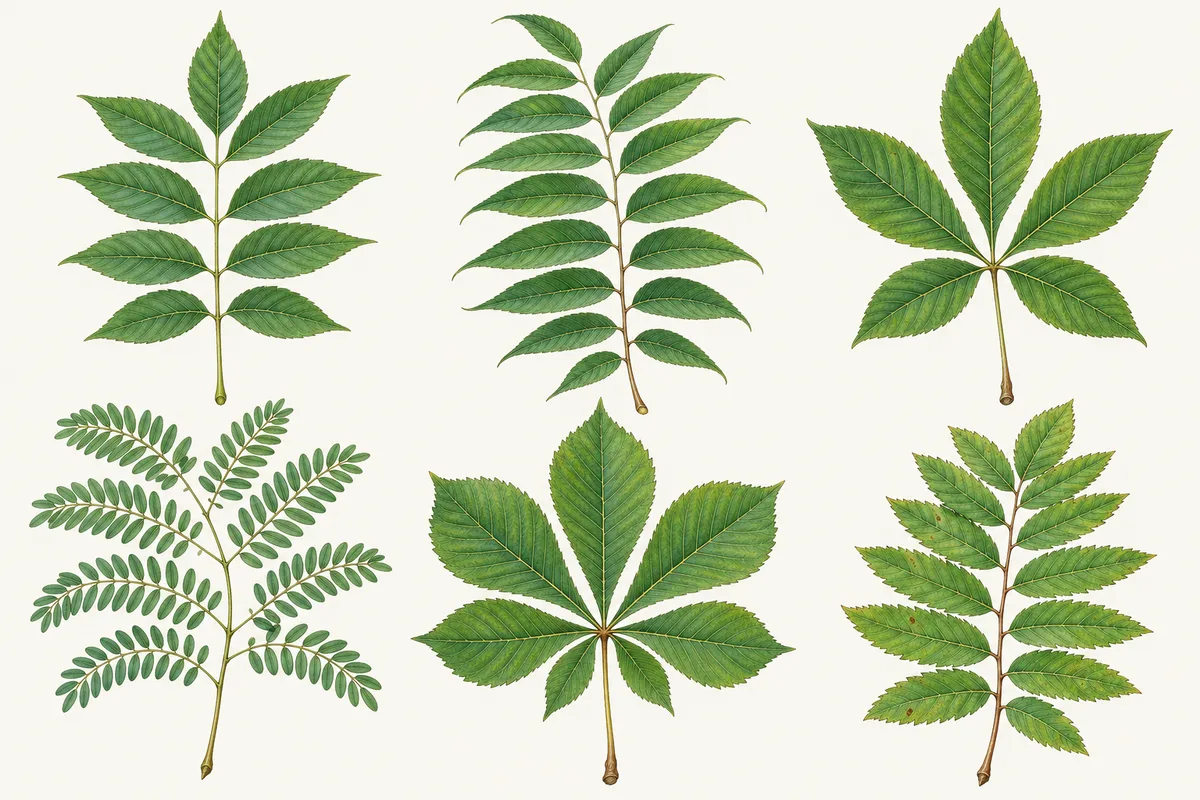
A compound leaf is one leaf split into leaflets. How the leaflets are set, how many there are and whether the leaves sit in pairs on the twig name most trees in under a minute.
In short
A tree with compound leaves is usually a walnut (15 to 23 leaflets), a hickory (5 to 7 with a big end leaflet), a black locust (rounded leaflets, paired spines), a mountain-ash (toothed leaflets, orange-red berries) or, if the leaves sit in pairs on the twig, an ash or boxelder. Leaflets spread like fingers from one point mean a buckeye or horse chestnut.
- Find the bud first: it sits where the whole leaf meets the twig, never at the base of a leaflet, so it tells you what to count.
- Opposite compound leaves leave only ashes, boxelder, buckeyes and horse chestnut, and elders; everything else on this page is alternate.
- Leaves divided twice, like a fern, belong to a separate short list: honey locust, mimosa, Kentucky coffeetree and jacaranda.
A compound leaf looks like a small branch covered in leaves, and that is what makes it confusing: the "leaves" you see are leaflets of one leaf. Once you know which part to count, a handful of checks names most trees. Never eat a berry, nut, seed or pod on the strength of a web page or an app; check with a local expert. Some trees below, black locust and buckeye among them, are reported poisonous.
Compound-leaved trees at a glance
Read two things before anything else: whether the leaves sit in pairs on the twig (opposite) or one per node (alternate), and whether the leaflets line up along a stalk (pinnate) or spread from one point (palmate).
| Tree | Arrangement | Leaflets | The feature that settles it | Region |
|---|---|---|---|---|
| Black walnut (Juglans nigra) | Alternate, pinnate | 15–23, finely toothed; leaf 12–24 in | Round green husk 1–3 in that does not split; chambered pith | Eastern North America |
| Shagbark hickory (Carya ovata) | Alternate, pinnate | 5–7, end leaflet largest; leaf 8–14 in | Bark in long, curling plates; four-part husk that splits | Eastern and central North America |
| Black locust (Robinia pseudoacacia) | Alternate, pinnate | 7–23, oval, smooth-edged; leaf 8–14 in | Paired spines at each leaf scar; white pea flowers; flat pods 2–4 in | Native East, naturalized in all lower 48 |
| American mountain-ash (Sorbus americana) | Alternate, pinnate | 9–17, toothed | Flat clusters of red-orange berries in fall | Newfoundland to Georgia, mountains |
| White ash (Fraxinus americana) | Opposite, pinnate | Usually 7 (5–9); leaf 8–12 in | Single-winged seeds; diamond-ridged bark | Eastern North America |
| Boxelder (Acer negundo) | Opposite, pinnate | Usually 3–5, coarse | Paired-wing seeds; green twigs | Across the US |
| Ohio buckeye (Aesculus glabra) | Opposite, palmate | 5–7 | Warty or prickly husk with shiny brown seeds | Ohio Valley, Great Plains, southern Appalachians |
Data from the NC State Extension Gardener Plant Toolbox profiles cited on this page, read on 21 October 2026.
The leaf-or-leaflet test
The University of Illinois Woody Plants Tutorial glossary gives the terms field guides use. A pinnate leaf has leaflets along both sides of a central stalk, the rachis. A palmate leaf has its parts radiating from a common point. A bipinnate leaf has leaflets that are themselves divided again, which gives the feathery, fern-like look. An odd-pinnate leaf ends in a single leaflet; an even-pinnate one ends in a pair.
The quickest way to tell a leaf from a leaflet is the bud. A bud sits in the angle where a whole leaf meets the twig, and never at the base of a leaflet. Follow a "leaf" back: if you reach a bud and a twig, it was a whole simple leaf; if you reach a long shared stalk, it was a leaflet. The leaf identification guide shows the same test with drawings of the terms.
Alternate and pinnate: walnut, hickory, locust, mountain-ash
Black walnut has the longest leaf of the common trees here. NC State gives 12 to 24 inches with 15 to 23 finely toothed, lance-shaped leaflets. The fruit is a round nut 1 to 3 inches across inside a yellow-green husk that does not split and stains skin and clothing, ready in October. Cut a twig lengthwise: the pith is chambered, with thin buff-colored walls. Walnut is native from northeastern Canada west to North Dakota and south to Texas and Florida. The walnut page separates black walnut, butternut and English walnut.
Shagbark hickory has fewer, bigger leaflets. NC State describes leaves 8 to 14 inches long with 5 to 7 finely toothed leaflets, the one at the tip the largest, and leaflets 3 to 7 inches long. On older trees, narrow plates of bark 1 to 3 feet long peel away from the trunk at both ends. The husk splits into four parts when the nut is ripe in October. Five to seven leaflets with a big end leaflet means hickory; fifteen or more small leaflets means walnut. The hickory page covers the other hickories.
Black locust has smooth-edged, oval leaflets, which sets it apart from the toothed walnut and hickory. NC State gives 7 to 23 leaflets on leaves 8 to 14 inches long, short paired spines up to about 1.25 inches beside each leaf scar, fragrant white pea-like flowers in hanging clusters from April to June, and flat purple-brown pods 2 to 4 inches long. It rates the bark, leaves and seeds as highly toxic, and notes the tree has become invasive in the Midwest. The locust page compares it with honey locust.
Mountain-ash is not an ash: its leaves are alternate. NC State describes American mountain-ash with 9 to 17 toothed leaflets, flat clusters of small white flowers in June and July, and bright red-orange berries about 1/4 inch across from September, often lasting into winter. It grows from Newfoundland to Georgia, mostly in the mountains in the South. The European rowan, planted widely, looks almost the same; see the rowan page.
Opposite compound leaves: ash, boxelder, buckeye
If the leaves sit in pairs on the twig, the list shrinks to a few groups; trees with opposite leaves has the full list.
Ashes have a feather-like leaf. For white ash, NC State gives leaves 8 to 12 inches long with usually 7 leaflets, sometimes 5 or 9, and bark with deep furrows in a net of diamond-shaped ridges. The seeds are single wings up to 2 inches long in drooping clusters. Emerald ash borer, which NC State says usually kills an ash within 3 to 5 years, has left many dead ashes along streets. The ash page separates white, green and European ash.
Boxelder is a maple with a compound leaf. NC State gives usually 3 to 5 leaflets, occasionally 7, green new twigs and paired samaras that hang into winter. Three leaflets on a young boxelder sometimes get it mistaken for poison ivy; boxelder is a tree or sapling with paired leaves, so check the twig.
Buckeyes and horse chestnut are the palmate ones. For Ohio buckeye, NC State describes 5 to 7 smooth leaflets spread from one point and a warty or prickly leathery husk with shiny brown seeds in October, and lists the seeds, leaves and bark as poisonous. Horse chestnut, planted in parks, has the same hand-shaped leaf. The chestnut vs buckeye page explains why neither is a true chestnut.
Fern-like and other look-alikes
- Twice-divided leaves. If the side stalks carry their own rows of small leaflets, you have a bipinnate leaf: honey locust, mimosa, Kentucky coffeetree or jacaranda. The fern-like leaves guide takes that list apart.
- Very long leaves on a weedy tree. A fast-growing tree on a vacant lot with very long leaves, whose leaflets are smooth-edged except for a few teeth near the base, may be tree of heaven rather than a walnut or sumac; the tree of heaven page has the leaflet test.
- Deeply lobed simple leaves. Oak and maple leaves can be cut almost to the midrib, but they are still one blade with one bud.
Using a photo
Lay one whole compound leaf flat, from the point where it left the twig to the tip, and photograph it with the twig if you can: that one picture shows the leaflet count and the arrangement. Tree Identifier names a tree from one photo, and black walnut, English walnut, black locust, European ash, rowan, horse chestnut and honey locust are among the species in its Collection. It shows no confidence score and no list of alternatives, so check the answer against the table above. The follow-up chat under each result can answer questions such as how a black walnut leaf differs from a butternut leaf, and the Tree Map remembers where the tree stands so you can come back for the nuts or flowers.
What a photo can't settle
- A photo of one leaflet looks like a whole simple leaf. Photograph the full leaf from the twig to its tip.
- Black walnut and butternut, and the many hickories, can look alike in a leaf photo; the nut, the husk and the bark settle it.
- Black locust and Ohio buckeye are reported poisonous by NC State. Never treat a name from a page or an app as permission to eat any part of a tree.
Questions people ask
What tree has compound leaves and red or orange berries?
A mountain-ash or rowan. NC State describes American mountain-ash with 9 to 17 toothed leaflets, flat clusters of white flowers in June and July, and bright red-orange berries about 1/4 inch across that ripen in September and October and often hang on into winter.
What tree has compound leaves and winged seeds?
An ash if the seeds are single wings in hanging clusters, or a boxelder if they are paired wings like other maples. Both have opposite leaves. NC State gives white ash seeds up to 2 inches long in drooping clusters, and boxelder seeds that hang on into winter.
What tree has compound leaves and white flowers?
Black locust if the flowers are fragrant, pea-like and hang in clusters from April to June; mountain-ash if they are tiny and in flat-topped clusters in early summer. Check the twig: both have alternate leaves, unlike the opposite-leaved elders.
Is a maple leaf compound?
No. A maple leaf is a simple, lobed leaf: one blade, however deep the cuts, with one bud at its base. The one maple with compound leaves is boxelder, which NC State describes with usually 3 to 5 leaflets.
What is the difference between pinnate and palmate compound leaves?
The Illinois Woody Plants Tutorial defines pinnate as leaflets arranged along both sides of a central stalk, and palmate as parts radiating from a common point. Walnut, ash and locust are pinnate; buckeye and horse chestnut are palmate.
Sources
- Glossary, Woody Plants Tutorial — University of Illinois, Department of Natural Resources and Environmental Sciences
- Juglans nigra (black walnut) — North Carolina Extension Gardener Plant Toolbox, NC State University
- Carya ovata (shagbark hickory) — North Carolina Extension Gardener Plant Toolbox, NC State University
- Robinia pseudoacacia (black locust) — North Carolina Extension Gardener Plant Toolbox, NC State University
- Sorbus americana (American mountain-ash) — North Carolina Extension Gardener Plant Toolbox, NC State University
- Fraxinus americana (white ash) — North Carolina Extension Gardener Plant Toolbox, NC State University
- Acer negundo (boxelder) — North Carolina Extension Gardener Plant Toolbox, NC State University
- Aesculus glabra (Ohio buckeye) — North Carolina Extension Gardener Plant Toolbox, NC State University