Tree profile
Live oak (Quercus virginiana): how to identify it
An oak that stays green all winter, with small leathery leaves, dark acorns in clusters and a crown often far wider than the tree is tall. Here is the order to check them in.
In short
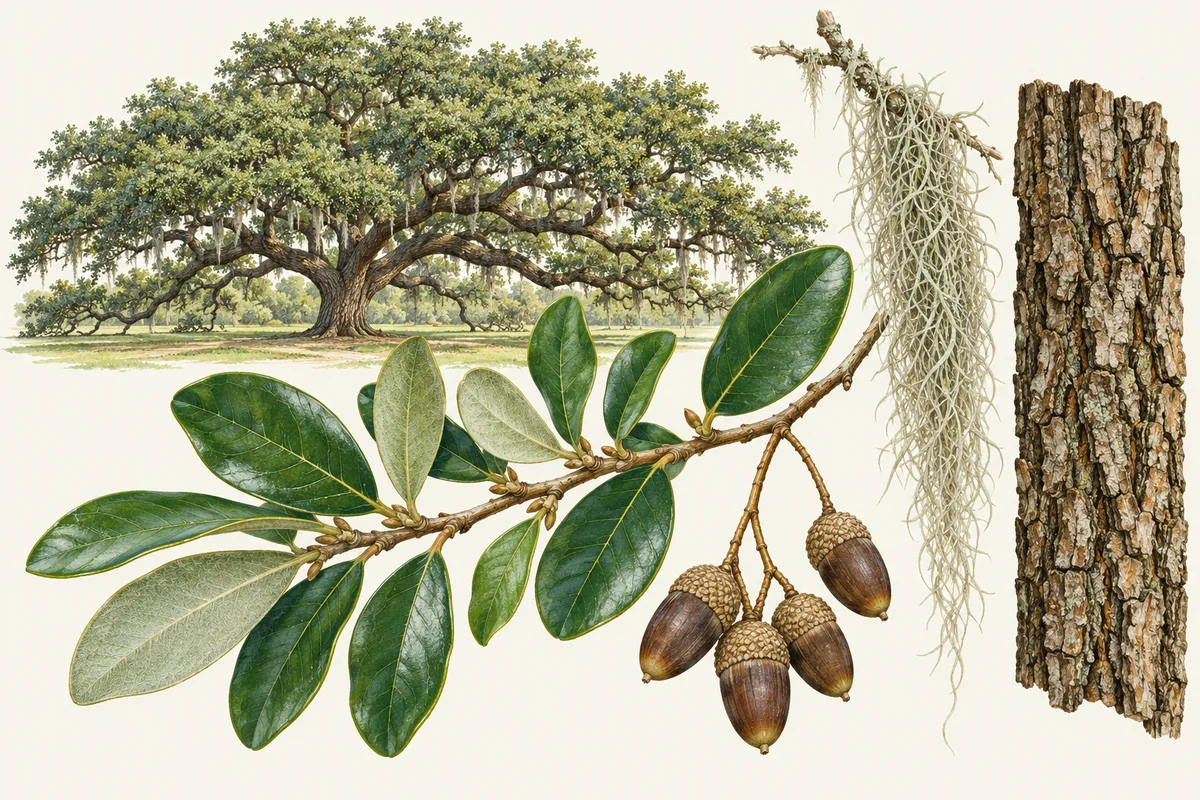
Live oak tree identification starts with the leaf: evergreen, leathery, 2 to 5 inches long, glossy above, pale and hairy below, with edges often rolled under and no lobes. Confirm with the acorns, dark, about 3/4 inch long and borne in clusters of 3 to 5, and with the form: a short trunk under a crown that can spread 150 feet. Southern live oak grows along the Southeast coastal plain.
- An oak with unlobed, leathery leaves that are still green in January, anywhere from Virginia to Texas, is almost always a live oak.
- Acorns ripen in a single season and come in clusters; water oak acorns are half an inch long and take two seasons.
- In California, the live oak you meet is a different species, coast live oak, with spiny, cupped leaves.
Field marks at a glance
- Scientific name
- Quercus virginiana
- Family
- Fagaceae (beech family)
- Type
- Broadleaf, evergreen
- Leaves
- Alternate, simple, evergreen and leathery, 2 to 5 inches (5 to 13 cm) long, oblong to elliptical; edge smooth or spiny and often rolled under; glossy dark green above, pale and hairy below. No lobes.
- Acorns
- Dark brown to black, about 3/4 inch (2 cm) long, in clusters of 3 to 5 on a stalk; warty, bowl-shaped cap covers about a third of the nut. Ripen in one season, early fall.
- Bark
- Red-brown and furrowed with small scales when young; dark gray to nearly black, rough and very blocky on old trunks.
- Twigs and buds
- Slender, gray and hairy, with small, blunt end buds clustered at the tip.
- Form and size
- Short, thick trunk and long, spreading, often drooping limbs. 60 to 80 ft tall with a spread of 60 to 120 ft (UF/IFAS); open-grown crowns can reach 150 ft across (Virginia Tech).
- Native range
- Lower Coastal Plain from southeastern Virginia through Georgia and Florida (including the Keys), west to southern and central Texas; scattered in southwestern Oklahoma and northeastern Mexico.
- Habitat
- Nearly always on sandy soil; tolerates salt spray and dominates many Atlantic and Gulf barrier islands. USDA hardiness zones 7B to 10B.
- Leaf habit
- Listed as semi-evergreen to evergreen by UF/IFAS: the crown stays green through winter, with no fall color.
Live oak is the evergreen oak of the American South, the wide, low-limbed tree that often carries Spanish moss. "Live oak" is a name for several oaks that keep their leaves in winter; this page centers on southern live oak (Quercus virginiana) and shows how to tell it from its Texas, California and water oak look-alikes. Never eat a berry, nut or acorn on the strength of a web page or an app; check with a local expert.
What to check first: leaf, acorn, then the crown
1. The leaf. Pick a few leaves from different parts of the crown. On southern live oak they are evergreen and leathery, 2 to 5 inches long, oblong or elliptical, glossy above and pale and hairy beneath, with an edge that is smooth or spiny and rolled back, according to the Virginia Tech Dendrology fact sheet. There are no lobes. A tree that bears acorns and holds leaves like these in January is a live oak of some kind.
2. The acorn. Look for acorns in clusters of 3 to 5 on a single stalk. Each nut is dark, about 3/4 inch long, with a warty, bowl-shaped cap covering about a third of it. The USDA Forest Service's Silvics of North America describes them as long, tapered and dark brown to black. They mature in September of their first year and fall before December, and the crop is annual and often abundant, so this test is available almost every autumn.
3. The crown. Step back. Live oak "never attains great height," says the Forest Service, but it spreads. UF/IFAS Extension gives 60 to 80 feet tall and 60 to 120 feet wide and calls it one of the broadest spreading of the oaks; Virginia Tech says an open-grown crown can reach 150 feet across. A short, massive trunk breaking into long, low, drooping limbs is the silhouette people remember.
If the tree is behind a fence or the acorns are gone, a photo of a leaf or the trunk is enough for Tree Identifier to suggest a name, and southern live oak is in the app's Collection. The app shows no confidence score and no list of alternatives, so check the leaf and acorn against the marks above, especially in Texas and California, where other live oaks grow.
Which live oak: southern, Texas, sand or coast
"Live oak" covers more than one tree, and where you stand narrows the answer.
| Live oak | Where | Leaf | Acorn | Form |
|---|---|---|---|---|
| Southern (Q. virginiana) | Southeastern Virginia to Florida and south and central Texas | 2–5 in, edges often rolled under | About 3/4 in, clusters of 3–5, cap covers 1/3 | Massive tree, crown to 150 ft wide |
| Texas (Q. fusiformis) | Texas, dry sites | 1–3 in, sometimes slightly rolled | About 3/4 in, clusters of 1–3, top-shaped cap covers 1/2, tapered at both ends | Thicket-forming shrub or tree to 40 ft |
| Sand (Q. virginiana var. geminata) | Southeastern coastal sands | Differs in leaf size | Differs in cup shape | — |
| Coast (Q. agrifolia) | Coastal California | 1–2 1/2 in, convex, spiny like holly | 1–1 1/2 in, narrow, light brown, pointed | Tree to 100 ft, crown often wider than tall |
The Texas and coast live oak rows come from Virginia Tech's Texas live oak and coast live oak fact sheets. The Forest Service treats Texas live oak and sand live oak as varieties of southern live oak (var. fusiformis and var. geminata) that differ in leaf size and in the shape of the acorn cup; Virginia Tech gives Texas live oak its own species. The two institutions simply classify them differently; in the field, leaf size, cap depth and growth form are what you check.
Coast live oak is the one to know in California. Its leaves curve down at the edges like an upturned spoon, carry holly-like spines, and have small tufts of fuzz where the veins meet underneath. Virginia Tech lists interior live oak, canyon live oak, Engelmann oak and scrub oak as its look-alikes, so in the foothills check a local key as well.
Live oak vs water oak and other look-alikes
Water oak (Quercus nigra) shares the same coastal plain and is the classic mix-up, because its leaves are also small and often unlobed. The Virginia Tech water oak fact sheet describes leaves 2 to 4 inches long, highly variable, often spoon-shaped and widest near the tip, with 0 to 5 lobes and edges that may be bristle-tipped. Two checks settle it:
- Acorns. Water oak acorns are about 1/2 inch long under a flattened cap and take two seasons to mature, so a summer twig carries two sizes of acorns. Live oak acorns are bigger, dark, in clusters, ripen in one season and sit in a bowl-shaped cap.
- Leaf edges and texture. Live oak leaves are thick and leathery, with edges rolled under; water oak leaves are thinner and flat, and some have a bristle at the tip of a lobe, a sign of the red oak group explained on the red oak vs white oak page.
American holly is on Virginia Tech's look-alike list for both southern and Texas live oak, because live oak leaf edges can be spiny (Virginia Tech). Holly never bears acorns; if you find acorns under the tree, it is an oak.
For the oak family as a whole, including how to place any oak in the white or red oak group, see the oak identification guide.
Bark, Spanish moss and young trees
Bark. Virginia Tech describes young bark as red-brown, furrowed and covered with small scales, turning black and very blocky with age. UF/IFAS gives the same sequence: reddish brown and furrowed on young trees, then gray to nearly black, rough and deeply furrowed.
Spanish moss and mistletoe. The Forest Service notes that mistletoe and Spanish moss can grow on live oak branches. Spanish moss is not part of the tree and also hangs from other trees, so treat it as a hint about the region, not an identification.
Young live oaks and sprouts. The Forest Service reports that live oak sprouts abundantly from its root collar and roots, and that when a top is killed, roots near the surface send up many sprouts. Clusters of small, leathery-leaved stems around a big tree or an old stump are usually live oak sprouts. Young trees also have thin bark, easily killed by a light ground fire.
Where live oak grows
Southern live oak is a tree of the lower Coastal Plain: from southeastern Virginia south through Georgia and Florida, including the Florida Keys, and west to southern and central Texas, with scattered populations in southwestern Oklahoma and the mountains of northeastern Mexico (USDA Forest Service). It nearly always grows on sandy soil, tolerates salt spray, and is a dominant tree on Atlantic and Gulf barrier islands. Common neighbors are water oak, laurel oak, southern magnolia and sweetgum.
UF/IFAS lists it for USDA hardiness zones 7B through 10B and rates its drought and salt tolerance as high. Because it is also planted as a shade tree, you can meet it outside its native coastal belt; a planted live oak follows the same field marks.
Live oak through the seasons
- Spring: flowers appear every spring, March through May (USDA Forest Service): male flowers in catkins, small female flowers on short spikes.
- Summer: glossy, dark green leaves; young acorns form on this year's growth only.
- Fall: no fall color, per UF/IFAS. Acorns ripen in September and drop by December, and the Forest Service describes them as a preferred food of many birds and animals.
- Winter: the crown stays green when the oaks around it are bare, which makes winter the easiest season to spot a live oak from a distance. See the winter tree identification guide for the deciduous trees around it.
If you want to return to a particular tree, for its acorns or to compare it with a neighbor, Tree Identifier's Tree Map pins each located identification so you can find it again.
Look-alikes and how to tell them apart
Texas live oak (Quercus fusiformis)
Smaller leaves, 1 to 3 inches, and acorns in clusters of 1 to 3 with a top-shaped cap covering about half the nut, tapered at both ends. Often a shrub forming dense thickets, or a tree up to 40 ft, on dry sites in Texas. Southern live oak acorns sit in a shallower cap covering a third.
Coast live oak (Quercus agrifolia)
The live oak of California. Its leaves are 1 to 2 1/2 inches, convex with downturned, holly-like spiny edges, and carry tufts of fuzz in the vein angles underneath. Its acorns are narrow, light brown and pointed, 1 to 1 1/2 inches long.
Water oak (Quercus nigra)
Water oak leaves are 2 to 4 inches and very variable, often spoon-shaped and widest near the tip, sometimes with up to 5 lobes and bristle tips. Its acorns are only 1/2 inch long under a flattened cap, and they take two seasons to mature.
What a photo can't settle
- Live oak hybridizes with several other oaks: the USDA Forest Service lists crosses with swamp white, overcup, bur, post, Durand and dwarf live oak. Intermediate trees will not match every line of the ID card.
- Southern live oak, Texas live oak and sand live oak grade into each other where their ranges meet, and the USDA Forest Service and Virginia Tech classify them differently (varieties vs species); a photo cannot settle that question.
- Leaf shape varies on a single tree, and Virginia Tech notes the edge can be smooth or spiny, so collect several leaves and an acorn before deciding.
Questions people ask
What does a live oak tree look like?
A broad tree with a short, thick trunk and long, spreading limbs: UF/IFAS gives 60 to 80 feet tall and 60 to 120 feet wide. The leaves are small, leathery and glossy, without lobes, and stay green through winter. Old bark is dark and blocky, and branches may carry Spanish moss.
What is the difference between an oak tree and a live oak?
A live oak is an oak, but most oaks in the eastern US drop their leaves in fall and have lobed leaves. Southern live oak keeps leathery, unlobed leaves 2 to 5 inches long through winter. Like every oak it bears acorns, which on live oak are dark and grow in clusters of 3 to 5.
What does a young live oak tree look like?
Young trees have the same small, leathery, evergreen leaves, but thin, red-brown, furrowed bark instead of the dark blocks of old trunks. Live oak sprouts freely from its roots and root collar, so young stems often come up in groups around an older tree or a cut stump.
Is a live oak in Texas the same as one in Florida?
Not always. Southern live oak reaches southern and central Texas, but Texas also has Texas live oak, which Virginia Tech treats as a separate species, Quercus fusiformis, and the USDA Forest Service as a variety of southern live oak. Texas live oak has smaller leaves, acorns in a deeper cap, and often grows as a thicket-forming shrub.
Are live oaks in California the same tree?
No. The common live oak of coastal California is coast live oak, Quercus agrifolia: an evergreen tree up to 100 feet with convex, spiny-edged leaves 1 to 2 1/2 inches long and narrow, pointed, light brown acorns. Virginia Tech lists interior live oak and canyon live oak among its look-alikes.
Sources
- Live oak fact sheet — Virginia Tech Dendrology
- Live Oak (Quercus virginiana), Silvics of North America — USDA Forest Service
- Quercus virginiana: Southern Live Oak (ENH-722/ST564) — University of Florida IFAS Extension
- Texas live oak fact sheet — Virginia Tech Dendrology
- Coast live oak fact sheet — Virginia Tech Dendrology
- Water oak fact sheet — Virginia Tech Dendrology