Tree profile
Whitebeam tree (Sorbus aria): how to identify it
A compact, domed tree whose leaves flash white when the wind turns them: oval, toothed, dark green above and covered in white felt below, with white flowers in May and scarlet berries by autumn.
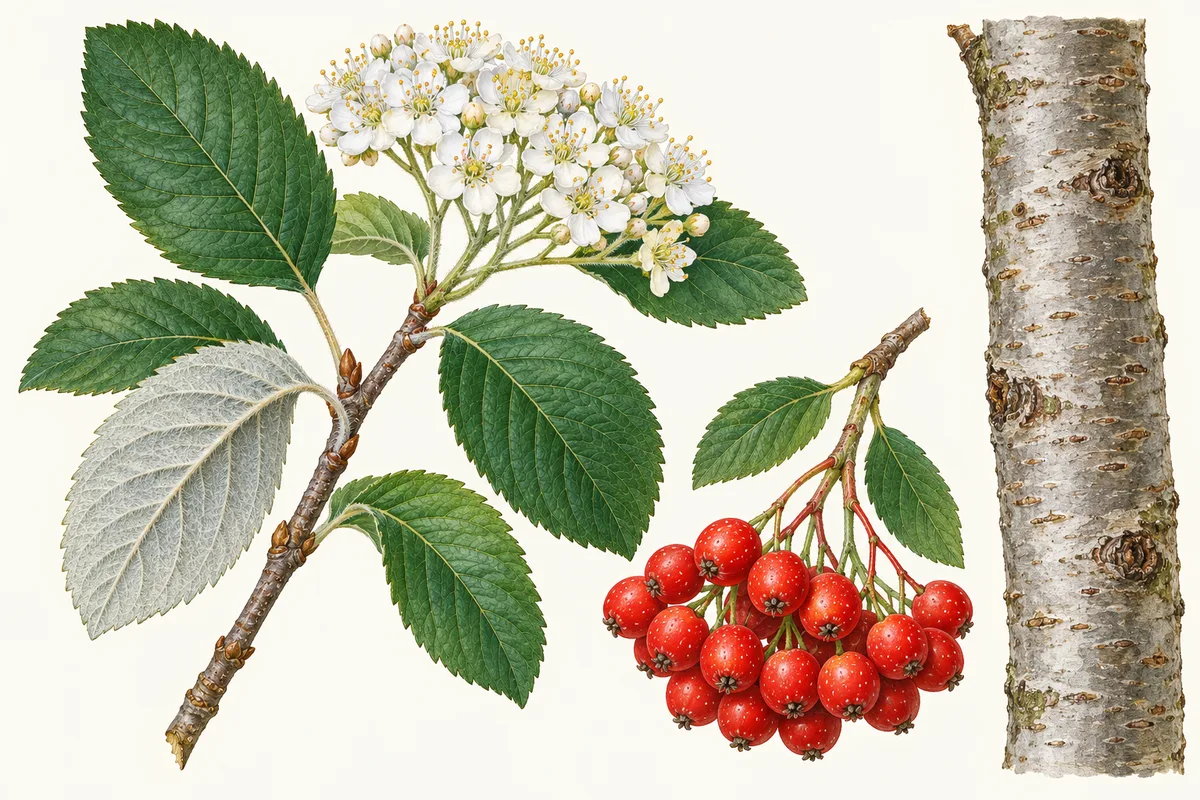
In short
A whitebeam tree is a compact, domed member of the rose family, up to about 20 m, best known by its leaves: thick, oval and irregularly toothed, dark green and shiny on top and covered in white, felt-like hairs underneath. White five-petalled flowers open in clusters in May and become scarlet berries in late summer or autumn. The bark is smooth and grey.
- Turn a leaf over: a white, felted underside on an oval, unlobed, toothed leaf points to common whitebeam.
- Swedish whitebeam, the common street tree, has lobed leaves with grey-white hairs underneath and orange-red berries.
- Common whitebeam is native to southern England, rare in the wild and widely planted in parks, gardens and streets (Woodland Trust).
Field marks at a glance
- Scientific name
- Sorbus aria
- Family
- Rosaceae (rose family)
- Type
- Broadleaf, deciduous
- Leaves
- Simple, thick, oval and irregularly toothed; dark green and shiny on top, covered in white, felt-like hair underneath. Short leaf stalks.
- Spring leaves
- When the leaves first unfold, the Woodland Trust says they look like magnolia flowers.
- Flowers
- White, five-petalled, in clusters in May; pollinated by insects.
- Berries
- Scarlet, in clusters, ripening in late summer or autumn; favoured by birds. Known as chess apples in north-west England.
- Bark and twigs
- Bark and twigs smooth and grey. Shoots brick red in sunlight, greyish-green in shade.
- Buds
- Green and pointed; in winter only the edges of the bud scales are hairy, and young twigs start hairy and become smooth.
- Autumn colour
- Leaves fade to a rich russet before falling.
- Size and shape
- Compact and domed; mature trees up to about 20 m (65 ft).
- Where
- Native to southern England, widely planted further north; rare in the wild, common in parks, gardens and streets.
Whitebeam is a tidy, domed tree of parks, gardens and streets whose leaves are white and felted underneath, so a breeze that turns them over shows their pale side. It belongs to the same group as rowan and the wild service tree, and like rowan it carries white flowers in May and red berries in autumn. Its leaves are what set it apart.
Never eat a berry, nut, seed or pod on the strength of a web page or an app; check with a local expert.
How to identify a whitebeam in three checks
1. Turn a leaf over. Common whitebeam leaves are thick, oval and irregularly toothed, without lobes, dark green and shiny on top and covered underneath in white, felt-like hair, says the Woodland Trust. When the leaves first unfold in spring, the Trust says they look like magnolia flowers.
2. Flowers in May, scarlet berries later. Clusters of white, five-petalled flowers open in May and are pollinated by insects. They become scarlet berries that ripen in late summer or autumn and are taken by birds. In north-west England the berries are known as chess apples.
3. Smooth grey bark and a domed crown. The bark and twigs are smooth and grey, and the tree is compact and domed, reaching about 20 m. Shoots in full sun turn brick red; shoots in shade stay greyish-green. In winter, look for green, pointed buds hairy only at the edges of the scales, on twigs that are hairy when young.
Tree Identifier can name whitebeam from one photo, but the app shows no confidence score and no list of look-alikes, so photograph the underside of a leaf as well as the top. That white felt, plus whether the leaf is lobed, is what separates the whitebeams.
Common whitebeam or Swedish whitebeam
Many of the whitebeams on British streets are not common whitebeam but Swedish whitebeam (Sorbus intermedia). The SAPS tree guide describes its leaves as 7 to 12 cm long and 5 to 7 cm broad, with 4 to 7 oval lobes on each side, the deepest cut a third of the way to the midrib, and dense grey-white hairs underneath. Its fruits are red to orange-red, about 15 mm long and 10 mm wide, and its bark grey-black and almost smooth. SAPS notes it tolerates urban streets, parks and avenues well, though it is native only to the Baltic coast of Sweden and possibly Poland.
| Feature | Common whitebeam | Swedish whitebeam |
|---|---|---|
| Leaf outline | Oval, toothed, not lobed | Oval with 4–7 lobes each side |
| Underside | White felt | Dense grey-white hairs |
| Berries | Scarlet | Red to orange-red, about 15 mm long |
| Bark | Smooth, grey | Grey-black, almost smooth |
| Height | Up to 20 m | 10–20 m (SAPS); 8–12 m in gardens (RHS) |
| Origin | Native to southern England | Baltic Sweden, possibly Poland |
Sources: the Woodland Trust, SAPS and the RHS's Swedish whitebeam profile, which describes broadly oval, deeply lobed, dark green leaves, white spring flowers and red autumn berries. If your tree has lobed leaves and orange-red berries, it is very likely Swedish whitebeam.
Whitebeam, rowan and wild service tree
The three British members of this group share white May flowers and berry-like fruit, but their leaves could hardly differ more:
- Rowan: feather-like leaves of 5 to 8 pairs of toothed leaflets, scarlet berries from August. See the rowan page.
- Whitebeam: a single, unlobed, toothed leaf with a white felted underside, scarlet berries.
- Wild service tree: maple-like leaves with 3 to 4 unequal lobes and green-brown, pale-spotted fruits 10 to 15 mm across, called chequers, according to the Woodland Trust. Its bark cracks into square plates.
These trees cross. On the Isle of Arran, the Arran whitebeams are rare trees that arose from crosses between rowan and rock whitebeam. The Royal Botanic Garden Edinburgh's Scottish Plant Recovery team (27 September 2023) describes them as microspecies, now placed in the genus Hedlundia, that set seed without fertilisation, so each seedling is a clone of its mother. They grow in Glen Rosa, Glen Diomhan and Glen Catacol, and only two wild Catacol whitebeams were known when the team wrote. RBGE also places rock whitebeam in a separate genus, Aria, reflecting a split of the old genus Sorbus that not every list follows yet.
Where to see whitebeam
The Woodland Trust describes common whitebeam as native to southern England and widely planted in the north of the UK, common in parks and gardens but quite rare in the wild. Its fine-grained, hard, white timber was used for turning and fine joinery, including cogs and wheels in machinery. Moth caterpillars feed on the leaves, and the tree can carry aphids and blister mites.
In towns it is one of the trees you meet most often. Our guide to the most common trees in the UK counts whitebeam among the ten most numerous street trees in London's council tree data. For the other common trees of British streets and woods, see tree identification in the UK, and for other trees with red fruit, the guide to trees with red berries.
If you want to compare street whitebeams over a season, Tree Identifier's Tree Map keeps each identification you save with its location, and the follow-up chat under a result can answer questions such as how the tree differs from rowan.
Look-alikes and how to tell them apart
Swedish whitebeam (Sorbus intermedia)
Its leaves are lobed, with 4 to 7 oval lobes on each side cut up to a third of the way to the midrib, and grey-white hairs underneath; the berries are red to orange-red, about 15 mm long. Common whitebeam's leaves are unlobed and only toothed.
Rowan (Sorbus aucuparia)
Rowan's leaves are feather-like, made of 5 to 8 pairs of narrow, toothed leaflets, with no white felt underneath. Both have white May flowers and red berries, so the leaf settles it.
Wild service tree (Sorbus torminalis)
Wild service leaves have 3 to 4 unequal lobes, like a maple's, with no white underside, and its fruits are green-brown, pale-spotted ovals 10 to 15 mm across instead of scarlet berries. Its brown bark cracks into square plates.
Arran whitebeams (Hedlundia species)
Rare Scottish endemics that grow wild only on the Isle of Arran, mainly in Glen Rosa, Glen Diomhan and Glen Catacol; their leaves sit between rowan and whitebeam because they descend from crosses of the two groups.
What a photo can't settle
- Whitebeams cross with rowan and include rare microspecies such as the Arran whitebeams; a photo can usually name the group, but separating Britain's rare endemic whitebeams takes a specialist.
- The white underside is the key feature, so photograph a leaf turned over as well as from above.
Questions people ask
Is whitebeam native to the UK?
Common whitebeam is. The Woodland Trust describes it as native to southern England, widely planted in the north, common in parks and gardens but quite rare in the wild. Swedish whitebeam, often planted on streets, is native only to the Baltic coast of Sweden and possibly Poland, according to SAPS. Scotland's Arran whitebeams are native and found nowhere else.
Are whitebeam berries poisonous?
We do not give edibility advice on this site. Whitebeam berries are favoured by birds, but never eat a berry, nut, seed or pod on the strength of a web page or an app; check with a local expert, and with a poison centre if someone has already eaten some.
Is whitebeam evergreen?
No. Common whitebeam is deciduous: the Woodland Trust says its leaves fade to a rich russet before falling in autumn. In winter, identify it by its smooth grey twigs, hairy when young, and green, pointed buds hairy only at the edges of the scales.
Why is it called whitebeam?
For the white undersides of its leaves. SAPS explains that the 'beam' part comes from the German Baum, meaning tree, so whitebeam simply means white tree. The white felt under each leaf is what earns the name.
How tall do whitebeam trees grow?
The Woodland Trust gives up to 20 m for mature common whitebeam, with a compact, domed crown. Swedish whitebeam is described by SAPS as 10 to 20 m tall, while the RHS gives 8 to 12 m for garden trees, so planted specimens are usually smaller.
Sources
- Whitebeam (Sorbus aria) — Woodland Trust
- Swedish Whitebeam (Sorbus intermedia) — Science and Plants for Schools (SAPS)
- Sorbus intermedia, Swedish whitebeam — Royal Horticultural Society
- Pressing conservation issue (Arran whitebeams), 27 September 2023 — Royal Botanic Garden Edinburgh, Botanics Stories
- Wild service tree (Sorbus torminalis) — Woodland Trust
Keep reading
- Tree profileRowan tree (mountain ash): how to identify it
- Clue guideWhich tree has red berries? Sort it by leaf and season
- Field guideThe most common trees in the UK: the top 10 and how to recognise them
- Field guideTree identification in the UK: British trees by leaf, bark and picture
- Field guideNative trees of the UK: the full list with one clue for each