Tree comparison
Silver maple vs red maple: how to tell them apart
Deep cuts and a silver-white underside, or shallow lobes and fine teeth. Then check the seeds, the twigs and the bark to be sure.
In short
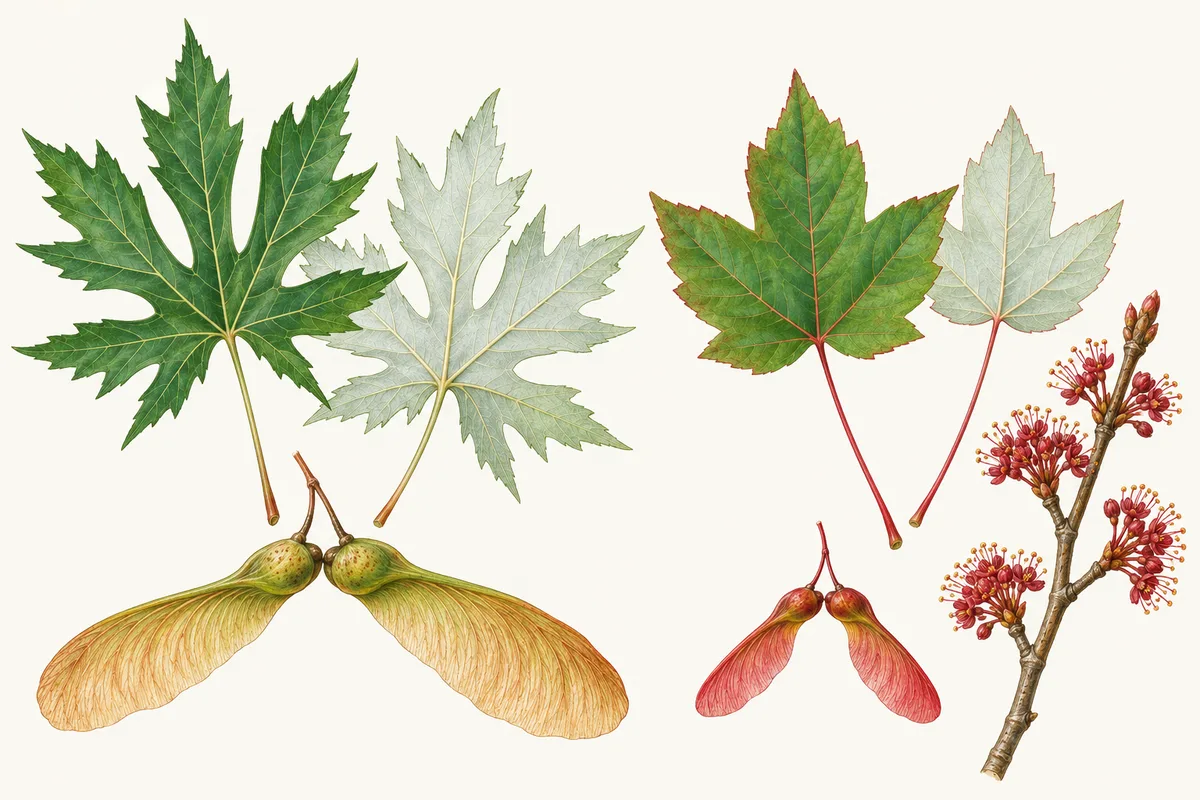
Silver maple vs red maple shows first in the leaf: silver maple leaves have five lobes cut deeply toward the center, coarse teeth and a silvery white underside, while red maple leaves have three to five shallower lobes with fine teeth. Silver maple samaras are the largest of any native maple, with wings 1 1/2 to 2 1/2 inches, against 1/2 to 3/4 inch on red maple.
- Deep sinuses, coarse teeth and a silver-white underside mean silver maple; shallower lobes and fine teeth mean red maple.
- Crush a twig: silver maple gives off an unpleasant smell; red maple twigs are shiny red and blunt-budded.
- The two hybridize. Freeman maple, sold as Autumn Blaze, sits in between and can't be settled from one leaf.
Field marks at a glance
- Scientific name
- Acer saccharinum and Acer rubrum
- Family
- Sapindaceae (soapberry family); Virginia Tech lists the older Aceraceae
- Type
- Broadleaf, deciduous
- Leaf shape
- Silver maple: five deep palmate lobes, the sinuses cut far toward the center. Red maple: 3 to 5 lobes, sinus depth variable but usually shallower.
- Leaf edge
- Silver maple: coarsely toothed lobes. Red maple: finely serrated edges.
- Underside and size
- Silver maple: pale silvery white beneath, 2 1/2 to 5 inches long (Virginia Tech), 3 to 6 inches (Morton Arboretum). Red maple: paler green beneath, sometimes waxy, 2 to 4 inches.
- Twigs and buds
- Silver maple: stouter, often chestnut-brown, unpleasant smell when crushed, flower buds in dense, conspicuous clusters. Red maple: reddish, shiny, buds blunt with several loose scales.
- Samaras
- Silver maple: wings 1 1/2 to 2 1/2 inches, the largest of any native maple. Red maple: 1/2 to 3/4 inch, slightly spreading. Both ripen in late spring.
- Bark
- Both smooth and light gray when young. Old silver maple: long, thin strips loose at the ends. Old red maple: long, fine, scaly plates.
- Form
- Silver maple: short trunk splitting into several subtrunks, long branches sweeping down then up. Red maple: in forests, a trunk clear of branches for a good distance.
- Fall color
- Silver maple: yellow-green (Morton Arboretum). Red maple: brilliant red, most reliably in the north (USDA Forest Service).
- In the app's Collection
- Red maple is one of the 138 Collection species; silver maple is not.
Silver maple and red maple grow side by side along rivers and in yards from New England to the Gulf, bloom on bare twigs in the same weeks, and cross with each other. The leaf usually settles it in one look; when it doesn't, the seeds, the smell of a crushed twig and the bark do.
The leaf test: depth, teeth and underside
Pick a leaf from a lower branch and check three things in order.
- How deep are the cuts? Virginia Tech's silver maple fact sheet describes five deep palmate lobes: the sinuses run far toward the center, so the lobes look like long, narrow fingers. Red maple's fact sheet gives 3 to 5 lobes with variable sinus depth; most leaves are cut much less deeply and look broader and more compact.
- Coarse or fine teeth? Silver maple lobes are coarsely toothed. Red maple edges are finely serrated.
- Turn it over. Silver maple is pale silvery white beneath, which is where the name comes from; a breeze that flips the leaves turns the whole crown silver. Red maple leaves are paler green beneath and sometimes waxy, but not white. Other trees with pale undersides are on the trees with silver leaves page.
Size helps a little. Virginia Tech gives silver maple leaves 2 1/2 to 5 inches long and red maple leaves 2 to 4 inches; the Morton Arboretum measures silver maple at 3 to 6 inches. Both have opposite leaves, the first check that you have a maple at all; the maple page covers that test and the other species.
If the leaf is deeply cut but finely toothed, or silvery but compact, you may be looking at the hybrid. That case has its own section below.
Seeds and flowers in early spring
Both maples flower on bare twigs and drop their seeds by early summer, so spring is a good time to compare them.
- Flowers. The USDA Forest Service's Silvics of North America calls silver maple among the first maples to bloom, as early as February, continuing into May, before the leaves. Its dense clusters are greenish to reddish. Red maple flowers from March to May, according to the red maple Silvics, usually several weeks before its leaves open; its small hanging clusters are usually bright red, occasionally yellow.
- Seeds. Silver maple samaras are the largest of any native maple, with wings spreading 1 1/2 to 2 1/2 inches, Virginia Tech says, and the Forest Service adds they are the largest seeds of any US maple. Red maple samaras are only 1/2 to 3/4 inch long, light brown or reddish, on long slender stalks. Both ripen from April to June and can germinate as soon as they fall, which is why both sprout in lawns and gutters.
A pile of oversized "helicopters" under a tree in May points to silver maple. The helicopter seeds guide compares them with ash, elm and other winged seeds.
Twigs, buds and bark in winter
Without leaves, start with the twigs. Virginia Tech describes silver maple twigs as thicker than red maple's and often more chestnut-brown, with reddish brown buds wearing large scales. Two marks are hard to miss:
- The smell. Crushed silver maple twigs give off an unpleasant odor. Red maple twigs don't.
- The flower buds. On silver maple they sit in conspicuous dense clusters along the twig. Red maple's buds are blunt, green or reddish, with several loose scales, and its twigs are reddish and shiny with small lenticels.
Bark starts the same on both: smooth and light gray. With age, silver maple breaks into long, thin strips loose at the ends, which the Morton Arboretum describes as curling upward at the ends. Red maple darkens and splits into long, fine, scaly plates; Virginia Tech calls silver maple's bark similar but coarser. For other trees you can name from twigs alone, see the winter tree identification guide.
Shape, site and fall color
Step back and look at the whole tree. Silver maple usually has a short trunk that splits low into several subtrunks, with long, slender branches that sweep downward and then curve back up at the tips. Red maple grown in a forest keeps a trunk clear of branches for a good distance; in the open it has a shorter trunk and a rounded crown.
Where it grows also helps. The Forest Service places silver maple on stream banks, floodplains and lake edges, where it tolerates temporary flooding better than most of its neighbors. Red maple is far less fussy: it grows from dry ridges to peat bogs and swamps, and in the far South it is almost purely a swamp tree. A big maple on a dry hilltop is more likely red than silver.
Fall color is a hint, not proof. Morton describes silver maple turning yellow-green, while the Forest Service calls red maple's brilliant fall color one of its outstanding features, reddest in the north. A blazing red tree is more likely red maple or a Freeman hybrid; a silver maple rarely turns scarlet.
Freeman maple: the hybrid in between
Red and silver maple hybridize naturally, and their flowering periods overlap, according to the Forest Service. The cross is called Freeman maple (Acer × freemanii), and nurseries sell selections of it widely; the best known is marketed as Autumn Blaze. Oregon State University's Landscape Plants describes its leaves as variable and intermediate between the parents, with seed wings longer than red maple's and shorter than silver maple's. Autumn Blaze itself has deeply cut, five-lobed leaves like silver maple and orange-red fall color like red maple.
The same page notes that leaf measurements could not reliably separate the hybrid from its parents. In practice, a young maple planted along a street or in a new subdivision, with silver-maple cuts and red-maple fall color, is quite likely a Freeman maple cultivar. A maple in a floodplain forest is more likely one of the parents, though natural hybrids occur there too.
Why the difference matters
For a yard, the difference is practical. The Morton Arboretum lists weak wood and branch structure for silver maple, with limbs that break in wind and ice, vigorous roots that can invade sewer pipes, and seedlings that come up in lawns and gardens; it adds that many authorities recommend against planting it. The Forest Service notes the same brittleness and roots that clog drain lines that aren't tightly sealed. Red maple is the steadier tree, though it seldom lives longer than 150 years; silver maple may pass 130.
For syrup, both can be tapped, but neither matches sugar maple. The Forest Service reports that silver maple had the lowest sap sugar of five maple species tested in Ontario. The red maple vs sugar maple page compares the tree most people would rather tap.
If you identify maples with Tree Identifier, a photo of a leaf turned to show its underside, or of a seed cluster, gives the app the most to work with. The result shows no confidence score or alternative species, so use the twig smell and seed size above to confirm it. Red maple is part of the app's 138-species Collection; silver maple is not.
Look-alikes and how to tell them apart
Freeman maple (Acer × freemanii)
The red × silver hybrid, sold under names such as Autumn Blaze. Oregon State University describes leaves intermediate between the parents and seed wings longer than red maple's but shorter than silver maple's. Planted along streets and in yards, rarely in the woods.
Sugar maple (Acer saccharum)
Leaf edges are smooth between the lobe points, not toothed, and the sinuses are rounded U shapes. Winter buds are brown and very sharp-pointed, and the horseshoe-shaped samaras ripen in fall, not in late spring.
Norway maple (Acer platanoides)
Snap a leaf stalk: Norway maple bleeds milky white sap. Its 5 to 7 lobes end in long pointed teeth, its buds are large and turban-shaped, and its 1 1/2- to 2-inch samaras spread almost flat.
What a photo can't settle
- Red and silver maple hybridize, and Oregon State University notes that leaf measurements could not reliably separate Freeman maple from its parents. A planted maple with in-between leaves may not be settled by any photo.
- Red maple leaves vary a lot in sinus depth from tree to tree, so one deeply cut red maple leaf can look like silver maple; check the underside, the seeds or the twig smell as well.
- A photo taken from below shows the leaf underside, which on both trees is paler than the top; compare against a leaf photographed from above before judging how silver it is.
Questions people ask
Is a silver maple a type of red maple?
No. Silver maple (Acer saccharinum) and red maple (Acer rubrum) are separate species, but they are close relatives. The USDA Forest Service reports that they hybridize naturally where both grow, and the cross, Freeman maple, is widely sold for planting.
How can you tell a silver maple from a red maple in winter?
Crush a twig. Virginia Tech notes that silver maple twigs are stouter, often chestnut-brown, and smell unpleasant when crushed; red maple twigs are shiny and reddish, with blunt buds. Silver maple's flower buds also sit in conspicuous dense clusters along the twig.
Which maple has a silver underside to the leaf?
Silver maple, whose name comes from the pale silvery white underside of its leaves. Red maple leaves are paler beneath too, sometimes waxy, but not as white. Freeman maple, the hybrid of the two, can show something in between.
Is an Autumn Blaze maple a red maple or a silver maple?
Neither: it is a cultivar of Freeman maple, the hybrid of red and silver maple. Oregon State University describes its leaves as deeply cut and five-lobed, resembling silver maple, with orange-red fall color closer to red maple.
Which is better for syrup, silver maple or red maple?
Both can be tapped. The USDA Forest Service says silver maple sap makes satisfactory syrup but had the lowest sugar content of five maple species tested in Ontario. Both flower and bud early in spring, which shortens the tapping season compared with sugar maple.
Sources
- Silver maple fact sheet — Virginia Tech Dendrology
- Red maple fact sheet — Virginia Tech Dendrology
- Silver Maple (Acer saccharinum), Silvics of North America — USDA Forest Service
- Red Maple (Acer rubrum), Silvics of North America — USDA Forest Service
- Silver maple (Acer saccharinum) — The Morton Arboretum
- Acer × freemanii (Freeman maple, hybrid red maple) — Oregon State University, Landscape Plants
- Norway maple fact sheet — Virginia Tech Dendrology
Keep reading
- Tree profileMaple trees (Acer): how to identify them
- Tree comparisonRed maple vs sugar maple: how to tell them apart
- Tree comparisonNorway maple vs sugar maple: how to tell them apart
- Clue guideWhich tree has helicopter seeds? Read the wings
- Winter field guideWinter tree identification, from buds to bark