Tree comparison
Sycamore vs maple: how to tell them apart
The leaves look alike, the trees are not related. Check the leaf arrangement, the base of the leaf stalk and the fruit.
In short
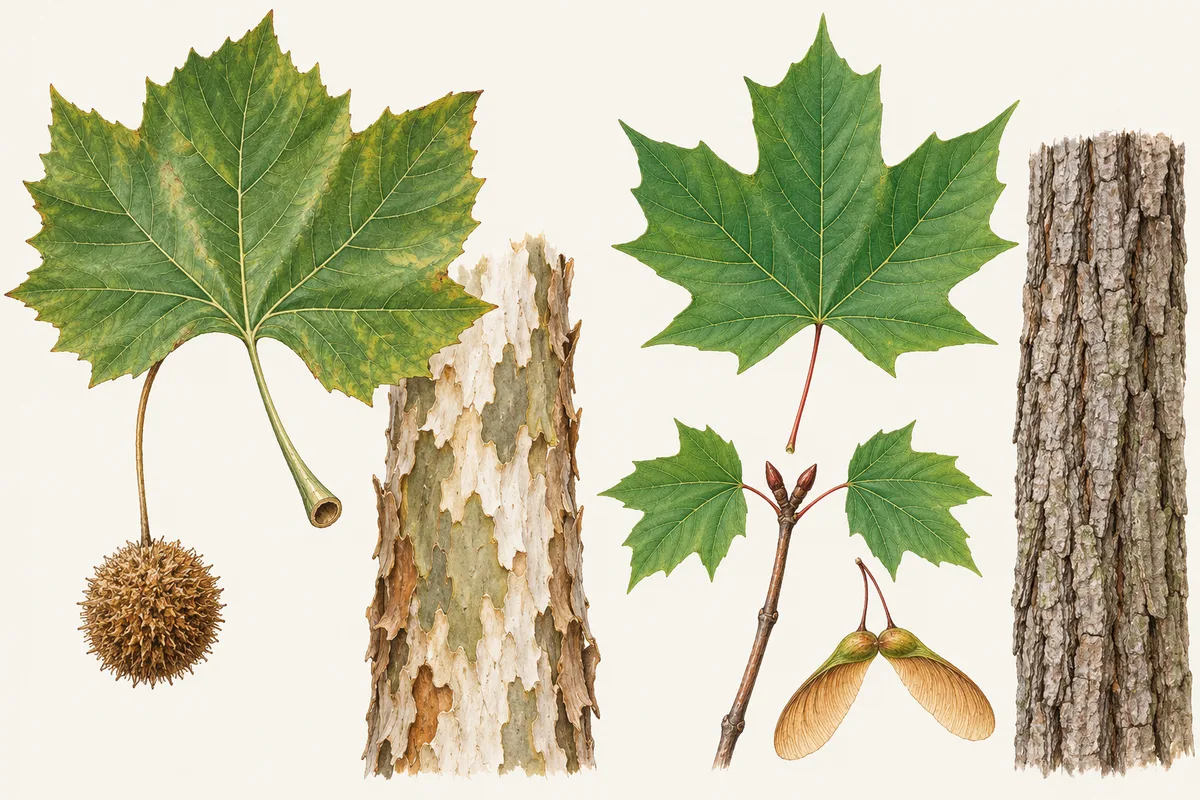
Sycamore vs maple is settled where the leaf meets the twig. An American sycamore has alternate leaves whose stalk base hides the bud like a cap; maples have opposite leaves with the bud visible above the stalk. Sycamores then bear round seed balls on 3- to 6-inch stalks and mottled bark peeling in patches; maples bear paired winged seeds.
- Alternate leaves mean sycamore; opposite leaves mean maple. This one check works on every maple.
- Pull a sycamore leaf off: the hollow base of its stalk fits over the bud like a cap.
- In Britain, sycamore is a maple (Acer pseudoplatanus), so the comparison there is maple against maple.
Field marks at a glance
- Scientific name
- Platanus occidentalis and Acer spp.
- Family
- Platanaceae (sycamore); Sapindaceae (maples)
- Type
- Broadleaf, deciduous
- Leaf arrangement
- Sycamore: alternate, one leaf per node on a zigzag twig. Maples: opposite, leaves and buds in pairs.
- Leaf stalk base
- Sycamore: the hollow base encloses the bud; a stipule scar rings the twig. Maples: bud sits in plain view above the leaf scar.
- Leaf size and edge
- Sycamore: 4 to 8 inches wide (Virginia Tech), 4 to 9 (Morton Arboretum), 3 to 5 lobes, broad coarse teeth. Sugar maple: 3 to 6 inches, smooth edges. Red maple: 2 to 4 inches, fine teeth.
- Fruit
- Sycamore: a round ball about 1 inch across on a stalk 3 to 6 inches long, usually one per stalk. Maples: paired winged samaras.
- Bark
- Sycamore: thin, mottled brown, green, tan and white, peeling in patches; upper limbs nearly white. Maples: smooth gray when young, then plates, strips or ridges, never camouflage patches.
- Buds
- Sycamore: reddish, resinous, under a single cap-like scale, no end bud. Maples: several scales; sugar maple's brown and sharp, red maple's blunt and reddish.
- Family
- Not related: sycamore is in the plane-tree family (Platanaceae), maples in the soapberry family (Sapindaceae).
- In the app's Collection
- American sycamore, London plane, sugar maple, red maple, Norway maple and Japanese maple.
Ask in the United States whether a tree is a sycamore or a maple and the answer is almost always on the twig. The American sycamore (Platanus occidentalis) has a leaf so maple-like that the Morton Arboretum describes it as "similar to maple", but the two trees are not related, and three checks tell them apart before you look at anything else.
The twig test: alternate leaves and a hidden bud
1. Opposite or alternate. Look at where the leaves attach. Maples grow their leaves and buds in opposite pairs: two leaves at the same point, one on each side of the twig. The American sycamore grows one leaf per node, alternating up a twig that Virginia Tech's sycamore fact sheet calls distinctly zigzag. This single check separates the sycamore from every maple, including the ones covered on the maple page.
2. Pull a leaf off. On a sycamore, the base of the leaf stalk is hollow and swollen: it wraps around the bud and covers it completely, so the bud only appears once the leaf falls. The leaf scar then forms a ring around the bud, and a second scar, left by the stipule, rings the whole twig. On a maple the bud sits in plain sight in the angle above the stalk.
3. Look at the bud. Sycamore buds are reddish and resinous, each under a single cap-like scale, and the twig has no end bud. Maple buds have several scales. Sugar maple's are brown and very sharp-pointed, according to Virginia Tech's sugar maple sheet; red maple's are blunt and green or reddish.
If you can reach a twig, you are done in under a minute. If you can't, the fruit and the bark will settle it from the ground.
Fruit: seed balls or helicopters
The American sycamore's fruit is a tight round ball of tiny seeds. Virginia Tech gives it a stalk 3 to 6 inches long and notes that it matures in November and hangs through winter like a Christmas tree ornament before breaking up; the Morton Arboretum measures the ball at about 1 inch across. Each seed is tiny and winged, about 1/2 inch long.
Every maple bears paired winged seeds instead, the samaras children call helicopters. Sugar maple's are horseshoe-shaped and about 1 inch long; red maple's are 1/2 to 3/4 inch; silver maple's, the largest of any native maple, have wings 1 1/2 to 2 1/2 inches long. No maple has seed balls, and no sycamore has winged pairs.
A dangling ball in winter can also come from a London plane, the sycamore's planted hybrid. The Morton Arboretum's London planetree page gives it two balls per stalk, where the American sycamore usually has one. Our London plane page covers that pair in full.
Leaves side by side
When only a fallen leaf is to hand, compare it with the three maples a sycamore is most often mistaken for. Figures are from the Virginia Tech fact sheets and the Morton Arboretum.
| Feature | American sycamore | Sugar maple | Red maple | Silver maple |
|---|---|---|---|---|
| Arrangement | Alternate | Opposite | Opposite | Opposite |
| Width or length | 4 to 8 in wide (Morton: 4 to 9) | 3 to 6 in long | 2 to 4 in long | 2 1/2 to 5 in long |
| Lobes | 3 to 5, shallow | 5, rounded sinuses | 3 to 5 | 5, cut deeply |
| Edge | Broad, coarse teeth | Smooth | Finely serrated | Coarse teeth |
| Underside | Paler; veins may be hairy | Paler | Paler, sometimes waxy | Silvery white |
| Stalk base | Hollow, covers the bud | Bud exposed | Bud exposed | Bud exposed |
Two things stand out. Sycamore leaves are bigger than most maple leaves and feel tougher; the Morton Arboretum calls them leathery. And their lobes are shallow, more like a broad triangle with points than a hand with fingers. The Virginia Tech red maple sheet shows how variable red maple's sinuses are, which is why the arrangement check above matters more than lobe shape.
Bark and the whole tree
Sycamore bark is the easiest clue from a distance. Virginia Tech describes it as thin and mottled brown, green, tan and white, peeling readily in patches, a pattern often called camouflage bark. The Morton Arboretum adds that the upper trunk and branches become nearly white, so in winter a sycamore stands out along a creek as a pale skeleton among gray trees. Older trunks near the ground turn gray-brown and scaly. The peeling bark guide compares it with other trees that shed bark in patches or strips.
Maple bark never shows that patchwork. Sugar maple darkens into long, firm ridges that curl outward; red maple breaks into long, fine, scaly plates; silver maple into long thin strips loose at the ends.
Size and site help too. The USDA Forest Service's Silvics of North America says the American sycamore grows to a larger diameter than any other North American hardwood, with trees past 120 inches through and 140 feet tall, and that it is most common and largest on alluvial soils along streams and in bottomlands. It grows in every state east of the Great Plains except Minnesota. A huge, white-limbed tree leaning over a river is almost always a sycamore.
When sycamore means a maple
In Britain and Ireland, "sycamore" is a maple: Acer pseudoplatanus, which Americans sometimes call sycamore maple or planetree maple. Oregon State University describes it as a European tree with opposite leaves, small yellow-green flowers in hanging clusters after the leaves, and samaras set at about 60 degrees. It is planted in parts of the US and, the same source notes, considered invasive in some areas, including parts of New England.
So "sycamore vs maple" asked in the UK is a different question: it means telling the sycamore from field maple or Norway maple, all of them maples with opposite buds and winged seeds. The sycamore vs Norway maple page sets the two big street maples side by side. The sycamore page explains both meanings of the name and compares the British sycamore with its maple neighbors.
Using a photo
Tree Identifier names a tree from one photo of the leaves, the bark or the fruit. For this pair, a shot of a twig with two or more leaves attached, or of the bark on the upper limbs, carries the deciding clue. The result shows no confidence score or list of alternatives, so check the leaf arrangement yourself. American sycamore, London plane, sugar maple and red maple are all in the app's 138-species Collection, and the Tree Map can hold the spot where you found each one.
Look-alikes and how to tell them apart
London plane (Platanus × acerifolia)
A hybrid of the American sycamore planted along city streets. The Morton Arboretum describes leathery leaves with nearly smooth edges and two seed balls on each stalk; the American sycamore has coarsely toothed leaves and usually one ball per stalk.
Silver maple (Acer saccharinum)
The maple most often found beside sycamores on riverbanks. Its leaves are opposite, deeply cut into five lobes and silvery white beneath, and its paired seeds have wings 1 1/2 to 2 1/2 inches long. The bark breaks into long strips, not patches.
Sycamore maple (Acer pseudoplatanus)
The European tree Britain calls sycamore, planted in parts of the US. It is a true maple: opposite leaves, paired winged seeds in pendulous clusters, and bark flaking in small scales, not the white camouflage of the American sycamore.
What a photo can't settle
- A photo of a single detached leaf hides the two marks that settle this pair: the opposite or alternate arrangement and the bud under the leaf stalk. Photograph a twig with two or more leaves.
- American sycamore and London plane can be hard to separate from leaves alone, and planted plane trees may be hybrids or cultivars; check the number of seed balls per stalk.
- Sycamore anthracnose can strip the first leaves in spring and the tree regrows a second set, so early-season leaves may be scarce, small or blotched.
Questions people ask
Are sycamore and maple trees related?
The American sycamore is not: it belongs to the plane-tree family, Platanaceae, while maples belong to the soapberry family, Sapindaceae. The leaves look alike by convergence. The European sycamore, Acer pseudoplatanus, is a true maple, which is why the two words get mixed up.
How do you tell a sycamore leaf from a maple leaf?
Look at how the leaves sit on the twig: alternate on sycamore, opposite on maples. Then pull one off. A sycamore leaf stalk has a hollow base that covered the bud; a maple leaf stalk leaves the bud exposed. Sycamore leaves are also larger, 4 to 8 inches wide, with broad coarse teeth.
Do sycamore trees have helicopter seeds like maples?
No. The American sycamore bears round seed balls about an inch across, hanging on long stalks through winter and breaking up into tiny winged seeds. Maples bear paired winged seeds, the helicopters. A tree with both large lobed leaves and helicopters is a maple.
What is a sycamore maple?
Acer pseudoplatanus, the tree called simply sycamore in Britain. It is a European maple with opposite leaves and paired winged seeds, planted in parts of the US. Oregon State University notes it is considered invasive in some areas, including parts of New England.
Can you tell a sycamore from a maple by the bark?
Usually, on a mature tree. American sycamore bark peels in patches of brown, green, tan and white, and its upper limbs look nearly white. Maple bark is gray or brown and breaks into plates, strips or ridges without the patchwork. On young trees both can be smooth, so check the leaves too.
Sources
- American sycamore fact sheet — Virginia Tech Dendrology
- Sycamore (Platanus occidentalis), Silvics of North America — USDA Forest Service
- Sycamore (Platanus occidentalis) — The Morton Arboretum
- London planetree (Platanus × acerifolia) — The Morton Arboretum
- Sugar maple fact sheet — Virginia Tech Dendrology
- Red maple fact sheet — Virginia Tech Dendrology
- Silver maple fact sheet — Virginia Tech Dendrology
- Acer pseudoplatanus (planetree maple, sycamore maple) — Oregon State University, Landscape Plants
Keep reading
- Tree profileSycamore tree: the British maple and the American plane tree
- Tree profileMaple trees (Acer): how to identify them
- Tree profileLondon plane tree (Platanus × hispanica): how to identify it
- Clue guideWhich tree has peeling bark? Sort it by the color underneath
- Field guideHow to identify trees by their leaves