Tree comparison
Sycamore vs Norway maple: how to tell them apart
Two introduced maples with five-lobed leaves, side by side in British parks and streets. Squeeze a leaf stalk first, then look at the seeds.
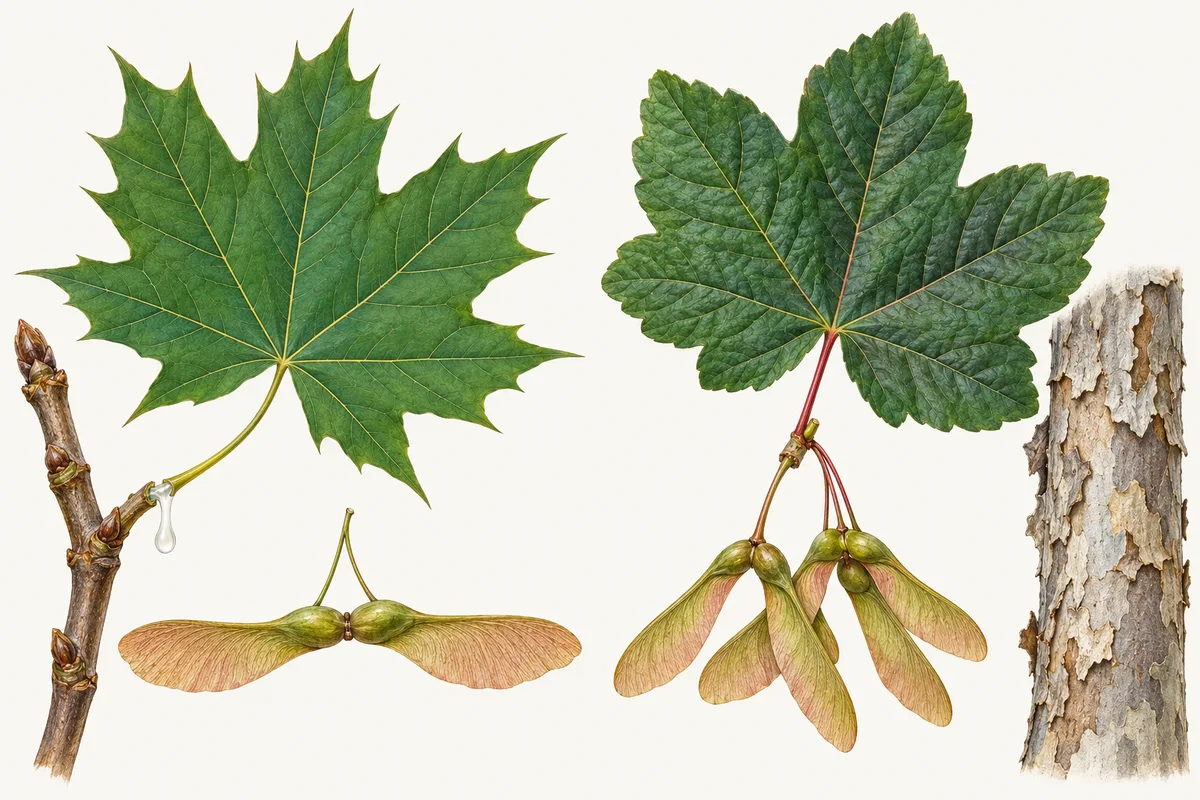
In short
Sycamore vs Norway maple is quickest to settle with the leaf stalk: squeeze it and a Norway maple oozes milky sap. Norway maple lobes end in a few long, sharply pointed teeth, and its seed wings spread almost in a straight line. Sycamore leaves are coarsely toothed with hairy veins underneath, and its seeds meet in a narrower V of about 60 degrees.
- Milky sap from a squeezed leaf stalk means Norway maple.
- Bright yellow-green flowers on bare twigs in early spring mean Norway maple; hanging green-yellow tassels among the leaves in late spring mean sycamore.
- A purple tree with leaves purple on both sides is a Norway maple such as Crimson King; green above and purple beneath is a purple sycamore.
Field marks at a glance
- Scientific name
- Acer pseudoplatanus and Acer platanoides
- Family
- Sapindaceae (soapberry family)
- Type
- Broadleaf, deciduous
- Leaf stalk
- Norway maple: oozes milky sap when squeezed or snapped. Sycamore: no milky sap; stalks often red on younger trees.
- Leaf lobes
- Norway maple: five lobes, each ending in a few long, sharply pointed teeth; glossy on both sides. Sycamore: five (sometimes up to seven) lobes, coarsely toothed all round, hairy veins underneath.
- Leaf size
- Sycamore: 7–16 cm long (Woodland Trust). Norway maple: 10–18 cm across (Oregon State University).
- Seeds
- Norway maple: wings spread wide, almost in a straight line, about 4–5 cm, often hanging on into winter. Sycamore: wings in a narrow V, about 60 degrees (Oregon State), 3–5 cm, in hanging clusters.
- Flowers
- Norway maple: bright yellow-green clusters of up to 30, before the leaves. Sycamore: green-yellow hanging spikes 8–12 cm long, after the leaves.
- Bark
- Sycamore: dark pinkish-grey and smooth, then cracking into small plates. Norway maple: grey with fine ridges, later shallow furrows and narrow interlacing ridges.
- Twigs
- Sycamore: pinkish-brown and hairless. Norway maple: slender and brown with tiny white spots; buds green and red in winter.
- Height
- Sycamore: up to about 35 m. Norway maple: up to about 25 m.
- In the app's Collection
- Norway maple is one of the 138 Collection species; the British sycamore is not.
Sycamore and Norway maple are the two big five-lobed maples of British towns. Both were introduced from mainland Europe, both have opposite leaves and winged seeds, and both line streets and fill parks, so a leaf on the pavement could be either. One squeeze of a leaf stalk usually ends the question.
The sap test, then the leaf
Pick a fresh leaf and squeeze or snap its stalk near the base. The Woodland Trust's Norway maple profile notes that its leaf stalks ooze milky sap when squeezed, and NatureSpot's maple identification page gives the same test. Neither lists milky sap for sycamore. A white drop means Norway maple; no white drop sends you on to the leaf.
Then look at the tips of the lobes:
- Norway maple has five lobes, each with "a few pointed teeth", in the Woodland Trust's words; NatureSpot says each lobe ends in sharp points. The teeth are long and few, so the leaf looks spiky but clean-edged between them. Both surfaces are glossy, according to Oregon State University, and the leaf is 10 to 18 cm across.
- Sycamore leaves are 7 to 16 cm long with five lobes; NatureSpot allows five to seven. The edges are coarsely toothed all the way round, and the veins on the underside are hairy. On younger trees the leaf stalks are red.
The sap test needs a living leaf. On a fallen one, rely on the teeth and the hairy veins, then check any seeds on the ground.
Seeds: straight line or narrow V
Maple seeds come in pairs, each with a wing, and the angle between the wings is the classic way to tell these two apart. The Woodland Trust names it as the difference between the species: Norway maple's seeds sit at a wider angle than sycamore's.
- Norway maple: NatureSpot describes the wings as held at only a slight angle from a straight line; Virginia Tech's Norway maple fact sheet says they spread widely, measure about 4 to 5 cm (1 1/2 to 2 in) and ripen in late summer, often staying on the tree into winter.
- Sycamore: the Woodland Trust calls its seeds V-shaped with a narrower angle. Oregon State's sycamore maple page puts the angle at about 60 degrees and the samaras at 3 to 5 cm, in hanging clusters. NatureSpot describes the wings as at right angles; either way they form a clear V, not a line.
Seeds lie under both trees through autumn, which makes this the best test in late summer and autumn, when the sap can be hard to see in old, leathery stalks.
Flowers in spring
The two trees flower at different times, which makes April and May an easy season for this pair.
- Norway maple flowers first. Virginia Tech describes bright yellow-green, fairly conspicuous flowers that open before the leaves, and Oregon State places them in early spring. The Woodland Trust counts up to 30 flowers in a cluster. A street tree glowing lime-green on bare twigs in early spring is very likely a Norway maple.
- Sycamore flowers after its leaves have opened. Oregon State describes small yellow-green flowers in hanging clusters 8 to 12 cm long, and the Woodland Trust calls them green-yellow spikes, or racemes. They dangle among the leaves like tassels.
Bark, twigs and winter
In winter the leaves are gone and the trees look alike, so start with the bark and the twigs.
- Bark. The Woodland Trust's sycamore profile describes dark pinkish-grey bark, smooth when young and cracking into small plates with age; Oregon State says it flakes in small rectangular scales. Norway maple bark is grey with fine ridges, and Virginia Tech adds that older trees have shallow furrows with long, narrow ridges that partly interlace. Plates point to sycamore, a net of fine ridges to Norway maple.
- Twigs. Sycamore twigs are pinkish-brown and hairless. Norway maple twigs are slender and brown with tiny white spots, and its winter buds are green and red, according to the Woodland Trust.
- Leftover seeds. Norway maple seeds often hang on into winter with their wings nearly straight.
Buds are a weak test here: Oregon State notes that sycamore buds resemble Norway maple's. For more trees to name from twigs, bark and leftover fruit, see the UK tree identification guide.
Purple and coloured forms
Both species come in purple and patterned garden forms, and these are the leaves most likely to fool a photo.
- Crimson King is a Norway maple with dark purple leaves, nearly black according to Virginia Tech. Oregon State describes its autumn colour as maroon to reddish bronze. The purple runs through both sides of the leaf.
- Purple sycamore, Acer pseudoplatanus 'Atropurpureum', has leaves dark green above and purple beneath, Oregon State says. From below, the crown looks purple; from above, green.
- Brilliantissimum is a sycamore whose new leaves open shrimp-pink, then turn pale yellow-green and finally light to medium green, according to Oregon State.
Turn a leaf over before deciding, and squeeze the stalk: the milky sap works on every Norway maple cultivar.
Where each one grows
The Woodland Trust gives sycamore's native range as central, eastern and southern Europe. It may have been brought to Britain by the Romans or in the 1500s, spread widely from the mid-1800s and now grows across the UK, colonising woods where it can crowd out native trees. It reaches about 35 m and can live around 400 years. The sycamore page covers its history and the other tree, the American plane, that shares its name. In North America, sycamore means a plane tree; sycamore vs maple compares it with the American maples.
Norway maple is native to eastern and central Europe and was introduced to the UK in the 17th century. It grows to about 25 m and is found mainly as a street and park tree, valued, the Woodland Trust says, for its tall trunk and its tolerance of compacted soil, shade and pollution. Oregon State notes that in North America it seeds heavily and has spread into woodlands near cities, especially in the northeastern US; the Norway maple vs sugar maple page covers that pairing.
If neither tree fits and the leaf is small and rounded, check the native field maple. Tree Identifier can name a maple from one photo of a leaf, the bark or a seed cluster; it shows no confidence score or alternatives, so confirm with the sap and the seed angle. Norway maple is in the app's 138-species Collection; the British sycamore is not.
Look-alikes and how to tell them apart
Field maple (Acer campestre)
Britain's only native maple, often a hedgerow shrub. Its leaves are much smaller, with three to five lobes that are usually untoothed, and its seed wings lie in a straight horizontal line. NatureSpot gives it up to about 20 m.
London plane (Platanus × hispanica)
Not a maple. Its thick, leathery leaves have five triangular lobes with smooth, unserrated edges, which the Woodland Trust gives as the key difference from sycamore. Its fruit is a green, spiky ball, not paired winged seeds, and its olive-grey bark peels to show cream patches.
Sugar maple (Acer saccharum)
The usual Norway maple look-alike in North America. Virginia Tech describes its leaf edges as smooth between the five rounded lobes, its terminal buds as brown and very sharply pointed, and its samaras as horseshoe-shaped, about 1 inch long.
What a photo can't settle
- Young, shaded or damaged leaves of both trees can lose their typical teeth and size; check the sap and the seeds before relying on leaf shape.
- A photo cannot show whether a leaf stalk bleeds milky sap, which is the fastest test for this pair; do it by hand.
- Cultivars of both species, with purple, variegated or pink young leaves, are widely planted and can confuse leaf-based identification from a photo.
Questions people ask
How do you tell a sycamore from a Norway maple?
Squeeze or snap a leaf stalk: milky sap means Norway maple. Then compare the lobes, which end in a few long, sharp teeth on Norway maple and are coarsely toothed on sycamore, and the seeds, whose wings are nearly in a straight line on Norway maple and in a narrow V on sycamore.
Is a Norway maple a sycamore?
No. Both are maples (genus Acer) and both were introduced to Britain, but they are different species. Sycamore is Acer pseudoplatanus, native to central, eastern and southern Europe; Norway maple is Acer platanoides, native to eastern and central Europe and introduced to the UK in the 17th century, according to the Woodland Trust.
Which maple flowers before its leaves come out?
Norway maple. Virginia Tech and Oregon State University both describe its bright yellow-green flower clusters opening in early spring before the leaves. Sycamore flowers hang in green-yellow spikes 8 to 12 cm long that appear after the leaves have opened.
Is a purple-leaved maple a Norway maple or a sycamore?
It can be either. Crimson King, a Norway maple, has deep purple leaves on both sides. Purple sycamore, Atropurpureum, has leaves that are dark green above and purple beneath, according to Oregon State University. Turn a leaf over, then squeeze the stalk for milky sap.
Which is more common in the UK, sycamore or Norway maple?
Sycamore. It has spread through woodland across the UK since the mid-1800s, the Woodland Trust says, while Norway maple is found mainly as a street tree and ornamental tree in parks and gardens.
Sources
- Sycamore (Acer pseudoplatanus) — Woodland Trust
- Norway maple (Acer platanoides) — Woodland Trust
- Maples: Field Maple, Sycamore, Norway Maple and London Plane — NatureSpot (Leicestershire and Rutland)
- Acer pseudoplatanus (planetree maple, sycamore maple) — Oregon State University, Landscape Plants
- Acer platanoides (Norway maple) — Oregon State University, Landscape Plants
- Norway maple fact sheet — Virginia Tech Dendrology
- London Plane (Platanus x hispanica) — Woodland Trust
- Sugar maple fact sheet — Virginia Tech Dendrology
Keep reading
- Tree profileSycamore tree: the British maple and the American plane tree
- Tree profileField maple (Acer campestre): how to identify it
- Tree comparisonNorway maple vs sugar maple: how to tell them apart
- Tree profileMaple trees (Acer): how to identify them
- Field guideTree identification in the UK: British trees by leaf, bark and picture