Tree profile
Field maple (Acer campestre): how to identify it
Britain's only native maple: small, round-lobed leaves in opposite pairs, seed wings spread in a straight line, corky ridges on older twigs and a golden-yellow autumn.
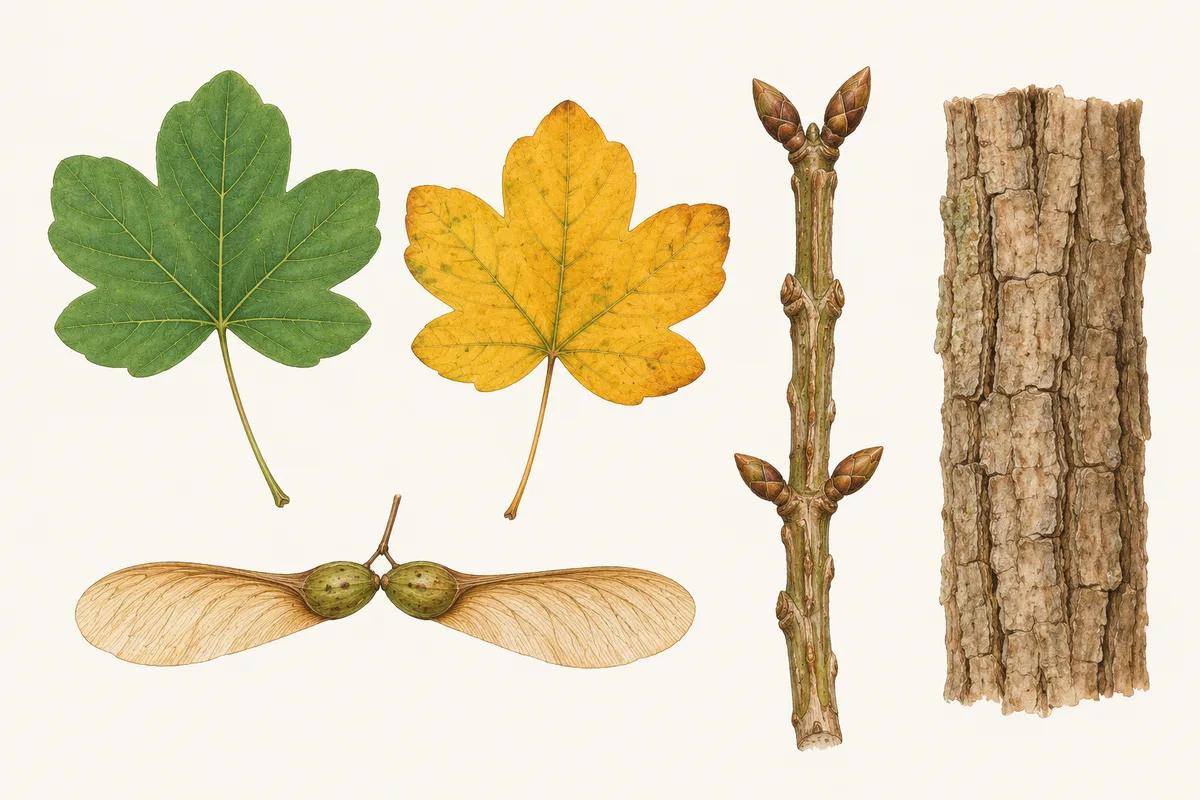
In short
Field maple identification rests on three checks. The leaves are small, about 5 to 10 cm, in opposite pairs, with five rounded lobes rather than the pointed lobes of sycamore or Norway maple. The paired seeds spread their wings in a straight line, often tinged pink or red. Older twigs grow corky ridges. It is the UK's only native maple, and its leaves turn golden yellow in autumn.
- Rounded lobes and small leaves separate field maple from sycamore (7 to 16 cm leaves) and Norway maple (pointed teeth).
- Seed wings in a straight line are the quick test; sycamore's form a narrow V and Norway maple's a wide angle.
- A snapped leaf stalk bleeds milky sap on both field maple and Norway maple, so the sap test cannot separate those two.
Field marks at a glance
- Scientific name
- Acer campestre
- Family
- Sapindaceae (soapberry family)
- Type
- Broadleaf, deciduous
- Leaves
- Opposite, simple, small (about 5 to 10 cm, 2 to 4 in), dark green and slightly shiny, with 3 to 5 rounded lobes and rounded teeth or smooth edges; softly hairy underneath.
- Leaf stalk
- Up to about 10 cm long; it oozes milky sap when snapped, as Norway maple's does.
- Seeds
- Paired winged seeds (samaras) with the wings spread in a straight line, horizontal; green and red, new seeds often tinged pink; spread by wind.
- Flowers
- Small, yellow-green and cup-shaped, in hanging clusters in spring as the leaves open; easy to overlook.
- Bark and twigs
- Bark light brown and flaky. Slender brown twigs that develop corky ridges with age; small grey buds.
- Autumn colour
- Rich golden yellow before the leaves fall; in North American plantings NC State calls the yellow colour late and not reliable.
- Size and lifespan
- Up to about 20 m in Britain and up to 350 years old (Woodland Trust); usually 7.5 to 10.5 m (25 to 35 ft) as a planted tree (NC State). Often a clipped hedgerow shrub.
- Where
- Woods, scrub, hedgerows and chalk lowland; planted in parks, gardens and streets for its compact habit and pollution tolerance.
Field maple is the small maple of English hedgerows and chalk downland, and the only maple native to Britain. It is often trimmed into a hedge, so many people walk past it daily without knowing it. Its leaves, seeds and twigs each tell it apart from sycamore and Norway maple, the two bigger maples that dominate British towns.
How to identify a field maple in three checks
1. Small leaves with rounded lobes, in opposite pairs. The Woodland Trust describes field maple leaves as small, dark green and shiny, with five lobes and rounded teeth. NC State's hedge maple profile gives 5 to 10 cm (2 to 4 in), 3 to 5 rounded lobes, smooth edges, a hairy underside and leaves set in opposite pairs. The Woodland Trust's easy test is that field maple leaves are much more rounded than those of sycamore and Norway maple.
2. Seed wings in a straight line. Like all maples, field maple carries its seeds in pairs, each with a papery wing. On field maple the two wings spread out flat, in a straight line; NC State calls the wings horizontal. The Woodland Trust says new seeds are tinged with pink, and the fruits are green and red.
3. Corky twigs. In winter, the Woodland Trust's giveaway is older twigs with corky ridges and small grey buds. The bark of the trunk is light brown and flaky.
A fourth check needs a leaf in your hand. Snap the stalk: NC State notes that field maple's leaf stalk carries milky sap. Norway maple bleeds milky sap too, according to the Woodland Trust, so milky sap does not separate field maple from Norway maple. The lobes and seed wings do that.
Tree Identifier can name field maple from one photo of a leaf, a seed pair or the bark. The app shows no confidence score and no list of look-alikes, so check the rounded lobes and the flat seed wings yourself.
Field maple, sycamore and Norway maple side by side
| Feature | Field maple | Sycamore | Norway maple |
|---|---|---|---|
| Leaf size | About 5–10 cm | 7–16 cm | – |
| Lobes | 3–5, rounded | 5, pointed, coarsely toothed | 5, with a few long pointed teeth |
| Seed wings | Straight line | Narrow V | Wide angle |
| Winter twig | Corky ridges, small grey buds | Pink-brown, hairless | Green and red buds |
| Height | Up to 20 m | Up to 35 m | Up to 25 m |
| Status in UK | Native | Non-native | Non-native |
Figures from the Woodland Trust profiles of field maple, sycamore and Norway maple, and NC State's hedge maple profile. The sycamore page explains why "sycamore" means a different tree in North America, and the guide to trees with helicopter seeds compares seed angles across all the common maples and ashes.
Field maple through the year
- Spring: small, yellow-green, cup-shaped flowers hang in clusters as the leaves open; the Woodland Trust notes the flowers appear to be hermaphrodite and are pollinated by insects. NC State calls them insignificant.
- Summer: dense, small, dark green leaves; the green and red seed pairs develop.
- Autumn: the leaves fade to a rich, golden yellow before they fall. The seeds turn brown and spin away on the wind.
- Winter: corky ridges on older twigs, small grey buds in opposite pairs, light brown flaky bark.
Field maple can reach 20 m and live for up to 350 years, according to the Woodland Trust, but most trees you meet are much smaller: hedgerow plants cut back every few years, or compact park and street trees. NC State describes the planted tree as slow-growing, reaching 7.5 to 10.5 m (25 to 35 ft), tolerant of dry soils, compaction and air pollution, and able to take severe pruning, which is why it is used under power lines and as a clipped screen.
Where field maple grows, and its wild relatives
The Woodland Trust describes field maple growing in woods, scrub and hedgerows and on chalk lowland, and widely planted in gardens and parks for its compact shape, tolerance of pollution and autumn colour. It supports aphids and their predators, ladybirds, hoverflies and birds, moths such as the mocha feed on its leaves, and small mammals eat the seeds. The Trust also notes that it produces the hardest, densest timber of all European maples, a creamy-brown wood once used for turning and carving and still used for harps.
In North America the same species is sold as hedge maple. NC State lists it as native to Europe and western Asia, a good street tree, and says it produces many seeds and has the potential to become weedy. Cultivars include 'Carnival', with white-variegated leaves, 'Pulverulentum', speckled with white and cream, and 'Royal Ruby', purplish-red in spring.
The wild service tree is the British native most often confused with field maple: the Woodland Trust lists them as look-alikes because of their similarly shaped leaves. Wild service leaves have 3 to 4 unequal lobes, less distinct than a maple's, and the tree carries brown, pale-spotted oval fruits called chequers in autumn, never winged seeds (Woodland Trust).
For the other maples, including the North American ones planted in British parks, see the maple page. The list of UK native trees places field maple among the trees that were here before people planted anything. If you keep a list of hedgerow finds, Tree Identifier's Collection and History keep each identification, and the Tree Map remembers where you saved it.
Look-alikes and how to tell them apart
Sycamore (Acer pseudoplatanus)
Sycamore leaves are much larger, 7 to 16 cm, with five pointed, coarsely toothed lobes, often on red stalks, and its seed wings form a narrow V; field maple's lie in a straight line.
Norway maple (Acer platanoides)
Norway maple also bleeds milky sap, so look at the lobes: five, ending in a few long, pointed teeth. Its seed wings spread at a wide angle, not flat, and its winter buds are green and red.
Wild service tree (Sorbus torminalis)
The Woodland Trust notes the maple-like leaves, but wild service leaves have 3 to 4 unequal lobes, and the tree carries brown oval fruits (chequers) instead of winged seeds. Its bark breaks into square plates.
Hawthorn (Crataegus monogyna)
In a hedge, small lobed hawthorn leaves can pass for field maple, but hawthorn leaves sit alternately, its twigs carry sharp thorns, and it bears white May blossom and red haws instead of winged seeds.
What a photo can't settle
- Field maple leaves vary a lot: hedge-trimmed shoots and suckers carry larger, more deeply cut leaves than the crown, so judge leaf size from several leaves.
- Cultivars such as 'Carnival' and 'Royal Ruby' change the leaf colour; the leaf shape, seeds and milky sap still identify the species.
- A photo rarely shows the seed-wing angle or corky twigs clearly; photograph a seed pair flat on your hand and a twig close up if you can.
Questions people ask
Is field maple native to the UK?
Yes. The Woodland Trust describes field maple as the UK's only native maple, growing in woods, scrub, hedgerows and on chalk lowland. Sycamore and Norway maple, the two maples most often seen in Britain, are both listed by the Woodland Trust as non-native.
How do I tell field maple from sycamore?
Compare the leaves and seeds. Field maple leaves are small, about 5 to 10 cm, with rounded lobes; sycamore leaves are 7 to 16 cm with pointed lobes, often on red stalks. Field maple's seed wings lie in a straight line, sycamore's form a narrow V. Sycamore is also much taller, up to 35 m.
What colour does field maple turn in autumn?
Golden yellow. The Woodland Trust says the leaves fade to a rich, golden yellow before falling. Some garden cultivars differ: NC State lists 'Royal Ruby', with purplish-red spring leaves that turn dark green by summer, and the white-variegated 'Carnival'.
Is hedge maple the same as field maple?
Yes. Hedge maple is the usual North American name for Acer campestre, which NC State describes as a slow-growing tree native to Europe and western Asia, often clipped as a hedge or planted as a street tree under utility lines. In Britain the same tree is called field maple.
Sources
- Field maple (Acer campestre) — Woodland Trust
- Acer campestre (Field Maple, Hedge Maple) — NC State Extension Gardener Plant Toolbox
- Sycamore (Acer pseudoplatanus) — Woodland Trust
- Norway maple (Acer platanoides) — Woodland Trust
- Wild service tree (Sorbus torminalis) — Woodland Trust
Keep reading
- Tree profileMaple trees (Acer): how to identify them
- Tree profileSycamore tree: the British maple and the American plane tree
- Clue guideWhich tree has helicopter seeds? Read the wings
- Field guideTree identification in the UK: British trees by leaf, bark and picture
- Field guideNative trees of the UK: the full list with one clue for each