Tree profile
Balsam poplar (Populus balsamifera): how to identify balm-of-Gilead
Squeeze a bud and your fingers smell of balsam for an hour: balsam poplar is the northern poplar with resinous buds, pale silvery leaf undersides and leaves that do not flutter like an aspen's.
In short
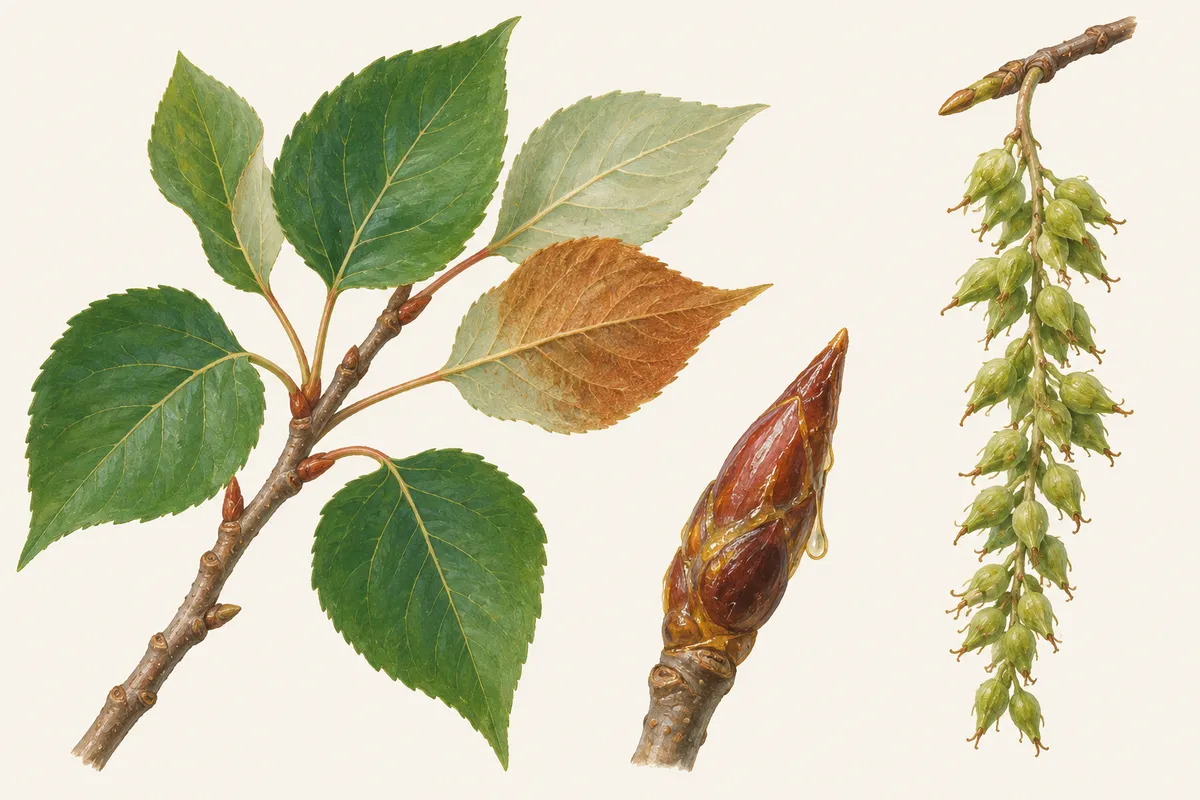
Balsam poplar identification starts with the buds: long, pointed, orange-brown, up to 1 inch (25 mm) long and so resinous they are sticky and fragrant. The leaves are broadly oval with a drawn-out tip, 7 to 12 cm long, dark green above and silvery green below, often stained with brownish resin. The leaf stalk is round, not flattened, so the leaves do not tremble like aspen leaves.
- The smell is the test: balsam poplar buds and young leaves are highly resinous and fragrant, especially at bud break.
- A round leaf stalk separates it from aspens and eastern cottonwood, whose stalks are flattened.
- It grows across the North, from Newfoundland and Labrador to Alaska, south into the northern United States.
Field marks at a glance
- Scientific name
- Populus balsamifera
- Family
- Salicaceae (willow family)
- Type
- Broadleaf, deciduous
- Buds
- End bud slender, long-pointed, up to 25 mm (1 in), orange-brown with 5 scales, very resinous and fragrant; side buds lie along the twig.
- Leaves
- Alternate, broadly oval with a long, drawn-out tip, 7 to 12 cm (about 3 to 5 in) long; edge finely toothed with small rounded teeth curving inward.
- Leaf underside
- Silvery green, mostly hairless, often blotched with brownish resin stains.
- Leaf stalk
- Round in cross-section and hairy, not flattened, so the leaf does not flutter like an aspen's.
- Twigs
- Moderately stout, bright reddish brown turning dark orange and then gray, with large, sparse lenticels.
- Bark
- Smooth and greenish brown when young, then gray; with age flat-topped ridges split by irregular V-shaped furrows.
- Catkins and seed
- Male and female trees; female catkins mature to 10 to 15 cm, with egg-shaped capsules 6 to 7 mm that split in two and release cottony seed in May to July.
- Size
- Up to 25 m (about 80 ft) in Canada according to Natural Resources Canada; large trees 75 to 100 ft according to the USDA Forest Service.
- Range
- Across northern North America, Newfoundland and Labrador to Alaska; south to Minnesota, Michigan, New York and Maine, and in the West to the Black Hills, central Colorado and northeast Oregon.
Balsam poplar is the poplar of the North: the tree along rivers in the boreal forest and the Prairies whose buds coat your fingers with sticky, sweet-smelling resin. It shares the willow family's cottony seed and catkins with aspens and cottonwoods, and in parts of its range it grows right beside them. Three checks separate it: the buds, the underside of the leaf and the leaf stalk.
How to identify a balsam poplar
1. Crush a bud. The end bud is the field mark. Natural Resources Canada describes it as slender and long-pointed, up to 25 mm long, orange-brown, with 5 scales, very resinous and fragrant. The USDA Forest Service's Silvics of North America adds that buds and leaves are highly resinous and that the trees give off a strong fragrance at bud break. In winter and early spring, a sticky bud that smells of balsam on a poplar twig in Canada or the northern states is almost always this tree or a hybrid of it.
2. Turn a leaf over. Leaves are broadly oval with a long, drawn-out tip, 7 to 12 cm long, dark green on top. The underside is silvery green and often blotched with brownish resin stains, according to Natural Resources Canada. The edge carries many small, rounded teeth that curve inward at their tips.
3. Roll the leaf stalk. Balsam poplar's stalk is round in cross-section and hairy. Aspens and eastern cottonwood have a stalk flattened from side to side, which is why their leaves flutter in the faintest breeze. A balsam poplar crown moves in the wind like any other tree.
4. Read the bark and form. Young bark is smooth and greenish brown, turning gray; older trunks split into flat-topped ridges with irregular V-shaped furrows. Forest-grown trees have a long, straight trunk and a narrow, open, somewhat columnar crown with a few stout, ascending branches. The Forest Service notes that young trees have a conical crown and that trees of 80 to 100 years often grow rounder.
When the buds are out of reach, a photo of a leaf, the bark or the whole tree gives Tree Identifier enough to suggest a name. The app returns one answer with no confidence score and no list of look-alikes, so check a balsam poplar result against the bud smell and the round leaf stalk.
Catkins and cotton
Balsam poplar is dioecious: male and female catkins grow on separate trees, which generally start flowering at 8 to 10 years old. The Forest Service gives flowering in April and May over most of the range, and in June or July at the northern limit and high elevations. Male catkins are 5 to 9 cm (2 to 3.5 in) long; female catkins lengthen to 10 to 15 cm (4 to 6 in) as they mature.
Natural Resources Canada describes the capsules as egg-shaped, short-tipped and hairless, 6 to 7 mm long, splitting into 2 parts when ripe. Seed dispersal begins in May and June and can run into late July in the northernmost stands. The seeds are tiny and carry silky hairs that take them on the wind, and most die within several weeks. Only female trees shed this cotton. Our guide to poplars, cottonwoods and aspens compares the cotton and catkins across the genus.
Where balsam poplar grows
The Forest Service describes one of the widest ranges of any North American broadleaf: about 110 degrees of longitude, from Newfoundland, Labrador and Quebec west to Hudson Bay, Mackenzie Bay and across Alaska, along the northern tree limit. In the United States it reaches Maine, New York, Michigan, Wisconsin and Minnesota, and in the West the Black Hills of South Dakota and Wyoming, central Colorado, northern Utah, Idaho and northeast Oregon, with scattered stands in Iowa, Ohio, Pennsylvania and Maryland.
It grows on uplands as well as flood plains but does best on river flood plains. On new sand and gravel bars it moves in first, dominates for about 50 years and is then largely replaced by white spruce (Forest Service). Natural Resources Canada lists its usual companions as alders, willows, balsam fir, black and white spruce and white birch, and notes that it is often planted in rural areas for shelterbelts and windbreaks. For the trees that grow with it across the country, see tree identification in Canada.
Balsam poplar vs black cottonwood, aspens and eastern cottonwood
| Tree | Leaf | Leaf stalk | Buds | Capsules |
|---|---|---|---|---|
| Balsam poplar | Broadly oval, long tip, 7–12 cm; silvery beneath with resin stains | Round, hairy | To 25 mm, very resinous, fragrant | Egg-shaped, 6–7 mm, hairless, 2 parts |
| Black cottonwood | Broadly oval, long tip, 7–12 cm; silvery beneath with resin stains | Round, 3–4 cm | 17–20 mm, very resinous, fragrant | Nearly round, 3–4 mm, hairy, 3 parts |
| Quaking aspen | Nearly round, 3–7 cm, 20–30 fine teeth per side | Flattened, usually longer than blade | Slightly resinous, not fragrant | Narrowly conical, hairless, 5–7 mm, 2 parts |
| Bigtooth aspen | Oval, 5–10 cm, 7–15 large teeth per side | Flattened, shorter than blade | 7–8 mm, dull brown, not gummy | Narrowly conical, downy, 6–7 mm |
| Eastern cottonwood | Triangular, 3–6 in | Flattened, glands at top | About 3/4 in, resinous | Not compared here |
Figures for black cottonwood, quaking (trembling) aspen and bigtooth (largetooth) aspen come from Natural Resources Canada's black cottonwood, trembling aspen and largetooth aspen factsheets; eastern cottonwood's from Virginia Tech Dendrology.
Black cottonwood is the hard one. Natural Resources Canada treats it as a subspecies of balsam poplar, and its leaves are described in the same words. Location helps: black cottonwood is the big western tree, up to 35 m and the largest broadleaf native to British Columbia, while balsam poplar is the tree of the boreal forest and the East. Where both grow, wait for the capsules in early summer: three parts and hairy means black cottonwood, two parts and hairless means balsam poplar.
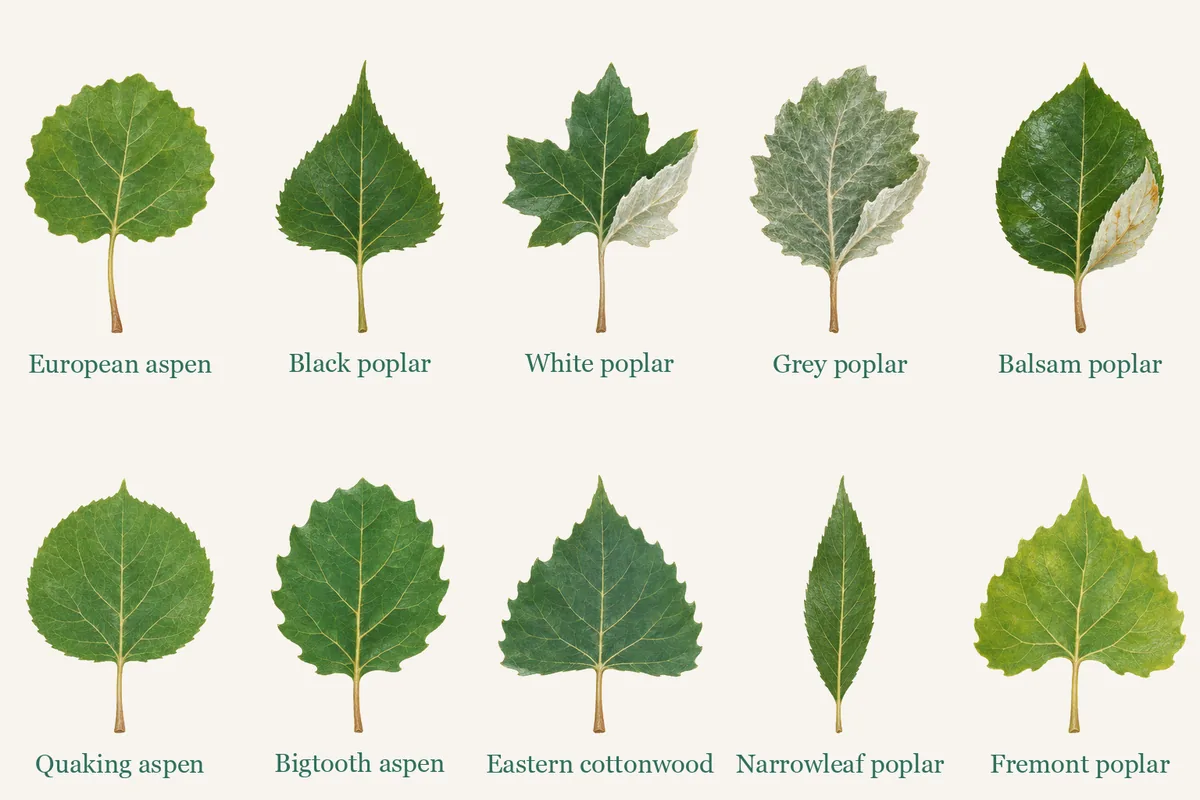
Aspens are told by the flattened leaf stalk and the trembling crown. The quaking aspen page covers its smooth pale bark and clones. Eastern cottonwood has resinous buds too, but its triangular leaf and flattened stalk rule out balsam poplar; the cottonwood page has the details.
Hybrids and planted poplars
The Forest Service lists hybrids of balsam poplar with white poplar, black poplar, European aspen and several Asian poplars, and notes that Populus × jackii, a cross with eastern cottonwood, is used in windbreaks on the northern plains. Natural Resources Canada lists it as Jack's hybrid poplar. Expect intermediate trees in farm shelterbelts and windbreaks, where the leaf and bud marks of the two parents mix; a wild tree on a northern riverbank, far from plantings, is more likely to be the pure species.
Balsam poplar is not one of the 138 species in Tree Identifier's Collection, though a photo of it still returns a name. If you want to come back to a particular tree in late spring to check whether it sheds cotton, the app's Tree Map pins every identification made with location turned on.
Look-alikes and how to tell them apart
Black cottonwood (Populus trichocarpa)
The leaf is nearly the same, and the two hybridize. Check the seed capsules in early summer: Natural Resources Canada describes black cottonwood's as round, 3 to 4 mm, hairy and splitting in three parts, while balsam poplar's are egg-shaped, 6 to 7 mm, hairless and split in two. Black cottonwood is the western, coastal tree.
Quaking aspen (Populus tremuloides)
Aspen leaves are small and nearly round, 3 to 7 cm, with 20 to 30 fine teeth per side, on a flattened stalk that makes them tremble. Natural Resources Canada describes aspen bark as pale green to almost white when young and its buds as only slightly resinous and not fragrant.
Eastern cottonwood (Populus deltoides)
Cottonwood buds are also resinous, about 3/4 inch long, but Virginia Tech describes its leaf as a triangle 3 to 6 inches long on a flattened stalk with glands at the top, not a long-tipped oval on a round stalk.
Bigtooth aspen (Populus grandidentata)
Bigtooth aspen has a round to oval leaf with 7 to 15 large, uneven teeth per side on a flattened stalk, and dull brown buds that Natural Resources Canada describes as not gummy or fragrant.
What a photo can't settle
- Balsam poplar and black cottonwood hybridize, and the Forest Service says intermediate trees are sorted by capsule shape, hairiness and carpel number; a photo of a leaf cannot do that.
- Planted windbreak poplars are often hybrids such as Jack's hybrid poplar (balsam poplar × eastern cottonwood), which blur the leaf and bud marks.
- The resin smell, the best single field mark, does not come through in a photo: crush a bud yourself.
Questions people ask
Why is balsam poplar called balm-of-Gilead?
For the resin. The USDA Forest Service lists balm-of-Gilead and tacamahac among its names and says the buds and leaves are highly resinous, giving the trees a strong fragrance at bud break.
Is balsam poplar the same as black cottonwood?
They are close relatives. Some authors treat black cottonwood as a subspecies, Populus balsamifera subsp. trichocarpa, which is how Natural Resources Canada lists it, and the Forest Service notes that the two hybridize where they meet. Capsule shape, hairiness and the number of parts separate them.
How long does balsam poplar live?
Generally not long. Natural Resources Canada gives a maximum age of about 70 years. The USDA Forest Service calls it generally short-lived but says some trees reach about 200 years.
Where does balsam poplar grow?
Across the boreal North, on river flood plains and moist low ground. The Forest Service says it pioneers new sand and gravel bars, dominates for about 50 years and is then largely replaced by white spruce. Natural Resources Canada adds that it is often planted for shelterbelts and windbreaks.
Sources
- Balsam Poplar (Populus balsamifera), Silvics of North America — USDA Forest Service
- Balsam poplar (Populus balsamifera) — Natural Resources Canada, Trees, insects and diseases of Canada's forests
- Black cottonwood (Populus balsamifera ssp. trichocarpa) — Natural Resources Canada, Trees, insects and diseases of Canada's forests
- Trembling aspen (Populus tremuloides) — Natural Resources Canada, Trees, insects and diseases of Canada's forests
- Largetooth aspen (Populus grandidentata) — Natural Resources Canada, Trees, insects and diseases of Canada's forests
- Eastern cottonwood fact sheet — Virginia Tech Dendrology
Keep reading
- Tree profilePoplars, cottonwoods and aspens (Populus): how to identify them
- Tree profileQuaking aspen (Populus tremuloides): how to identify an aspen tree
- Tree profileEastern cottonwood (Populus deltoides): how to identify it
- Canada field guideTree identification in Canada, region by region
- Alberta field guideAlberta trees, natural region by natural region