Also in Français
Tree profile
Quaking aspen (Populus tremuloides): how to identify an aspen tree
A small round leaf that trembles on a flat stalk, smooth pale bark marked with black, and whole hillsides of stems that turn gold together because they are one plant.
In short
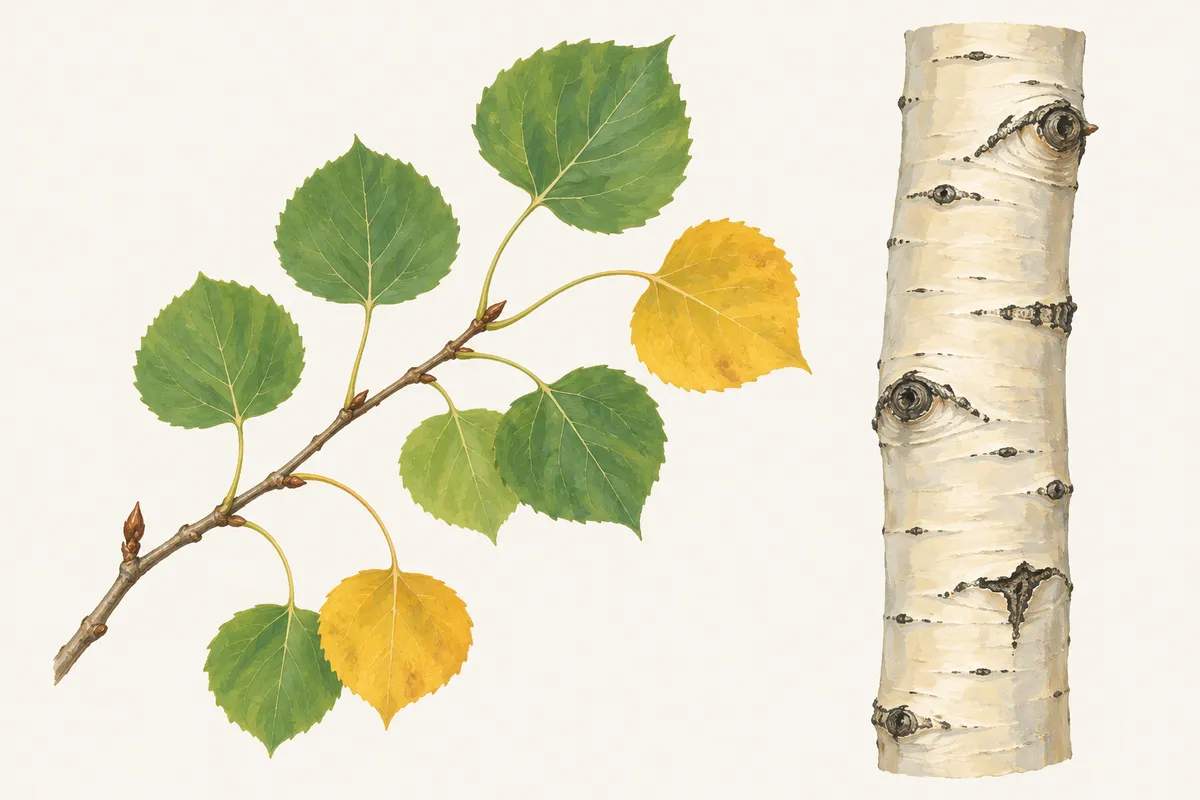
Aspen tree identification starts with the leaf: on quaking aspen it is nearly round, 1 to 3 inches long, finely toothed, on a flattened stalk usually longer than the blade, so it trembles in the faintest breeze. The bark is smooth, creamy white to pale green and does not peel, with black scars and patches, and the trees grow in clonal groves that turn golden yellow in fall.
- Round leaf, 1 to 3 inches, on a flat stalk longer than the blade: quaking aspen.
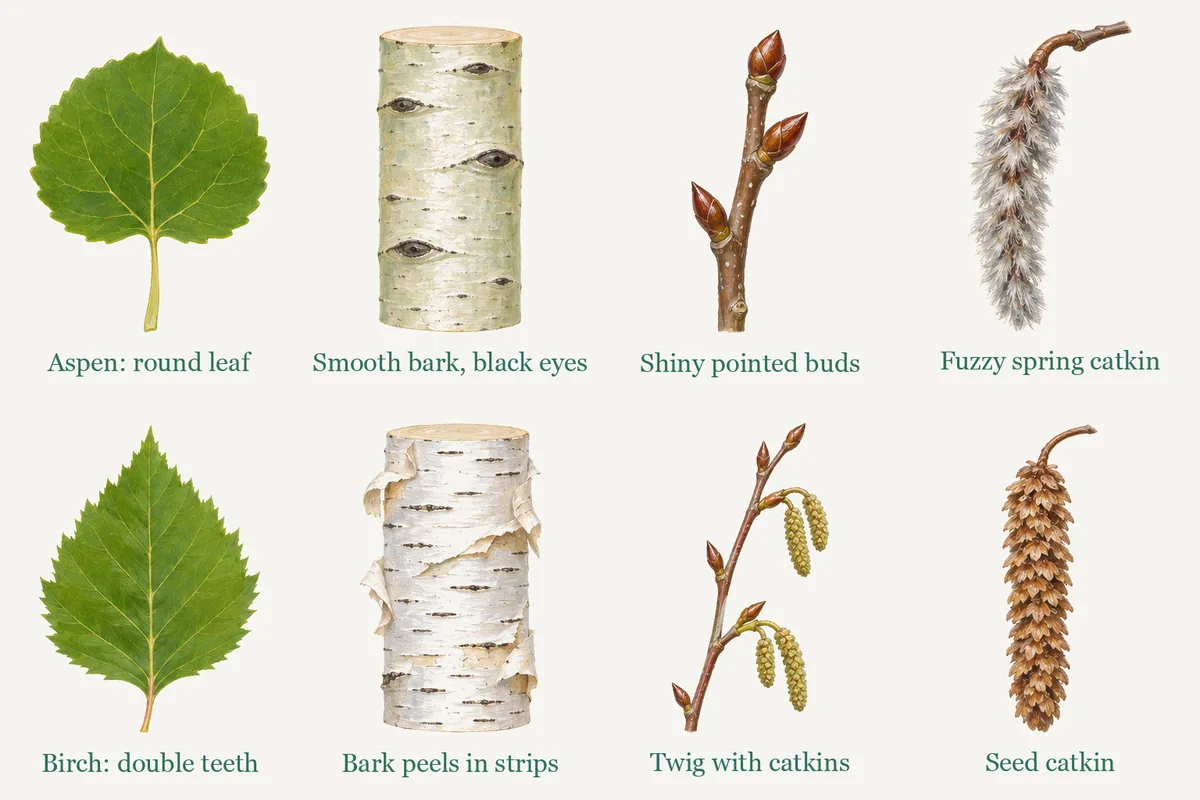
- Aspen bark does not peel. White bark that peels in papery sheets is a birch.
- A patch of stems that leaf out, turn color and drop leaves together is usually one clone, all male or all female.
Field marks at a glance
- Scientific name
- Populus tremuloides
- Family
- Salicaceae (willow family)
- Type
- Broadleaf, deciduous
- Leaves
- Alternate, simple, nearly round to broadly oval or heart-shaped, 1 to 3 inches (3 to 7 cm) long, with a short sharp tip and 20 to 30 fine teeth per side.
- Leaf stalk
- Flattened from side to side, slender and usually longer than the blade (Natural Resources Canada), which makes the leaf quake.
- Bark
- Smooth, waxy, creamy yellowish white to very light green; does not peel. With age, chalky white with black warty patches, and dark furrows near the base.
- Buds and twigs
- Buds conical, reddish brown, shiny, about 1/4 inch, tips curving in toward the twig; twigs slender, reddish brown, often with a gray waxy film.
- Flowers and seed
- Catkins 1 to 3 inches before the leaves, male and female on separate trees; fruiting catkins about 4 inches, capsules releasing seeds in white cotton.
- Fall color
- Golden yellow; whole clones change at the same time.
- Form
- Slender, straight trunk and a short, rounded crown; 30 to 40 ft (Virginia Tech), 20 to 50 ft in gardens (NC State), mature forest stands 66 to 82 ft (USDA Forest Service); in groves of many stems.
- Range
- The most widely distributed native tree in North America: across Canada to northwestern Alaska, through the western mountains, east to New Jersey.
Quaking aspen is the tree of golden mountainsides in the Rockies and of birch-like pale groves across Canada and the northern states. It is easy to recognize once you know three things: the round leaf on a flat stalk, the smooth bark that never peels, and the habit of growing as a clone. Most mistakes come from calling it a birch, which the bark and the leaf stalk settle in seconds.
How to identify an aspen tree
Check these in order.
1. The leaf: small and nearly round. The Virginia Tech fact sheet gives leaves 1 to 3 inches long, heart-shaped to nearly round, with a fine-toothed edge, green above and paler below. Natural Resources Canada's trembling aspen factsheet adds a short, sharp tip and 20 to 30 fine, irregular teeth per side. A leaf about the size of a large coin is typical.
2. The leaf stalk: flat and long. Roll the stalk between finger and thumb: it is flattened from side to side, slender, and usually longer than the blade (NRCan). This is why the whole crown shimmers and rustles when other trees are still.
3. The bark: smooth, pale and unpeeling. Young bark is smooth and waxy, creamy yellowish white to very light green (Virginia Tech). NC State Extension describes older bark as chalky white with black warty patches, and at the base of old trunks the bark becomes dark and furrowed. Unlike paper birch, aspen bark never comes off in sheets.
4. The grove. Aspen spreads by root suckers. A stand of similar-looking stems, all leafing out and changing color at the same time, is very likely one clone.
5. The buds. In winter, look for conical, shiny, reddish-brown buds about 1/4 inch long whose tips curve inward toward the twig (NRCan and Virginia Tech). NRCan describes them as shiny and slightly resinous, with no fragrance.
When the crown is out of reach, a photo of a fallen leaf with its stalk, or of the bark, is enough for Tree Identifier to suggest a name. Quaking aspen itself is not among the app's 138 Collection species (the European aspen is), though a photo still returns a name. The app shows no confidence score or list of look-alikes, so confirm with the flat-stalk test.
Aspen bark: white, green and black
Aspen bark changes with age and place, and it carries a record of what has happened to the tree.
- Young stems: smooth, waxy and pale, creamy white to greenish. NRCan notes diamond-shaped marks about 1 cm across on some trees.
- Older trunks: chalky white with black warty patches (NC State); the base turns dark gray and furrowed.
- Black scars: the USDA Forest Service's Silvics of North America explains that elk and moose strip the bark of pole-size and larger trees with their incisors, and that deer, elk and moose also browse young stems and rub antlers on them. These wounds heal as dark scars, which is why aspen trunks in elk country are often blackened low down.
- Cankers and holes: the Forest Service names Hypoxylon canker as probably the most serious aspen disease east of the Rockies, and notes that sapsuckers drill holes in the trunks.
If you are deciding between aspen and a white birch, the birch vs aspen comparison covers the peel test, the leaf and the catkins side by side.
Clones, groves and fall color
Each aspen grove is usually a family of stems from one root system. The Forest Service says clones east of the Rockies typically cover up to a few tenths of a hectare, while in the Rockies they are much larger: one Utah clone covered 107 acres with an estimated 47,000 stems. Clones can be thousands of years old, though the individual stems are short-lived. NC State gives about 50 years for a tree, NRCan a maximum of about 80, and the Forest Service's oldest recorded stem was 226 years.
Clones are usually all male or all female. Stems within a clone look alike, but clones differ from their neighbors in leaf shape and size, bark, branching, the date they leaf out and their fall color. That is why a mountainside in October can show sharp-edged blocks of gold, orange and still-green aspen: each block is a different clone.
The usual fall color is golden yellow (NC State). The guide to trees with yellow leaves in fall sets aspen beside birches, ginkgo and other gold trees.
Flowers and seed
Aspen flowers before its leaves open: from mid-March to April in New England and May to June in the central Rockies, according to the Forest Service. Male and female flowers grow on separate trees in hanging catkins 1 to 3 inches long (Virginia Tech). Female catkins lengthen to about 4 inches and carry small capsules, each with about 10 seeds wrapped in cottony hairs (NRCan), which ripen 4 to 6 weeks after flowering.
The seed is light and is carried far by wind and water, but the Forest Service says it stays viable for only 2 to 4 weeks after it matures under natural conditions. Most new aspen stems come from root suckers instead, especially after fire or cutting.
Where aspen grows
The Forest Service calls quaking aspen the most widely distributed native tree in North America, spanning 111 degrees of longitude and 48 degrees of latitude: across Canada to northwestern Alaska, through the mountains of the western United States, and east to New Jersey. NC State notes a small area in the mountains of North Carolina. In the West it is a mountain tree: the Forest Service gives 6,900 to 11,000 feet in Colorado and southern Wyoming, and 6,500 to 10,000 feet in Arizona and New Mexico. The Rocky Mountain tree guide places it among the conifers it grows with.
It is a pioneer of open ground: the Forest Service describes it colonizing disturbed sites with bare soil, and fire, which kills the stems, often stimulates suckering from the roots.
Aspen look-alikes: bigtooth, European, cottonwood
Bigtooth aspen shares the eastern part of quaking aspen's range. The Virginia Tech fact sheet describes round to oval leaves 3 to 4 inches long with large, blunt teeth, and thin bark that is gray, olive-green to milky green on young stems, later gray-brown and ridged. Count the teeth: a few big ones means bigtooth, many fine ones means quaking. The bigtooth aspen page gives its bark, buds and range in full.
European aspen (Populus tremula) is the aspen of Britain and Europe. The Woodland Trust describes round leaves with large, irregular, blunt teeth on flattened stalks, young leaves that open coppery, bright yellow and occasionally red autumn color, and grey bark with diamond-shaped lenticels. It reaches about 25 m, grows in clonal colonies, and in the UK is most common in north-west Scotland. European aspen is the aspen species in Tree Identifier's Collection.
Eastern cottonwood also has flat leaf stalks, but its leaves are triangles 3 to 6 inches long and its old bark is deeply furrowed. The cottonwood page covers it and the western cottonwoods that grow with aspen along mountain streams.
Look-alikes and how to tell them apart
Paper birch (Betula papyrifera)
Paper birch bark peels in thin horizontal sheets with orange beneath, and its leaves are oval, pointed, doubly toothed, 3 to 5 inches, on round stalks. Aspen bark never peels, and its leaves are round on flat stalks.
Bigtooth aspen (Populus grandidentata)
Same flat stalk, but the leaf is bigger, 3 to 4 inches, with a few large blunt teeth instead of many fine ones, and young bark is olive to milky green rather than creamy white.
Eastern cottonwood (Populus deltoides)
Cottonwood leaves are triangles 3 to 6 inches long, and old cottonwood bark is gray and deeply furrowed. It grows as single large trees on riverbanks, not in upland groves.
European aspen (Populus tremula)
The Old World aspen, planted in North America and native in Britain. Its round leaves have large, irregular, blunt teeth and young leaves open coppery; quaking aspen's teeth are fine and even.
What a photo can't settle
- Aspen clones differ from each other in leaf shape and size, bark, branching and fall color, according to the USDA Forest Service, so one grove may not match a book description.
- Catkins and seed show for only a few weeks in spring, so most photos carry only leaves or bark, and a leaf without its stalk loses the best aspen clue.
- Young paper birches and aspens are both smooth-barked, and a bark photo of a sapling is weak evidence; take the leaf and its stalk too.
Questions people ask
Why do aspen leaves shake?
The leaf stalk is flattened from side to side and is usually longer than the blade, so the leaf twists and flutters in the slightest air movement. Natural Resources Canada describes the stalk as flattened, slender and usually longer than the blade; bigtooth aspen and cottonwood share the flat stalk.
Is an aspen a birch?
No. Aspen is a poplar, genus Populus, in the willow family; birches are Betula, in the birch family. Both have pale bark, but aspen bark does not peel, aspen leaves are round on flat stalks, and aspen seeds come wrapped in cotton instead of falling from cone-like catkins.
Is an aspen grove one tree?
Often, yes. Aspen spreads by root suckers, so a grove is frequently a single clone of genetically identical stems. The USDA Forest Service cites a Utah clone covering 107 acres with an estimated 47,000 stems, and says clones can be thousands of years old, though each stem lives far less.
How tall do aspen trees get?
NC State gives 20 to 50 feet in gardens. In forests the USDA Forest Service reports mature stands 66 to 82 feet tall, with exceptional trees to about 120 feet, and Natural Resources Canada gives up to 25 m (82 ft).
What is the difference between quaking aspen and trembling aspen?
None: they are two names for Populus tremuloides. Trembling aspen is the usual name in Canada, where Natural Resources Canada lists quaking aspen as a synonym. In Britain, aspen means the related European species, Populus tremula.
Sources
- Quaking Aspen (Populus tremuloides), Silvics of North America — USDA Forest Service
- Quaking aspen fact sheet — Virginia Tech Dendrology
- Trembling aspen (Populus tremuloides) — Natural Resources Canada, Trees, insects and diseases of Canada's forests
- Populus tremuloides (Quaking Aspen) — North Carolina Extension Gardener Plant Toolbox, NC State University
- Bigtooth aspen fact sheet — Virginia Tech Dendrology
- Aspen (Populus tremula) — Woodland Trust
Keep reading
- Tree comparisonBirch vs aspen: how to tell the two white-barked trees apart
- Tree profilePoplars, cottonwoods and aspens (Populus): how to identify them
- Tree profileEastern cottonwood (Populus deltoides): how to identify it
- Clue guideWhich trees have yellow leaves in fall? Sort them by leaf shape
- Regional guideRocky Mountain tree identification, from foothills to treeline