Tree profile
Bigtooth aspen (Populus grandidentata): how to tell it from quaking aspen
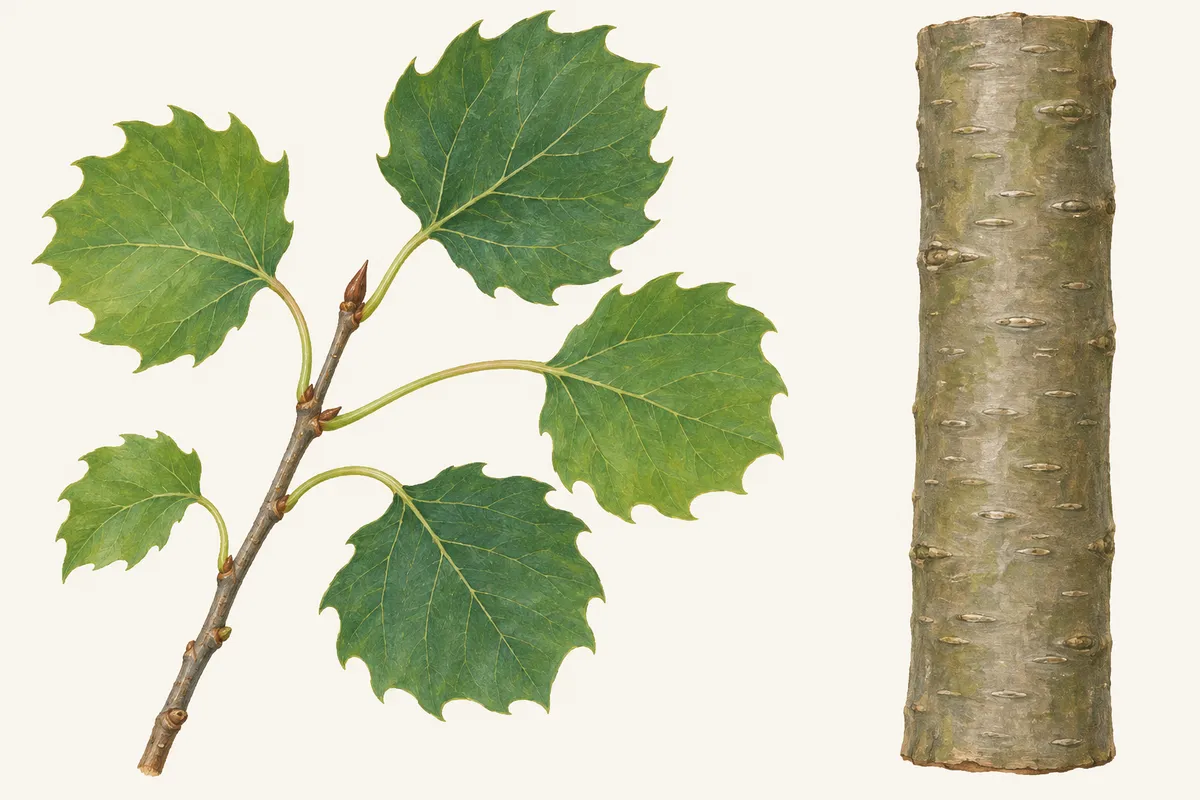
Count the teeth: a trembling leaf with a few big, uneven teeth on each side is bigtooth aspen, the eastern aspen that leafs out a week or so after its quaking cousin.
In short
Bigtooth aspen identification comes down to the leaf edge: the leaves are round to oval, 5 to 10 cm (2 to 4 in) long, with 7 to 15 large, uneven teeth per side, where quaking aspen has 20 to 30 fine ones. The leaf stalk is flattened, so the leaves flutter. New leaves are white-woolly underneath in spring, and the smooth bark is olive to yellowish gray with an orange cast.
- Count the teeth on one side of a leaf: 7 to 15 big ones means bigtooth, 20 to 30 small ones means quaking aspen.
- In spring, bigtooth leaves unfold white and woolly beneath, 7 to 10 days later than quaking aspen's.
- Its range is the Northeast, the upper Midwest and southeastern Canada, from Cape Breton Island to southeastern Manitoba.
Field marks at a glance
- Scientific name
- Populus grandidentata
- Family
- Salicaceae (willow family)
- Type
- Broadleaf, deciduous
- Leaves
- Alternate, round to oval, 5 to 10 cm (3 to 4 in per Virginia Tech) long, with 7 to 15 large, uneven, blunt teeth per side; dark green above, paler below.
- Leaf stalk
- Flattened from side to side and shorter than the blade, so the leaf trembles in the wind.
- Spring leaves
- Unfold with dense white woolly hairs underneath, 7 to 10 days later than trembling aspen's.
- Buds
- Egg-shaped, 7 to 8 mm, dull brown to gray, finely hairy, not gummy or fragrant.
- Twigs
- Moderately coarse, dull brownish to gray-brown with orange lenticels and raised, heart-shaped leaf scars; bitter, aspirin-like taste.
- Bark
- Thin and smooth, pale green to yellowish gray with an orange cast, darker than quaking aspen; later gray-brown and ridged, with diamond-shaped marks about 1 cm across.
- Catkins and seed
- Male and female trees; catkins 2 to 3 inches before the leaves; downy capsules 6 to 7 mm that split in two and release cottony seed 4 to 6 weeks after flowering.
- Size
- 60 to 80 ft (18 to 24 m) at maturity per the USDA Forest Service, about 100 ft on the best sites; to 20 m in Canada per Natural Resources Canada.
- Range
- Cape Breton Island west to southeastern Manitoba, south to northeastern Missouri and east to Delaware; local in western North Carolina and Tennessee.
Two aspens share the forests of the Northeast and the upper Midwest. Both have pale smooth bark, round leaves on flattened stalks that tremble in the slightest air, and spread by root suckers into clones. Quaking aspen is the famous one; bigtooth aspen is the one people miss. The difference is on the edge of every leaf, and it is easy to see once you know to count.
How to identify a bigtooth aspen
1. Count the teeth. Pick a leaf from an older branch and count the teeth along one side. Natural Resources Canada gives 7 to 15 large, uneven teeth per side on bigtooth (largetooth) aspen, and 20 to 30 fine, irregular teeth on trembling aspen. Virginia Tech Dendrology describes the teeth as large and blunt. A dozen coarse scallops means bigtooth; a fine saw edge means quaking aspen.
2. Measure the leaf. Bigtooth leaves are 5 to 10 cm long (Natural Resources Canada) or 3 to 4 inches (Virginia Tech), round to egg-shaped, sometimes with a short sharp tip. Quaking aspen leaves are smaller, 3 to 7 cm.
3. Roll the stalk. Both aspens have a leaf stalk flattened from side to side. On bigtooth aspen it is shorter than the blade; on quaking aspen it is usually longer. This confirms you have an aspen, not a birch or a basswood sprout.
4. Look in spring. Bigtooth leaves unfold with white hairs underneath, and Natural Resources Canada describes the lower surface as densely woolly; trembling aspen leaves are usually hairless. Natural Resources Canada puts the difference in leafing at 7 to 10 days, and the USDA Forest Service at about 10 days for flowering, leafing and seed.
5. Check the bark and buds. Bigtooth bark is pale green to yellowish gray, usually with an orange cast, and darker than quaking aspen's. Its buds are dull brown to gray, 7 to 8 mm long and finely hairy, not gummy or fragrant.
A photo of a leaf, held flat so the teeth show, gives Tree Identifier the best chance of naming an aspen correctly. The app returns one answer with no confidence score and no list of look-alikes, so count the teeth yourself before accepting either aspen.
Bark, twigs and clones
On young stems the bark is thin and smooth: Virginia Tech calls it gray to olive-green or milky green, and Natural Resources Canada adds the orange cast. With age it turns gray-brown and ridged, and diamond-shaped marks about 1 cm across appear. The USDA Forest Service notes that the bark is thin enough for fire to kill the trees easily.
The twigs are moderately coarse and dull brown with orange lenticels. Virginia Tech describes raised, heart-shaped leaf scars and a bitter, aspirin-like taste when the twig is chewed, shared with other poplars and willows. In winter, the finely hairy, dull brown bud helps separate a bigtooth twig from quaking aspen, whose buds Natural Resources Canada describes as slightly resinous; our winter tree identification guide covers the method.
Bigtooth aspen spreads by root suckers. The Forest Service's Silvics of North America reports suckers rising from shallow, cord-like roots about 3 inches deep, 3,200 to 24,000 stems per acre after cutting or fire, and clones covering 0.01 to 3.8 acres. Natural Resources Canada describes small pure stands that are usually a single clone. In mixed stands, the Forest Service notes, the boundaries between bigtooth and quaking aspen clones are well defined.
Where bigtooth aspen grows
The Forest Service gives the range as Cape Breton Island, Nova Scotia, west to southeastern Manitoba, south to extreme northeastern Missouri, and east to Delaware, with local stands in western North Carolina and northwestern Tennessee. It is most abundant in southwestern Quebec and southeastern Ontario.
It is pickier than quaking aspen. Bigtooth does best on moist, fertile sandy uplands where the water table lies within about 5 feet of the surface, and it is most common on floodplains and lower slopes at 500 to 2,000 feet. Natural Resources Canada lists trembling aspen, white birch, eastern white pine, balsam fir, white spruce, willows and alders as its usual companions. Bigtooth does not reach west of southeastern Manitoba or northeastern Missouri, so an aspen in the Rockies or farther west is not a bigtooth.
Mature trees are 60 to 80 feet tall with trunks 8 to 10 inches across, and reach about 100 feet at 50 to 60 years on the best sites (Forest Service). Natural Resources Canada gives up to 20 m and a maximum age of 60 years in Canada; the Forest Service reports that stands begin to decay from rot at 40 to 70 years, though single trees over 100 years old occur.
Bigtooth aspen vs quaking aspen, cottonwood and birch
| Tree | Leaf | Teeth per side | Leaf stalk | Bark | Buds |
|---|---|---|---|---|---|
| Bigtooth aspen | Round to oval, 5–10 cm | 7–15, large, uneven | Flattened, shorter than blade | Pale green to yellowish gray, orange cast | 7–8 mm, dull brown, hairy |
| Quaking aspen | Nearly round, 3–7 cm | 20–30, fine | Flattened, usually longer than blade | Pale green to almost white | Slightly resinous, not fragrant |
| Eastern cottonwood | Triangular, 3–6 in | Not counted by the sources | Flattened, glands at top | Gray, thick ridges, deep furrows | About 3/4 in, several resinous scales |
| Balsam poplar | Broadly oval, long tip, 7–12 cm | Many small, rounded | Round | Gray, flat-topped ridges | To 25 mm, sticky, fragrant |
Sources: Natural Resources Canada for the two aspens and balsam poplar, Virginia Tech for eastern cottonwood. The quaking aspen page covers the commoner aspen in depth, and the poplar, cottonwood and aspen guide places both in the genus.
Pale, smooth aspen bark can pass for birch at a distance. The birch vs aspen page walks through bark, leaves and catkins side by side, and bigtooth's leaf teeth settle it close up.
Hybrids
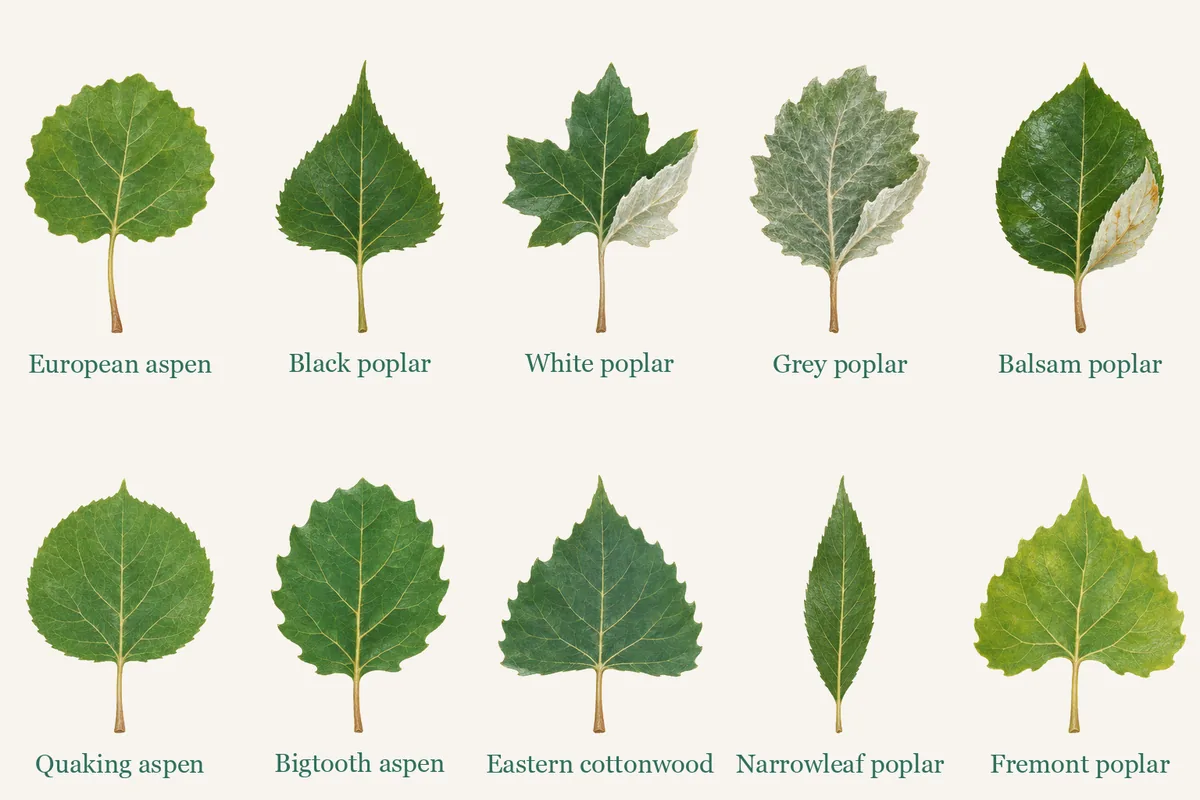
The Forest Service reports that natural hybrids between bigtooth and quaking aspen occur but less often than expected, because the two flower about 10 days apart; when they occur they are usually male quaking aspen crossed with female bigtooth. The best-known cross with another species is white poplar × bigtooth aspen (Populus × rouleauiana), which grows well on dry, sandy soils. A tree with leaf teeth halfway between the two aspens' counts is worth noting as a possible hybrid rather than forced into one name.
Bigtooth aspen is not one of the 138 species in Tree Identifier's Collection, though a photo still returns a name. With location turned on, the app's Tree Map pins the find, so you can come back in early spring to see whether that clone leafs out white and woolly a week after the quaking aspens around it.
Look-alikes and how to tell them apart
Quaking aspen (Populus tremuloides)
Quaking aspen leaves are smaller, 3 to 7 cm, with 20 to 30 fine teeth per side and a stalk usually longer than the blade. Its bark is paler, green to almost white, and its leaves unfold 7 to 10 days earlier and are not woolly beneath.
Eastern cottonwood (Populus deltoides)
Cottonwood's leaf is a triangle 3 to 6 inches long rather than a round oval, and its buds are about 3/4 inch long with several resinous scales. Bigtooth aspen buds are under 1/3 inch, hairy and not resinous.
Balsam poplar (Populus balsamifera)
Balsam poplar has long, sticky, fragrant buds up to 25 mm, leaves with a long drawn-out tip and a silvery underside, and a round leaf stalk, so its leaves do not flutter like an aspen's.
What a photo can't settle
- Leaves on vigorous sprouts and suckers have smaller, more numerous teeth, according to Natural Resources Canada, so a sucker leaf can look like quaking aspen; check leaves on an older branch.
- Hybrids of bigtooth and quaking aspen occur and carry intermediate teeth; a photo app gives one species name, not a hybrid.
- From a distance, smooth pale aspen bark can pass for birch; the leaf or the bark close up settles it, not a photo of the whole stand.
Questions people ask
Is bigtooth aspen the same as largetooth aspen?
Yes. Bigtooth aspen and largetooth aspen are two common names for Populus grandidentata. The USDA Forest Service and Virginia Tech use bigtooth; Natural Resources Canada uses largetooth aspen.
Do bigtooth aspen leaves tremble like quaking aspen?
Yes. Natural Resources Canada describes its leaf stalk as flattened, like quaking aspen's, so the leaves flutter in a breeze. The stalk is shorter than the blade, while quaking aspen's is usually longer, but both trees tremble.
Does bigtooth aspen grow in clones?
Yes. The USDA Forest Service says root suckering is its most common way of reproducing, and clones cover 0.01 to 3.8 acres. Natural Resources Canada describes small pure stands that are usually a single clone. Where bigtooth and quaking aspen grow together, the boundaries between their clones are well defined.
Do bigtooth and quaking aspen hybridize?
Sometimes, but less often than expected. The Forest Service explains that bigtooth flowers about 10 days later than quaking aspen, which limits crossing; most natural hybrids are male quaking aspen crossed with female bigtooth aspen.
Sources
- Bigtooth Aspen (Populus grandidentata), Silvics of North America — USDA Forest Service
- Bigtooth aspen fact sheet — Virginia Tech Dendrology
- Largetooth aspen (Populus grandidentata) — Natural Resources Canada, Trees, insects and diseases of Canada's forests
- Trembling aspen (Populus tremuloides) — Natural Resources Canada, Trees, insects and diseases of Canada's forests
- Eastern cottonwood fact sheet — Virginia Tech Dendrology
- Balsam poplar (Populus balsamifera) — Natural Resources Canada, Trees, insects and diseases of Canada's forests
Keep reading
- Tree profileQuaking aspen (Populus tremuloides): how to identify an aspen tree
- Tree profilePoplars, cottonwoods and aspens (Populus): how to identify them
- Tree comparisonBirch vs aspen: how to tell the two white-barked trees apart
- Tree profileBalsam poplar (Populus balsamifera): how to identify balm-of-Gilead
- Tree profileEastern cottonwood (Populus deltoides): how to identify it