Tree comparison
Birch vs aspen: how to tell the two white-barked trees apart
Does the bark peel, is the leaf pointed or nearly round, and is the leaf stalk flat? Three checks separate paper birch from quaking aspen.
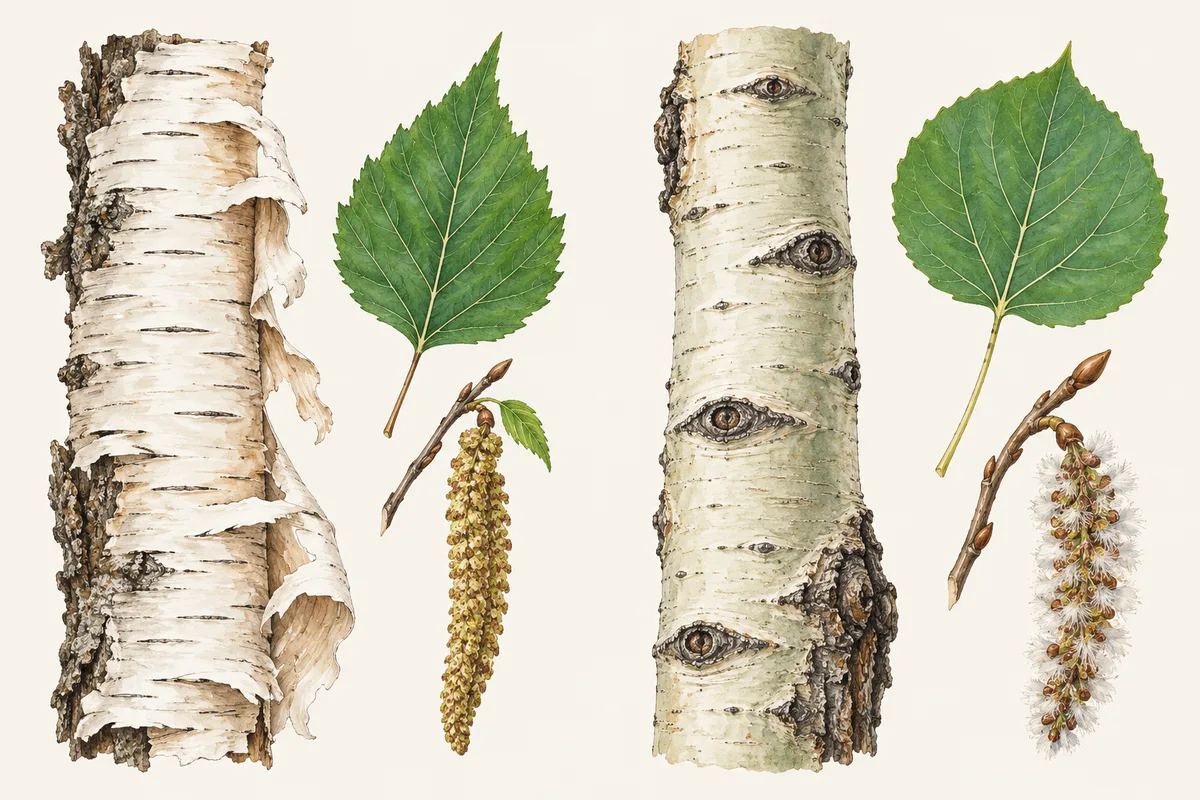
In short
Birch vs aspen comes down to the bark and the leaf. Paper birch bark is chalky white and peels in thin horizontal sheets with orange beneath; quaking aspen bark is smooth, creamy to greenish white and does not peel. Birch leaves are oval, pointed and doubly toothed, 3 to 5 inches long; aspen leaves are nearly round, 1 to 3 inches, on flattened stalks that make them flutter.
- Peeling white sheets with orange inner bark: paper birch. Smooth, waxy, greenish white bark that never peels: aspen.
- Roll the leaf stalk: a flat, ribbon-like stalk often longer than the blade means aspen.
- Aspen grows in clonal groves from root suckers; paper birch often grows as one tree with several trunks.
Field marks at a glance
- Scientific name
- Betula papyrifera and Populus tremuloides
- Family
- Betulaceae (birch family) and Salicaceae (willow family)
- Type
- Broadleaf, deciduous
- Bark
- Paper birch: chalky to creamy white, peels in thin horizontal sheets, orange inner bark. Aspen: smooth, creamy yellowish white to light green, waxy, does not peel.
- Leaf shape
- Paper birch: oval with a pointed tip, doubly toothed, 3 to 5 inches. Aspen: nearly round to heart-shaped, finely toothed, 1 to 3 inches.
- Leaf stalk
- Aspen: flattened from side to side, slender, usually longer than the blade, so the leaf trembles. Birch leaves do not flutter this way.
- Catkins and fruit
- Paper birch: male and female catkins on the same tree; a cone-like fruit 1 to 1 1/2 inches that falls apart into winged seeds. Aspen: male and female on separate trees; catkins 2 to 4 inches with capsules of small hairy seeds.
- Twig
- Paper birch: slender, dull red-brown, many pale lenticels, no wintergreen smell. Aspen: slender, reddish brown, often with a gray waxy film, conical buds.
- Form
- Paper birch: to about 70 ft, often several trunks. Aspen: usually 30 to 40 ft, upright, often in dense thickets of clones.
- Young stems
- Paper birch bark stays reddish brown or golden until age 10 to 12 before turning white. Aspen is pale and smooth from the start.
- Range
- Both cross Canada and the northern US. Quaking aspen is the most widely distributed tree in North America (USDA Forest Service).
Paper birch and quaking aspen are the two white-barked trees of the northern woods, from Newfoundland to Alaska and down the Rockies, and they often grow side by side. They are not related: aspens are poplars in the willow family, birches are in the birch family. Up close they differ in almost every part. Three checks settle it.
Birch vs aspen in three checks
1. Touch the bark. Virginia Tech's paper birch fact sheet describes mature bark that is chalky to creamy white and peels in thin horizontal sheets, with orange inner bark. Its quaking aspen fact sheet describes bark that is at first smooth, creamy yellowish white to very light green, later thickly furrowed and darker toward the base. Natural Resources Canada calls young aspen bark smooth with a waxy appearance. Curling papery strips mean birch; smooth, slightly green, waxy bark means aspen.
2. Look at a leaf. Paper birch leaves are oval with a pointed tip, 3 to 5 inches long (Virginia Tech), with double-toothed edges (Natural Resources Canada): big teeth with smaller teeth on them. Aspen leaves are nearly round to heart-shaped, 1 to 3 inches, with fine teeth.
3. Roll the leaf stalk. Natural Resources Canada's trembling aspen factsheet describes the stalk as flattened and slender, usually longer than the blade. Roll it between finger and thumb and it feels like a ribbon. That flat stalk is why aspen leaves shimmer and clatter in a breeze. If the stalk is not flattened, it is not an aspen.
| Feature | Paper birch | Quaking aspen |
|---|---|---|
| Family | Betulaceae (birch) | Salicaceae (willow) |
| Bark | Chalky white, peels in sheets, orange beneath | Smooth, creamy to greenish white, waxy, no peeling |
| Leaf | Oval, pointed, doubly toothed, 3–5 in | Nearly round, fine teeth, 1–3 in |
| Leaf stalk | Not described as flattened | Flat, often longer than the blade |
| Flowers | Male and female catkins on one tree | Male and female on separate trees |
| Fruit | Cone-like cylinder, 1–1 1/2 in, falls apart | Catkin 2–4 in, capsules of hairy seeds |
| Height | To about 70 ft, often several trunks | Usually 30–40 ft, in thickets |
| Regrowth | Sprouts from cut stumps | Root suckers form clonal groves |
Bark: peeling sheets or smooth and waxy
Bark is what most people notice first, and it works on mature trees. Birch bark is thin and papery; Natural Resources Canada's white birch factsheet says it often peels in large sheets. The Forest Service's paper birch silvics adds that the bark is highly flammable.
Two traps. First, young birch is not white: the Forest Service says paper birch bark stays golden or brown until about age 10 to 12, and Natural Resources Canada describes young stems as dark red to almost black, then reddish brown. Second, old aspen darkens at the base, as Virginia Tech notes, so look higher up the trunk where the bark is still pale and smooth. On both trees, the leaf is the safer check.
The trees with white bark guide covers the other pale trunks you may meet, such as sycamore, white poplar and beech.
Leaves, catkins and seeds
Birch leaves have a clear point and a doubly toothed edge, and are usually larger than aspen leaves. Aspen leaves are broadly oval to kidney-shaped with fine, irregular teeth, 3 to 7 cm (1 to 3 inches) long according to Natural Resources Canada.
Flowers and fruit separate them in spring. Paper birch carries male and female flowers on the same tree, with male catkins near the twig tips in groups of 2 to 5, and its fruit is a cone-like cylinder 1 to 1 1/2 inches long that breaks apart in autumn, scattering small winged seeds (Virginia Tech). Aspen trees are either male or female; female catkins lengthen to 2 to 4 inches, hung with capsules full of small hairy seeds. Fluffy white seeds drifting in late spring come from aspens and other poplars, not birches.
In winter, scratch a birch twig: Virginia Tech notes that paper birch lacks the wintergreen smell of black and yellow birch. The birch identification page explains that test and tells the other birches apart.
Groves, clones and where each grows
Aspen spreads by root suckers. The Forest Service's quaking aspen silvics calls it the most widely distributed tree in North America and cites a single Utah clone covering 107 acres with an estimated 47,000 stems, all from one root system. A hillside of identical white trunks that leaf out and turn color together is usually aspen.
Paper birch often grows as a single tree with several trunks, to about 70 ft, and the Forest Service notes that it can regenerate from stump sprouts after cutting or fire. Both trees are very intolerant of shade and colonize land opened by fire or logging. Where they mix, the Forest Service reports that birch takes the cooler, moister sites and aspen the warmer, drier ones.
Both live short lives for trees. Natural Resources Canada gives a maximum age of about 80 years for trembling aspen and 120 years for white birch, though the Forest Service records a few aspens past 200 years and some paper birches living 140 to 200. Across Canada both are everywhere; the Canada tree identification guide shows where they fit by region.
Bigtooth aspen and other look-alikes
In the East, a second aspen can join in. Virginia Tech's bigtooth aspen fact sheet gives round to oval leaves 3 to 4 inches long with large blunt teeth, and smooth bark that is gray, olive-green or milky green on young stems, less white than quaking aspen. Its stalks are flattened too, so it trembles like its cousin. The poplar page compares both aspens with cottonwoods and Lombardy poplar.
Tree Identifier can name the tree from one photo of a leaf or the bark, and paper birch is in the app's Collection. A leaf held flat with its stalk visible gives a clearer answer than a trunk from across the road, and the follow-up chat can answer questions such as how old an aspen grove might be.
Look-alikes and how to tell them apart
Bigtooth aspen (Populus grandidentata)
Same flat leaf stalk as quaking aspen, but leaves are 3 to 4 inches with large blunt teeth, and the smooth bark is gray to olive or milky green rather than creamy white.
Other white birches (gray birch, European white birch)
White bark that peels little or not at all, so the peel test alone can mislead. Check the leaf: birch leaves are pointed and doubly toothed, on stalks that are not flattened like an aspen's.
What a photo can't settle
- Young paper birch has reddish brown or golden bark until about age 10 to 12, the Forest Service notes, so a sapling can fail the white-bark test entirely. Use the leaf.
- Gray birch and European white birch peel little, so on those trees the peel test does not separate birch from aspen; the leaf and its stalk do.
- Tree Identifier names one species from one photo, with no confidence score and no look-alike list. A bark photo from a distance can fit either tree, so add a photo of a single leaf with its stalk.
Questions people ask
Is an aspen a type of birch?
No. Aspens are poplars, genus Populus, in the willow family (Salicaceae). Birches are genus Betula in the birch family (Betulaceae). They share white bark and northern forests, which is why they are confused, but their leaves, stalks, flowers and fruit differ.
Are trembling aspen and quaking aspen the same tree?
Yes. Natural Resources Canada calls Populus tremuloides trembling aspen and lists quaking aspen as a synonym; the USDA Forest Service and Virginia Tech use quaking aspen. In Canada, paper birch is likewise usually called white birch.
Why do aspen leaves shake and birch leaves do not?
Natural Resources Canada describes the aspen leaf stalk as flattened, slender and usually longer than the blade, so the leaf twists in the slightest breeze. Virginia Tech and Natural Resources Canada describe no flattened stalk on paper birch, so its leaves move with the branch instead of flickering on their own.
Do aspen trees peel like birch?
No. Virginia Tech describes young aspen bark as smooth, creamy yellowish white to very light green, later thickening into dark furrows near the base. Paper birch bark peels in thin horizontal sheets. If loose white strips come away in your hand, it is a birch.
Do birch and aspen grow together?
Often. Both are sun-loving trees that move in after fire or logging. The USDA Forest Service notes that in mixed Alaskan stands, birch predominates on cooler, moister sites and aspen on warmer, drier ones.
Sources
- Paper birch fact sheet — Virginia Tech Dendrology
- Quaking aspen fact sheet — Virginia Tech Dendrology
- Bigtooth aspen fact sheet — Virginia Tech Dendrology
- Paper Birch (Betula papyrifera), Silvics of North America — USDA Forest Service
- Quaking Aspen (Populus tremuloides), Silvics of North America — USDA Forest Service
- White birch (Betula papyrifera) — Natural Resources Canada, Trees, insects and diseases of Canada's forests
- Trembling aspen (Populus tremuloides) — Natural Resources Canada, Trees, insects and diseases of Canada's forests
Keep reading
- Tree profileBirches (Betula): how to identify a birch tree
- Tree profilePoplars, cottonwoods and aspens (Populus): how to identify them
- Clue guideWhich tree has white bark? Sort it by peel, leaf and region
- Field guideTree bark identification: seven bark types and the trees that have them
- Canada field guideTree identification in Canada, region by region