Tree profile
Eastern cottonwood (Populus deltoides): how to identify it
A triangular leaf that rattles on a flat stalk, fat resinous buds, gray bark cut by deep furrows, and a summer snow of cotton from the female trees: the big poplar of American riverbanks.
In short
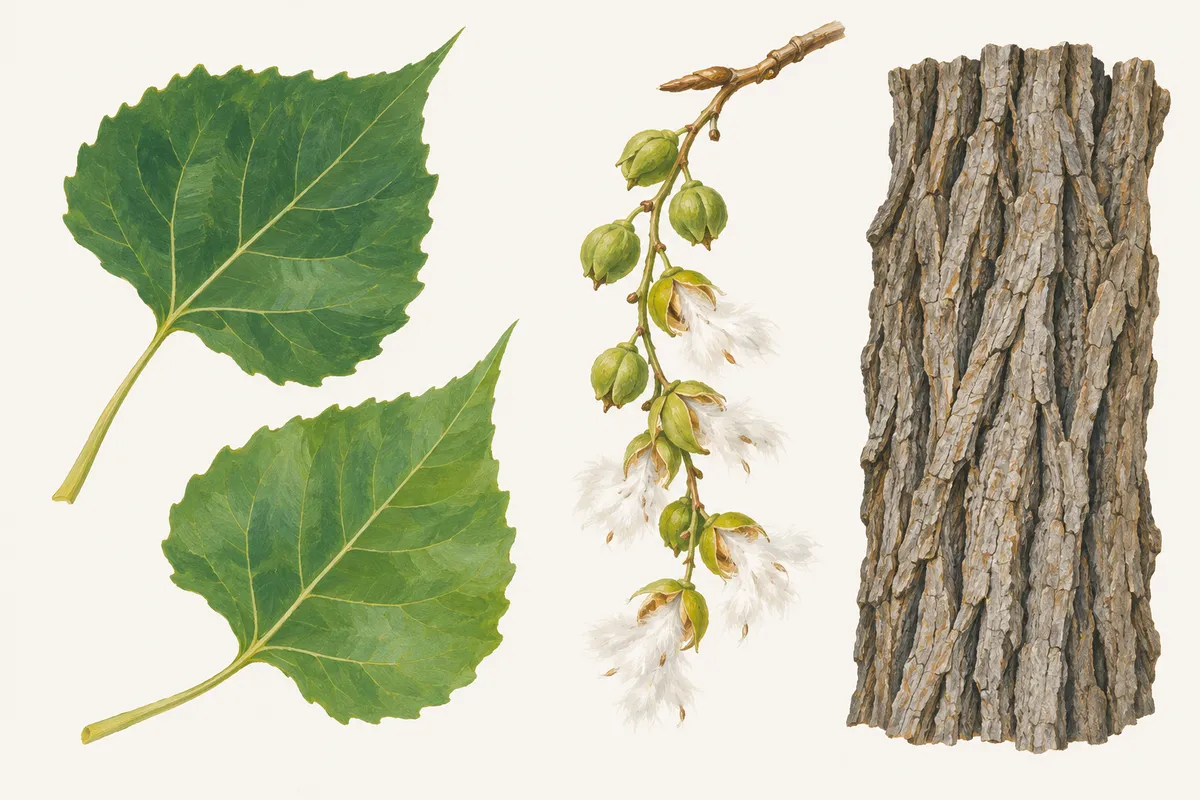
Cottonwood tree identification starts with the leaf: on eastern cottonwood it is triangular, 3 to 6 inches long, coarsely toothed, on a flattened stalk with small glands where it meets the blade. Buds are about 3/4 inch long with brown, resinous scales, old bark is gray with thick ridges and deep furrows, and female trees release seeds in white cotton in early summer.
- Triangle-shaped leaf, flat leaf stalk, big tree by a river: eastern cottonwood.
- Only female trees shed cotton, from May to mid-July depending on latitude; male trees shed only pollen in late winter or spring.
- West of the Plains, check the leaf underside and stalk: silvery white with a round stalk means black cottonwood, small and heart-shaped on a flat stalk means Fremont cottonwood.
Field marks at a glance
- Scientific name
- Populus deltoides
- Family
- Salicaceae (willow family)
- Type
- Broadleaf, deciduous
- Leaves
- Alternate, simple, triangular, 3 to 6 inches long and up to 4 inches wide, coarsely toothed with curved teeth, glossy light to medium green.
- Leaf stalk
- Flattened from side to side, 2.5 to 4 inches long, with two small glands where it joins the blade (NC State); the leaves flutter in light wind.
- Buds and twigs
- Buds about 3/4 inch long, covered in several brown, resin-coated scales; twigs thick, somewhat angled and yellowish (Virginia Tech).
- Bark
- Smooth and greenish gray to yellow-green on young trees; on old trunks gray, with thick ridges and deep furrows.
- Flowers
- Hanging catkins before the leaves, February to April; male and female on separate trees. Male catkins 3 to 5 inches, reddish.
- Fruit and seed
- Egg-shaped green capsules 8 to 12 mm long on catkins 7 to 10 inches long; they split into 3 or 4 parts and release seeds in white cotton from May to mid-July.
- Fall color
- Yellow, and the leaves may drop early (NC State).
- Size
- Usually 75 to 100 ft tall and 35 to 60 ft wide (NC State); the USDA Forest Service notes exceptional trees reported at 175 to 190 ft.
- Range and habitat
- Stream banks and bottomlands from southern Quebec to North Dakota and southwestern Manitoba, south to central Texas, east to northwestern Florida and Georgia; absent from the higher Appalachians.
Eastern cottonwood is the giant poplar of American rivers, and in early summer it announces itself: drifts of white fluff on the water and the sidewalk. The rest of the year, three checks name it: the triangular leaf on a flat stalk, the fat resinous buds, and the deeply furrowed gray bark of an old trunk. This page goes deeper on eastern cottonwood than our poplar, cottonwood and aspen page, and adds the western cottonwoods that replace it beyond the Plains.
How to identify a cottonwood tree
Work through these in order. Three matches make a confident identification.
1. The leaf: a toothed triangle. The NC State Extension Plant Toolbox describes triangular, coarsely toothed leaves 3 to 6 inches long and up to 4 inches wide, glossy and light to medium green, with curved teeth. The species name deltoides means triangle-shaped, like the Greek letter delta. Fallen leaves under the tree are often the easiest to examine.
2. The leaf stalk: flat, with glands. Roll the stalk between finger and thumb. It is flattened from side to side, which is why a cottonwood's leaves flutter and rattle in a light breeze. NC State gives a stalk 2.5 to 4 inches long with two small glands where it meets the blade; the Virginia Tech fact sheet also notes glands at the top of the flattened stalk. A hand lens shows them as two small bumps.
3. The buds: big, brown and sticky. Virginia Tech describes buds about 3/4 inch long, covered in brown, resin-coated scales, on thick, somewhat angled, yellowish twigs. This is the best winter clue. A willow bud, by contrast, has a single cap-like scale.
4. The bark: deep furrows with age. Young cottonwoods have smooth, greenish gray to yellow-green bark. Old trunks turn gray, with thick ridges and deep furrows (Virginia Tech); NC State describes mature bark as brown to ashy gray with ridges and fissures. On a big tree, the bark high in the crown often stays smoother and paler than at the base.
5. The place. The USDA Forest Service's Silvics of North America says it grows along streams and on bottomlands and is rarely a well-formed tree more than 15 to 20 feet above the average stream level. A huge, broad-crowned tree on a riverbank or a sandbar is the classic cottonwood setting.
If the leaves are high overhead, a photo of a fallen leaf, the bark or the whole tree is enough to get a name from Tree Identifier. Eastern cottonwood (Populus deltoides) is one of the 138 species in the app's Collection. The app gives one name, without a confidence score or a list of look-alikes, so confirm it with the flat-stalk test.
Cotton, catkins and male and female trees
Cottonwood is dioecious: male and female flowers grow on separate trees, about one to one in wild stands, according to the Forest Service. Both open in hanging catkins before the leaves, from February to April. The male catkins are 3 to 5 inches long and reddish, more conspicuous than the females, which lengthen to 6 to 12 inches as the fruit develops.
The female catkins carry egg-shaped green capsules 8 to 12 mm long, which split into 3 or 4 parts (NC State). Each capsule holds 30 to 60 seeds wrapped in white cottony hairs, and the Forest Service estimates that one open-grown tree can produce up to 48 million seeds a year. Seed falls from May through mid-July in the South and from June through mid-July in the North.
Two practical points follow. A cottonwood that never sheds cotton is probably male, and the Forest Service notes that male clones are preferred for planting for exactly that reason. And cotton in the air in June is not proof of cottonwood: willows and aspens release cotton-wrapped seed too. Our guide to the tree with white fluff sorts them.
Eastern, plains and western cottonwoods
East of the Rockies there is one cottonwood species with two varieties. The Forest Service describes the western variety, plains cottonwood (Populus deltoides var. occidentalis), as having leaves broader than long, slightly smaller and more coarsely toothed than the typical eastern tree; the two intergrade on the Plains. Farther west, three other cottonwoods take over. Figures from Virginia Tech fact sheets.
| Cottonwood | Leaf | Leaf stalk | Buds | Bark and form |
|---|---|---|---|---|
| Eastern (P. deltoides) | Triangular, 3–6 in, coarse curved teeth, green on both sides | Flat, with glands at the top | About 3/4 in, brown, resinous | Gray, thick ridges, deep furrows; broad vase-shaped crown |
| Black (P. trichocarpa) | Ovate-lanceolate to triangular, 3–6 in, silvery white below with rusty resin smears | Long, usually round | 1/2–3/4 in, sharp, resinous and aromatic | Gray to gray-brown, deep furrows; to 200 ft, the tallest broadleaf tree in the West |
| Fremont (P. fremontii) | Broadly heart-shaped to triangular, 2–4 in, rounded teeth, shiny | Flat | Large, green-brown, pointed, not sticky | Light gray-brown, deep furrows, flat-topped ridges; to 60 ft, broad flat-topped crown |
| Swamp (P. heterophylla) | Broadly ovate, heart-shaped base, 4–7 in | Round | About 1/3 in, reddish brown, slightly gummy | Gray-brown, strongly ridged; over 80 ft |
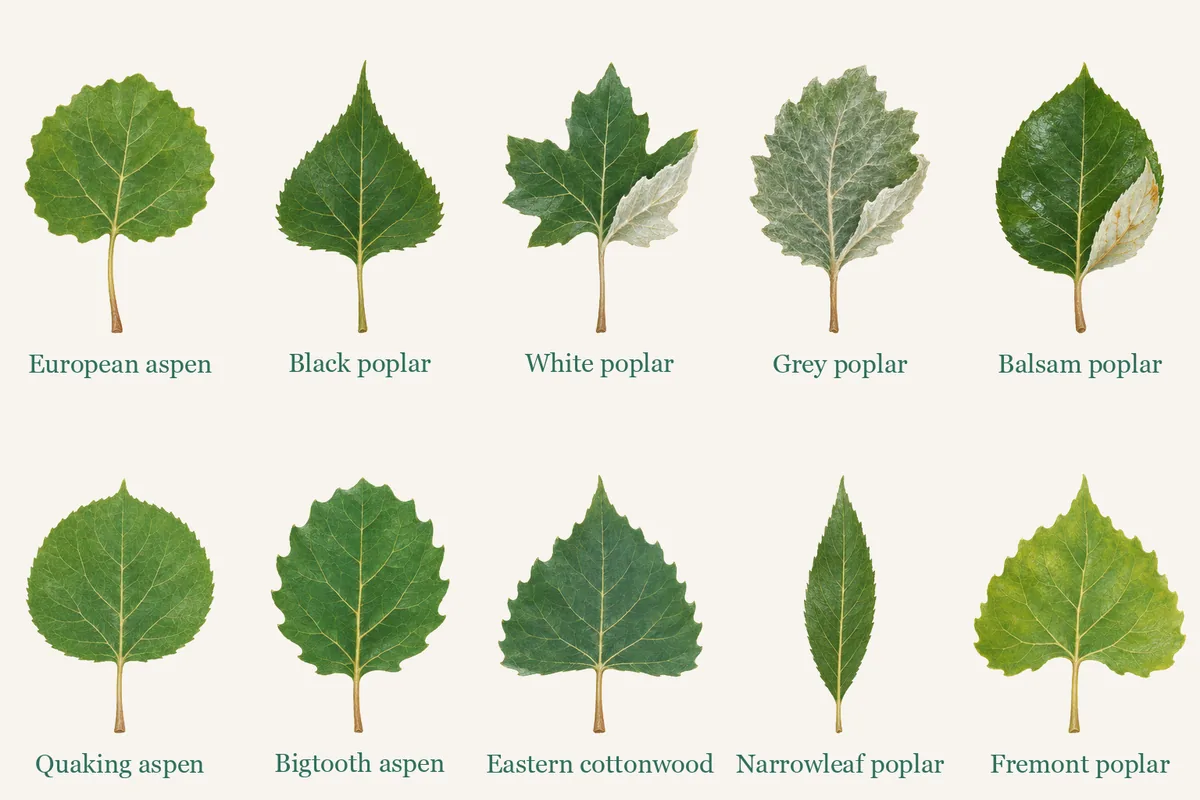
The quickest field sort uses the stalk and the underside. A flat stalk and a leaf green on both sides points to eastern or Fremont cottonwood; a round stalk and a silvery white underside points to black cottonwood. Swamp cottonwood, a tree of wet southeastern bottomlands, has the largest, most heart-shaped leaves of the four, on round stalks.
Cottonwood vs aspen, poplar and willow
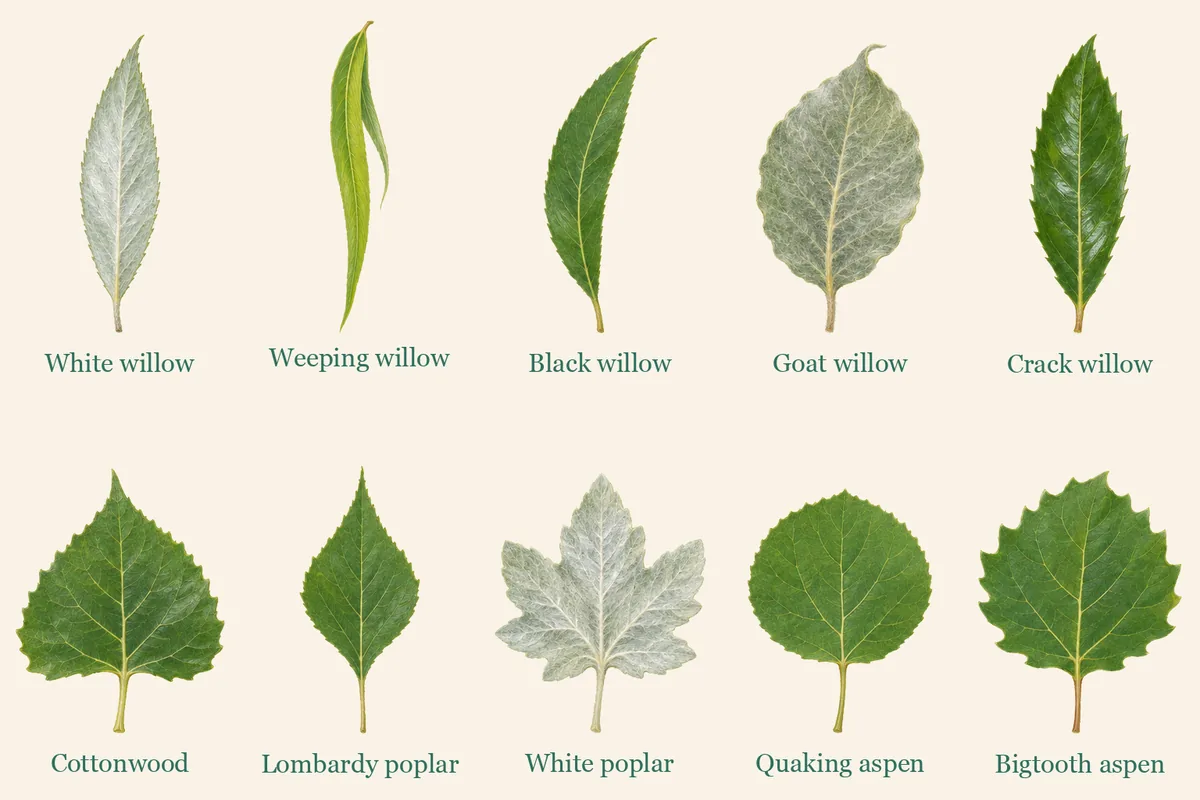
Quaking aspen shares the flat leaf stalk and the fluttering leaves, but its leaf is nearly round and only 1 to 3 inches long, and its bark stays smooth and creamy white to pale green for years. Aspen also grows in clonal groves on uplands, not as single giants on riverbanks. The quaking aspen page covers it in detail.
Bigtooth aspen has a round to oval leaf 3 to 4 inches long with a few large, blunt teeth (Virginia Tech), and smooth olive to milky green bark on young stems. Its leaf is never a triangle.
Lombardy poplar has small triangular leaves on flat stalks, but it grows as a narrow column branched almost to the ground, and the planted clone is male, so it sheds no cotton.
Black willow shares the riverbank, the cotton and the furrowed bark, but its leaves are long and narrow, and its buds have a single cap-like scale. See the willow page.
Size, growth and life span
The Forest Service calls eastern cottonwood one of the largest eastern hardwoods. NC State gives a usual height of 75 to 100 feet and a spread of 35 to 60 feet. The Forest Service says heights of 175 to 190 feet and trunk diameters of 48 to 72 inches have been reported (exceptional trees, far above the usual), and calls it the fastest-growing commercial forest species on the continent, with individual plantation trees over 100 feet tall at age 9.
That speed has a cost. NC State describes the wood as brittle, the tree as messy, and its life as relatively short, up to 70 years. It also warns that the roots may damage sidewalks or sewer lines. Female trees add cotton to that list. A large cottonwood in a yard is usually either a survivor from the old floodplain or a planted male clone.
Fall color is yellow, though NC State notes the leaves may drop early. With location turned on, Tree Identifier's Tree Map pins the find, so you can go back in June and check whether the tree is the one releasing the cotton.
Look-alikes and how to tell them apart
Black cottonwood (Populus trichocarpa)
The western one. Turn a leaf over: black cottonwood's underside is silvery white with rusty smears of resin, and its stalk is usually round. Eastern cottonwood's leaf is green on both sides, on a flat stalk.
Fremont cottonwood (Populus fremontii)
Southwestern. Its leaves are smaller, 2 to 4 inches, broadly heart-shaped to triangular with rounded teeth, and its large green-brown buds are not sticky. Eastern cottonwood buds are brown and resinous.
Swamp cottonwood (Populus heterophylla)
Its leaves are broadly oval with a heart-shaped base, 4 to 7 inches, on a round stalk, and its buds are only about 1/3 inch. A triangular leaf on a flat stalk is eastern cottonwood.
Bigtooth aspen (Populus grandidentata)
Same flat leaf stalk, but the leaf is round to oval, 3 to 4 inches, with large blunt teeth, and the young bark is smooth and olive to milky green. Cottonwood leaves are triangles with a straight or slightly heart-shaped base.
Lombardy poplar (Populus nigra 'Italica')
Also a triangular leaf on a flat stalk, but smaller, 2 to 4 inches, on a narrow column of a tree that branches from near the ground. Cottonwood has a broad, open, vase-shaped crown.
What a photo can't settle
- Planted cottonwoods are often selected clones and hybrids grown from cuttings. A photo can say cottonwood; it often can't name a nursery clone or hybrid poplar.
- Eastern and plains cottonwood are varieties of one species and intergrade on the Great Plains, so no photo can draw the line between them there.
- In winter, without leaves or cotton, a photo of the bark alone is weak evidence: many old riverbank trees have gray, deeply furrowed bark.
Questions people ask
Is a cottonwood tree a poplar?
Yes. Cottonwoods are poplars, genus Populus, in the willow family. The USDA Forest Service lists Carolina poplar, eastern poplar and necklace poplar among the other names of eastern cottonwood. The name cottonwood comes from the cotton-wrapped seed of the female trees.
When do cottonwood trees release their cotton?
The USDA Forest Service gives May through mid-July in the South and June through mid-July in the North. Only female trees produce it; each capsule holds 30 to 60 seeds, and one open-grown tree has been estimated to produce up to 48 million seeds a year.
Do male cottonwood trees produce cotton?
No. Male and female flowers grow on separate trees, about one to one in wild stands, and only females make seed. Male trees shed pollen from reddish catkins in late winter or spring. The Forest Service notes that male clones are preferred for planting because they lack the cotton.
How long do cottonwood trees live?
Not long, for such a big tree. NC State Extension calls eastern cottonwood relatively short-lived, up to 70 years, and the USDA Forest Service describes it as fast-growing and short-lived.
How do you tell a cottonwood from an aspen?
By leaf size and shape and by bark. Cottonwood leaves are triangles 3 to 6 inches long; quaking aspen leaves are nearly round, 1 to 3 inches. Aspen bark stays smooth and creamy white to pale green for years, while old cottonwood bark is gray and deeply furrowed.
Sources
- Eastern Cottonwood (Populus deltoides), Silvics of North America — USDA Forest Service
- Eastern cottonwood fact sheet — Virginia Tech Dendrology
- Populus deltoides (Eastern Cottonwood) — North Carolina Extension Gardener Plant Toolbox, NC State University
- Black cottonwood fact sheet — Virginia Tech Dendrology
- Fremont cottonwood fact sheet — Virginia Tech Dendrology
- Swamp cottonwood fact sheet — Virginia Tech Dendrology
- Bigtooth aspen fact sheet — Virginia Tech Dendrology
Keep reading
- Tree profilePoplars, cottonwoods and aspens (Populus): how to identify them
- Tree profileQuaking aspen (Populus tremuloides): how to identify an aspen tree
- Clue guideWhich tree sheds white fluff? Sort it by month, leaf and where the fluff sits
- Tree profileWillow trees (Salix): how to identify them
- Field guideTree bark identification: seven bark types and the trees that have them