Regional guide
Rocky Mountain tree identification, from foothills to treeline
In the Rockies, elevation decides which trees you meet. Note your altitude, then check needles, cones and bark.
In short
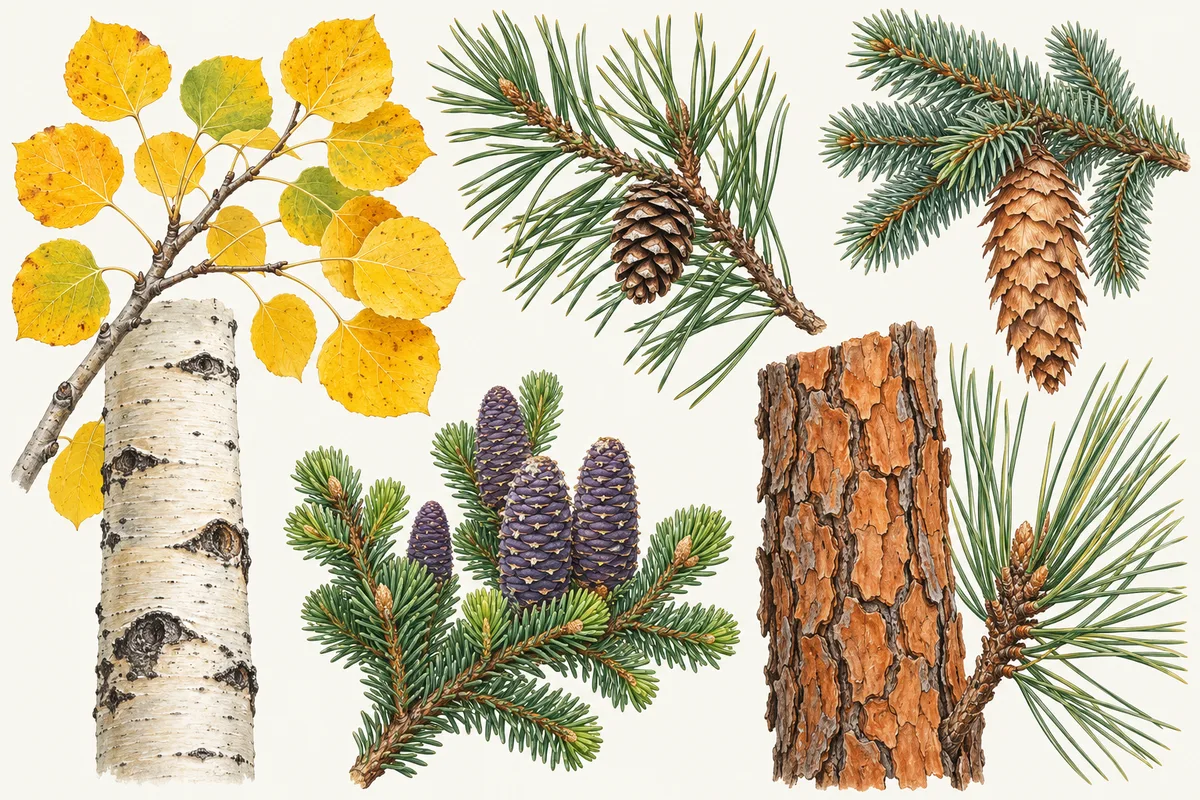
Rocky Mountain tree identification starts with elevation. In the foothills, piñon pine has two short needles per bundle and Rocky Mountain juniper has scale leaves. From about 6,000 to 9,500 feet, ponderosa pine has three long needles per bundle and Douglas-fir has three-pronged bracts on its cones. Near treeline, Engelmann spruce has square needles you can roll, and subalpine fir holds its cones upright.
- Douglas-fir cones carry three-pronged papery bracts between the scales, a feature no other Rocky Mountain conifer has (National Park Service).
- Subalpine fir is the only Rocky Mountain conifer whose cones grow upright instead of hanging.
- Ponderosa pine bark is red-orange in big plates, and on warm days it smells like vanilla or butterscotch.
The Rocky Mountains stack their forests by elevation. Piñon and juniper woodlands cover the foothills, ponderosa pine and Douglas-fir the montane slopes, lodgepole pine and aspen the middle heights, and Engelmann spruce and subalpine fir the cold zone just below treeline. Check your altitude on a map or phone, then use needles, cones and bark. Elevations and sizes below follow the Colorado State Forest Service and the Rocky Mountain National Park conifer guide; trees in New Mexico, Wyoming and Montana shift up or down with latitude.
The Rocky Mountain trees to learn first
| Tree | Elevation in Colorado (ft) | The feature that settles it | Our page |
|---|---|---|---|
| Piñon pine | 5,200 to 9,000 | Two stout needles per bundle, 1 to 1 1/2 in | Pine |
| Rocky Mountain juniper | 5,000 to 9,000 | Scale leaves; berry-like cones about 1/4 in | Cedar |
| Ponderosa pine | 6,300 to 9,500 | Three needles per bundle, 3 to 7 in; red-orange plated bark | Pine |
| Douglas-fir | 6,000 to 9,500 | Three-pronged bracts sticking out of the cones | Douglas-fir |
| Lodgepole pine | 6,000 to 11,000 | Two twisted needles per bundle, 1 to 3 in | Pine |
| Quaking aspen | 6,500 to 11,500 | Greenish-white bark with black marks; round leaves | Poplar |
| Colorado blue spruce | 6,700 to 11,500 | Stiff, sharp, silver-blue needles; streamside groves | Spruce |
| Engelmann spruce | 8,000 to 11,000 | Four-sided needles that roll; papery hanging cones | Spruce |
| Subalpine fir | 8,000 to 12,000 | Flat needles; cones standing upright | Fir |
| Limber pine | 5,000 to 12,000 | Five needles per bundle, 1 to 3 in | Pine |
If you only learn four, learn ponderosa pine, Douglas-fir, quaking aspen and Engelmann spruce: they cover most trails from the foothills to treeline.
Foothills and mesas: piñon, juniper and cottonwood
Below the main forests, on dry mesas and the lower slopes, trees are small and spaced apart.
- Piñon pine (Pinus edulis): two stout, light green needles per bundle, 1 to 1 1/2 inches long; cones 1 to 2 inches; bark gray and smooth when young, red-brown and furrowed later. It grows 20 to 50 feet tall at 5,200 to 9,000 feet (Colorado State Forest Service).
- Rocky Mountain juniper (Juniperus scopulorum): small gray-green or silvery scale leaves instead of needles, berry-like cones about 1/4 inch across, and thin, fibrous gray-brown bark that shreds to show red-brown beneath. 20 to 50 feet tall at 5,000 to 9,000 feet. Junipers are often called cedars; the cedar page explains the difference, and the juniper page compares the western junipers.
- Plains cottonwood: on the eastern plains and along rivers at 3,500 to 6,500 feet, with glossy, yellow-green, toothed leaves 3 to 6 inches long and bark that becomes dark gray and deeply furrowed.
- Narrowleaf cottonwood: along mountain streams, with slender, lance-shaped leaves about 3 to 4 inches long on flattened stalks. The park's deciduous tree guide notes that young trees look like willows; cottonwood catkins hang limp, willow catkins stand upright.
Never eat a seed, berry or nut on the strength of a web page or an app; check with a local expert.
The montane zone: ponderosa pine, Douglas-fir and blue spruce
Rocky Mountain National Park places the montane zone at roughly 5,600 to 9,500 feet, where ponderosa pine and Douglas-fir dominate.
- Ponderosa pine (Pinus ponderosa): stiff, dark yellow-green needles 3 to 7 inches long, three per bundle; cones 3 to 4 inches; mature bark red-orange and split into large, flat, scaly plates. The park service notes that on warm days the bark smells like vanilla or butterscotch, so press your nose to a sunny trunk.
- Douglas-fir (Pseudotsuga menziesii): soft, flat, fragrant needles 3/4 to 1 inch long, attached singly; cones 1 1/3 to 3 inches with three-pronged papery bracts poking out between the scales. Despite the name it is neither a true fir nor a spruce. The Douglas-fir page covers the coastal variety too.
- Colorado blue spruce (Picea pungens): needles 1 to 1 1/4 inches, rigid and sharp, with new growth silver-blue; cones 2 to 4 inches. In the wild it grows in small groves along streams, but it is planted in yards across the region.
Lodgepole pine and quaking aspen: the middle heights
Both span a wide band of elevation, from the montane zone up into the subalpine.
- Lodgepole pine (Pinus contorta): two needles per bundle, 1 to 3 inches, often twisted and more yellow-green than other conifers; cones up to 2 inches; thin, light brown bark with many small scales. Trees are 20 to 80 feet tall.
- Quaking aspen (Populus tremuloides): smooth, greenish-white bark with black spots and lines, and nearly round, saw-toothed leaves that turn yellow, orange and red from early September into October. In Rocky Mountain National Park it grows from about 5,600 to 11,000 feet and reaches 30 to 65 feet (National Park Service). The poplar page separates aspen from cottonwoods.
The subalpine zone: spruce, fir and the five-needle pines
Just below treeline, between about 9,000 and 11,000 feet in the park, dense dark forests of spruce and fir take over.
- Engelmann spruce (Picea engelmannii): deep blue-green needles 5/8 to 1 inch, four-sided so they roll between finger and thumb, with a skunk-like smell when crushed. Papery cones 1 to 2 inches cluster in the top third of the tree. The Montana Field Guide calls it very common across the mountains of western and central Montana, often along streams.
- Subalpine fir (Abies lasiocarpa): flat, soft blue-green needles 1 to 1 1/2 inches that curve upward on the twig; cones 2 to 4 inches that stand upright, the only Rocky Mountain conifer to do so; young bark gray and smooth with resin blisters. Trees are 60 to 100 feet tall.
- Limber pine (Pinus flexilis): five needles per bundle (sometimes four), 1 to 3 inches long (the park service gives 1 to 2, the Colorado State Forest Service 2 to 3), usually on a small tree with a broad, flat-topped crown.
- Bristlecone pine (Pinus aristata): usually five needles per bundle, under 1 inch, dark with white lines; 15 to 30 feet tall at 9,200 to 11,800 feet in Colorado.
The northern Rockies: western larch
In western Montana and Idaho the mix changes. Western larch (Larix occidentalis) has needles 2 to 5 cm long in clusters of 15 to 30 on short spurs, cones 25 to 40 mm long, and thick, deeply furrowed bark with cinnamon-colored plates. The Montana Field Guide says large trees reach 60 m and can live more than 700 years. It is a larch like the tamarack of the north woods.
Using a photo on the trail
Conifer branches are often out of reach. Pick up a fallen cone and a twig, and photograph them together on your palm. Tree Identifier names a tree from one photo of a twig, cone, bark or leaf, and its follow-up chat can answer "is this Engelmann spruce or blue spruce?". It needs a data connection, which high trails may not have, so take the photos and identify them later from your library. It shows no confidence score, so check the result against the table above. The app's Collection includes ponderosa pine, Colorado blue spruce and Douglas-fir, and the Tree Map keeps the place of each find you locate.
What a photo can't settle
- Towns along the Front Range are full of planted trees, such as Colorado blue spruce outside its natural streamside groves, so elevation tells you less in a yard than on a trail.
- Young Engelmann and Colorado blue spruce can look alike; the cone, the twig and the habitat matter more than needle color.
- Photos taken from below often show only the crown; for conifers, a close photo of one twig and one cone settles far more.
Questions people ask
What are the most common trees in the Rocky Mountains?
In Colorado, the State Forest Service lists 14 major native species, among them ponderosa pine, lodgepole pine, Douglas-fir, Engelmann spruce, subalpine fir, quaking aspen, piñon pine and Rocky Mountain juniper. Which ones you see depends on elevation: piñon and juniper low, ponderosa and Douglas-fir in the middle, spruce and fir near treeline.
How do I tell a spruce from a fir in the Rockies?
Roll a needle between finger and thumb. Engelmann and Colorado blue spruce needles are four-sided and roll; subalpine fir needles are flat and soft and will not roll. Then look up: subalpine fir cones stand upright on the top branches, while spruce cones hang down.
What are the white trees in Colorado?
Almost always quaking aspen. Its bark is smooth and greenish-white with black spots and lines, and the nearly round, saw-toothed leaves turn yellow, orange or red from early September into October. In Rocky Mountain National Park it grows from about 5,600 to 11,000 feet.
How do I tell lodgepole pine from ponderosa pine?
Count the needles. Lodgepole has two per bundle, 1 to 3 inches long and often twisted, with thin, light brown, scaly bark. Ponderosa has three per bundle, 3 to 7 inches long, and mature bark in large red-orange plates. Lodgepole cones are up to 2 inches; ponderosa cones 3 to 4 inches.
Is there a conifer in the Rockies that loses its needles?
Yes, in the northern Rockies. Western larch grows at low to moderate elevations in western Montana, with needles 2 to 5 cm long in clusters of 15 to 30 on short spurs and thick bark with cinnamon-colored plates. Like tamarack, it is a larch.
Sources
- Colorado's Major Tree Species — Colorado State Forest Service
- Conifers - Rocky Mountain National Park — U.S. National Park Service
- Deciduous Trees - Rocky Mountain National Park — U.S. National Park Service
- Western Larch - Larix occidentalis — Montana Field Guide, Montana Natural Heritage Program
- Engelmann Spruce - Picea engelmannii — Montana Field Guide, Montana Natural Heritage Program
Keep reading
- Tree profileDouglas-fir (Pseudotsuga menziesii): how to identify it
- Tree profileSpruce trees (Picea): how to identify the species
- Tree profilePoplars, cottonwoods and aspens (Populus): how to identify them
- Tree profilePines (Pinus): how to identify a pine tree
- Field guideConifer identification: three questions about the needles, then the cone