Tree profile
Juniper trees: how to identify them
A conifer with tiny scales or prickly needles and blue, berry-like cones is a juniper. The leaves, the cone and the bark then tell you which one.
In short
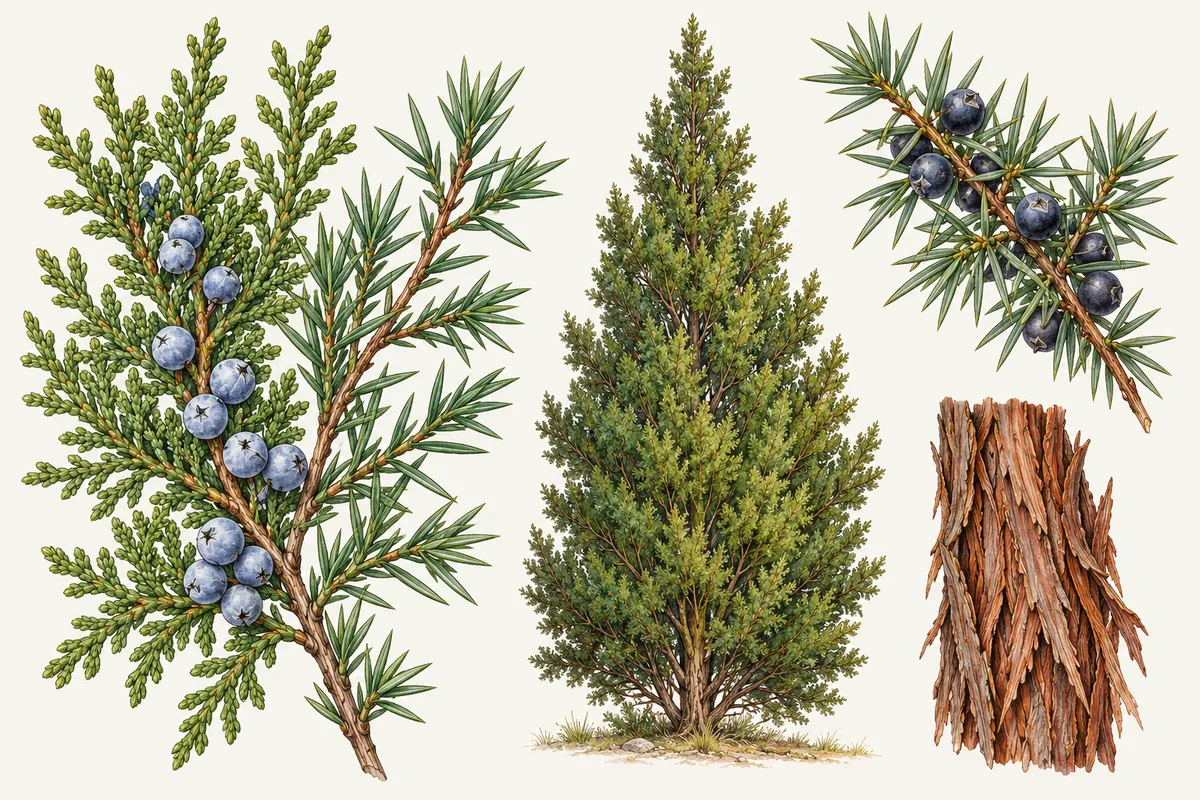
Juniper tree identification starts with the cone: junipers carry small, fleshy, berry-like cones, usually blue with a whitish bloom, instead of woody cones. The leaves are tiny scales pressed to the twig, sharp awl-like needles, or both on one tree. Common juniper has needles in whorls of three; most tree-sized western junipers have scales; alligator juniper has checkered bark.
- A fleshy, berry-like cone, often dusty blue, is the mark of the genus Juniperus; no other North American conifer has one.
- Many junipers carry two leaf types: sharp awl-like needles on young growth and tiny scales on older shoots.
- Eastern red cedar is a juniper too; the cedar page covers it in detail.
Field marks at a glance
- Scientific name
- Juniperus
- Family
- Cupressaceae (cypress family)
- Type
- Conifer, evergreen
- Leaves
- Two types, often on one plant: tiny scale-like leaves pressed tight to the twig, and longer, sharp awl-like (needle-like) leaves, usually on young plants and vigorous shoots.
- Cones
- Berry-like, round, about 1/4 to 1/2 inch, with soft or leathery scales fused together; bluish with a white bloom in most species, reddish brown in Utah and alligator juniper.
- Bark
- Thin and shreddy or scaly, reddish brown weathering to gray; alligator juniper breaks into square, checkered plates.
- Form
- From flat groundcovers under 6 inches tall (creeping juniper) to trees of 20 to 60 feet (western juniper). Many are shrubby with low branches.
- Sexes
- Most species are dioecious: only female plants bear the berry-like cones. Utah juniper is usually monoecious.
- Common juniper
- Needles 1/3 to 1/2 inch, in whorls of three, with a white band on the upper side; usually a low, mat-forming shrub.
- Range
- The USDA Forest Service counts 13 junipers native to North America. Eastern red cedar grows in every state east of the 100th meridian; Rocky Mountain juniper is the most widespread in the West.
- In the app's Collection
- Common juniper (Juniperus communis).
Junipers are the conifers with berries. The genus Juniperus belongs to the cypress family, and its members range from mats that hug the ground to trees 60 feet tall on the dry plateaus of the West. Two clues get you to "juniper" in seconds, the cone and the leaves, and a few more get you to the species.
The juniper test: a berry-like cone and two kinds of leaves
1. Find a cone. A juniper's female cone is small, round and fleshy, with its scales fused so tightly that it looks like a berry. In most species it is bluish with a whitish, dusty bloom: Virginia Tech describes common juniper's cones as about 1/4 inch, green when young and bluish black when mature, "always covered with white bloom" (common juniper fact sheet). No pine, spruce, fir or arborvitae has a cone like that.
2. Look at the leaves. Junipers have scale-like leaves, awl-like (needle-like) leaves, or both. Eastern red cedar shows the pattern well: tiny four-sided scales about 1/16 inch long held tightly to the twig, and longer, sharp, dark blue-green needles about 1/4 inch that are more common on young trees and fast-growing shoots (Virginia Tech, eastern redcedar). Run a hand up a young juniper and it feels prickly; stroke an old scaled branch and it feels like braided cord.
3. Check the sex. Most junipers are dioecious, so only female plants bear cones. If you find none, look at a neighboring plant, or rely on the foliage and bark.
If the plant has flat sprays of scales and woody cones that open, it is an arborvitae or false cypress instead: the cedar guide separates those groups.
Common juniper: needles in threes
Common juniper (Juniperus communis) is the easiest to recognize and the one most people outside the dry West meet. Its leaves are all needles, never scales: sword-shaped, about 1/3 to 1/2 inch long, sessile, and arranged in whorls of three, with a white stomatal band on the upper side and green below (Virginia Tech). The cones take three growing seasons to mature, so one plant can carry green and bluish-black cones at the same time.
It most often grows as a prostrate, mat-forming shrub, sometimes as an upright shrub or small tree, with thin, shreddy, red- to gray-brown bark. Virginia Tech lists Chinese, creeping, Ibuki and shore junipers as its look-alikes, all of them common in gardens. Common juniper is one of the species in Tree Identifier's Collection.
Eastern red cedar: the juniper called cedar
East of the Great Plains, the tree juniper you will see is eastern red cedar (Juniperus virginiana). The USDA Forest Service's Silvics of North America calls it the most widely distributed conifer of tree size in the eastern United States, found in every state east of the 100th meridian, and lists red juniper and savin among its names. Its scales, prickly juvenile needles and dark blue cones are described above.
The Forest Service also notes that its cones mature in one year, while Rocky Mountain juniper needs two. Because the tree is so widely called a cedar, its full profile, bark and range sit on our cedar tree identification page, with a table that separates it from white cedar, western redcedar and the true cedars.
Western junipers: Rocky Mountain, western, Utah, oneseed and alligator
The junipers of the West are mostly scale-leaved trees of dry hills and plateaus. According to the Forest Service, 13 junipers are native to North America, and 11 normally reach tree size in the United States. The table uses Virginia Tech fact sheets and the Forest Service's Silvics for Rocky Mountain juniper and western juniper.
| Juniper | Leaves | Berry-like cone | Bark and form |
|---|---|---|---|
| Rocky Mountain (J. scopulorum) | Scales about 1/8 in, green to gray-green | About 1/3 in, bluish with bloom, two seasons to mature | Thin, scaly, long narrow ridges, reddish brown to gray; small tree or large shrub, often with a round crown |
| Western (J. occidentalis) | Scales and awls, mostly in whorls of three, resin-dotted and very aromatic | About 1/4 in, bluish black with bloom, two seasons | Reddish brown weathering grayish brown, broad flat ridges; 20 to 60 ft with a short, thick trunk |
| Utah (J. osteosperma) | Scales in opposite pairs, yellow-green, no resin gland | 1/4 to 1/2 in, bluish when young, reddish brown and dry when mature | Gray, irregular furrows; shrubby tree to 25 ft |
| Oneseed (J. monosperma) | Scales in opposite pairs, yellow- to gray-green | About 1/4 in, bluish brown, soft and juicy, one seed, one season | Brown to gray, scaly, exfoliating ridges; to 25 ft, branches from near the ground |
| Alligator (J. deppeana) | Scales in opposite pairs, bluish green, often with a white resin dot | About 1/2 in, reddish brown, 3 to 5 seeds | Square, checkered plates; to 55 ft with a wide crown |
Range narrows the choice. The Forest Service calls Rocky Mountain juniper the most widely distributed juniper of western North America, concentrated from central British Columbia and southern Alberta through northwestern Montana and southeastern Idaho into Colorado and northern New Mexico, with more in the western Great Plains, Utah's Uinta and Wasatch Mountains and northern Arizona. Western juniper reaches its greatest abundance in central Oregon and grows more sparsely in southeastern Washington, southwestern Idaho, northwestern Nevada and northern California.
Virginia Tech's Utah juniper sheet is the one to read if your tree's "berries" are brown and dry rather than blue, and its alligator juniper sheet explains the checkered bark, which our bark identification guide shows alongside other bark textures. The Forest Service records a western juniper on the Stanislaus National Forest 87 feet tall and 163 inches in diameter.
Rocky Mountain juniper also goes by Rocky Mountain redcedar and even western redcedar, the Forest Service notes. It is not the giant Thuja of the Pacific Northwest coast: check for berry-like cones.
Garden junipers: Chinese, creeping and shore
Most junipers in yards are planted cultivars. Chinese juniper (Juniperus chinensis) is the most common: adult foliage of scales in opposite pairs, juvenile foliage of awl-like needles about 1/4 inch, dark green to blue-green or yellow in some cultivars, and round cones about 1/3 inch, bluish white turning brown (Virginia Tech). It usually stays a sprawling bush or small tree up to about 10 feet.
Creeping juniper (Juniperus horizontalis) is a native groundcover, rarely taller than 6 inches but spreading over 6 feet, with soft, silvery blue-green foliage. If your "juniper tree" is a flat carpet, it is probably this or a shore or Ibuki juniper.
Garden forms vary so much in color and shape that naming the cultivar from foliage alone is unreliable. If you can't tell whether a planted conifer is a juniper at all, a photo of a cone-bearing shoot in Tree Identifier gives you a species name to check against the leaf and cone tests above, and the conifer identification guide covers the other needle and scale trees. Arizona, Leyland and Italian cypress have scale leaves too, but woody cones; see the cypress page.
Juniper berries: look, never taste
Juniper cones are a reliable identification mark, but this page is not a foraging guide. Berry-like cones, red arils and true berries grow on different evergreen shrubs in the same yards and hedges, and they are easy to mix up. Never eat any berry or cone from a plant you have identified from a photo or a web page.
When you photograph a juniper for identification, include a shoot with cones and a close view of the leaves: whether they are scales, needles in threes, or both is the single most useful thing a picture can show. Tree Identifier's follow-up chat can then answer questions about the species it names, such as where it grows or how its cones ripen.
Look-alikes and how to tell them apart
Arborvitae and western redcedar (Thuja)
Thuja holds its scales in flat, fan-like sprays and bears small, upright woody cones that open. A juniper's scaled twigs are rounder or four-sided, and its cone stays closed and fleshy, like a berry.
Yews (Taxus)
Yew needles are flat, in two rows, with no scales on the plant at all, and the seed sits in an open red cup. Juniper needles are sharp awls, often in whorls of three, and the fruit is a closed blue cone.
Eastern red cedar vs Rocky Mountain juniper
The two are close relatives with blue, bloom-covered cones. The USDA Forest Service notes Rocky Mountain juniper's cones take two years to mature and eastern red cedar's one, so a western tree carrying two sizes of cone at once points to Rocky Mountain juniper; range settles most cases.
Atlantic white cedar (Chamaecyparis thyoides)
Its scales sit on slender, irregular branchlets, and its 1/4-inch cones have 4 or 5 visible woody scales. A juniper cone of the same size has no separate scales you can pry apart.
What a photo can't settle
- Junipers change leaf type as they age: a photo of a young, needle-covered shoot can look like a different species than the scaled foliage on the same tree.
- Only female junipers carry berry-like cones, so a male plant must be named from foliage, bark, form and range.
- Garden junipers come in hundreds of cultivars; Tree Identifier may name the species, such as Chinese juniper, but not the cultivar, and it gives one name with no confidence score.
Questions people ask
What does a juniper tree look like?
Most tree junipers are small, often shrubby evergreens with low branches and a rounded or egg-shaped crown. Up close, the foliage is either tiny scales hugging the twig or short, sharp needles, and female plants carry round, berry-like cones, usually blue with a whitish bloom. The bark is thin and shreddy or scaly.
Is a juniper a cedar?
Some junipers are called cedars. Eastern red cedar is Juniperus virginiana, and the USDA Forest Service lists Rocky Mountain redcedar among the names of Rocky Mountain juniper. True cedars (Cedrus) are pine-family trees with needles in tufts and upright barrel-shaped cones, so they are not junipers.
Are juniper berries real berries?
No. They are cones whose scales stay soft and fused, so they look like berries. Virginia Tech describes common juniper's as round, about 1/4 inch, with smooth, leathery scales, bluish black with a white bloom when mature. Never eat a berry-like cone from a tree you have identified from a photo.
How do I tell common juniper from eastern red cedar?
Look at the leaves. Common juniper has only needles, 1/3 to 1/2 inch long, in whorls of three, with a white band on top, and usually grows as a low, spreading shrub. Eastern red cedar has mostly tiny scales, with needles only on young growth, and grows into an upright tree.
Which juniper has bark like an alligator?
Alligator juniper (Juniperus deppeana). Virginia Tech describes its bark breaking into nearly square plates, dark gray with almost black fissures, in a checkered pattern. Its berry-like cones are larger than most, about 1/2 inch, and reddish brown, and the tree reaches up to 55 feet.
Sources
- Common juniper fact sheet — Virginia Tech Dendrology
- Eastern redcedar fact sheet — Virginia Tech Dendrology
- Rocky Mountain Juniper, Silvics of North America — USDA Forest Service
- Western Juniper, Silvics of North America — USDA Forest Service
- Eastern Redcedar, Silvics of North America — USDA Forest Service
- Utah juniper fact sheet — Virginia Tech Dendrology
- Alligator juniper fact sheet — Virginia Tech Dendrology
- Chinese juniper fact sheet — Virginia Tech Dendrology