Tree profile
Cypress: how to identify a cypress tree
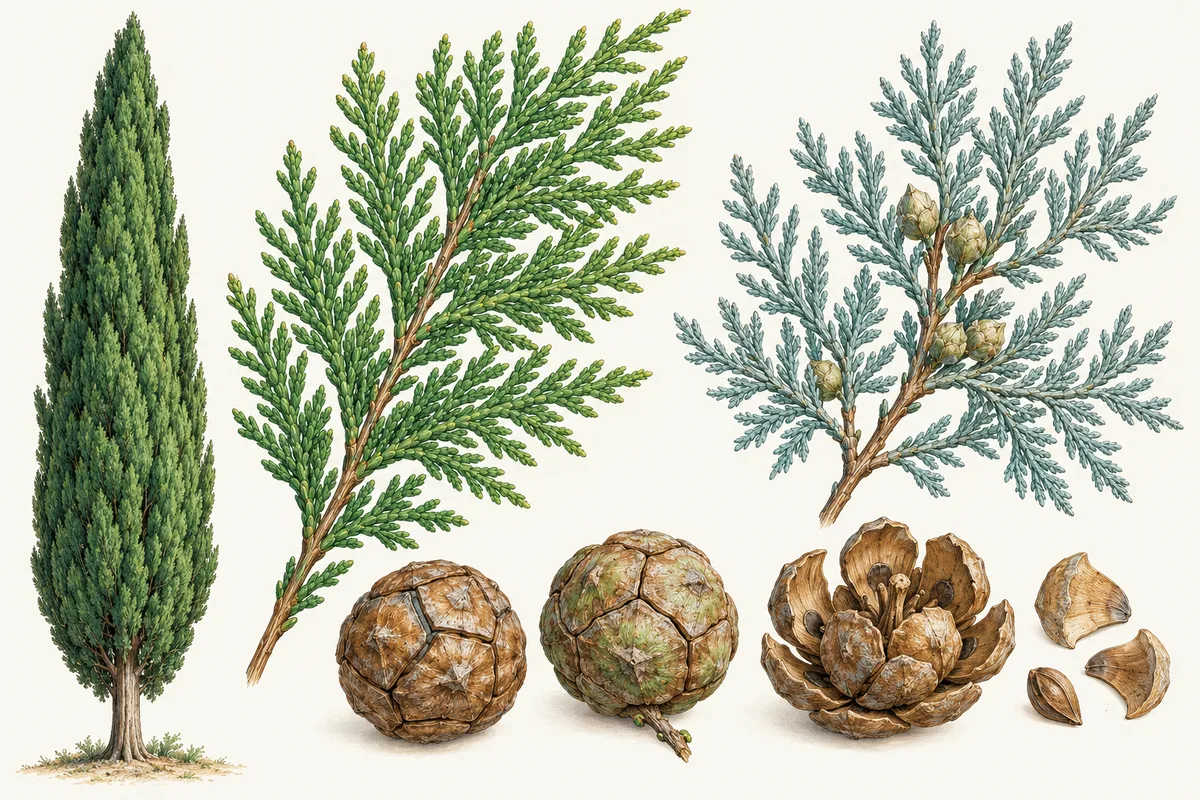
Cypresses have scale leaves, not needles, and small round cones. Check the foliage sprays, the cone size and the shape of the tree, then match the species.
In short
Cypress tree identification starts with the leaves: tiny scales, about 1/16 to 1/8 inch, in opposite pairs pressed tight around the shoot, so the foliage looks braided rather than needled. The cones are round and woody, from pea-sized on Lawson cypress to about 1 inch on Arizona cypress. Then use shape and colour: a narrow column is Italian cypress, silvery-blue foliage Arizona cypress, a fast hedge Leyland cypress.
- Scale leaves in opposite pairs and small round cones made of a few shield-like scales: that is a cypress.
- Lawson cypress has a drooping top, white marks under the sprays and a parsley smell; Leyland cypress has flat sprays on long stalks and smells of resin.
- Bald cypress is a different tree: it has soft, flat needles that turn rusty orange and fall in autumn.
Field marks at a glance
- Scientific name
- Cupressus, Hesperocyparis and Chamaecyparis
- Family
- Cupressaceae (cypress family)
- Type
- Conifer, evergreen
- Leaves
- Scale-like, about 1/16 to 1/8 inch (2 to 3 mm), in opposite pairs pressed against the shoot.
- Foliage sprays
- Flat sprays on Leyland and Lawson cypress (false cypresses); round, cord-like shoots on Italian, Arizona and Monterey cypress.
- Cones
- Round and woody, made of a few tightly fitting scales. Pea-sized (about 1 cm) on Lawson cypress, 1/2 to 3/4 inch on Leyland, about 1 inch on Arizona, 2.5 to 4 cm on Monterey.
- Bark
- Thin and fibrous or scaly, reddish-brown to grey. Smooth, peeling mahogany-red bark on some Arizona cypress cultivars.
- Form
- Narrow columns (Italian cypress), dense cones of foliage (Leyland, Lawson), or broad, wind-shaped crowns (Monterey cypress on the coast).
- Smell
- Lawson cypress smells of parsley when crushed; Leyland smells of resin; Italian cypress is fragrant.
- Where
- Native cypresses grow in the western US and Mexico (Arizona, Monterey, Lawson); Italian cypress comes from the eastern Mediterranean. Leyland cypress is a garden hybrid.
"Cypress" covers several groups of evergreen conifers that share tiny scale leaves and small round cones. In North American yards you often meet Leyland and Arizona cypress; in Britain, Leyland and Lawson cypress hedges are everywhere; around the Mediterranean and in warm gardens, the slim Italian cypress; on the California coast, Monterey cypress. Bald cypress shares the name but not the leaves. Here is how to tell a cypress from its look-alikes, then which cypress it is.
How to identify a cypress tree: leaves, cones, shape
1. Look closely at a shoot. A cypress has no needles in the usual sense. Its leaves are tiny scales, 1/16 to 1/8 inch long on Leyland cypress according to Virginia Tech's Leyland cypress fact sheet, set in opposite pairs and pressed against the twig so that the shoot looks braided. If the tree has long separate needles, it is not a cypress.
2. Check how the shoots are arranged. Two patterns cover most trees. On Leyland and Lawson cypress, the shoots form flat sprays, like fronds. On Italian, Arizona and Monterey cypress, the shoots are rounder and cord-like, branching in several directions.
3. Find a cone. Cypress cones are round, dry and woody, made of a few scales that fit tightly together until they open. Lawson cypress cones are pea-sized, rarely more than 1 cm across, ripening from green to cream to brown (Woodland Trust's Lawson cypress profile). Monterey cypress cones are bigger, 2.5 to 4 cm, with 4 to 6 pairs of smooth scales (Gymnosperm Database). A blue, waxy, berry-like cone means a juniper instead.
4. Step back for the shape. A pencil-thin column is almost always Italian cypress. A dense, broad wall of green along a property line is usually Leyland cypress. A broad, wind-shaped tree on a sea cliff in California is likely Monterey cypress.
Leyland and Lawson cypress: the hedge cypresses
Leyland cypress is a hybrid between Monterey cypress and Alaska yellow-cedar (Nootka cypress), Virginia Tech notes, now named ×Hesperotropsis leylandii. The Woodland Trust's Leyland cypress page says it was created by accident in a Welsh nursery in the 19th century, can grow to 40 m, and is one of the fastest growing conifers, which is why hedges often outgrow their gardens. Its soft scale leaves form flat sprays on long stalks; crushed, they smell of resin. Cones are small, round and brown, but Virginia Tech says the tree rarely fruits, so most Leyland hedges show none.
Lawson cypress (Chamaecyparis lawsoniana) is a false cypress from Oregon and California. The Woodland Trust lists three quick tests: twigs in flattened, horizontal sprays with narrow white markings underneath; foliage with a pungent, parsley-like scent; and a treetop that droops over. It was introduced to Britain in 1854 and can reach 45 m there. The Gymnosperm Database's Chamaecyparis lawsoniana page places it wild in coastal southwest Oregon and northwest California, calls it the most important ornamental conifer in the UK and counts 559 cultivar names, from dwarf to golden and blue.
| Test | Leyland cypress | Lawson cypress |
|---|---|---|
| Top of the tree | Use the other tests | Droops over |
| Sprays | Flat, on long stalks | Flat and horizontal, white marks beneath |
| Smell when crushed | Resin | Parsley |
| Cones | Rare, 1/2–3/4 in, round | Common, pea-sized, about 1 cm |
Arizona, Monterey and Italian cypress
Arizona cypress (Hesperocyparis arizonica, formerly Cupressus arizonica) is the blue cypress. NC State Extension's Arizona cypress profile describes silvery-blue to teal foliage year-round, a mature height of 40 to 60 feet and a width of 15 to 20 feet, and dark red-brown seed cones about an inch across that open only once their branch has died, so they stay on the tree. The cultivar 'Blue Pyramid' has smooth, peeling, mahogany-red bark. It is native to the southwestern United States and Mexico and is grown as a screen, a windbreak and, in warmer parts of North Carolina, a Christmas tree.
Monterey cypress (Hesperocyparis macrocarpa) grows wild only in two groves on the California coast, at Cypress Point and Point Lobos near Monterey, according to the Gymnosperm Database's Hesperocyparis macrocarpa page. It reaches about 25 m, with a broad, sparse crown strongly shaped by wind and salt spray on exposed headlands, and its oblong cones are 2.5 to 4 cm. It has been planted far from home: the largest tree in Great Britain stands in Devon, and in New Zealand, where it has been popular since the 1850s, it is simply called macrocarpa.
Italian cypress (Cupressus sempervirens) is the dark column of Mediterranean landscapes. NC State Extension's Italian cypress profile gives 40 to 70 feet of height and only 3 to 6 feet of width, dark blue-green scale leaves that are fragrant when crushed, and round, glossy brown cones under 1 inch that persist for years. Its origin is the eastern Mediterranean to Iran. Wild trees are broader; the narrow column comes from the commercial forms.
Cypress vs cedar, juniper and bald cypress
Three groups get called cypress, or get mistaken for one.
Junipers and "red cedars." Eastern red cedar is a juniper. The juniper page covers it and the other junipers. Virginia Tech's eastern redcedar fact sheet describes scale leaves about 1/16 inch on the same tree as needle-like leaves about 1/4 inch, and berry-like cones about 1/4 inch that turn dark blue and waxy in fall. A cypress cone is woody and dry. The cedar page sorts the trees called cedar, including arborvitae and the true cedars.
Bald cypress. Despite its name, bald cypress has soft, flat needles, not scale leaves, and it drops them in autumn. If the tree is in a swamp, has knees around its trunk or goes rusty orange in fall, it belongs on the bald cypress page.
Other needle conifers. If the leaves are needles in bundles, tufts or rows, the conifer identification key sorts pines, spruces, firs, hemlocks and larches with three questions.
Photographing a cypress for identification
Tree Identifier names a tree from one photo, and Italian cypress and Monterey cypress are among the 138 species in the app's Collection. For a cypress, the best photo is a close-up of a shoot tip with a cone in frame; for a hedge without cones, photograph a single spray against a plain background, front and back, so the white marks or their absence show. The app shows no confidence score and no look-alike list, so check a cypress answer against the top, smell and cone tests above. In Britain, the UK tree identification guide places Leyland and Lawson cypress among the other planted conifers.
Look-alikes and how to tell them apart
Eastern red cedar (Juniperus virginiana)
A juniper, not a cypress: its cones are dark blue, waxy and berry-like, about 1/4 inch, instead of dry and woody. It often carries both scale leaves and short prickly needles on the same tree.
Bald cypress (Taxodium distichum)
Not a true cypress. Bald cypress has soft, flat needles in two rows that turn rusty orange and fall in autumn, and it grows in swamps with knees around the trunk.
What a photo can't settle
- Lawson cypress alone has hundreds of cultivar names, many dwarf, golden or blue. A photo can usually name the species, not the cultivar.
- Leyland cypress rarely produces cones, so the cone test often fails on hedges; use the top of the tree, the smell and the sprays instead.
- Cypress names have been reshuffled between genera (Cupressus, Hesperocyparis, Callitropsis), so the scientific name in a nursery label or an app may differ from the one in a field guide.
Questions people ask
How do you tell Leyland cypress from Lawson cypress?
Look at the top of the tree: the Woodland Trust gives a treetop that droops over as a Lawson cypress mark. Then crush the foliage: Lawson smells of parsley and has narrow white marks under the shoots; Leyland smells of resin, and its flat sprays sit on long stalks.
What is the difference between a cedar and a cypress?
In North America many trees called cedar are junipers or arborvitae. Junipers such as eastern red cedar have blue, berry-like cones; arborvitae have small, elongated cones. Cypress cones are round, dry and woody. True cedars (Cedrus) have needles in tufts and large barrel cones, nothing like a cypress.
Is bald cypress a real cypress?
No. Bald cypress (Taxodium distichum) is in the same family but a different genus. It has soft, flat needles instead of scale leaves, and it drops them every autumn after they turn rusty orange. True cypresses keep their scale leaves all year.
What does a Leyland cypress look like?
A dense, fast-growing evergreen with a narrow, oblong crown and flat sprays of tiny green to bluish-green scale leaves. Virginia Tech gives landscape trees 60 to 70 feet, with round brown cones 1/2 to 3/4 inch that are rarely produced. The Woodland Trust calls it one of the fastest growing conifers.
How do you identify an Italian cypress?
By its shape: a tall, slender column, 40 to 70 feet high and only 3 to 6 feet wide in the commercial forms NC State Extension describes. Foliage is dark blue-green and fragrant when crushed, and the round, glossy brown cones, under 1 inch, stay on the tree for years.
Sources
- Leyland cypress fact sheet — Virginia Tech Dendrology
- Leyland cypress (Cupressus × leylandii) — Woodland Trust
- Lawson cypress (Chamaecyparis lawsoniana) — Woodland Trust
- Chamaecyparis lawsoniana — The Gymnosperm Database
- Hesperocyparis macrocarpa — The Gymnosperm Database
- Hesperocyparis arizonica (Arizona cypress) — NC State Extension, North Carolina Extension Gardener Plant Toolbox
- Cupressus sempervirens (Italian cypress) — NC State Extension, North Carolina Extension Gardener Plant Toolbox
- Eastern redcedar fact sheet — Virginia Tech Dendrology
Keep reading
- Tree profileCedar trees: how to identify red, white and true cedars
- Tree profileBald cypress (Taxodium distichum): how to identify it
- Tree comparisonRedwood vs sequoia: coast redwood, giant sequoia and dawn redwood
- Field guideConifer identification: three questions about the needles, then the cone
- Field guideTree identification in the UK: British trees by leaf, bark and picture