Tree profile
Cedar elm (Ulmus crassifolia): how to identify the tree
The elm of Texas, with the smallest leaves of any native elm and a calendar that runs backward: it flowers in late summer and drops its seeds in fall.
In short
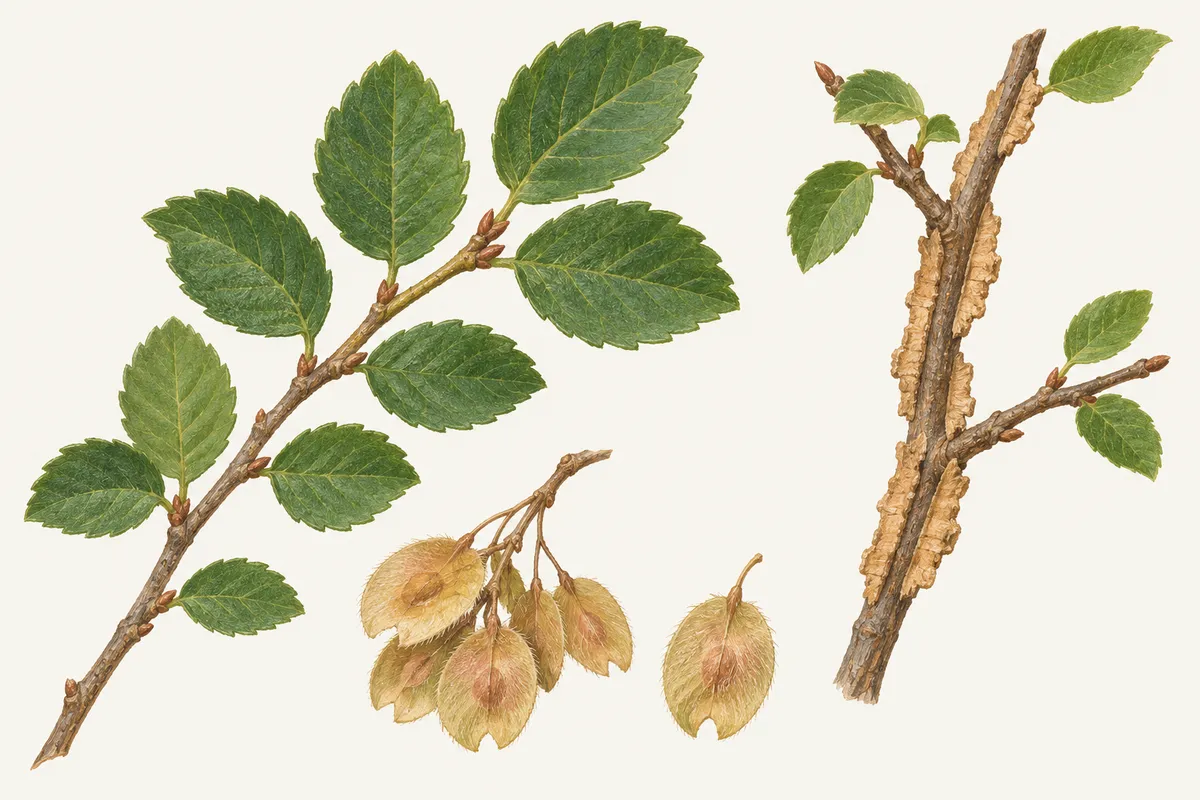
Cedar elm tree identification starts with the leaf: only 1 to 2 inches long, thick, leathery, rough on top, with coarse rounded teeth and a lopsided base. Then check the season: cedar elm flowers in August and September and ripens flat, hairy, notched seeds in September and October, when other native elms are long done. Twigs often carry corky ridges.
- A native elm with fresh seeds in fall is a cedar elm; American, slippery and winged elm all drop theirs in spring.
- Chinese elm also seeds in fall, but its bark flakes into mottled jigsaw pieces and its leaves are shiny and nearly hairless.
- Cedar elm is a Texas, Oklahoma, Arkansas and lower Mississippi tree, often planted for shade.
Field marks at a glance
- Scientific name
- Ulmus crassifolia
- Family
- Ulmaceae (elm family)
- Type
- Broadleaf, deciduous
- Leaves
- Alternate, simple, narrow and roughly lance-shaped, 1 to 2 inches long; thick and leathery, dark green and rough above, soft-hairy beneath; coarse, rounded teeth; base unequal.
- Flowers
- Small and reddish, in clusters of 3 to 5, August to September (reported from July).
- Fruit
- Flat, one-seeded samara shaped like a football with a notch at the tip, 1/4 to 1/2 inch, covered in soft white hairs; ripens September to October.
- Twigs
- Slender, zigzag, brownish, sometimes with corky ridges; buds small, pointed, reddish brown.
- Bark
- Light brown, with furrows that form scaly ridges.
- Trunk
- In cross-section the stem may be triangular, almost square or deeply scalloped, with very indistinct growth rings.
- Size
- From 20 ft on the Edwards Plateau to nearly 98 ft (30 m); national champion 94 ft, in Limestone County, Texas. Rounded crown of drooping branches.
- Range
- Extreme southwestern Tennessee, Arkansas and eastern and southern Oklahoma, south through central and southern Texas to northeastern Mexico, east to Louisiana and western Mississippi; isolated in northern Florida.
Cedar elm is the native elm of Texas: a tough tree of river bottoms, limestone hills and city streets, with the smallest leaves of any native elm, according to the USDA Forest Service. Its leaf looks like a miniature elm leaf, thick and rough. Its calendar is the giveaway: it flowers at the end of summer and drops its seeds in fall, when every other native elm is bare of seed.
How to identify a cedar elm
Use these four checks in order.
1. The tiny, thick leaf. Virginia Tech's cedar elm fact sheet gives leaves only 1 to 2 inches long, narrow and roughly lance-shaped, thick and leathery. The upper surface is dark green and rough to the touch, the underside soft-hairy. The teeth are coarse and rounded, and the base is lopsided like other elms'. Leaves this small and stiff on an elm are a strong clue in Texas.
2. The late flowers. Cedar elm flowers from August to September; the USDA Forest Service's Silvics of North America notes reports as early as July. The flowers are small and reddish, in clusters of 3 to 5 (Virginia Tech). An elm in flower in late summer is either a cedar elm or a planted Chinese elm.
3. The fall seeds. The fruit ripens from September to October, occasionally as late as November. Virginia Tech describes a flat, football-shaped samara with a notch at the tip, 3/8 to 1/2 inch long and covered in soft white hairs; the Forest Service gives 1/4 to 1/2 inch. Seeds blow away and germinate the next spring.
4. The twigs and bark. Twigs are slender, zigzag and brownish, sometimes with corky ridges, and the buds are small, pointed and reddish brown. The bark is light brown, with furrows that form scaly ridges.
When the leaves are high, Tree Identifier can name the tree from one photo of a leaf, a twig or the bark. It gives one name with no confidence score and no list of look-alikes, so check the season of the flowers or seeds before you accept cedar elm over winged elm.
Cedar elm vs winged, Chinese and other elms
| Elm | Leaf | Flowers | Seeds | Bark |
|---|---|---|---|---|
| Cedar elm | 1–2 in, thick, rough, rounded teeth | Aug–Sep | Sep–Oct, hairy all over | Light brown, scaly ridges |
| Winged elm | About 2 in, sharp double teeth | Mar–Apr | Spring, hairy margin | Red-brown to gray, flat-topped ridges |
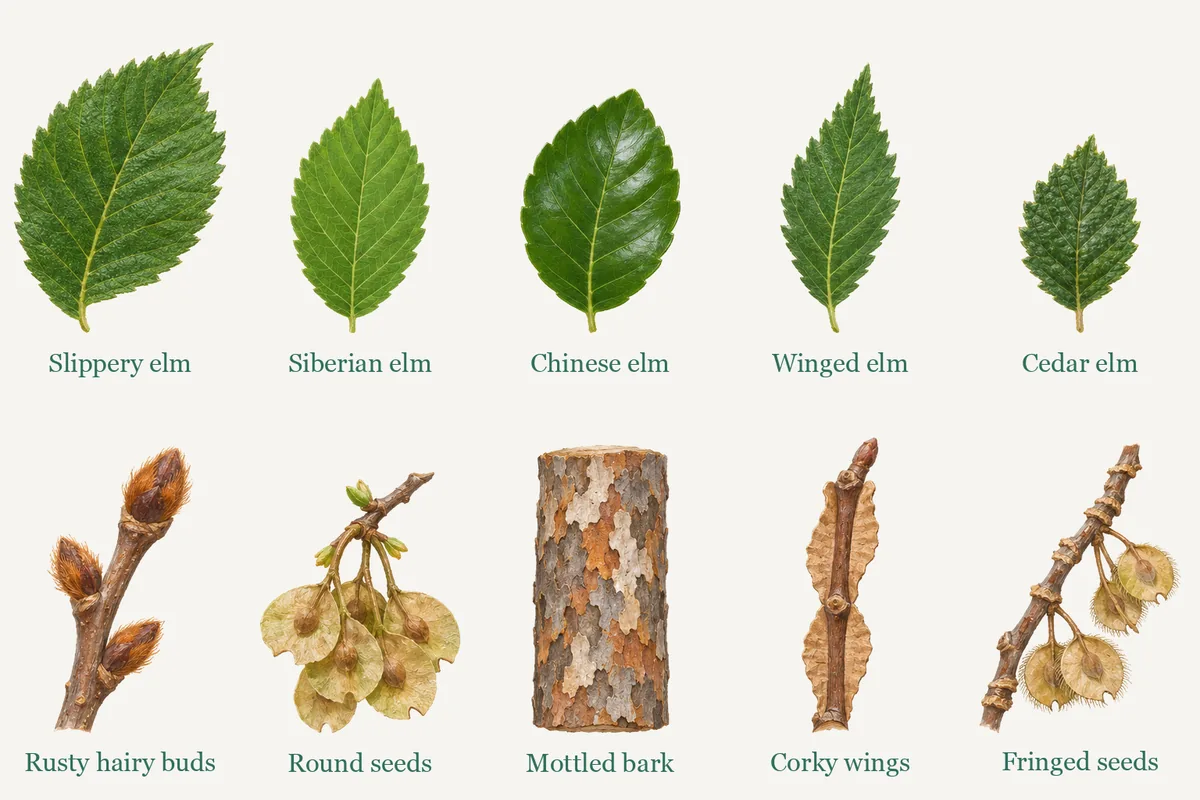
| Chinese elm | Up to 2 1/2 in, shiny, nearly hairless | Late summer to early fall | Fall | Mottled green, gray, orange jigsaw |
| American elm | 3–5 in, doubly toothed | Early spring | Spring, hairy rim only | Ashy gray, diamond fissures |
Rows come from Virginia Tech's fact sheets for winged elm, Chinese elm and American elm.
Winged elm is the native look-alike where the ranges meet in east Texas, Oklahoma, Arkansas and Louisiana. Both have small leaves and corky twigs. In spring, winged elm is the one in flower or dropping seeds; in fall, cedar elm is. See the winged elm page for its two-winged twigs.
Chinese (lacebark) elm shares cedar elm's backward calendar, which is why the two get mixed up in Texas yards and parking lots. Its bark is the quickest test: mottled green, gray and orange puzzle pieces over red-orange inner bark, distinctive even on young trees. Its leaves are shiny and nearly hairless above, not rough. Siberian elm vs Chinese elm covers the Asian elms.
American and slippery elm have leaves two to four times longer and flower in early spring. The slippery elm page covers the rough-leaved one.
Where cedar elm grows
The Forest Service maps cedar elm from extreme southwestern Tennessee, Arkansas and eastern and southern Oklahoma south into central and southern Texas and northeastern Mexico (Nuevo León and Tamaulipas), and east to Louisiana and western Mississippi, with an isolated population in northern Florida. It usually grows on moist limestone soils along waterways with other bottomland trees, but also on dry limestone hills, and on poorly drained clays in central Texas. The Texas tree identification guide places it in the Blackland Prairies and Post Oak Savannah.
Height varies with the site. The Forest Service reports mature trees from about 20 feet on the Edwards Plateau to nearly 98 feet, a national champion 94 feet tall in Limestone County, Texas, and mature trunks averaging about 36 inches across. Virginia Tech describes a medium-sized tree about 60 feet tall with a rounded crown of drooping branches. The Forest Service also notes an odd trunk: in cross-section it may be triangular, almost square or deeply scalloped.
Cedar elm in towns and its uses
Cedar elm is a common planted shade tree. The Forest Service says it is frequently planted in Oklahoma and Texas, so a street or yard elm there is often a cedar elm rather than a wild one. If you are unsure which elm you planted, the follow-up chat under a Tree Identifier result can answer a question such as when that elm should flower. Its wood is strong and highly shock resistant; it is sold with other southern elms as "rock elm" and has been steam-bent into boxes, baskets, crates and barrels. Several bird species eat the seeds, and squirrels eat the buds.
Cedar elm is susceptible to Dutch elm disease, spread mainly by bark beetles, though the Forest Service says it appears less harmful to cedar elm than to American elm. If branches wilt and yellow in summer, ask an ISA Certified Arborist or your county extension office. For the whole elm genus, see the elm identification page.
Look-alikes and how to tell them apart
Winged elm (Ulmus alata)
Winged elm also has small leaves and corky twigs, but its wings are usually two thin strips set opposite each other, its teeth are sharp, and it flowers in March and April and drops its seeds in spring.
Chinese elm (Ulmus parvifolia)
Chinese or lacebark elm also flowers in late summer and seeds in fall, but its bark flakes into mottled green, gray and orange jigsaw pieces and its leaves are shiny and nearly hairless above. Cedar elm bark is light brown and ridged and its leaves are rough.
American elm (Ulmus americana)
American elm leaves are 3 to 5 inches long and thinner, it flowers in early spring before the leaves, and its seeds, hairy only on the rim, fall in spring.
Siberian elm (Ulmus pumila)
Siberian elm leaves are small too, but singly toothed with a nearly even base, and it flowers in early spring. Cedar elm leaves are lopsided at the base and the tree flowers in late summer.
What a photo can't settle
- Out of season, a small cedar elm leaf overlaps with winged, Chinese and Siberian elm; the flowering and seed season and the bark settle it better than one leaf photo.
- Cedar elm and winged elm both grow corky twigs, so a winged twig on its own does not name the species.
- Dutch elm disease is a reason to call a certified arborist or your county extension office; a leaf photo cannot diagnose it.
Questions people ask
Is a cedar elm a kind of cedar?
No. Cedar elm is a true elm, Ulmus crassifolia, in the elm family, with broad deciduous leaves and papery seeds; cedars and junipers are conifers with needles or scales. The USDA Forest Service lists other names for it: basket elm, red elm, southern rock elm and olmo.
Why does my elm have seeds in the fall?
In Texas and nearby states it is most likely a cedar elm, which flowers in August and September and ripens its seeds in September and October. The other elm that seeds in fall is the planted Chinese elm, which has mottled, flaking bark.
How big do cedar elms get?
It depends on the site. The USDA Forest Service reports mature heights from about 20 feet on the Edwards Plateau to nearly 98 feet, with a national champion 94 feet tall in Limestone County, Texas, and mature trunks averaging about 36 inches across.
Does cedar elm get Dutch elm disease?
Yes. The USDA Forest Service says cedar elm is susceptible to Dutch elm disease, spread mainly by bark beetles, though the disease appears less harmful to it than to American elm. Wilting branches are a reason to call a certified arborist.
What is the difference between cedar elm and winged elm?
The season. Cedar elm flowers in late summer and drops its seeds in fall; winged elm flowers in March and April and its seeds fall in spring. Winged elm's twigs usually carry two thin corky wings, and its leaf teeth are sharp rather than rounded.
Sources
- Cedar elm fact sheet — Virginia Tech Dendrology
- Cedar Elm (Ulmus crassifolia), Silvics of North America — USDA Forest Service
- Winged elm fact sheet — Virginia Tech Dendrology
- Chinese elm fact sheet — Virginia Tech Dendrology
- American elm fact sheet — Virginia Tech Dendrology
- Siberian elm fact sheet — Virginia Tech Dendrology
Keep reading
- Tree profileElms (Ulmus): how to identify an elm tree
- Tree profileWinged elm (Ulmus alata): how to identify it
- Tree comparisonSiberian elm vs Chinese elm: two Asian elms, one mixed-up name
- Regional guideTexas tree identification, from the Pineywoods to the Trans-Pecos
- Tree profileSlippery elm (Ulmus rubra): how to identify the tree