Tree comparison
Siberian elm vs Chinese elm: two Asian elms, one mixed-up name
Siberian elm is often sold and spoken of as Chinese elm, but the true Chinese elm is a different tree. The flowering season and the bark settle it in any month.
In short
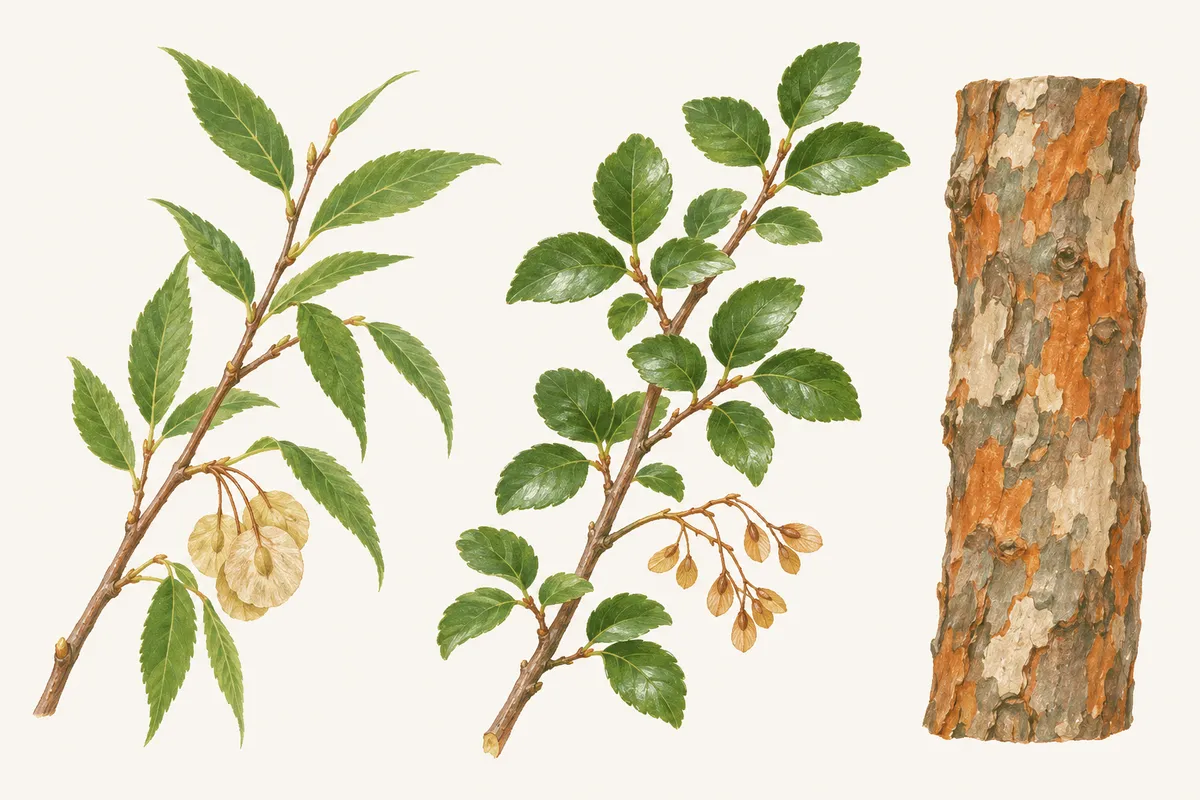
Siberian elm vs Chinese elm comes down to season and bark. Siberian elm (Ulmus pumila) flowers in early spring before the leaves and drops its round seeds in spring; its bark is gray-brown and furrowed. Chinese or lacebark elm (Ulmus parvifolia) flowers in late summer and carries seeds in fall; its bark flakes into mottled green, gray and orange puzzle pieces. Many trees called Chinese elm are Siberian elms.
- Seeds in spring mean Siberian elm; seeds in fall mean Chinese (lacebark) elm.
- Furrowed gray-brown bark, often streaked with dark stains: Siberian. Flaking jigsaw bark in green, gray, orange and cinnamon: Chinese.
- Utah State University calls Siberian elm commonly, but incorrectly, called Chinese elm; check the Latin name on any tag.
Field marks at a glance
- Scientific name
- Ulmus pumila and Ulmus parvifolia
- Family
- Ulmaceae (elm family)
- Type
- Broadleaf, deciduous
- Flowering season
- Siberian: early spring, before the leaves (March to April in Missouri). Chinese: late summer to early fall.
- Seeds
- Both a round, papery wafer about 1/2 inch, notched at the tip. Siberian: ripens in spring. Chinese: in tight clusters in fall, sometimes into early winter.
- Bark
- Siberian: light grayish brown, irregularly furrowed, often streaked by bacterial wetwood. Chinese: mottled green, gray and orange puzzle pieces over red-orange inner bark, even on young trees.
- Leaf
- Siberian: 1 to 2 1/2 inches, mostly single teeth, base nearly even, dull dark green. Chinese: up to 2 1/2 inches, shiny dark green, base lopsided to weakly lopsided, often leathery.
- Twig and buds
- Siberian: grayish twig, round dark buds about 1/8 inch, flower buds much larger. Chinese: brown zigzag twig with orange lenticels.
- Form
- Siberian: up to 60 to 70 ft, often ragged with broken limbs and sprouts on the trunk. Chinese: up to 70 ft (40 to 50 ft in NC State's figures), a graceful, wide-spreading crown of fine branches.
- Origin
- Siberian: Siberia, China and Korea; introduced to the US in the 1860s and seeds freely. Chinese: China, Korea and Japan; not known to escape cultivation in Missouri.
- Leaf habit
- Siberian deciduous. Chinese deciduous, but NC State lists it as semi-evergreen too, so it can hold leaves into winter in the South.
"Chinese elm" is one of the most confused tree names in North America. The tree most people call by that name, the fast, weedy elm of alleys, windbreaks and vacant lots, is usually a Siberian elm. The true Chinese elm, also called lacebark elm, is a separate species planted for its bark. The two are easy to tell apart once you know what to look for: when the tree flowers, and what its trunk looks like.
Siberian elm vs Chinese elm, side by side
Figures come from Virginia Tech Dendrology's fact sheets for Siberian elm and Chinese elm, with NC State Extension and the Missouri Department of Conservation where noted.
| Feature | Siberian elm (Ulmus pumila) | Chinese or lacebark elm (Ulmus parvifolia) |
|---|---|---|
| Flowers | Early spring, before the leaves | Late summer to early fall |
| Seeds | Round wafer about 1/2 in, ripe in spring | Round wafer about 1/2 in, in fall clusters |
| Bark | Light gray-brown, irregular furrows, wetwood streaks | Mottled green, gray, orange; flaking puzzle pieces |
| Leaf length | 1–2 1/2 in | Up to 2 1/2 in |
| Leaf edge | Mostly single teeth | Toothed |
| Leaf base | Nearly even | Lopsided to weakly lopsided |
| Leaf surface | Dark green, smooth | Shiny dark green, often leathery |
| Twig | Grayish, tinged green; buds about 1/8 in | Brown, zigzag, orange lenticels |
| Tree | Up to 70 ft, often ragged and broken | Up to 70 ft, graceful spreading crown |
| Spread | Seeds freely, escapes cultivation | Not known to escape in Missouri |
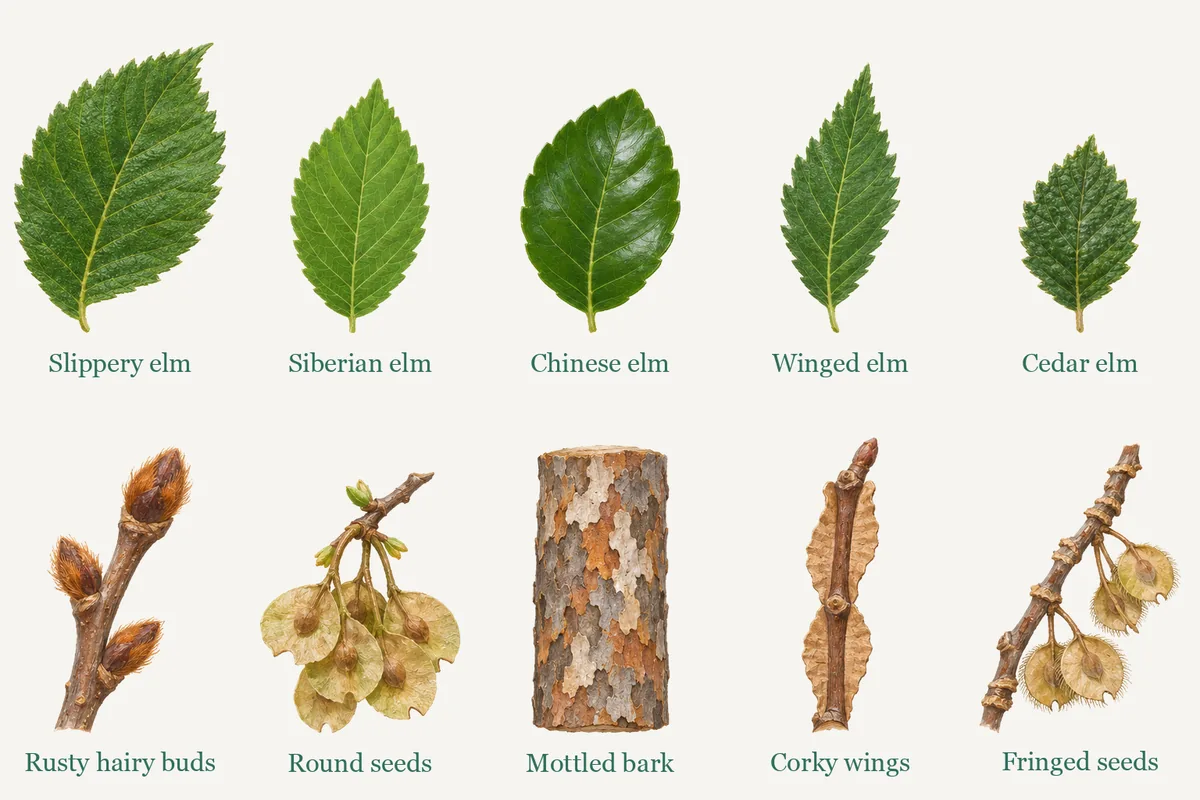
If you only check one thing, check the calendar. A tree covered in pale green flower clusters on bare twigs in March, then shedding drifts of papery seeds in April or May, is a Siberian elm. A small-leaved elm with tight clusters of fresh seeds in October is a Chinese elm.
Flowering season: the test that works without a lab
Virginia Tech gives Siberian elm small, pale green flower clusters in early spring, before the leaves open, and seeds ripening in spring. The Missouri Department of Conservation is more precise for the Midwest: flowers from March to April, appearing with or before the leaves, and fruit ripening from April to May.
Chinese elm runs the other way. Virginia Tech describes inconspicuous light green flowers in late summer and early fall and seeds in tight clusters in fall. The NC State Plant Toolbox adds that the papery samara, about 1/2 inch, appears in fall and may last through early winter. Missouri's field guide also notes that the true Chinese elm blooms in autumn.
This makes the fall check simple. In October or November, any elm carrying new seeds is a Chinese elm; Siberian, American and slippery elms dropped theirs months earlier.
Bark: furrows or puzzle pieces
The trunk works in every season and is the best photo to take.
Siberian elm bark is irregularly furrowed and light grayish brown in Virginia Tech's description, often streaked with lighter stains from bacterial wetwood and the bleeding it causes. Missouri describes older trunks as dark gray and deeply grooved, with long, flat ridges forming a broad, interlacing network. Either way it is rough and furrowed, and never colorful.
Chinese elm bark is the reason people plant it. Virginia Tech calls it "very distinctive, even on young trees": mottled green, gray and orange, in jigsaw-like puzzle pieces separated by red-orange inner bark, and the trunk may become fluted. NC State describes it as lacy and exfoliating, in shades of brown, tan, olive and cinnamon. A smooth trunk patched like a camouflage pattern is a lacebark elm, or one of the few other trees with patchwork bark; our guide to identifying trees by bark covers those.
When you cannot reach a leaf, a single photo of the trunk is usually enough for Tree Identifier to name the tree. It shows one name, with no confidence score and no list of alternatives, so check the flowering season against the table above.
Leaves, twigs and the shape of the tree
The leaves are the weakest test, because both species have small elm leaves and the sources do not fully agree.
- Siberian elm: Virginia Tech gives leaves 1 to 2 1/2 inches long, singly serrated, with a nearly equal base, smooth and dark green. Utah State and Missouri also describe single teeth. NC State's Siberian elm profile instead describes double teeth and an oblique base, and gives leaves 1 to 3 inches.
- Chinese elm: up to 2 1/2 inches, shiny dark green above, with a lopsided base in Virginia Tech's description and "weakly asymmetrical" in NC State's. NC State lists the species as deciduous and semi-evergreen, with leaves that can persist; in mild winters a Chinese elm may still be green when a Siberian elm is bare.
Twigs help a little. Siberian elm twigs are slender, grayish and tinged green, with round, dark reddish-gray leaf buds only about 1/8 inch long and much larger flower buds in late winter. Chinese elm twigs are brown and zigzag with obvious orange lenticels.
The overall tree is a strong hint. Virginia Tech calls Siberian elm "typically a very bad looking tree", with many broken limbs and sprouts along the trunk; its wood is weak and breaks easily, according to Missouri. Chinese elm makes a graceful, wide-spreading crown of fine branches.
Why the names are mixed up
Utah State University Extension puts it plainly: Siberian elm is "commonly, but incorrectly, called Chinese elm." Missouri's field guide says many people know Siberian elm as Chinese elm, while another species is more correctly called by that name. NC State even lists "Chinese elm" among Siberian elm's common names.
Part of the reason is origin: Siberian elm is native to Siberia, China and Korea, and Chinese elm to China, Korea and Japan, so both are Chinese elms in a loose sense. Siberian elm reached the United States in the 1860s, and Missouri notes that it was once planted as a substitute for American elm during the Dutch elm disease years. It seeds so freely that many urban trees were never planted at all. NC State describes it as weedy and borderline invasive; our invasive trees guide covers other escaped species.
The practical rule for a nursery tag: trust the Latin name. Ulmus pumila is Siberian elm, Ulmus parvifolia is Chinese or lacebark elm.
The other elms they get confused with
American elm has far larger leaves, 3 to 5 inches, doubly toothed with a strongly lopsided base, and seeds in spring hairy on the rim; see the American elm page. Japanese zelkova is planted on streets alongside Chinese elm and shares its small leaves. Virginia Tech's zelkova fact sheet gives leaves 1 1/2 to 2 1/2 inches with rounded teeth, a tiny triangular drupe about 1/6 inch instead of a papery wafer, and smooth bark that peels in small reddish-brown patches only late in life. The elm overview compares all the common elms, and Tree Identifier's follow-up chat can answer a direct question such as "Siberian or Chinese elm?" under a result.
Look-alikes and how to tell them apart
American elm (Ulmus americana)
Much larger leaves, 3 to 5 inches, doubly toothed with a conspicuously lopsided base; seeds in spring like Siberian elm but hairy on the rim; a bark slice shows buff and reddish-brown layers.
Japanese zelkova (Zelkova serrata)
Leaves 1 1/2 to 2 1/2 inches with rounded teeth and an even base; fruit a tiny three-sided drupe, about 1/6 inch, not a papery wafer; bark smooth for years, then peeling in small reddish-brown patches; tight, vase-shaped branching.
Slippery elm (Ulmus rubra)
Leaves 4 to 6 inches and sandpaper-rough, buds nearly black and rusty-hairy, seeds 3/4 to 1 inch in late spring. Far bigger leaves than either Asian elm.
What a photo can't settle
- Sources disagree on the Siberian elm leaf: Virginia Tech and Utah State describe single teeth and a nearly even base, NC State double teeth and an oblique base. Use the season and the bark rather than one leaf.
- Nurseries sell named cultivars and hybrids of both species, which can blur the leaf and bark marks.
- A photo app names the species from what it sees; it cannot read a mislabeled nursery tag. If the tag says Ulmus pumila, it is a Siberian elm whatever its common name.
Questions people ask
Is Siberian elm the same as Chinese elm?
No. They are two species. Siberian elm is Ulmus pumila; the true Chinese or lacebark elm is Ulmus parvifolia. Utah State University Extension says Siberian elm is commonly, but incorrectly, called Chinese elm, and the Missouri Department of Conservation makes the same point.
Which elm has bark that peels in patches?
Chinese or lacebark elm. Virginia Tech describes mottled green, gray and orange bark broken into jigsaw-like puzzle pieces separated by red-orange inner bark, distinctive even on young trees. Siberian elm bark is gray-brown and furrowed, never mottled.
Why does my elm drop seeds in fall?
An elm with fresh seeds in fall is almost certainly a Chinese (lacebark) elm, which flowers in late summer and early fall. Siberian, American and slippery elms flower in early spring and drop their seeds in spring.
Is Siberian elm invasive?
It seeds aggressively. NC State calls it weedy and borderline invasive, considered invasive in some states, and the Missouri Department of Conservation says it readily escapes cultivation and that many urban trees grew from seed rather than being planted.
How big do Siberian and Chinese elms get?
Virginia Tech gives both up to 70 feet. The Missouri Department of Conservation gives Siberian elm up to 60 feet, and NC State gives Chinese elm 40 to 50 feet tall and about as wide.
Sources
- Siberian elm fact sheet — Virginia Tech Dendrology
- Chinese elm fact sheet — Virginia Tech Dendrology
- Ulmus parvifolia (Chinese elm, lacebark elm) — North Carolina Extension Gardener Plant Toolbox, NC State University
- Ulmus pumila (Siberian elm) — North Carolina Extension Gardener Plant Toolbox, NC State University
- Siberian elm — Missouri Department of Conservation, Field Guide
- Siberian elm — Utah State University Extension Forestry
- Japanese zelkova fact sheet — Virginia Tech Dendrology
Keep reading
- Tree profileElms (Ulmus): how to identify an elm tree
- Tree profileAmerican elm (Ulmus americana): how to identify it
- Tree profileHackberry tree identification: warty bark, lopsided leaves
- Field guideInvasive tree identification, one field test per tree
- Field guideTree bark identification: seven bark types and the trees that have them