Also in Français
Tree profile
American elm (Ulmus americana): how to identify it
A leaf that meets its stalk off-center, a bark slice that shows buff and red-brown layers, and a crown shaped like a vase: three checks name the old street tree of American towns.
In short
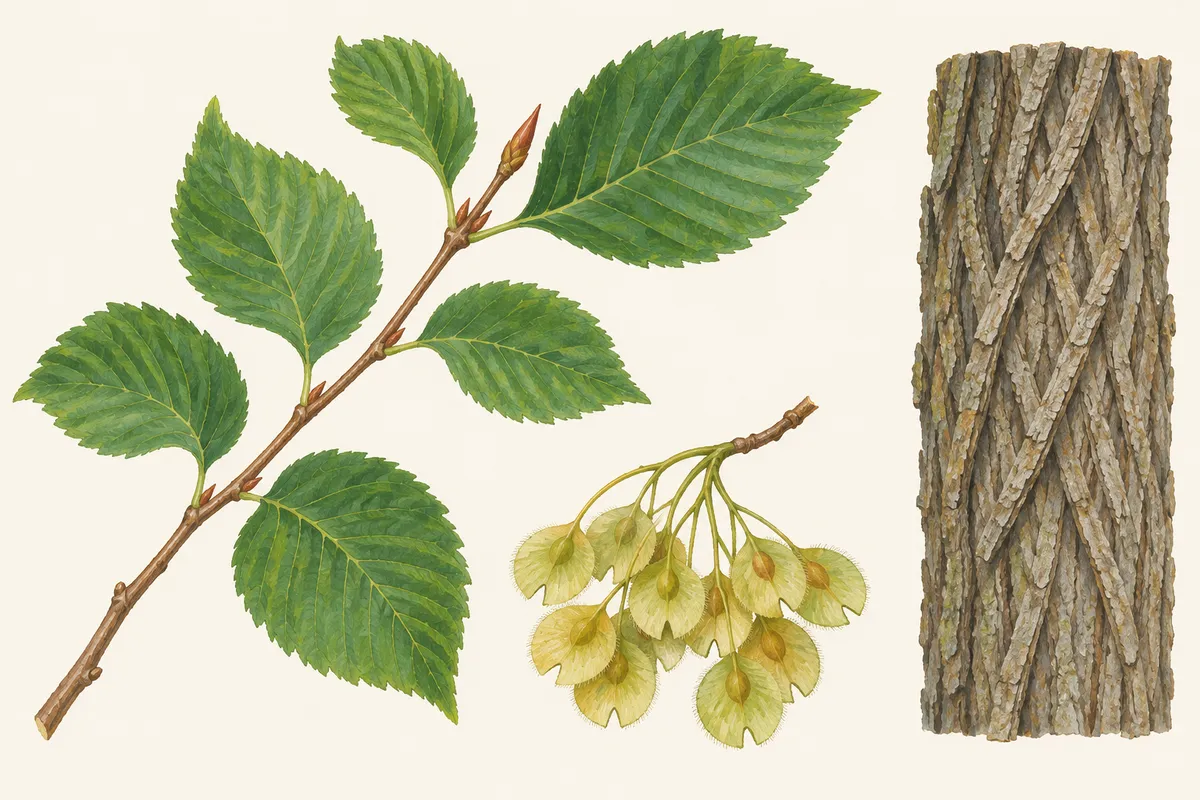
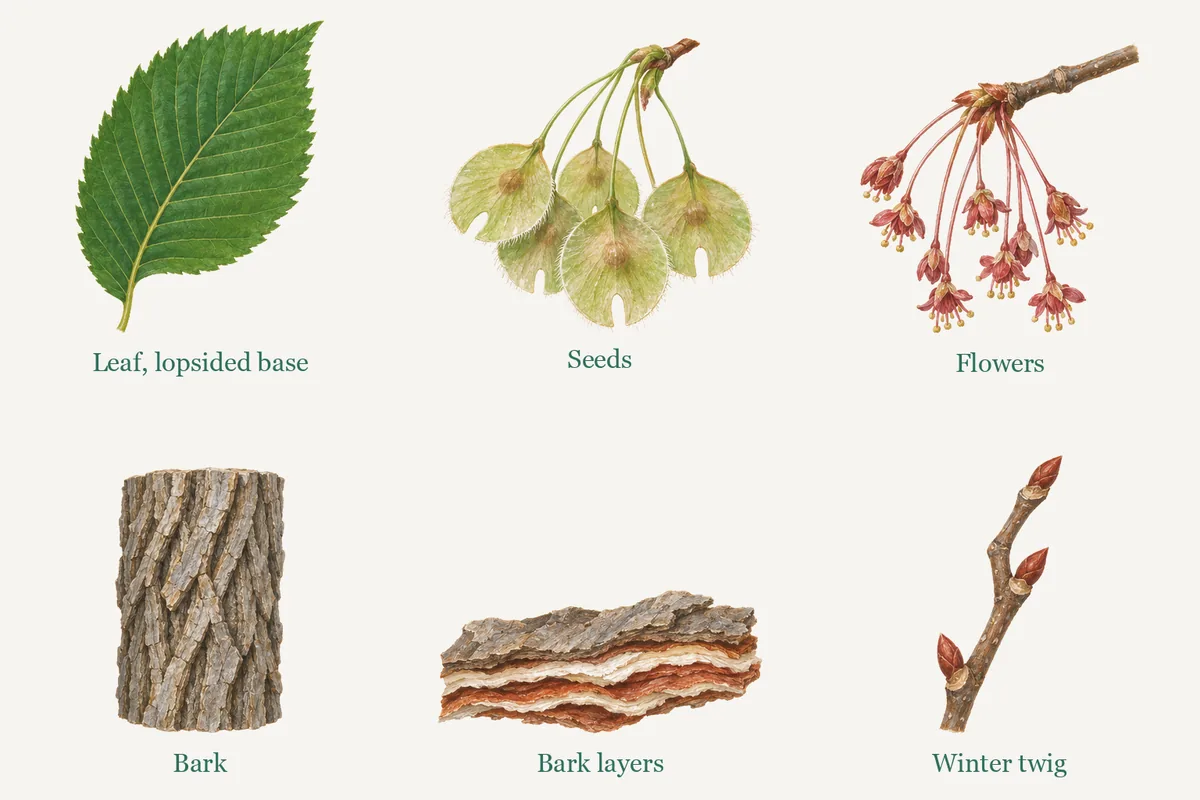
American elm tree identification rests on three checks. The leaf is 3 to 5 inches long, doubly toothed, with a lopsided base where one half meets the stalk lower than the other. The seed is a flat, papery wafer 3/8 to 1/2 inch across, notched at the tip and hairy only on the edge, falling in spring. A thin slice of outer bark shows alternating buff and reddish-brown layers.
- Cut a sliver of outer bark: buff and reddish-brown layers mean American elm; slippery elm shows no buff patches.
- American elm seeds are hairy only along the rim; slippery elm seeds are larger and hairy over the seed.
- A vase of arching limbs ending in drooping twigs is the classic open-grown shape.
Field marks at a glance
- Scientific name
- Ulmus americana
- Family
- Ulmaceae (elm family)
- Type
- Broadleaf, deciduous
- Leaves
- Alternate, simple, oval to oblong, 3 to 5 inches long and 1 to 3 inches wide; edge doubly toothed; base conspicuously lopsided; paler and downy beneath.
- Seeds
- Flat, papery, wafer-like samara 3/8 to 1/2 inch across, notched at the tip, hairless except for a fringe of hairs on the rim; ripens and falls in spring.
- Flowers
- Tiny, in hanging clusters of 3 to 5 on long stalks, opening in early spring 2 to 3 weeks before the leaves.
- Bark
- Dark ashy gray, flat-topped ridges separated by diamond-shaped fissures; a cut through the outer bark shows alternating buff and reddish-brown layers.
- Twigs and buds
- Slender, smooth, slightly zigzag, reddish brown; buds over 1/4 inch, often set a little to one side of the leaf scar.
- Form
- In the open the trunk divides low into several ascending, arching limbs ending in drooping branchlets: a vase.
- Fall color
- Yellow to gold (Morton Arboretum).
- Size and age
- 98 to 125 ft on good forest sites, about 80 ft on medium sites, 40 to 60 ft on very wet or very dry soils; often 175 to 200 years old, some over 300.
- Range
- Cape Breton Island, Nova Scotia, south to central Florida, west to extreme eastern Montana, northeastern Wyoming, western Nebraska, Kansas, Oklahoma and central Texas.
American elm is the tree that once arched over Main Street, and it still grows wild across most of eastern North America, on river flats and in old fields. Most are younger and smaller than the famous street elms, because Dutch elm disease killed the big ones, but every American elm carries the same marks. Check the leaf base, then the seeds or the bark slice, then the shape of the crown.
How to identify an American elm in four checks
1. The leaf base. Lay a leaf flat and look where the blade meets the stalk. Virginia Tech's American elm fact sheet describes the base as unequal-sided: one half of the blade starts lower on the stalk than the other. The leaf is oval to oblong, 3 to 5 inches long and 1 to 3 inches wide, green above and paler and downy beneath. Leaves alternate along the twig, one per node.
2. The teeth. Run a fingernail along the edge. American elm leaves are doubly toothed: each larger tooth carries smaller ones. Together with the lopsided base, double teeth narrow the tree to American or slippery elm.
3. The seeds in spring. American elm flowers before it leafs out, in tiny hanging clusters of 3 to 5, and sets flat, papery seeds that blow across sidewalks in spring. Each wafer is 3/8 to 1/2 inch across, deeply notched at the tip, and hairless except for a fringe of hairs around the rim. The USDA Forest Service's Silvics of North America reports that the flowers open 2 to 3 weeks before the leaves and that seed fall is usually complete by mid-March in the South and mid-June in the North. Elm seeds are a different shape from the paired helicopters of maples: the wing runs all the way round the seed.
4. The bark slice. This is the test that separates American elm from its closest relative. The bark is dark ashy gray, with flat-topped ridges divided by diamond-shaped fissures. With a pocketknife, pare a thin slice of the outer bark and look at the cut edge: American elm shows alternating buff and reddish-brown layers. Slippery elm's bark, cut the same way, shows no buff patches or streaks.
If the leaves are out of reach, Tree Identifier can name an elm from one photo of the bark, a fallen leaf or a handful of seeds. It shows one name with no confidence score and no list of look-alikes, so confirm with the bark slice before settling on American rather than slippery elm. American elm is one of the 138 species in the app's Collection.
American elm vs slippery elm
The two native elms grow on the same flats and are the pair most often confused. Virginia Tech's slippery elm fact sheet gives the differences:
| Feature | American elm | Slippery elm |
|---|---|---|
| Leaf | 3–5 in, smooth or slightly rough above | 4–6 in, very rough above, like sandpaper |
| Seed | 3/8–1/2 in, hairy only on the rim | 3/4–1 in, hairy over the seed cavity |
| Buds | Reddish brown, scales darker-edged | Dark chestnut brown to nearly black, often rusty-hairy |
| Bark slice | Buff and reddish-brown layers | No buff patches |
| Twig, chewed | Not slimy | Slimy (mucilaginous) |
| Form | Vase-shaped, drooping branchlets | Longer clear trunk, branches droop less |
The leaf roughness test is quick: stroke the upper surface from tip to base. A slippery elm leaf catches like fine sandpaper; an American elm leaf is smooth or only slightly rough. But shade leaves vary, so back it up with the bark slice or the seed. The slippery elm page covers that tree's buds, range and seasons in full.
The vase shape and the winter twig
An open-grown American elm is easy to spot from a distance. Virginia Tech describes a trunk that divides low into several large, ascending and arching limbs ending in a mass of drooping branchlets. That fountain or vase outline is why it was planted along so many streets. Trees in a forest grow taller and narrower; the Forest Service gives 98 to 125 feet on good sites, with a clear trunk up to about 49 feet.
In winter, look at the twig. It is slender, smooth, slightly zigzag and reddish brown. The buds are oval, a little over 1/4 inch long, with darker edges to the scales, and they often sit slightly off to one side of the leaf scar. Flower buds swell from February in the South to May in Canada, according to the Forest Service, so a bare elm in late winter often looks fuzzy with fat buds before anything else in the woods. Our winter tree identification guide has the full bud key for other trees.
American elm vs hackberry and the Asian elms
Hackberry is the tree most often called an elm by mistake. The hackberry fact sheet also describes a lopsided leaf base, but three distinct veins start from that base, the tip is long and tapered, and the edge is singly toothed. The bark settles it: corky warts that grow into rough, irregular ridges. The fruit is a small round drupe, 1/4 to 3/8 inch, turning orange-red to dark purple, never a papery wafer. The hackberry page covers it in full.
Siberian elm was planted widely as a fast replacement. Virginia Tech's Siberian elm fact sheet gives leaves only 1 to 2 1/2 inches long with single teeth and a nearly even base, tiny buds about 1/8 inch, and a ragged tree with broken limbs and sprouts along the trunk. Chinese or lacebark elm has small shiny leaves, bark that flakes into mottled puzzle pieces, and flowers in late summer. The page on Siberian elm vs Chinese elm separates those two, and the elm overview covers the genus.
Where American elm grows
The Forest Service maps a range from Cape Breton Island in Nova Scotia south to central Florida, along the whole east coast, and west to extreme eastern Montana, northeastern Wyoming, western Nebraska, Kansas, Oklahoma and central Texas. It is most common on flats and bottomlands but not restricted to them, and grows best on rich, well-drained loams. It rarely forms pure stands. Look for it with silver maple, green ash, boxelder, sycamore, eastern cottonwood, sweetgum, pin oak and hackberry: the Forest Service names four forest types in which it is a major component, including Silver Maple–American Elm and Sugarberry–American Elm–Green Ash.
The Morton Arboretum lists it as hardy from zone 3 to zone 9 and native to the eastern half of the United States.
Dutch elm disease and the elms you see today
Dutch elm disease reached the United States in 1930 in a shipment of elm logs from Europe and had spread to 41 states by the time the Forest Service chapter was written. A fungus is carried into the twigs by the European elm bark beetle and the native elm bark beetle; the tree's leaves wilt and yellow, branches die, then the whole tree. A second disease, phloem necrosis, carried by a leafhopper and through root grafts, browns the leaves and turns the inner bark butterscotch-colored with a wintergreen smell; the Forest Service reports that trees usually die within a year of the first symptoms.
That history explains what you find. Wild American elms are mostly young, and big vase-shaped trees in parks are often disease-resistant cultivars. The Morton Arboretum lists 'Princeton', 'Valley Forge', 'New Harmony', 'Jefferson' and Prairie Expedition among them. The Forest Service notes that American elm has 56 chromosomes, twice as many as other elms, which makes true hybrids rare. If an elm in your yard wilts in summer, ask an ISA Certified Arborist or your county extension office. Tree Identifier's Diagnose tool can describe what it sees in a photo, but a lab sample confirms the disease. With location turned on, the app's Tree Map pins the trees you identify, which helps when you want to check the same elm for seeds next spring.
Look-alikes and how to tell them apart
Slippery elm (Ulmus rubra)
Leaves larger, 4 to 6 inches, and very rough like sandpaper above. Seeds 3/4 to 1 inch, hairy over the seed cavity. Buds dark chestnut brown to nearly black, often rusty-hairy. A bark slice shows no buff patches, and a chewed twig is slimy.
Hackberry (Celtis occidentalis)
Also lopsided at the base, but three distinct veins start from the base of the leaf and the edge is singly toothed. The bark carries corky warts and ridges, and the fruit is a small round drupe, 1/4 to 3/8 inch, not a papery wafer.
Siberian elm (Ulmus pumila)
Leaves only 1 to 2 1/2 inches long with a nearly even base (Virginia Tech), buds tiny, about 1/8 inch, and the tree is often ragged with broken limbs and sprouts along the trunk. Bark is light grayish brown, often streaked by wetwood.
Chinese or lacebark elm (Ulmus parvifolia)
Small shiny leaves up to 2 1/2 inches, bark that flakes in mottled green, gray and orange puzzle pieces, and flowers and seeds in late summer and fall instead of spring.
What a photo can't settle
- American and slippery elm overlap in leaf size and roughness, and a single leaf photo may not separate them; the bark slice, the buds and the seeds do better.
- Disease-resistant cultivars look like the species; a photo app names Ulmus americana, not 'Princeton' or 'Valley Forge'.
- Wilting or yellowing branches in summer can mean Dutch elm disease or phloem necrosis, which need an arborist or extension office, not a leaf photo.
Questions people ask
How can you tell an American elm from a slippery elm?
Cut a thin slice of outer bark: American elm shows alternating buff and reddish-brown layers, slippery elm shows none. Slippery elm leaves are larger, 4 to 6 inches, and sandpaper-rough, its buds nearly black and rusty-hairy, and its seeds 3/4 to 1 inch with hairs over the seed.
When does an American elm drop its seeds?
In spring, early. The flowers open 2 to 3 weeks before the leaves, and the USDA Forest Service reports that seed fall is usually over by mid-March in the South and by mid-June in the North.
Are American elms still common?
As young and mid-sized trees, yes, especially on flats and river bottoms. Dutch elm disease, which reached the United States in 1930, killed most of the large street elms, so a big vase-shaped elm is now uncommon outside planted disease-resistant cultivars.
What do disease-resistant American elms look like?
Mostly like the wild tree. The Morton Arboretum lists cultivars such as 'Princeton', 'Valley Forge', 'New Harmony' and 'Jefferson', all vase-shaped. They share the species' leaf, seed and bark marks, so field checks still work; only nursery records name the cultivar.
Does American elm turn color in fall?
Yes, yellow. The Morton Arboretum describes the leaves turning gold in fall. The color is not a strong identification mark, because hackberry and many other trees also turn yellow.
Sources
- American elm fact sheet — Virginia Tech Dendrology
- American Elm (Ulmus americana), Silvics of North America — USDA Forest Service
- American elm (Ulmus americana) — The Morton Arboretum
- Slippery elm fact sheet — Virginia Tech Dendrology
- Hackberry fact sheet — Virginia Tech Dendrology
- Siberian elm fact sheet — Virginia Tech Dendrology
Keep reading
- Tree profileElms (Ulmus): how to identify an elm tree
- Tree profileHackberry tree identification: warty bark, lopsided leaves
- Tree comparisonSiberian elm vs Chinese elm: two Asian elms, one mixed-up name
- Winter field guideWinter tree identification, from buds to bark
- Clue guideWhich tree has helicopter seeds? Read the wings