Tree profile
Slippery elm (Ulmus rubra): how to identify the tree
The big rough-leaved elm of eastern and Midwestern woods. Stroke a leaf, look at the buds, then slice the bark: three checks separate it from American elm.
In short
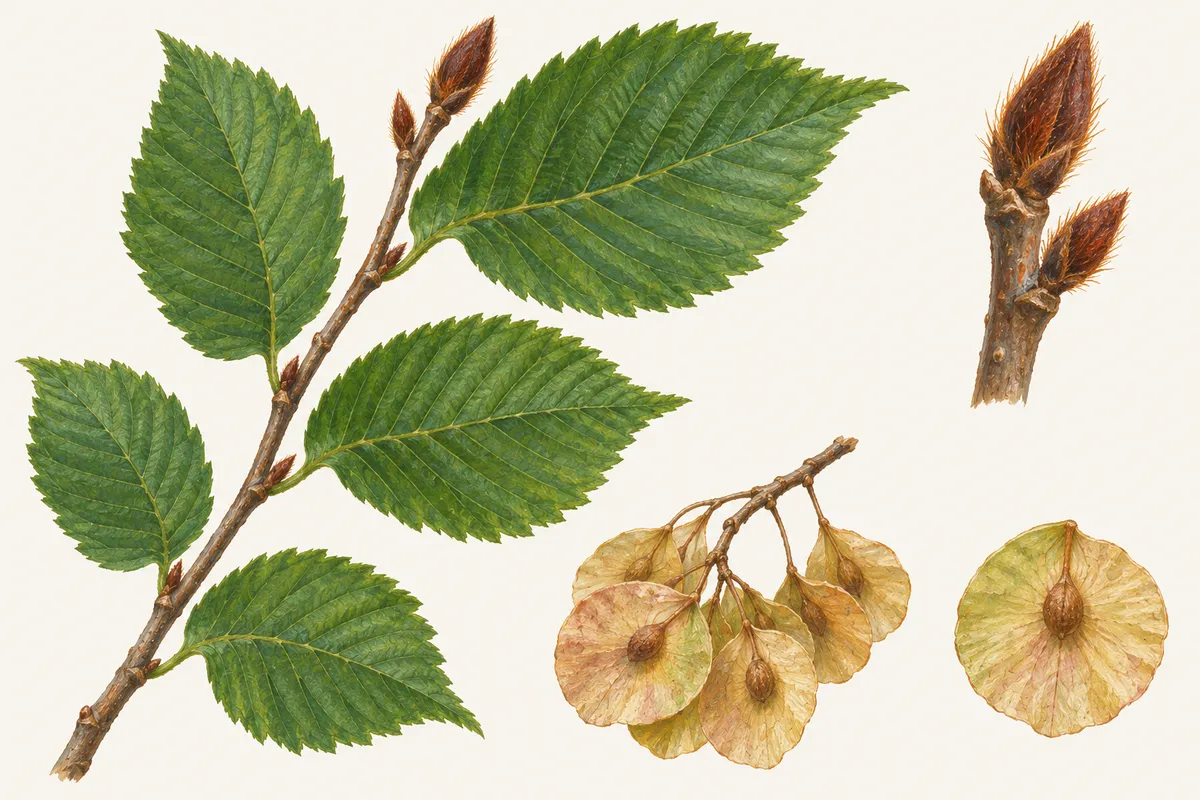
Slippery elm tree identification rests on three checks. The leaves are large for an elm, 4 to 6 inches or more, doubly toothed, lopsided at the base and rough as sandpaper on top. The buds are dark chestnut brown to nearly black and often rusty-hairy. The papery seeds are 3/4 to 1 inch across, hairy over the seed, and a slice of outer bark shows no buff layers.
- A leaf that catches like fine sandpaper when you stroke it from tip to base points to slippery elm.
- Dark, rusty-hairy buds separate it from American elm, whose buds are reddish brown.
- The inner bark is slimy when wet, which gives the tree its name.
Field marks at a glance
- Scientific name
- Ulmus rubra
- Family
- Ulmaceae (elm family)
- Type
- Broadleaf, deciduous
- Leaves
- Alternate, simple, ovate to oblong, 4 to 6 inches long (NC State gives up to 8) and 2 to 3 inches wide; coarsely doubly toothed, base clearly unequal; very rough above, paler and slightly rough or hairy below.
- Buds
- Lateral buds dark chestnut brown to nearly black, sometimes rusty-hairy.
- Twigs
- Often stouter than American elm, slightly zigzag, ashy gray to brownish gray, often mottled and rough; slimy when chewed.
- Flowers
- Small, light green to greenish-red, in tight clusters, before the leaves, February to May depending on place.
- Fruit
- Round, papery samara 3/4 to 1 inch across, smooth wing, hairy over the seed; ripens April to June.
- Bark
- Dark reddish brown to gray, narrow flat ridges, fissures less diamond-shaped than American elm; a slice of outer bark shows no buff layers. Inner bark slimy.
- Size
- 60 to 70 ft (18 to 21 m) on average sites, up to 135 ft on the best; trunk 24 to 36 in across.
- Range
- Southwestern Maine west to New York, southern Ontario, northern Michigan, central Minnesota and eastern North Dakota, south to central Texas and northwestern Florida.
Slippery elm is the second native elm of eastern North America, after American elm, and the one people confuse with it most. The USDA Forest Service finds it most abundant in the southern Lake States and the Midwest corn belt, on moist lower slopes, stream banks and bottomland. The name comes from the inner bark, which turns slimy when wet. In the field, the leaf you can feel and the bud you can see do most of the work.
How to identify a slippery elm
Check these in order; the first three together are a confident identification.
1. Feel the leaf. Stroke the upper surface from tip to base. Virginia Tech's slippery elm fact sheet describes a dark green, rough upper surface; the NC State Extension Plant Toolbox says the roughness comes from minute hairs. A slippery elm leaf catches like fine sandpaper.
2. Measure the leaf. It is a big elm leaf: Virginia Tech gives 4 to 6 inches long and 2 to 3 inches wide, NC State up to 8 inches. It has the elm pattern, coarsely doubly toothed with one side of the base starting lower on the stalk than the other. The underside is paler; NC State notes prominent pale veins.
3. Look at the buds. This is the clearest single difference from American elm, and it works in winter. Virginia Tech describes the lateral buds as dark chestnut brown to nearly black, sometimes covered in rusty hairs; NC State simply calls them black. American elm buds are reddish brown with darker scale edges.
4. Find a seed. In spring, slippery elm drops round, papery samaras 3/4 to 1 inch across, with a smooth wing and a hairy center over the seed (Virginia Tech). American elm's are half the size and hairy only on the rim. Our guide to trees with helicopter seeds shows elm wafers beside maple and ash seeds.
5. Slice the bark. Pare a thin piece of outer bark with a pocketknife and look at the cut edge. Slippery elm's is dark reddish brown with no buff-colored patches; American elm shows alternating buff and reddish-brown layers. The ridges of slippery elm are narrow and flat, and the fissures are less diamond-shaped.
Tree Identifier can name an elm from one photo of a leaf, the bark or a seed. It gives one name with no confidence score and no list of look-alikes, so if it says American elm, run the leaf-roughness and bud checks before you accept it.
Slippery elm vs American elm
The two grow on the same flats and are the pair most often confused.
| Feature | Slippery elm | American elm |
|---|---|---|
| Leaf | 4–6 in, very rough above | 3–5 in, smooth or slightly rough |
| Buds | Dark chestnut to nearly black, often rusty-hairy | Reddish brown, darker scale edges |
| Seed | 3/4–1 in, hairy over the seed | 3/8–1/2 in, hairy only on the rim |
| Bark slice | No buff layers | Alternating buff and red-brown layers |
| Twig | Stouter, gray, rough; slimy when chewed | Slender, smooth, reddish brown |
| Form | Trunk clear for longer, branches droop less | Vase of arching limbs, drooping tips |
Rows come from Virginia Tech's slippery elm and American elm fact sheets. Shade leaves vary, so do not rely on roughness alone: back it up with the bud or the seed. The American elm page covers that tree in depth.
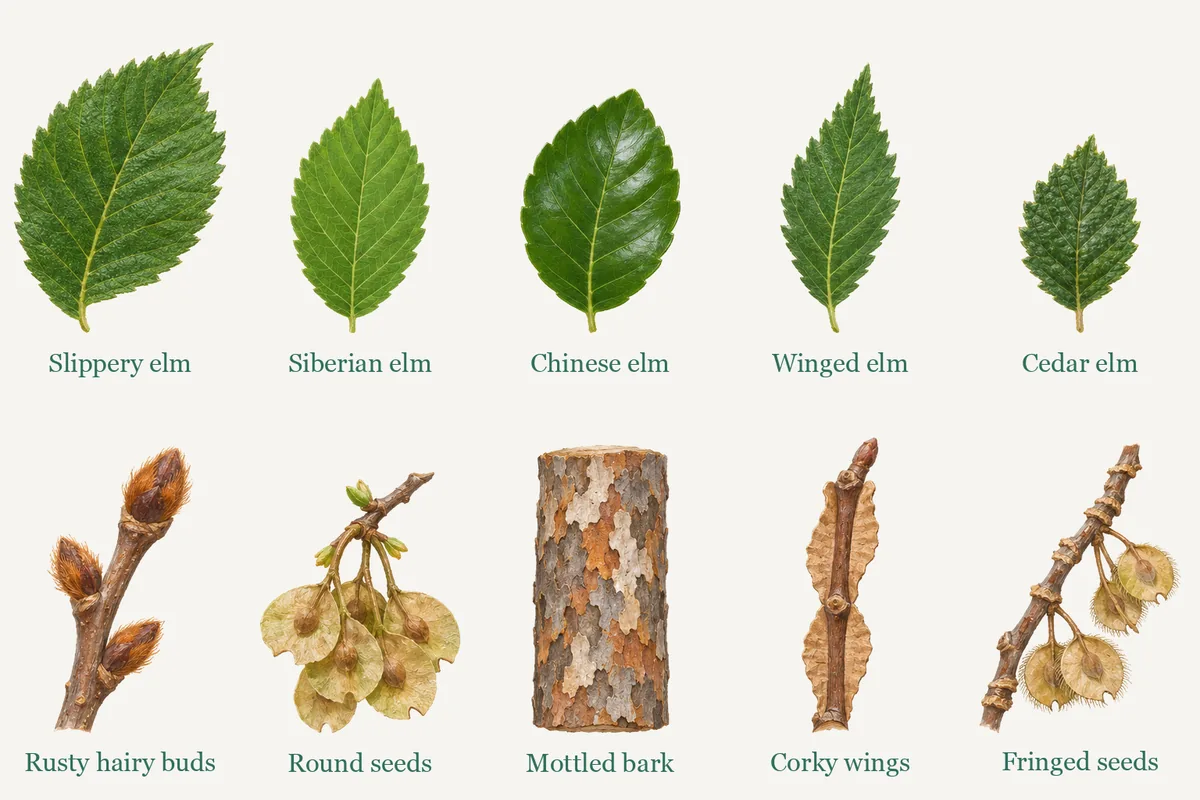
Two small-leaved southern elms also share the range. Winged elm has leaves half the size and corky wings on its twigs (Virginia Tech); see the winged elm page. Cedar elm of Texas and the lower Mississippi has thick leaves only 1 to 2 inches long and flowers in late summer (Virginia Tech).
Hackberry is the non-elm that fools people, because its leaf base is also lopsided. Three veins starting from the base and warty, corky bark identify it; see the hackberry page.
Where slippery elm grows
The USDA Forest Service's Silvics of North America maps a range from southwestern Maine west to New York, southern Ontario, northern Michigan, central Minnesota and eastern North Dakota, south to central Texas, northwestern Florida and Georgia. It grows best on moist, rich soils of lower slopes, stream banks, terraces and bottomlands, but also on drier sites over limestone.
On average sites it reaches 60 to 70 feet with a trunk 24 to 36 inches across; on the best sites the Forest Service reports 135 feet. It may live about 200 years. Virginia Tech notes that the trunk stays free of branches for longer than American elm's and the branches droop less, so a slippery elm rarely has the classic vase shape.
Seasons: flowers, seeds and winter
Slippery elm flowers before its leaves open, from February to May depending on weather and place (USDA Forest Service). The flowers are small and greenish, in tight clusters; NC State describes them as greenish-red. Seeds ripen from April to June and blow away soon after, and the Forest Service reports large seed crops every 2 to 4 years, starting at about 15 years old. Fall color is a dull yellow, according to NC State.
In winter, look at the buds first: dark, nearly black, often rusty-hairy, set alternately on stout, rough, gray twigs. Then do the bark slice. With location turned on, Tree Identifier's Tree Map pins the tree, so you can return in spring to check the seeds. The elm identification page has the winter twig method for the whole genus.
Elm diseases and hybrids
The Forest Service calls slippery elm highly susceptible to Dutch elm disease and adds that elm yellows kills it across much of its range, so it seldom reaches commercial size. If an elm in your yard wilts and yellows branch by branch in summer, ask an ISA Certified Arborist or your county extension office.
Slippery elm also crosses with other elms. The Forest Service reports that it is commonly crossed with Siberian elm, with hybrids intermediate in form, and that natural hybrids with rock elm have been found in Wisconsin and Missouri. A planted elm that mixes features from two fact sheets may be one of these. Slippery elm bark is sold as a herbal product, but that is outside the scope of an identification page: never take any part of a tree as medicine on the strength of a web page or an app.
Look-alikes and how to tell them apart
American elm (Ulmus americana)
American elm leaves are 3 to 5 inches and smooth or only slightly rough, its buds are reddish brown with darker scale edges, its seeds are 3/8 to 1/2 inch and hairy only on the rim, and a slice of its outer bark shows buff and reddish-brown layers.
Winged elm (Ulmus alata)
Winged elm leaves are much smaller, about 1 1/2 to 3 1/2 inches, and its slender twigs usually carry two corky wings. Slippery elm twigs are stout and unwinged.
Cedar elm (Ulmus crassifolia)
Cedar elm has small, leathery leaves only 1 to 2 inches long and flowers in late summer and fall. Slippery elm leaves are 4 inches or more and it flowers in early spring.
Hackberry (Celtis occidentalis)
Hackberry leaves are lopsided too, but three main veins start from the base, the bark carries corky warts, and the fruit is a small round purple drupe, not a papery wafer.
What a photo can't settle
- Slippery and American elm overlap in leaf size and roughness, and shade leaves of either can mislead; a single leaf photo may not separate them, while the buds, the seed and the bark slice do better.
- Slippery elm hybridizes with Siberian elm, and planted hybrids may match neither species' fact sheet (USDA Forest Service).
- This page identifies the tree; it does not cover slippery elm bark as a herbal product, which is a question for a doctor or pharmacist.
Questions people ask
Why is it called slippery elm?
For its inner bark. Virginia Tech and NC State Extension both describe the inner bark as mucilaginous or slimy, and Virginia Tech adds that the twigs are slimy when chewed. NC State notes the moist inner bark has been used in throat lozenges.
How can you tell slippery elm from American elm?
Stroke a leaf: slippery elm feels like sandpaper and is usually 4 to 6 inches long. Its buds are dark and often rusty-hairy, its seeds are 3/4 to 1 inch and hairy over the seed, and a slice of outer bark shows no buff layers. American elm shows buff and reddish-brown layers.
Is red elm the same as slippery elm?
Yes. The USDA Forest Service lists red elm, gray elm and soft elm as other names for Ulmus rubra, and the scientific name rubra means red. Other trees are sometimes called red elm locally, including cedar elm in Texas, so check the leaf size.
Does slippery elm get Dutch elm disease?
Yes. The USDA Forest Service calls slippery elm highly susceptible to Dutch elm disease, and says elm yellows also kills it across much of its range, so it seldom reaches large size. Wilting, yellowing branches in summer are a reason to call an arborist.
When does slippery elm flower and drop its seeds?
The USDA Forest Service gives flowering from February to May, before the leaves, depending on weather and place, and seed ripening from April to June. Large seed crops come every 2 to 4 years once the tree is about 15 years old.
Sources
- Slippery elm fact sheet — Virginia Tech Dendrology
- Slippery Elm (Ulmus rubra), Silvics of North America — USDA Forest Service
- Ulmus rubra (slippery elm) — North Carolina Extension Gardener Plant Toolbox, NC State University
- American elm fact sheet — Virginia Tech Dendrology
- Winged elm fact sheet — Virginia Tech Dendrology
- Cedar elm fact sheet — Virginia Tech Dendrology