Tree profile
Winged elm (Ulmus alata): how to identify it
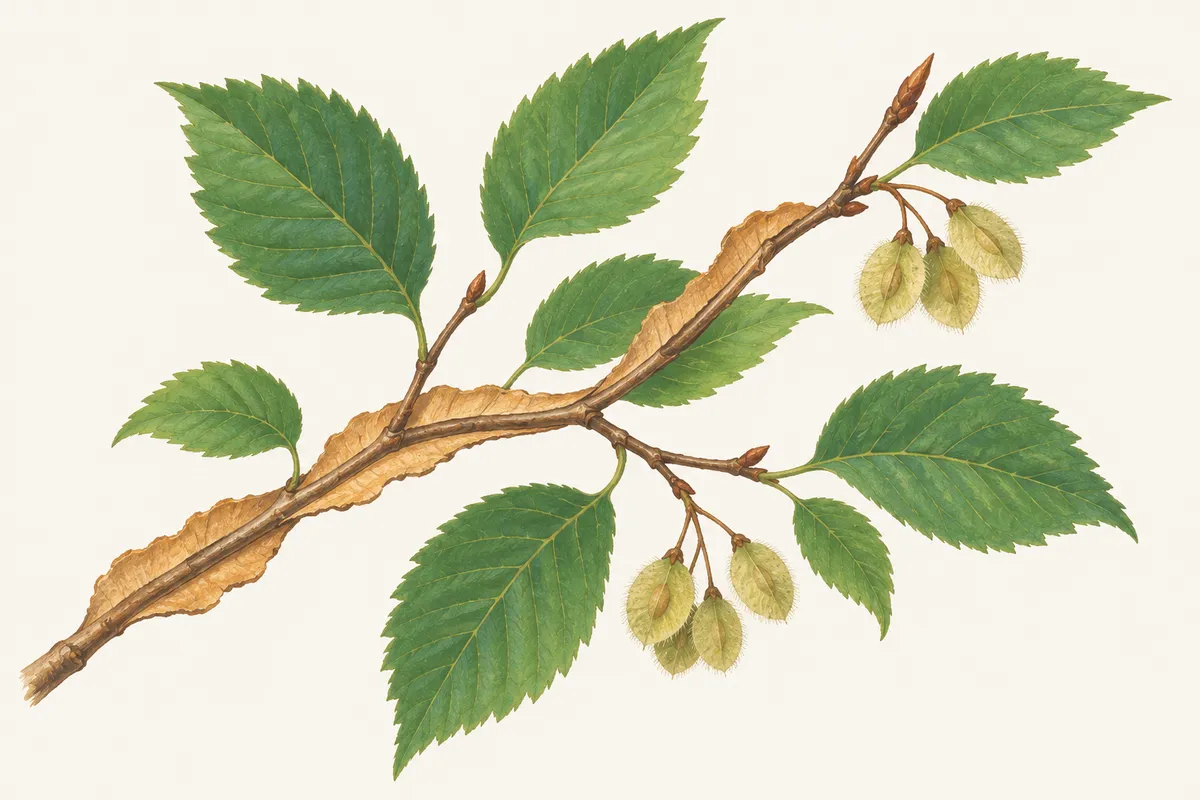
A small-leaved southern elm whose twigs carry two thin corky wings, set opposite each other along the stem. Check the wings, then the leaf, then the season the seeds fall.
In short
Winged elm identification starts with the twigs: most carry two thin, corky wings set opposite each other, sticking out up to 1/2 inch. The leaves are small for an elm, about 1 1/2 to 3 1/2 inches long, doubly toothed and lopsided at the base. Small reddish flowers open in March and April before the leaves, and the hairy-edged seeds fall in April and May.
- Two corky wings facing each other along the twig are the winged elm's mark; sweetgum's corky ridges come with star-shaped leaves and spiny gumballs.
- Cedar elm also has corky twigs and small leaves, but it flowers and drops its seeds in late summer and fall, not in spring.
- Winged elm is a southern tree, from southern Virginia to central Florida and west to central Oklahoma and southeastern Texas.
Field marks at a glance
- Scientific name
- Ulmus alata
- Family
- Ulmaceae (elm family)
- Type
- Broadleaf, deciduous
- Twigs
- Slender, slightly zigzag, reddish brown, usually with two corky wings set opposite each other and sticking out up to 1/2 inch; some twigs have none.
- Leaves
- Alternate, simple, narrowly ovate to elliptic, about 1 1/2 to 3 1/2 inches long and under 1 inch wide, doubly toothed, base unequal, dark green and rough above, paler and slightly hairy below, on a very short stalk.
- Flowers
- Small and reddish, in clusters, March to April (February in North Carolina), before the leaves.
- Fruit
- Flat, papery samara 3/8 to 1/2 inch, hairy on the margin, with two curved points at the tip; ripens and falls in April and May.
- Bark
- Red-brown to ashy gray, with flat-topped ridges separated by irregular fissures; may be scaly.
- Buds
- Slender, sharp-pointed, chestnut brown, very small (about 1/16 inch).
- Size
- Usually 40 to 50 ft (12 to 15 m), occasionally 80 to 100 ft; trunk rarely over 24 in across. Rounded crown.
- Range
- Southern Virginia west to Kentucky, southern Indiana and Illinois and central Missouri, south to central Oklahoma and southeastern Texas, east to central Florida; local in Maryland.
Winged elm is the small-leaved elm of southern woods, old fields and fencerows, and one of the most numerous trees on US forest land in the Forest Service inventory (see the most common trees in the US). Its leaves are ordinary elm leaves in miniature. What gives it away is the twig: two thin, corky wings running along it, one on each side.
How to identify a winged elm
Work through these four checks in order. Two of them together, the wings and the leaf, are usually enough.
1. The corky wings. Look along the twigs and small branches. Virginia Tech's winged elm fact sheet describes "conspicuous corky wings" that stick out up to 1/2 inch. The USDA Forest Service's Silvics of North America explains how they form: two wings appear opposite each other on the stem late in the first year, and branches often keep them as persistent corky wings or projections. From a few steps away, a winged twig looks like a thin stick between two flat strips of cork.
2. The small, lopsided leaf. Winged elm has the elm leaf: alternate, simple, doubly toothed, with one side of the base starting lower on the stalk than the other. It is just smaller. Virginia Tech gives about 2 inches; the NC State Extension Plant Toolbox gives 1 1/2 to 3 1/2 inches long and under 1 inch wide. The blade is narrow, dark green and rough on top, paler and slightly hairy beneath, and the stalk is very short.
3. The spring seeds. Winged elm flowers before its leaves open: small reddish clusters in March and April according to Virginia Tech, as early as February in North Carolina according to NC State. The fruit is a flat, papery samara 3/8 to 1/2 inch across with a hairy margin, and NC State notes two long, curving points at its tip. The seeds ripen and fall in April and May. A carpet of small papery wafers in spring under a small-leaved elm points to winged elm.
4. The bark. Virginia Tech describes red-brown to ashy gray bark with flat-topped ridges separated by irregular fissures; NC State adds that it may be scaly and shred. The bark is not distinctive on its own, so use it to confirm an elm, not to name the species.
If the twigs are out of reach, Tree Identifier can name a tree from one photo of a leaf, a branch or the bark. It returns a single name with no confidence score and no list of look-alikes, so check the corky wings and the flowering season before you accept winged elm over cedar elm.
Winged elm vs cedar elm, sweetgum and the larger elms
| Tree | Leaf | Twigs | Flowers and seeds |
|---|---|---|---|
| Winged elm | 1 1/2–3 1/2 in, doubly toothed, sharp teeth | Usually two corky wings, opposite | Flowers Mar–Apr, seeds Apr–May |
| Cedar elm | 1–2 in, thick, leathery, rounded teeth | Sometimes corky ridges | Flowers Aug–Sep, seeds in fall |
| American elm | 3–5 in, doubly toothed | Slender, no wings | Early spring, seeds in spring |
| Slippery elm | 4–6 in, very rough | Stout, no wings | Early spring, seeds in late spring |
| Sweetgum | Star-shaped, 5–7 points | Often 2–4 corky ridges | Spiny gumballs hang all winter |
Elm rows come from Virginia Tech's fact sheets for cedar elm, American elm and slippery elm.
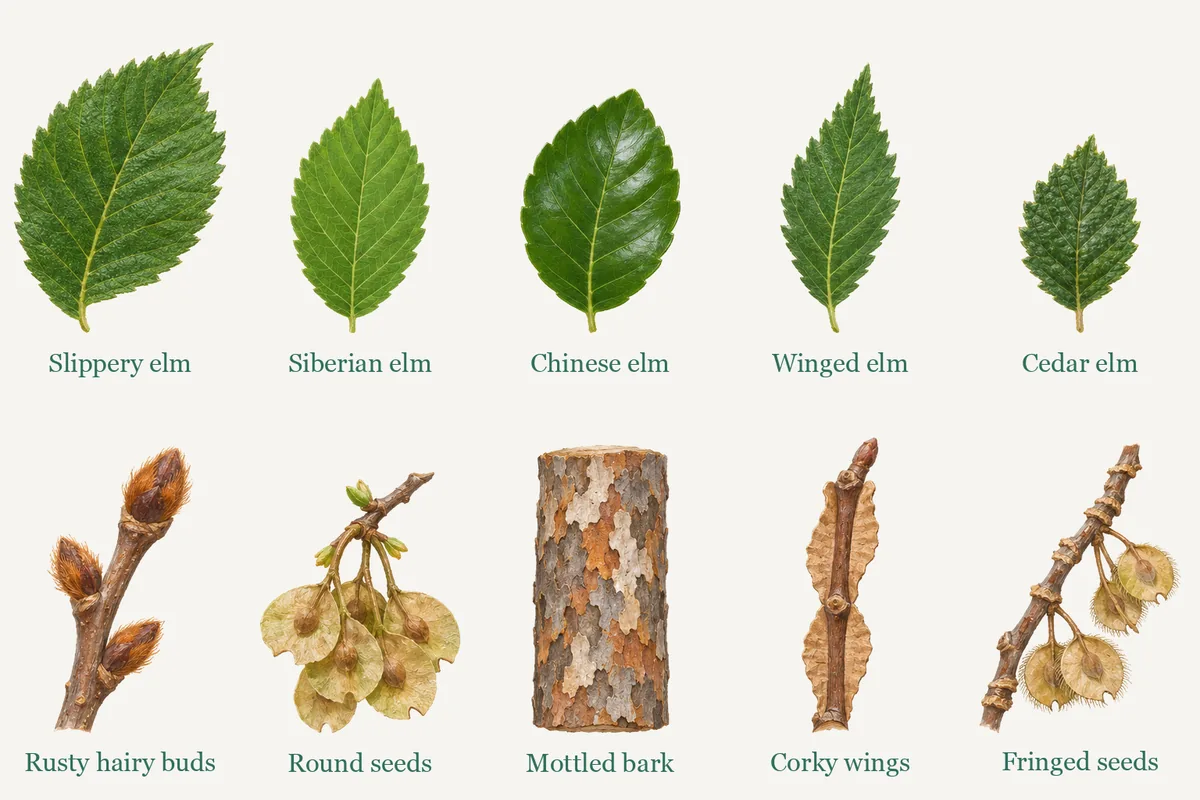
Cedar elm is the real look-alike in Texas, Arkansas and Louisiana, where both grow. It too has small rough leaves and twigs that sometimes carry corky ridges. The calendar separates them: cedar elm flowers in late summer and fall and ripens its seeds in fall, while winged elm's seeds are gone by early summer. See the cedar elm page for its leathery leaf.
Sweetgum is the other tree with corky wings on its twigs, and in winter the two can look alike from a distance. One leaf settles it: NC State's sweetgum profile describes 5 to 7 pointed, star-shaped lobes, two to four corky wings on twigs after their second year, and spiny gumballs that usually stay on the tree through winter. The sweetgum page covers its corky twigs.
American and slippery elm share the doubly toothed, lopsided leaf, but at roughly twice the size, and their twigs have no wings. The American elm page covers the bark-slice test that separates those two.
Where winged elm grows
The USDA Forest Service maps winged elm from southern Virginia west to Kentucky, southern Indiana and Illinois and central Missouri, south to central Oklahoma and southeastern Texas, and east to central Florida, with local stands in Maryland. It grows on many soils, dry or moist, most often near intermittent streams and on moist lower slopes, up to about 2,500 feet (760 m). On poor, dry sites the Forest Service describes it as stunted and gnarled. It is also an old-field tree: NC State lists woodlands and naturalized areas, and it is occasionally planted as a shade or street tree in southern landscapes.
Size depends on site. The Forest Service gives a usual height of 40 to 50 feet, occasionally 80 to 100 feet, with a trunk rarely more than 24 inches across. NC State lists 40 to 60 feet tall and 20 to 40 feet wide, with a rounded crown.
Winged elm in winter and fall
Winter is a good season for this tree, because the wings are easier to see on bare twigs. Check several twigs and the lower branches: the wings show best on vigorous growth. The buds are tiny, slender, sharp-pointed and chestnut brown, about 1/16 inch long according to the Forest Service. Then look at the trunk for flat-topped ridges, and under the tree for last year's leaves, small and lopsided at the base. In winter a photo of a winged twig gives Tree Identifier a clearer clue than a fallen leaf. The winter tree identification guide covers the bud and twig method for other trees.
Fall color is modest. NC State describes it as an undistinguished, dull yellowish-green to yellow. In the fall, a small-leaved elm still carrying fresh seeds is more likely a cedar elm or a planted Chinese elm than a winged elm.
Uses, wildlife and elm diseases
The Forest Service notes that winged elm wood is sold as hard or rock elm for furniture, flooring, boxes and crates, and that its resistance to splitting once made it suitable for hockey sticks. Birds and small mammals eat the seeds, and white-tailed deer browse the twigs and leaves, especially in spring. NC State lists it as a larval host for the mourning cloak, question mark, eastern comma and painted lady butterflies.
Winged elm is susceptible to Dutch elm disease and to elm phloem necrosis. The Forest Service notes that Dutch elm disease is most prevalent in the northern part of the species' range. If a winged elm wilts or yellows branch by branch in summer, ask an ISA Certified Arborist or your county extension office. For the elm genus as a whole, including the Asian elms planted in towns, see the elm identification page.
Look-alikes and how to tell them apart
Cedar elm (Ulmus crassifolia)
Cedar elm also has small rough leaves and sometimes corky twigs, but it flowers in August and September and drops its seeds in fall. Its leaves are thick and leathery, 1 to 2 inches, with coarse rounded teeth. Winged elm's seeds fall in spring.
Sweetgum (Liquidambar styraciflua)
Sweetgum twigs also grow corky wings, often 2 to 4 of them, but the leaves are star-shaped with 5 to 7 points and the tree hangs spiny gumballs all winter. A winged elm leaf is an unlobed, toothed oval with a lopsided base.
American elm (Ulmus americana)
American elm leaves are larger, 3 to 5 inches, its twigs have no corky wings, and a slice of its outer bark shows alternating buff and reddish-brown layers.
Slippery elm (Ulmus rubra)
Slippery elm leaves are 4 to 6 inches long and sandpaper-rough, its buds are dark and often rusty-hairy, its twigs are stout and unwinged, and its seeds are larger, 3/4 to 1 inch across.
What a photo can't settle
- Winged elm, cedar elm and sweetgum all grow corky twigs, so a photo of a winged twig alone is not proof; add a leaf, and the season of the flowers or seeds.
- Leaf size varies with sun and site, and a small winged elm leaf overlaps with cedar elm and Chinese elm; a photo app gives one name, so check the flowering season yourself.
- Dutch elm disease and elm phloem necrosis both affect winged elm; wilting or yellowing branches are a reason to call an arborist, not something a leaf photo can diagnose.
Questions people ask
Why does winged elm have wings on its branches?
The wings are corky outgrowths of the bark. The USDA Forest Service says two wings form opposite each other on the stem late in the first year, and branches often keep corky wings or projections. They are normal for the species, not a disease or an insect gall.
Do all winged elm twigs have wings?
No. Many twigs carry them, but some branches, shaded twigs and young sprouts show narrow wings or none. If one twig is plain, look along several others and on the lower branches before ruling winged elm out.
What is the difference between winged elm and cedar elm?
Season is the quickest test. Winged elm flowers in March and April and drops its seeds in April and May; cedar elm flowers in August and September and ripens its seeds in fall. Cedar elm leaves are also thicker and leathery, with blunter teeth.
Is winged elm the same as cork elm?
Yes. The USDA Forest Service lists cork elm and wahoo as other names for Ulmus alata, and NC State Extension adds small leaf elm and witch elm. Common names are shared between trees, so the scientific name, Ulmus alata, is the safe one to search.
How big does a winged elm get?
The USDA Forest Service gives a usual height of 40 to 50 feet, occasionally 80 to 100 feet, with a trunk rarely more than 24 inches across. NC State Extension lists 40 to 60 feet tall and 20 to 40 feet wide.
Sources
- Winged elm fact sheet — Virginia Tech Dendrology
- Winged Elm (Ulmus alata), Silvics of North America — USDA Forest Service
- Ulmus alata (winged elm) — North Carolina Extension Gardener Plant Toolbox, NC State University
- Cedar elm fact sheet — Virginia Tech Dendrology
- American elm fact sheet — Virginia Tech Dendrology
- Slippery elm fact sheet — Virginia Tech Dendrology
- Liquidambar styraciflua (sweetgum) — North Carolina Extension Gardener Plant Toolbox, NC State University
Keep reading
- Tree profileElms (Ulmus): how to identify an elm tree
- Tree profileCedar elm (Ulmus crassifolia): how to identify the tree
- Tree profileAmerican elm (Ulmus americana): how to identify it
- Tree profileSweetgum tree (Liquidambar styraciflua): how to identify it
- Winter field guideWinter tree identification, from buds to bark