Regional guide
Texas tree identification, from the Pineywoods to the Trans-Pecos
Texas runs from pine forest to desert, so start with where you stand. Then check the leaf, the bark and the fruit of the handful of trees that fill each region.
In short
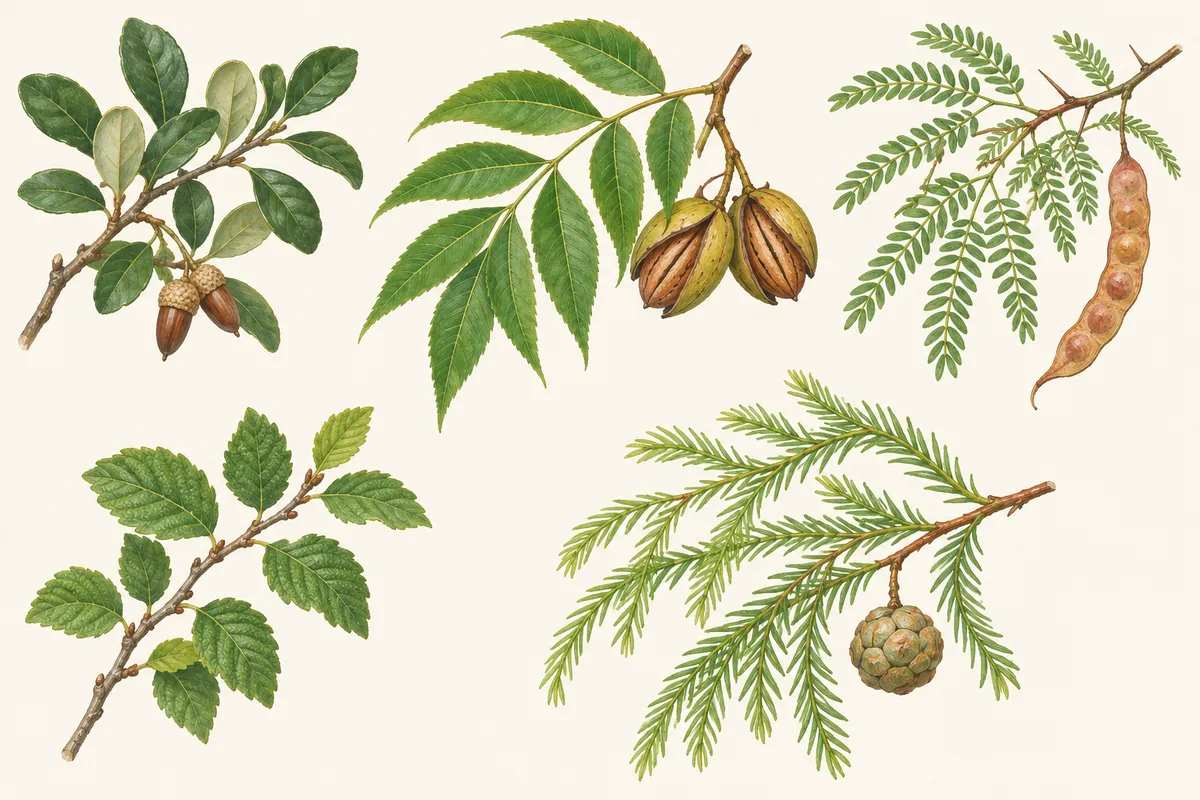
Texas tree identification starts with your region. In the Pineywoods of East Texas, count pine needles: loblolly carries three per bundle. In the Post Oak Savannah and Cross Timbers, look for post oak's cross-shaped leaves. On the Edwards Plateau, scale-leaved Ashe juniper ("cedar") grows with Texas live oak. West and south, feathery leaves and bean pods mean honey mesquite, the most numerous tree on Texas forest land.
- Honey mesquite is the most numerous tree on Texas forest land, 14.5% of live trees on forest land, ahead of Ashe juniper (11.4%) and loblolly pine (10.0%) (USDA Forest Service, Forests of Texas, 2020).
- Loblolly pine holds the most wood: 31.7% of the timber volume on Texas forest land.
- The pecan has been the Texas state tree since 1919 (Texas State Library and Archives).
Texas is too big for one tree list. The Texas A&M Forest Service divides it into ecoregions, from the Pineywoods along the Louisiana line to the Trans-Pecos mountains, and each holds a different handful of trees. Find your region first, then check leaves, bark and fruit. Counts below come from the USDA Forest Service's Forests of Texas, 2020 inventory, which estimates about 59 million acres of forest land, 36% of the state. East Texas shares its pines and swamp trees with the rest of the South, covered in southern tree identification; far West Texas shares its trees with the desert Southwest.
The Texas trees to learn first
| Tree | Where in Texas | The feature that settles it |
|---|---|---|
| Honey mesquite | South Texas Plains, Trans-Pecos, rangeland statewide | Feathery leaves of tiny leaflets, thorns, long bean pods |
| Ashe juniper ("cedar") | Edwards Plateau, Central Texas | Scale leaves on rounded shoots; blue berry-like cones; bark in long strips |
| Loblolly pine | Pineywoods of East Texas | Needles in bundles of three; spiny cones |
| Post oak | Post Oak Savannah, Cross Timbers | Leaves with two square middle lobes, like a cross |
| Cedar elm | Blackland Prairies, Post Oak Savannah | Small, rough leaves 1 to 2 in; flowers and seeds in fall |
| Texas live oak | Edwards Plateau | Leathery leaves 1 to 3 in kept in winter; often in thickets |
| Pecan | River and creek bottoms | Compound leaves 12 to 18 in with 9 to 15 leaflets; oblong nuts |
The first three are the most numerous trees in the state. The Forest Service counts about 18.9 billion live trees on Texas forest land: honey mesquite makes up 14.5% of them, Ashe juniper 11.4% and loblolly pine 10.0%. Loblolly holds the most wood, 31.7% of the volume, because it grows into tall timber while mesquite and juniper stay small. By forest type, the inventory puts 34.9% of Texas forest land in woodland hardwoods, 21.0% in oak-hickory and 14.4% in pinyon-juniper.
East Texas: the Pineywoods
The Pineywoods are the wettest part of the state, with 32 to 50 inches of rain a year for most of the region, according to Trees of Texas. Pine forest dominates. Three southern yellow pines are native here, shortleaf, longleaf and loblolly; slash pine also grows in places but was planted, not native. Count the needles in one bundle and find a cone; the pine page walks through the measurements that separate them.
Hardwoods fill the rest: oaks, elms, hickories, pecan, black walnut, tupelo and sweetgum. Post oak and blackjack oak take the dry uplands; water oak, cherrybark oak, Nuttall oak and black hickory grow in the river bottoms. Yaupon and wax myrtle crowd the understory. Trees of Texas lists Chinese tallow as well established here; its diamond-shaped leaves and white, popcorn-like seeds are covered on the Chinese tallow page.
Central Texas: post oak country and the Blacklands
Between the pines and the Hill Country lie the Post Oak Savannah, the Blackland Prairies and the Cross Timbers. The savannah is mostly grassland, with post oak as its main tree, scattered across the landscape, along with plateau live oak, black hickory and blackjack oak. The Blackland Prairies sit on heavy black clay; their trees include post oak, blackjack oak, American, winged and cedar elm, sugarberry, green ash, Osage-orange, honey mesquite and eastern redcedar. The Eastern Cross Timbers, a strip of woods from Cooke County south to Hill County, carry post oak and blackjack oak on the uplands and pecan, bur oak, elms and cottonwood along the streams.
- Post oak (Quercus stellata): leaves with five lobes, the two middle ones squared off so the leaf looks like a cross; small acorns 1/2 to 2/3 inch long in a warty, bowl-shaped cap; ashy gray, scaly bark; a tree up to 65 feet with gnarled, twisted limbs (Virginia Tech Dendrology).
- Cedar elm (Ulmus crassifolia): the small-leaved elm of Texas. Leaves are only 1 to 2 inches long, thick, dark green and rough on top. Unlike most elms it flowers in late summer and fall, and its flat, notched, hairy seeds ripen in fall. Twigs often carry corky ridges; the tree reaches about 60 feet with drooping branches (Virginia Tech Dendrology). The elm page compares it with American and Siberian elm, and the cedar elm page separates it from winged and Chinese elm.
The Hill Country: Edwards Plateau
The Edwards Plateau rises from about 600 to 3,000 feet over limestone, and erosion has left most of its soils less than 10 inches deep. Trees of Texas names four main woodland trees: escarpment live oak, Texas oak, honey mesquite and Ashe juniper. Protected canyons hold Texas madrone, bigtooth maple, Texas mountain-laurel, Mexican plum and lacey oak; baldcypress, sycamore and black willow line the springs and creeks.
- Ashe juniper (Juniperus ashei), the "cedar" of Central Texas: a small conifer up to about 30 feet with scale-like leaves that stay green all year on rounded shoots. Female trees carry blue berry-like cones; male trees carry small pollen cones that ripen from December to February. Bark is reddish brown and peels in long strips. The USA National Phenology Network calls it one of the most important causes of seasonal allergies in Texas, the "cedar fever" of winter. The Ashe juniper page separates it from eastern red cedar and redberry juniper.
- Redberry juniper (Juniperus pinchotii), its look-alike to the west: a shrubby tree up to 20 feet whose berry-like cones are copper to copper-red, about 1/3 inch across (Virginia Tech Dendrology). Cone color is the quick check: blue for Ashe, copper-red for redberry.
- Texas live oak (Quercus fusiformis): leathery leaves 1 to 3 inches long, evergreen or nearly so; dark brown acorns about 3/4 inch long, half covered by the cap, in clusters of one to three. It often grows as large shrubs forming dense thickets, or as a tree up to 40 feet (Virginia Tech Dendrology). The live oak page separates it from southern live oak.
The juniper page covers the other junipers you may meet in Texas, including eastern redcedar.
South and West Texas: mesquite, brush and mountains
The South Texas Plains get about 19 to 23 inches of rain, and honey mesquite dominates. Huisache grows on poorly drained flats; blackbrush, guajillo, cenizo, Texas mountain-laurel and Spanish dagger cover the dry ridges, and Texas persimmon, spiny hackberry and guayacan fill the rocky draws.
The Trans-Pecos is Chihuahuan Desert country, from about 1,000 feet near the Rio Grande to 8,749 feet on Guadalupe Peak, the highest point in Texas, with under 8 inches of rain a year near El Paso. Trees of Texas lists honey mesquite, redberry juniper, netleaf hackberry, cottonwood, desert willow, western soapberry, Texas walnut and Mexican buckeye, with Ashe juniper toward the east. The desert tree guide gives honey mesquite's thorns, leaflets and pods, and separates it from velvet mesquite, palo verde and desert willow.
Mesquite thorns cut skin and clothing. Never eat a pod, berry, nut or seed on the strength of a web page or an app; check with a local expert.
The state tree: pecan
The Texas State Library and Archives records the pecan as the state tree since 1919, named by Senate Bill 317 of the 36th Legislature. Trees of Texas lists it among the hardwoods of the Pineywoods and in the stream bottoms of the Blackland Prairies and the Cross Timbers, and it is planted across the state.
Look for alternate compound leaves 12 to 18 inches long with 9 to 15 finely toothed, often curved leaflets, and oblong brown nuts 1 1/2 to 2 inches long, splotched with black, in thin husks that grow in clusters and split in fall. Bark is smooth when young and breaks into thin, scaly strips with age. The pecan page separates it from black walnut and the other hickories.
Using a photo in Texas
Texas trees are often small and spread out, and in drought mesquite and juniper look alike from a distance. Photograph the feature that settles it: a juniper cone, an oak leaf with its acorn, a mesquite pod. Tree Identifier names a tree from one photo of a leaf, bark, flower or fruit, and its follow-up chat can answer a question such as "Ashe juniper or redberry juniper?". It shows no confidence score, so check the answer against the table above. Southern live oak is in the app's 138-species Collection; pecan and Ashe juniper are not, and finds outside it are kept under Wild Discoveries. With location turned on, the Tree Map pins where each tree grew. For a second opinion, the Texas A&M Forest Service ID-by-leaf key on Trees of Texas covers the state's native trees one leaf shape at a time.
What a photo can't settle
- Texas towns plant many trees from other regions and continents, such as crape myrtle (the state shrub) and Bradford pear, that a list of native trees does not cover.
- Oaks in Central Texas hybridize and vary leaf by leaf, so one leaf rarely settles the species; check the acorn, the bark and the habitat too.
- Shrubby trees of the South Texas Plains and the Trans-Pecos, such as huisache, blackbrush and guajillo, need flowers or pods to name with confidence.
Questions people ask
What is the most common tree in Texas?
By number of trees, honey mesquite. The USDA Forest Service's Forests of Texas, 2020 counts about 18.9 billion live trees on Texas forest land: 14.5% are honey mesquite, 11.4% Ashe juniper and 10.0% loblolly pine. By wood volume, loblolly pine leads with 31.7%, because East Texas pines are far bigger trees.
What is the state tree of Texas?
The pecan, designated in 1919 by Senate Bill 317 of the 36th Legislature, according to the Texas State Library and Archives. Look for compound leaves 12 to 18 inches long with 9 to 15 curved leaflets, and oblong nuts in thin husks that split. Wild pecans grow along rivers and creek bottoms.
What is the tree Texans call cedar?
In Central Texas it is usually Ashe juniper, also called mountain cedar, a juniper rather than a true cedar. It has scale-like leaves on rounded shoots, blue berry-like cones on female trees and reddish-brown bark that peels in long strips. Its winter pollen causes the allergy known locally as cedar fever.
How do I tell Texas live oak from southern live oak?
Virginia Tech treats Texas live oak (Quercus fusiformis) as its own species: leathery leaves 1 to 3 inches long, acorns 3/4 inch long, half covered by the cap, often on shrubby trees that form thickets, or a tree up to 40 feet. Our live oak page compares it with southern live oak, which reaches southern and central Texas.
Is there a free Texas tree identification guide?
Yes. Texas A&M Forest Service runs Trees of Texas, a free website with an ID-by-leaf key, a list of trees, a tree dictionary and a page for each Texas ecoregion naming the trees that grow there. It is the best place to check a name you get from a book or an app.
Sources
- Forests of Texas, 2020: FIA Annual Snapshot (Resource Update FS-319) — USDA Forest Service, Forest Inventory and Analysis
- Trees of Texas: Texas Eco-Regions — Texas A&M Forest Service
- Texas State Symbols — Texas State Library and Archives Commission
- Juniperus ashei (Ashe's juniper, mountain cedar) Phenophase Photo Guide — USA National Phenology Network, Nature's Notebook
- Post oak (Quercus stellata) fact sheet — Virginia Tech Dendrology
- Cedar elm (Ulmus crassifolia) fact sheet — Virginia Tech Dendrology
- Texas live oak (Quercus fusiformis) fact sheet — Virginia Tech Dendrology
- Redberry juniper (Juniperus pinchotii) fact sheet — Virginia Tech Dendrology