Tree profile
Pecan (Carya illinoinensis): how to identify it
The largest hickory, with more leaflets than any of its relatives, oblong nuts in thin husks and bark that breaks into scaly strips. Here is the order to check them in.
In short
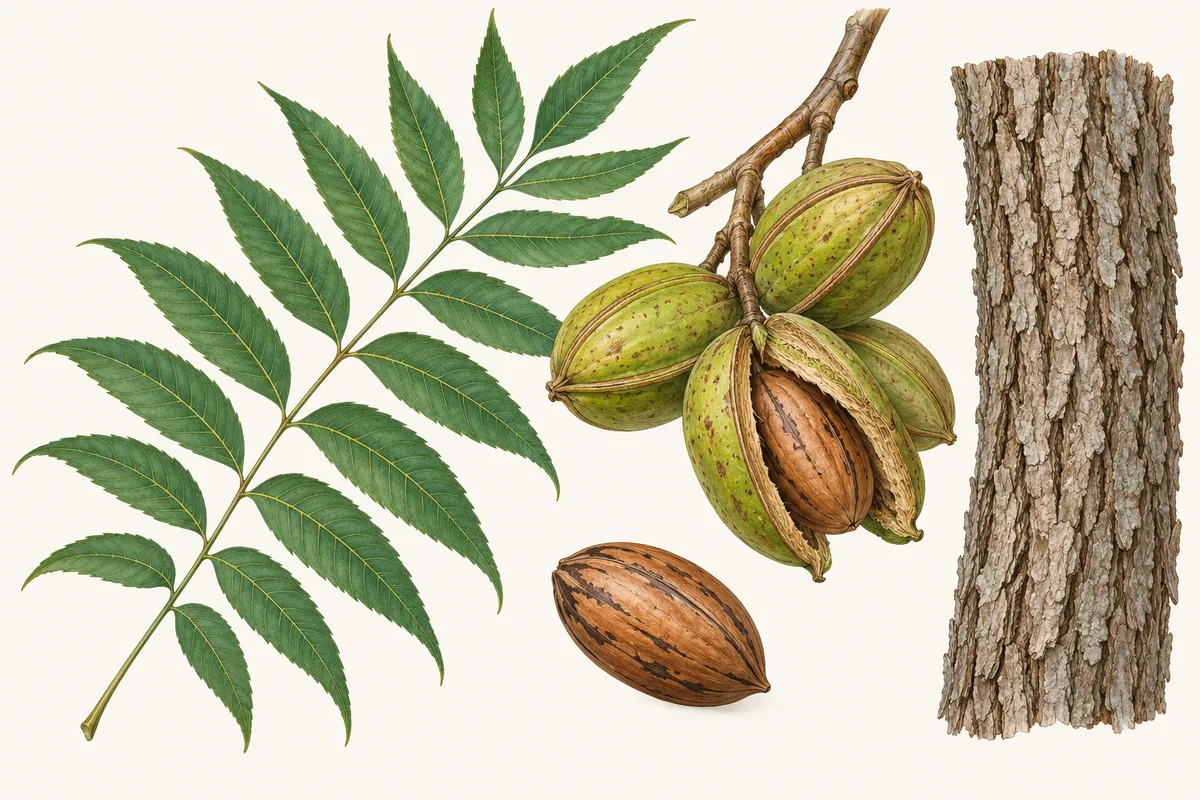
Pecan tree identification starts with the leaf: alternate, 12 to 18 inches long, with 9 to 15 finely toothed leaflets that are often curved like a sickle. Confirm with the nuts, oblong, 1 1/2 to 2 inches long, brown splotched with black, in thin husks and in clusters, and with the twig, whose pith is solid, not chambered like a walnut's. Mature bark breaks into narrow, scaly strips.
- Count leaflets on several leaves: pecan usually has 11 or more, most other hickories 5 to 9.
- Split a twig: pecan's pith is solid, black walnut's is divided into chambers.
- Every pecan tree has both male and female flowers; there are no separate male and female trees.
Field marks at a glance
- Scientific name
- Carya illinoinensis
- Family
- Juglandaceae (walnut family)
- Type
- Broadleaf, deciduous
- Leaves
- Alternate, pinnately compound, 12 to 18 inches (30 to 45 cm) long, with 9 to 15 finely toothed leaflets that are often curved; a single leaflet at the tip.
- Nuts
- Oblong, 1 1/2 to 2 inches (4 to 5 cm) long, brown with black splotches, in a thin husk that splits to the base of the nut; usually in clusters. Ripen in September and October.
- Flowers
- On the same tree: male flowers in yellow-green catkins 4 to 5 inches long, often three from one stalk; small, yellowish green, four-angled female flowers at the shoot tips. April to May.
- Twigs and buds
- Fairly stout, light brown, fuzzy when young; three-lobed leaf scars. Buds yellowish brown to brown and hairy, the end bud 1/4 to 1/2 inch, with scales that meet edge to edge instead of overlapping.
- Pith
- Solid, as in all hickories; walnuts have chambered pith.
- Bark
- Smooth on young trees, later split by narrow fissures into thin, broken, often scaly strips.
- Form and size
- A large tree, often well over 100 ft, recorded to 180 ft; open-grown trees have a wide, spreading crown. Trunks occasionally 70 to 83 in across.
- Native range
- Mainly the lower Mississippi Valley, west to eastern Kansas and central Texas, east to western Mississippi and western Tennessee; scattered north to southwestern Ohio; also Mexico. Widely planted beyond.
Pecan (Carya illinoinensis) is a large hickory of the lower Mississippi Valley and the South, grown in orchards and backyards far outside its wild range. Never eat a berry, nut or seed on the strength of a web page or an app; check with a local expert. This page is about naming the tree: leaf, nut, twig and bark, in that order.
What to check first: leaflets, nuts, then the twig
1. Count the leaflets. Pecan leaves are alternate, one per node, and pinnately compound: a long stalk with paired leaflets and one at the tip. The Virginia Tech Dendrology fact sheet gives 9 to 15 finely toothed leaflets, often curved, on a leaf 12 to 18 inches long. The Key to the Juglandaceae of Iowa puts it another way: mature pecan leaves commonly carry 11 or more leaflets. Count several leaves, because the number varies.
2. Find the nuts. From September to December look on the ground and in the crown. Pecan nuts are oblong, 1 1/2 to 2 inches long, brown splotched with black, in a thin husk, and they grow in clusters (Virginia Tech). The Iowa key notes that the husk splits to the base of the nut. The USDA Forest Service's Silvics of North America says the fruits ripen in September and October and are dispersed from September through December, often carried off by squirrels.
3. Cut a twig. Slice a twig lengthwise with a pocketknife and look at the pith, the soft center. In pecan, as in every hickory, it is solid. In a walnut it is divided by thin crosswalls into a row of small chambers. While you hold the twig, look at the end bud: yellowish brown, hairy, 1/4 to 1/2 inch long, with scales that meet edge to edge rather than overlapping like roof shingles, a mark the Iowa key uses on the way to pecan.
4. Then the bark. On young trees it is smooth. On older trunks Virginia Tech describes narrow fissures that break it into thin, broken, often scaly strips. It never peels in long curling plates like shagbark hickory.
If the leaves are out of reach, a photo of a fallen leaf, a cluster of nuts or the bark is enough for Tree Identifier to suggest a name. Pecan is not one of the 138 species in the app's Collection, but the app can still name it from a photo. It shows no confidence score and no list of alternatives, so check the leaflet count and the pith yourself.
Pecan vs walnut
Walnut is the mix-up people search for most, and for good reason: both are big trees with long compound leaves and husked nuts. Black walnut, per its Virginia Tech fact sheet, has these differences:
| Feature | Pecan | Black walnut |
|---|---|---|
| Leaflets | 9–15, often curved, end leaflet present | 10–24, end leaflet often small or missing |
| Leaf length | 12–18 in | 12–24 in |
| Pith | Solid | Buff, chambered |
| Fruit | Oblong, 1 1/2–2 in, in clusters | Round, 2–2 1/2 in |
| Husk | Thin, splits to the base | Thick, green, never splits; rots off the nut |
| Bark | Narrow fissures, scaly strips | Rough, ridged in a diamond pattern, dark brown inside |
The pith test is the most reliable, and it works in winter on a fallen twig. In summer the fruit settles it from a distance: single round green balls 2 inches or more across are walnuts; clusters of narrow, oblong husks are pecans. The walnut page covers black walnut, butternut and English walnut in more detail.
Male and female pecan trees
Many people search for how to tell a male pecan tree from a female one. There is no male or female pecan tree. The USDA Forest Service describes pecan as monoecious: every tree carries both kinds of flower, and the wind carries the pollen. In April and May look for the male flowers, yellow-green catkins 4 to 5 inches long hanging in threes, and the tiny four-angled female flowers at the tips of new shoots (Virginia Tech).
What does differ between trees is timing. New Mexico State University's Guide H-659 explains that pecan cultivars fall into two pollination types: Type I ("protandrous") cultivars shed pollen before their own female flowers are receptive, and Type II ("protogynous") cultivars have receptive female flowers first and shed pollen afterwards. NMSU advises commercial orchards to plant pollinizer cultivars of the opposite type. A tree that bears no nuts is not a "male" tree; it may simply be too young (see below).
Young pecan trees and saplings
A young pecan shows the same leaf as an old one, with 9 to 15 narrow, often curved leaflets, but its bark is still smooth. Two checks separate it from the saplings it is confused with:
- From young walnuts: solid pith, not chambered, and an end leaflet that is present and normal-sized.
- From young bitternut hickory: bitternut's end buds are sulfur-yellow and four-angled, and its leaves have only 7 to 11 leaflets, according to the Virginia Tech bitternut fact sheet. Pecan's buds are yellowish brown and hairy.
The Forest Service names squirrels as the main animals that carry pecan nuts away, so seedlings can come up well away from the parent tree. The Forest Service notes that some cultivars bear nuts at 2 to 4 years, while trees in natural stands may take up to 20.
Pecan among the hickories
Pecan is a hickory, and the full comparison of shagbark, shellbark, pignut, mockernut, bitternut and pecan by leaflets, husks, bark and buds is on the hickory identification page. In short: most hickories have 5 to 9 leaflets and round or pear-shaped nuts, while pecan has the most leaflets and oblong nuts in clusters. Virginia Tech lists water hickory and bitternut as pecan's closest look-alikes.
Where pecan grows
The USDA Forest Service says pecan grows principally in the lower Mississippi Valley, west to eastern Kansas and central Texas, east to western Mississippi and western Tennessee, and sparsely from southwestern Ohio to Kentucky and Alabama, with local populations in northeastern and central Mexico. It favors deep, well-drained loam that does not stay flooded for long, and it rarely grows on poorly drained clay flats.
It is also widely planted for its nuts: the Forest Service counts more than a hundred named cultivars, propagated by grafting onto improved rootstocks, and NMSU's guide lists the ones grown as far west as New Mexico. Big pecans can top 100 feet; the Forest Service records trees to 180 feet, with trunks occasionally 70 to 83 inches across. To estimate a big tree's age from its trunk, the tree age calculator works from circumference, and Tree Identifier's Tree Map keeps a pin for each located find so you can come back in nut season.
Look-alikes and how to tell them apart
Black walnut (Juglans nigra)
Black walnut leaves carry 10 to 24 leaflets, with the end leaflet often small or missing; pecan has 9 to 15 with an end leaflet. Walnut pith is buff and chambered, pecan's solid. Walnut fruit is round, 2 to 2 1/2 inches, in a thick husk that never splits; pecan nuts are oblong, in clusters, in thin husks that split.
Bitternut hickory (Carya cordiformis)
Bitternut has fewer leaflets, 7 to 11, on shorter leaves of 7 to 10 inches, and a small, nearly round fruit about 1 inch long whose thin husk is four-winged above the middle. Its end buds are sulfur-yellow; pecan's are yellowish brown and hairy.
Other hickories (Carya)
Shagbark, pignut and mockernut hickories carry 5 to 9 leaflets and round to pear-shaped nuts, not oblong ones in clusters. Pecan's many narrow, curved leaflets are the quickest separation; the hickory page compares six species side by side.
What a photo can't settle
- More than a hundred pecan cultivars have been named (USDA Forest Service). A photo can tell you the tree is a pecan, not which cultivar it is: that takes the nut, the flowering type and often the grafting record.
- Virginia Tech lists water hickory as a pecan look-alike. Where the two grow together in southern bottomlands, leaves alone can mislead; check the nut.
- Leaflet counts vary on a single tree, so count several leaves from the sunlit crown before deciding.
Questions people ask
How do you tell a pecan tree from a walnut tree?
Cut a twig lengthwise: walnut pith is divided into small chambers, pecan pith is solid. Then look at the fruit. Black walnut bears single round fruits 2 to 2 1/2 inches across in a thick green husk that never splits; pecan bears oblong nuts in clusters, in thin husks that split open to the base.
Is a pecan tree a hickory?
Yes. Pecan is Carya illinoinensis, one of the hickories, in the walnut family. It has more leaflets than the other common hickories, 9 to 15 against 5 to 9 on shagbark, pignut and mockernut, and its nuts are oblong rather than round.
How can you tell if a pecan tree is male or female?
You can't, because there is no such thing: every pecan tree carries male catkins and female flowers. What differs is timing. NMSU describes Type I cultivars, which shed pollen before their own female flowers are receptive, and Type II cultivars, whose female flowers are receptive first.
What does a young pecan tree look like?
A sapling has the same alternate compound leaves with 9 to 15 narrow, often curved leaflets, and smooth bark; the scaly strips come later. Hairy, yellowish brown buds whose scales meet edge to edge, and solid pith in a cut twig, help separate it from a young walnut.
How long before a pecan tree produces nuts?
The USDA Forest Service gives a minimum seed-bearing age of 2 to 4 years for some cultivars and up to 20 years for trees in natural stands, and reports trees still bearing at up to 300 years. Planted orchard trees are usually grafted cultivars.
Sources
- Pecan fact sheet — Virginia Tech Dendrology
- Pecan (Carya illinoensis), Silvics of North America — USDA Forest Service
- Pecan Cultivars for New Mexico (Guide H-659) — New Mexico State University Cooperative Extension Service
- Black walnut fact sheet — Virginia Tech Dendrology
- Bitternut hickory fact sheet — Virginia Tech Dendrology
- Key to the Juglandaceae of Iowa (modified from Pohl, Keys to Iowa Vascular Plants, 1975) — Plants of Iowa