Regional guide
Desert tree identification in the American Southwest
Few trees, but each one is distinctive. Look at bark color, thorns, leaflet size and where the tree stands, a wash or a slope.
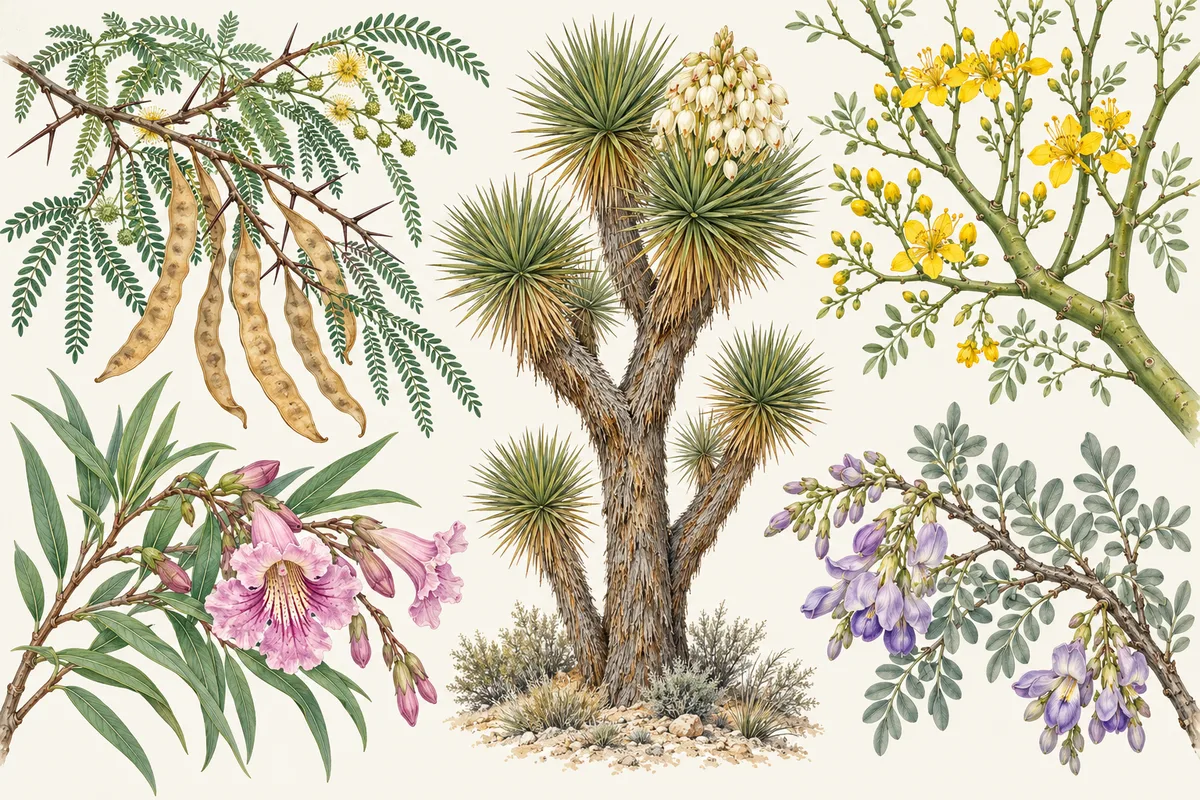
In short
Desert tree identification in the US Southwest comes down to a few checks. Green bark means palo verde: blue palo verde has small thorns, foothill palo verde none. Dark bark, fuzzy gray-green leaflets and long tan pods mean velvet mesquite. Lavender pea flowers and short curved thorns mean desert ironwood. Dagger leaves on a branching trunk in the Mojave mean Joshua tree.
- Palo verde trunks and branches are green because their bark contains chlorophyll (National Park Service, Saguaro).
- Honey mesquite thorns are 1 to 2 inches long and usually single; USDA NRCS gives its straight pods as 7 to 20 cm (3 to 8 in), constricted between the seeds, and velvet mesquite's as 8 to 15 cm (3 to 6 in).
- Desert willow is not a willow: it belongs to the catalpa family (Bignoniaceae) and has orchid-like pink to lavender flowers.
Desert trees are few, small and spread out, which makes them easier to learn than an eastern forest. Most are legumes with tiny leaflets, thorns and bean pods, so start with bark color and thorns, then look at where the tree stands: a rocky slope, a sandy wash or a spring. The Sonoran Desert of southern Arizona holds palo verde, mesquite and ironwood; the Mojave to the north and west holds the Joshua tree; fan palms grow only around desert springs. Descriptions below follow the Saguaro National Park trees and shrubs guide, University of Arizona Cooperative Extension and Joshua Tree National Park.
The desert trees to learn first
| Tree | Where it grows | The feature that settles it |
|---|---|---|
| Foothill palo verde | Rocky hillsides, Sonoran Desert | Yellow-green bark, no thorns, pale yellow flowers |
| Blue palo verde | Sandy washes and valley floors | Blue-green bark, small thorns, bright yellow spring flowers |
| Velvet mesquite | Lower ground, washes, Arizona | Dark trunk, fuzzy gray-green leaflets, tan pods 3 to 6 in |
| Honey mesquite | Washes and flats, Arizona to Texas | Single thorns 1 to 2 in; hairless leaflets; pods 3 to 8 in |
| Desert ironwood | Low Sonoran Desert | Lavender pea flowers in late spring; short curved thorns |
| Desert willow | Dry washes, low deserts and foothills | Narrow leaves up to 10 in; orchid-like pink to lavender flowers |
| Joshua tree | Mojave Desert, 2,800 to 5,800 ft in the park | Dagger-like leaves on a branching trunk |
| California fan palm | Spring-fed oases, southern California | Fan leaves; skirt of dead brown fronds; up to 75 ft |
If you only learn three, learn foothill palo verde, velvet mesquite and the Joshua tree: they cover most desert hikes in Arizona and southern California.
Green bark: the palo verdes
Green bark tells you at once that you are looking at a palo verde. The park service explains that the green comes from chlorophyll in the bark of the branches and the main trunk.
- Foothill (yellow) palo verde (Parkinsonia microphylla): yellow-green bark, tiny drought-deciduous leaves, pale yellow flowers one to two weeks after the blue palo verde, and no thorns. The most common tree in the Tucson Mountain District of Saguaro National Park, mainly on hillsides and the upper bajada.
- Blue palo verde (Parkinsonia florida): blue-green bark, leaves that are fewer and larger than the foothill's, showy bright yellow flowers in spring, and small thorns. It grows in sandy washes at the bottom of the bajada and out into the valley.
The trees with yellow flowers guide covers other yellow-flowered trees.
Dark bark and pods: the mesquites
Mesquites have dark trunks, feathery leaves split into many small leaflets, and long bean pods.
- Velvet mesquite (Prosopis velutina): larger leaves than the other legume trees of Saguaro National Park, soft and fuzzy gray-green; trunk and big branches dark gray to almost black, small branches greenish; pale yellow flowers in catkins; flat tan pods, sometimes streaked with red, 8 to 15 cm (3 to 6 inches) long according to the USDA NRCS velvet mesquite plant guide. It dominates the lower elevations of the park.
- Honey mesquite (Prosopis glandulosa): hairless leaves, usually with two primary leaf sets of 8 to 20 narrow leaflets each; thorns 1 to 2 inches long, usually single on young branches; fragrant greenish-yellow flowers in narrow clusters up to 3 inches, March to August; straight, reddish-brown pods 7 to 20 cm (3 to 8 inches) long, constricted between the seeds, according to the USDA NRCS honey mesquite plant guide. It grows about 20 feet tall in bottomlands, washes and sandy flats, from 0 to about 5,000 feet (University of Arizona Cooperative Extension).
Honey locust, another legume with thorns and long pods, is covered on the locust page. For other trees with pods, see the long seed pods guide.
Thorns and purple flowers: desert ironwood and other legumes
- Desert ironwood (Olneya tesota): gray-green leaves smaller than mesquite's; pale lavender, pea-shaped flowers in late spring; short, slightly curved thorns on the branches. It grows at low elevations in the Sonoran Desert.
- Whitethorn acacia (Vachellia constricta): a shrubby tree with tiny leaflets, reddish new branches that fade to gray, yellow ball-shaped flowers in late spring and straight white thorns, common in washes and small drainages.
Thorns on all of these can cut skin and clothing; the trees with thorns guide covers thorny trees across the US. Never eat a pod, seed, berry or flower on the strength of a web page or an app; check with a local expert.
Washes and springs: desert willow and fan palm
- Desert willow (Chilopsis linearis): narrow, light green leaves up to 10 inches long and 3/8 inch wide; fragrant, orchid-like flowers in pink, lavender or white with purple and yellow streaks in the throat, April to August; long, narrow, slightly twisted seed capsules. Up to 29 feet tall in dry washes and on river terraces from 0 to 5,000 feet. Despite the name, University of Arizona Cooperative Extension places it in the catalpa family, not with willows.
- California fan palm (Washingtonia filifera): native to the low, hot deserts of southern California, up to 75 feet tall, with dead fronds hanging down the trunk like a brown skirt until fire, wind or flood removes them. The park service counts only 118 desert fan palm oases in North America, seven of them in Joshua Tree National Park, usually where a fault forces groundwater to the surface. The palm page separates the California and Mexican fan palms.
The Mojave: Joshua tree
The Joshua tree (Yucca brevifolia) marks the Mojave Desert. It has tough, sharp, dagger-like leaves at the ends of thick, branching arms, and clusters of white-green flowers at the branch tips from mid-February into April in years with well-timed rain and a winter freeze. Most reach about 40 feet, rare giants 50. In Joshua Tree National Park it grows between 2,800 and 5,800 feet. DNA work places it in the agave family; it is a monocot, not a woody tree. The close relative Mojave yucca has longer, broader leaves with fibrous threads along the edges (National Park Service).
Using a photo in the desert
Desert leaves are tiny and can be missing in drought, so photograph more than one feature: the bark, a thorn, a pod or a flower. Tree Identifier names a plant from one photo, and its follow-up chat can answer "blue palo verde or foothill palo verde?". It needs a data connection, which remote trails may lack, so take the photos and identify them later from your library. It shows no confidence score, so check the answer against the table above. Mesquite, palo verde and Joshua tree are not among the 138 species of the app's Collection; finds outside it are kept under Wild Discoveries, and the Tree Map remembers where each one grew. For yard and street trees nationwide, see the most common trees in the US.
What a photo can't settle
- Desert cities plant many trees from other deserts and continents that a native-tree list does not cover.
- Leaves, thorns and pods vary from tree to tree within a mesquite species, so check several features before settling on one.
- Foothill palo verde drops its tiny leaves in drought; a photo of a bare tree may need bark, thorns and pods to settle.
Questions people ask
What is the most common tree in the Arizona desert?
It depends on the ground. In the Tucson Mountain District of Saguaro National Park, the park service names foothill palo verde as the most common tree, on hillsides and the upper bajada. Velvet mesquite dominates lower ground, and blue palo verde grows in sandy washes down into the valleys.
How do I tell blue palo verde from foothill palo verde?
Both have green bark. Blue palo verde is blue-green, has small thorns, slightly larger and fewer leaves, and grows in sandy washes; it flowers bright yellow in spring. Foothill palo verde is yellow-green, has no thorns, grows on rocky hillsides and blooms pale yellow one to two weeks later.
How do I tell mesquite from palo verde?
Look at the trunk. Mesquite trunks and large branches are dark gray to almost black, while palo verde bark is green right down the trunk. Velvet mesquite also has larger, soft, fuzzy gray-green leaves and long tan to reddish pods.
Is a Joshua tree a tree?
It grows like one, up to about 40 feet and rarely 50, but it is a yucca (Yucca brevifolia), a monocot in the agave family, not a woody tree like an oak. The park service calls it native to the Mojave Desert, with some in the Sonoran Desert of western Arizona.
What is the palm with a skirt of dead leaves in the desert?
In the low deserts of southern California it is likely the California fan palm (Washingtonia filifera). Dead fronds hang down the trunk like a brown skirt until fire, wind or flood strips them. It grows up to 75 feet tall around springs, often along fault lines.
Sources
- Trees and Shrubs - Saguaro National Park — U.S. National Park Service
- Prosopis glandulosa - honey mesquite — University of Arizona Cooperative Extension, Yavapai County Native and Naturalized Plants
- Honey mesquite (Prosopis glandulosa) Plant Guide — USDA Natural Resources Conservation Service
- Velvet mesquite (Prosopis velutina) Plant Guide — USDA Natural Resources Conservation Service
- Chilopsis linearis - desert willow — University of Arizona Cooperative Extension, Yavapai County Native and Naturalized Plants
- Joshua Trees - Joshua Tree National Park — U.S. National Park Service
- Fan Palm Oases - Joshua Tree National Park — U.S. National Park Service
Keep reading
- Clue guideWhich tree has thorns? Look at where they grow
- Clue guideWhich tree has long seed pods? Sort it by leaf, pod and region
- Tree profilePalm trees (Arecaceae): how to identify them
- Tree profileLocust trees: how to identify black locust and honey locust
- Data guideThe most common trees in the US, by number of trees