Tree profile
Bigtooth maple (Acer grandidentatum): how to identify it
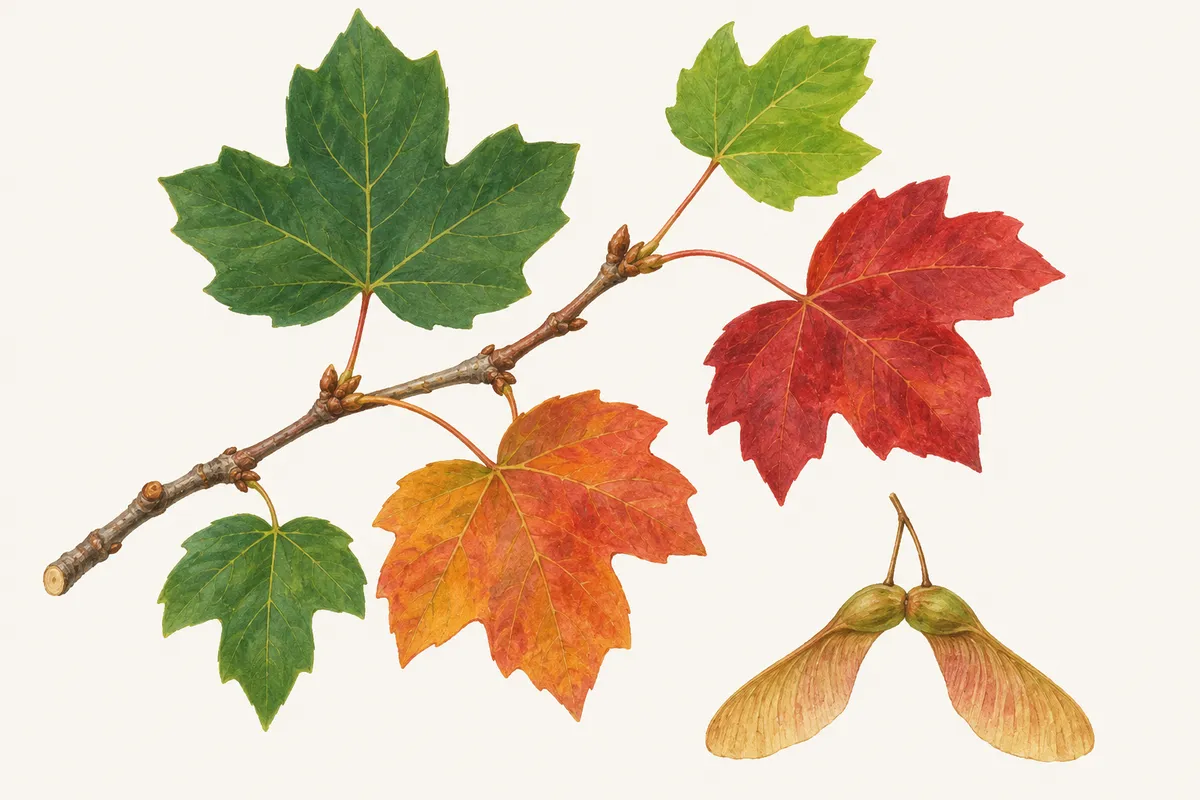
A sugar maple leaf in miniature, on a small, often many-stemmed tree in a dry western canyon: the bigtooth maple is what turns the Wasatch and the Texas Hill Country red in fall.
In short
Bigtooth maple identification starts with the leaf: opposite, 2 to 4 inches across, with 3 main lobes (sometimes 5) and only a few widely spaced, blunt teeth, paler and slightly fuzzy beneath. Paired samaras about 1 inch long hang in a V or U shape in early fall. It is a small tree or many-stemmed shrub of western canyons, from Idaho to Texas, turning yellow, orange or red.
- Few, blunt teeth on a 3-lobed leaf separate bigtooth maple from Rocky Mountain maple, whose lobes are sharply serrated.
- Its leaves look like a small sugar maple's, but the two barely meet: bigtooth maple is a tree of the interior West and central Texas.
- In Utah it grows mostly between 4,500 and 7,500 feet, on lower slopes and canyon bottoms.
Field marks at a glance
- Scientific name
- Acer grandidentatum
- Family
- Sapindaceae (soapberry family; formerly Aceraceae)
- Type
- Broadleaf, deciduous
- Leaves
- Opposite, simple, nearly round in outline, 2 to 4 inches across, 3 lobes (sometimes 5) with a few widely spaced, blunt teeth; dark green above, paler and slightly fuzzy beneath.
- Fall color
- Yellow, orange or red, long-lasting; arguably the top source of fall color in Utah (Utah State University Extension).
- Fruit
- Paired samaras about 1 inch long, wings forming a V or U, round seed cavity; ripen in early fall.
- Flowers
- Small, yellow-green, in hanging clusters on thread-like stalks 1 to 2 inches long, as the leaves open; heavy flowering only every 2 to 3 years in Utah.
- Bark
- Thin, smooth and gray-brown when young, later with many shallow furrows and grayish, flat-topped ridges.
- Twigs and buds
- Slender, shiny chestnut brown to reddish with pale lenticels; buds small and sharp-pointed; U-shaped leaf scars.
- Size and form
- A shrub up to 20 feet on dry sites, a tree of 30 to 45 feet on moist, cool sites; often multi-stemmed.
- Range
- Southeastern Idaho through Utah, western Colorado, Arizona and New Mexico to west Texas, the Edwards Plateau, western Oklahoma and northern Mexico.
- Habitat
- Canyon bottoms, lower mountain slopes and stream sides; in Texas, moist limestone soils in sheltered canyons.
Bigtooth maple is the native maple of the dry interior West. In fall it turns whole canyon sides in Utah's Wasatch Mountains red and orange, and in Texas it colors sheltered limestone canyons of the Hill Country. The leaf looks like a small sugar maple leaf with fewer, blunter teeth, which is where the name comes from. Utah calls the same tree canyon maple. If you find a maple growing wild on a canyon floor between Idaho and west Texas, this is the one to check first.
How to identify a bigtooth maple
Five checks, from the leaf to the bark.
1. Leaf: 3 lobes, few blunt teeth. Virginia Tech Dendrology describes opposite, simple leaves 2 to 3 1/2 inches long and wide, mainly 3-lobed but up to 5, with a few widely spaced rounded teeth, lighter beneath with some fuzz. Utah State University's range plant profile gives a nearly round leaf about 4 inches across with several blunt teeth. Count the teeth: a handful of rounded points on each lobe, never a saw edge.
2. Opposite pairs. Leaves, buds and twigs grow in opposite pairs, as on all maples. That rules out most other small trees in a western canyon, such as Gambel oak.
3. Samaras: 1 inch, in a V or U. The paired winged seeds are about 1 inch long and hang with the wings forming a V or a U, ripening in early fall (Virginia Tech). In Utah, the tree usually flowers heavily only every 2 to 3 years, so some years show few seeds.
4. Bark and twigs. Virginia Tech describes smooth, thin, gray-brown bark that develops many shallow furrows with age; USU adds grayish, flat-topped ridges. Twigs are slender and shiny chestnut brown with pale lenticels, buds are small and sharp, and leaf scars are U-shaped.
5. Form and place. On dry sites it is a multi-stemmed shrub up to about 20 feet; on moist, cool sites it becomes a tree up to 45 feet. It grows on lower slopes, canyon bottoms and stream sides.
Tree Identifier can name a bigtooth maple from one photo of a leaf, the samaras or the whole tree. It does not list look-alikes, so check the teeth on the leaf yourself if you are in Rocky Mountain maple country.
Bigtooth maple vs Rocky Mountain maple, sugar maple and boxelder
| Maple | Leaf | Lobes and edge | Where |
|---|---|---|---|
| Bigtooth | 2–4 in, nearly round | 3 lobes (sometimes 5), few blunt teeth | Canyons, Idaho to Texas |
| Rocky Mountain | Small, 3–5 lobes | Sharply serrated all around; some leaves in 3 leaflets in the south | Mountains of the West |
| Sugar | 3–6 in | 5 rounded lobes, smooth edges | Eastern North America |
| Boxelder | Compound | 3–5 coarsely toothed leaflets | Stream sides across the US |
Rocky Mountain maple (Acer glabrum) is the look-alike in the mountains. Virginia Tech's sheet describes leaves with 3 to 5 serrated lobes in the north of its range and deeper sinuses, sometimes three leaflets, in the south, with thin, smooth gray bark and pale green to red twigs. The edge decides it: many sharp teeth on Rocky Mountain maple, a few blunt ones on bigtooth.
Sugar maple is the leaf people compare it to. Virginia Tech's sugar maple sheet gives leaves of 3 to 6 inches with 5 rounded lobes, larger than a bigtooth's. Range sorts most cases: our sugar maple page covers the eastern tree. Boxelder, a maple with compound leaves, also grows along western streams; see the boxelder page.
For all the maples side by side, our maple identification page compares leaves, buds, bark and samaras.
Where bigtooth maple grows
Utah State University Extension describes its range as moist, mountainous sites from southeastern Idaho, throughout Utah, western Colorado and parts of Arizona and New Mexico, with scattered stands in northern Mexico, southwestern Texas and western Oklahoma. In Utah it is especially common in the Wasatch Mountains between 4,500 and 7,500 feet, usually on lower slopes and canyon bottoms, often with boxelder nearby.
In Texas it is a tree of the Edwards Plateau: the City of Austin's Grow Green plant guide lists it as native there, and the Texas A&M Forest Service calls it a Hill Country native for moist, well-drained limestone soils that handles shade. Our Texas tree identification guide places it among the trees of the plateau's protected canyons, with Texas madrone and Mexican plum.
The Texas A&M Forest Service lists tolerance of drought and alkaline soils above pH 7.5, and the City of Austin calls it the best maple for alkaline soils. That tolerance is part of why it, rather than an eastern maple, holds the limestone canyons.
Fall color and size
Fall is the season to find it. USU calls the color spectacular, varying from yellow to orange to red and lasting a long time, and treats it as arguably the top source of fall color in northern Utah. The Texas A&M Forest Service lists orange, red or yellow, and the City of Austin gold and red. One tree can be red while its neighbor is yellow, so the leaf shape, not the color, identifies it. Our guide to trees with red leaves in fall covers the other red trees.
Size depends on water. USU gives 30 to 40 feet and about 10 inches in trunk diameter for a mature tree, and up to 40 to 50 feet with a 20 to 30 foot crown in a watered landscape; Virginia Tech gives up to 20 feet as a shrub on dry sites and 45 feet on moist, cool sites. The City of Austin lists 20 to 50 feet. Many canyon trees are clumps of several stems rather than a single trunk.
The wood is hard, heavy and light brown (USU). If you find one in October, the Tree Map in Tree Identifier pins it when location is on, so you can return to the same canyon the next fall.
Look-alikes and how to tell them apart
Rocky Mountain maple (Acer glabrum)
Rocky Mountain maple leaves have 3 to 5 lobes with sharply serrated edges all around, and in the south of its range some leaves split into three leaflets. Bigtooth maple leaves have only a few blunt, widely spaced teeth. Rocky Mountain maple bark stays smooth and gray; its twigs are pale green to red.
Sugar maple (Acer saccharum)
Sugar maple leaves are larger, 3 to 6 inches, with 5 rounded lobes and smooth edges, and it is a tree of eastern North America. A wild maple with small 3-lobed leaves in a western canyon is a bigtooth maple, not a sugar maple.
Boxelder (Acer negundo)
Boxelder shares western canyon bottoms with bigtooth maple, but its leaves are compound, with 3 to 5 coarsely toothed leaflets, and its twigs are green to purplish. Bigtooth maple has a single lobed leaf.
What a photo can't settle
- A single leaf photo can be mistaken for a small sugar maple leaf; the place you found it (a western canyon or central Texas) matters as much as the leaf.
- Leaf shape varies from tree to tree and sun to shade, and the number of teeth is not fixed; check several leaves.
- Fall color depends on the tree, the site and the year, so color alone does not identify it.
Questions people ask
Is bigtooth maple the same as canyon maple?
Yes. Canyon maple is the usual name in Utah, where Utah State University Extension uses both; bigtooth maple refers to the few large, blunt teeth on the leaf. Both mean Acer grandidentatum.
How do I tell bigtooth maple from sugar maple?
By size and place. Virginia Tech gives bigtooth maple leaves of 2 to 3 1/2 inches with 3 main lobes, against 3 to 6 inches and 5 rounded lobes on sugar maple. Bigtooth maple grows in western canyons and central Texas; sugar maple is an eastern tree, so a wild maple in Utah or Arizona is not a sugar maple.
Where can I see bigtooth maple fall color?
In Utah, Utah State University Extension calls it arguably the top source of fall color, common in the Wasatch Mountains between 4,500 and 7,500 feet. In Texas it grows in sheltered canyons of the Edwards Plateau, where the City of Austin calls its fall color outstanding.
How tall does a bigtooth maple get?
Virginia Tech describes a multi-stemmed shrub up to 20 feet on dry sites and a tree up to 45 feet on moist, cool sites. Utah State University Extension gives 30 to 40 feet and about 10 inches in trunk diameter for a mature tree.
Sources
- Bigtooth maple (Acer grandidentatum) fact sheet — Virginia Tech Dendrology
- Canyon Maple: A Tree for the Interior West — Utah State University Extension
- Bigtooth Maple (Acer grandidentatum Nutt.) — Utah State University Extension, Range Plants of Utah
- Rocky Mountain maple (Acer glabrum) fact sheet — Virginia Tech Dendrology
- Sugar maple (Acer saccharum) fact sheet — Virginia Tech Dendrology
- Bigtooth maple, Texas Tree Planting Guide — Texas A&M Forest Service
- Maple, Bigtooth (Grow Green plant guide) — City of Austin Watershed Protection
Keep reading
- Tree profileMaple trees (Acer): how to identify them
- Tree profileSugar maple tree (Acer saccharum): how to identify it
- Tree profileBoxelder (Acer negundo): how to identify it
- Regional guideTexas tree identification, from the Pineywoods to the Trans-Pecos
- Clue guideWhich trees have red leaves in fall? Sort them by leaf shape