Also in Deutsch
Tree profile
Sugar maple tree (Acer saccharum): how to identify it
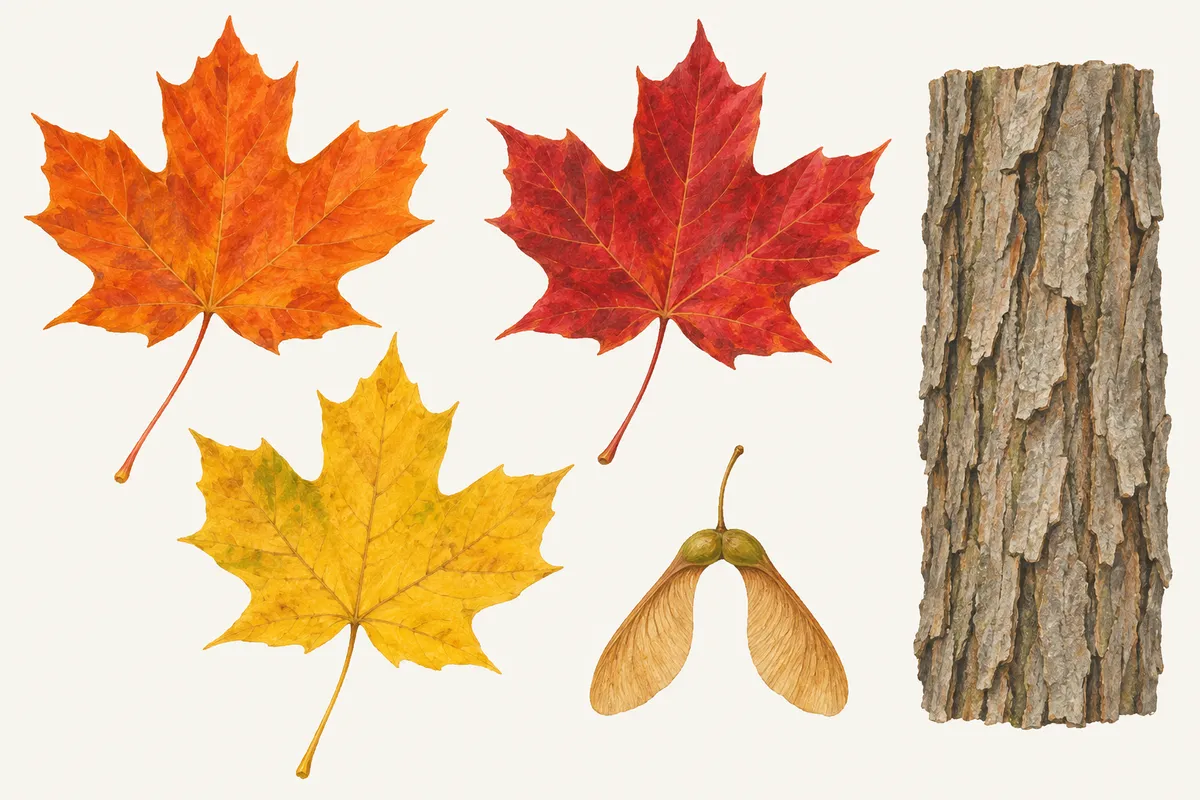
Five lobes with smooth edges, a U between them, a slender brown bud as sharp as a pencil point and bark that never peels off: the hard maple of syrup country, in every season.
In short
For sugar maple tree identification, check the leaf first: opposite, 3 to 6 inches long, with five lobes, smooth edges between the few large points and rounded, U-shaped notches. The winter buds are brown, slender and very sharp-pointed, the paired seeds are about 1 inch long in a horseshoe shape and ripen in fall, and old bark forms firm ridges that stay tight to the trunk.
- Smooth leaf edges and U-shaped notches separate sugar maple from red and silver maple, which are toothed.
- Snap a leaf stalk: clear sap is sugar maple, milky sap is Norway maple.
- A leaf that droops at the sides, with hairs beneath and little leafy flaps at the stalk base, is black maple, now often treated as a subspecies of sugar maple.
Field marks at a glance
- Scientific name
- Acer saccharum
- Family
- Sapindaceae (soapberry family); Virginia Tech lists the older Aceraceae
- Type
- Broadleaf, deciduous
- Leaves
- Opposite, simple, 3 to 6 inches long, five lobes with a few large points and smooth edges between them; notches between lobes rounded, U-shaped. Green above, paler below.
- Leaf stalk
- A snapped stalk gives clear sap, as on other native maples, never the milky sap of Norway maple (Purdue Extension).
- Winter buds
- End buds brown, very sharp-pointed, with tight scales, on slender, shiny brown twigs dotted with pale lenticels.
- Flowers
- Small, pale yellow-green, without petals, hanging in clusters on slender stalks 1 to 3 inches long, late March to mid-May, with or just before the leaves.
- Samaras
- Paired, about 1 inch, wings nearly parallel in a horseshoe that points down; green in summer, brown when ripe in fall.
- Bark
- Never truly smooth: a faint diamond pattern on young trees, then gray-brown and deeply furrowed, with firm ridges that curl outward but stay tight to the trunk.
- Fall color
- Brilliant yellow to burnt orange, often with red, in early to mid fall.
- Size and age
- 60 to 75 ft in landscapes (Morton Arboretum); 90 to 120 ft and 300 to 400 years in old forests (USDA Forest Service).
- Range
- Southeastern Manitoba to Nova Scotia, south through New England and the Appalachians to the Tennessee border, west to Missouri, eastern Iowa and eastern Minnesota; outliers in the Carolinas and Georgia.
Sugar maple (Acer saccharum) is the big shade maple of the Northeast and the Great Lakes, the tree of maple syrup, hardwood floors and orange October hillsides. It shares its palm-shaped leaf with half a dozen other maples, so the identification rests on a few precise marks: smooth leaf edges, a U between the lobes, a sharp brown bud and bark that holds tight.
How to identify a sugar maple: five checks
Work through these in order. Three matches make a confident identification.
1. Opposite leaves. Leaves, buds and twigs grow in pairs. A star-shaped leaf that sits alone at its node belongs to a sweetgum or a sycamore, not a maple. The maple identification page covers this genus test.
2. Five lobes, smooth edges, U-shaped notches. Virginia Tech's sugar maple fact sheet describes an opposite, simple leaf 3 to 6 inches long with five rounded lobes and an entire margin: the edge runs smooth between a few large, blunt points, with no fine teeth. The notches between lobes are rounded at the bottom. University of New Hampshire Extension's memory aid is that there is a "U" in sugar. The underside is paler green, not white.
3. Clear sap. Pull off a leaf and look at the broken end of the stalk. Clear sap fits sugar maple; a bead of milky white sap means Norway maple, the planted look-alike.
4. Sharp brown buds. On the twig tips, sugar maple's end buds are brown, slender and very sharp-pointed, with tightly overlapping scales, on slender, shiny brown twigs with pale lenticels (Virginia Tech). This is the best single winter clue.
5. Tight, ridged bark. On mature trees the bark is gray-brown and deeply furrowed, with long, firm ridges that curl outward at the edges. UNH Extension stresses that even shaggy sugar maple bark stays tight to the tree and does not knock off the way red maple's does.
On the chart below, sugar maple is bottom left, beside red maple; Norway maple sits above it.
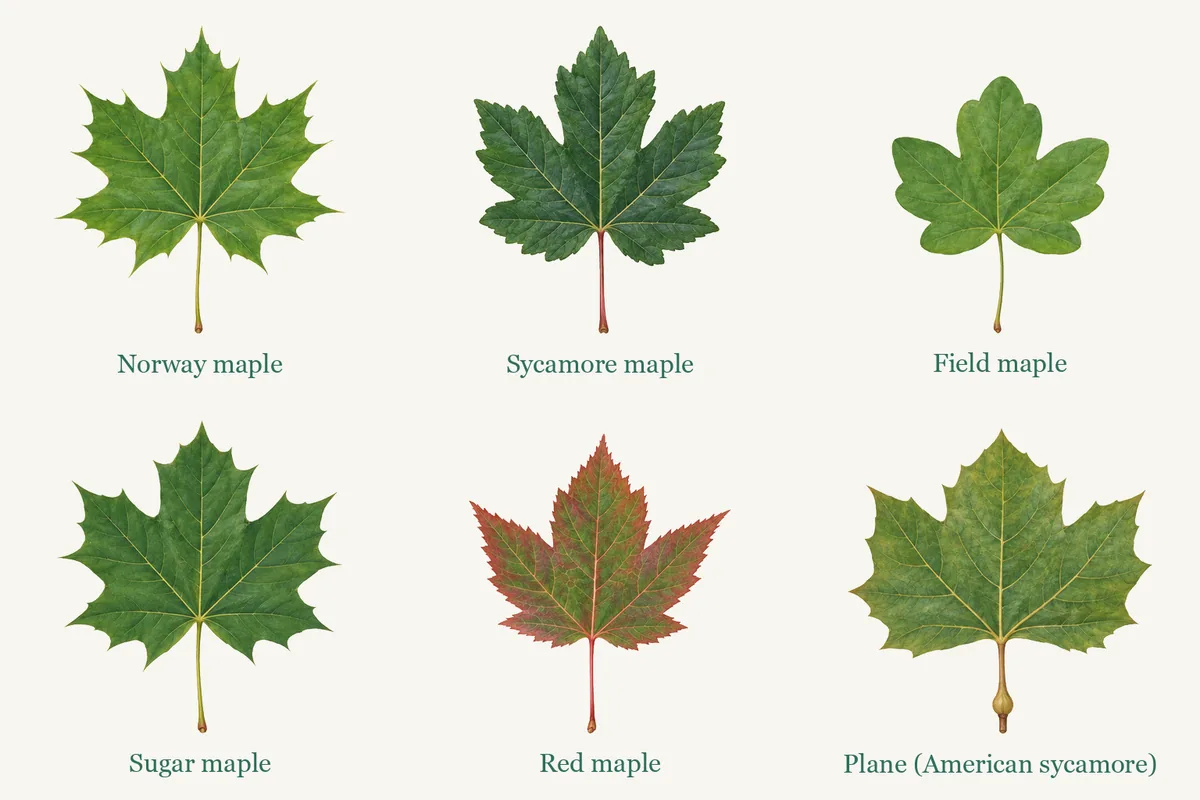
If the crown is out of reach, Tree Identifier can name a sugar maple from one photo of a fallen leaf, the bark or a seed cluster, and sugar maple is one of the 138 species in the app's Collection. The result has no confidence score, so check the edge and the sap yourself.
Sugar maple through the year
Each season gives a different clue, which matters if you want to find the same tree again in late winter, when the sap runs.
- Spring. The USDA Forest Service's Silvics of North America puts flowering between late March and mid-May. The flowers are small, yellow and without petals, hanging on long slender stalks; Virginia Tech gives stalks of 1 to 3 inches, with the flowers opening with or just before the leaves. Single flowers are easy to miss, but the Morton Arboretum notes the whole tree looks showy in bloom.
- Summer. Dense, dark green crown and green seed pairs about 1 inch long, their wings nearly parallel in a horseshoe. The Forest Service gives wings 20 to 27 mm (0.8 to 1.1 inches) long.
- Fall. The seeds ripen about 16 weeks after flowering and start falling about two weeks later. Morton describes the fall color as brilliant yellow to burnt orange, in early to mid fall; NC State adds red. Other gold and orange trees are sorted in trees with yellow leaves in fall.
- Winter. Sharp brown buds, slender shiny twigs, firm ridged bark. Mark your trees before the leaves drop: in February you will be working from buds and bark alone.
Sugar maple vs Norway, red and black maple
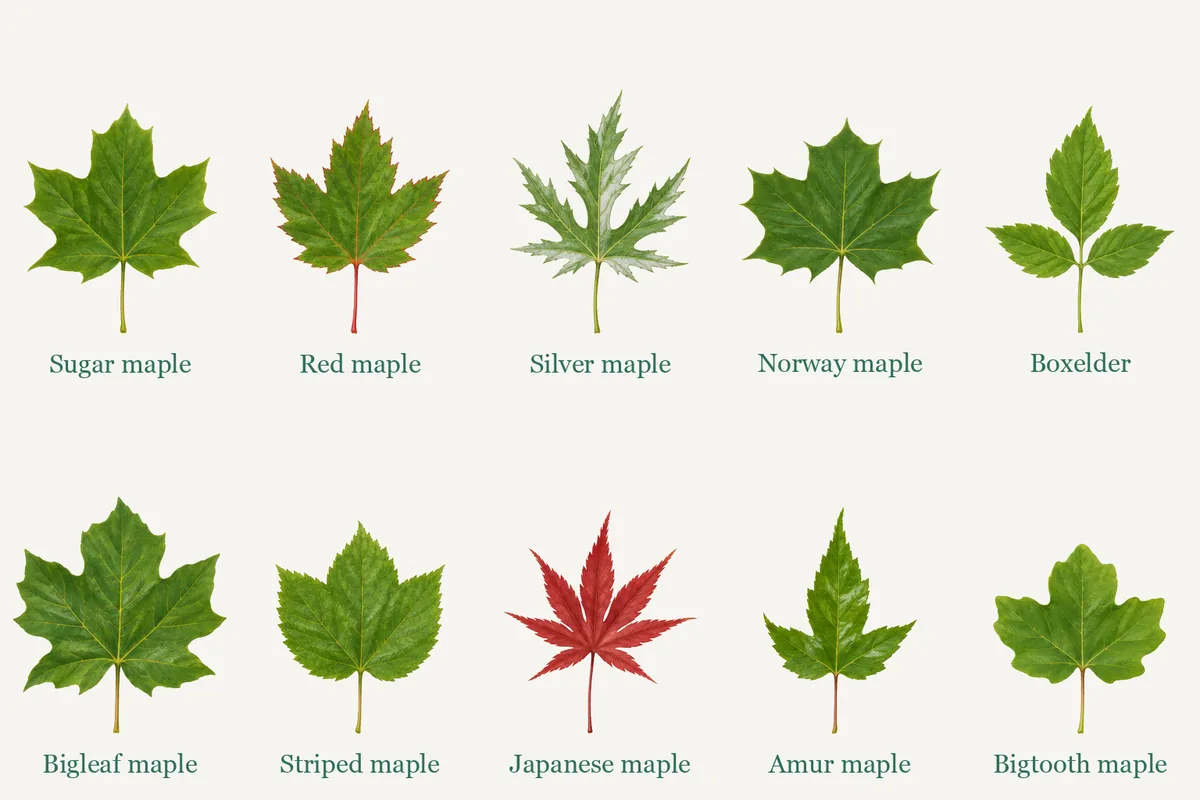
Virginia Tech lists four trees that are confused with sugar maple: red maple, black maple, Norway maple and Florida maple. The first two have their own comparison pages, so here is only the deciding test for each.
- Norway maple: milky sap from the leaf stalk, 5 to 7 lobes with long tapering teeth, large purple turban buds, seed wings spread nearly flat. The Norway maple vs sugar maple page goes through every part, with a comparison sheet.
- Red maple: fine teeth all around the edge, V-shaped notches, blunt bright red buds, seeds dropped in late spring. See red maple vs sugar maple.
- Black maple: the hardest one. Purdue Extension's guide to Norway, sugar and black maples gives four marks: the two bottom lobes are so small that the leaf often looks three-lobed, the leaf sides droop as if wilting, the underside is hairy, and small leafy stipules sit at the base of the stalk, which sugar maple lacks. Both have clear sap and seeds that point downward.
- Florida maple: a southern tree of Coastal Plain bottomlands. NC State's Florida maple page gives leaves of only 1.5 to 3.5 inches with a whitish, often fuzzy underside; it was once classed as a subspecies of sugar maple.
Where sugar maple grows
The Forest Service traces the northern edge from southeastern Manitoba through central Ontario and southern Quebec to New Brunswick and Nova Scotia. In the United States it covers New England, New York, Pennsylvania and the Mid-Atlantic states, runs down the Appalachians to the Tennessee border and west to Missouri, eastern Iowa and eastern Minnesota, with outlying stands in northern Kansas, Georgia and the Carolinas. NC State finds it in the North Carolina mountains and only sporadically in the Piedmont.
Sugar maple is a fussy tree about soil. UNH describes it as needing nutrient-rich, well-drained soil, neither too dry nor too wet, and doing well on north- and east-facing slopes. The Forest Service says it does best on well-drained loams and rarely grows well on dry, shallow soils or in swamps. A maple standing in a swamp is far more likely red or silver.
It is also one of the most shade-tolerant trees of the eastern forest: the Forest Service calls its seedlings very shade tolerant, able to survive long periods of suppression. As a street tree it struggles: the Morton Arboretum lists it as intolerant of salt, drought and air pollution, and NC State adds heat and soil compaction, with leaf scorch possible in drought.
Size, age and the hard maple wood
Morton gives a mature height of 60 to 75 feet and a spread of 40 to 50 feet for planted trees, with an oval to rounded crown that casts deep shade. In old forests the Forest Service reports trees 90 to 120 feet tall and 30 to 36 inches in diameter, reaching 300 to 400 years. Height growth stops at around 140 to 150 years, and trees seldom flower before about age 22, so a young sugar maple may carry no seeds at all.
Sugar maple is the hard or rock maple of the lumber trade. UNH Extension says its wood is about one and a half to two times as hard as red maple's, which is sold as soft maple. The tree also seals off wounds well, UNH adds, so rot spreads less far inside than in red maple.
For syrup, sugar maple is the standard. The Forest Service reports sap averaging about 2.5 percent sugar and about 34 gallons of sap per gallon of syrup; UNH's rule of thumb is 40. The maple page compares the sap of the other maples. To find your tapping trees again when the leaves are gone, identify them in summer with location turned on, and Tree Identifier's Tree Map pins each one.
Look-alikes and how to tell them apart
Norway maple (Acer platanoides)
Snap a leaf stalk: Norway maple bleeds milky white sap. It has 5 to 7 lobes with long tapering teeth, large turban-shaped buds that turn purple, and seed wings spread nearly flat, 1 1/2 to 2 inches long.
Red maple (Acer rubrum)
Red maple leaves are toothed all around the edge, with three main lobes and V-shaped notches. Its winter buds are blunt and bright red, and its small seeds ripen in late spring, not fall.
Black maple (Acer nigrum, or A. saccharum subsp. nigrum)
Purdue Extension describes leaves that often look three-lobed because the bottom lobes are small, sides that droop as if wilting, hairs beneath, and leafy stipules at the base of the stalk, which sugar maple lacks.
Florida maple (Acer floridanum)
A southern relative of Coastal Plain bottomlands with much smaller leaves, 1.5 to 3.5 inches, three to five rounded lobes and a whitish, often fuzzy underside, according to NC State Extension. Sugar maple leaves run 3 to 6 inches and are only paler green beneath.
What a photo can't settle
- Sugar maple and black maple intergrade and hybridize, so some trees show intermediate leaves; a photo app gives one name and cannot settle the subspecies.
- Shade leaves and leaves on sprouts are often larger and less typical than sunlit leaves from the outer crown; judge from several leaves.
- The clear-sap check needs a fresh green leaf stalk, which no photo shows; Tree Identifier names the tree from one image, with no confidence score and no list of look-alikes.
Questions people ask
How do I know if my tree is a sugar maple?
Check that the leaves are opposite, then look for five lobes with smooth edges and U-shaped notches. Snap a leaf stalk: the sap should be clear, not milky. In winter, the end buds should be brown and very sharp-pointed. If all four match, it is a sugar maple or its close relative, black maple.
Why is it called hard maple?
Because the wood is dense. UNH Extension calls sugar maple hard or rock maple and says its wood is about one and a half to two times as hard as red maple's, which is sold as soft maple. The Morton Arboretum also lists hard maple and rock maple as common names.
Is black maple a separate species from sugar maple?
Opinions differ. The Morton Arboretum notes that black maple was once considered a separate species and is now treated as a subspecies of sugar maple. The USDA Forest Service reports hybrids between the two. In the field, look for drooping leaf sides, hairs beneath and stipules at the stalk base.
When does a sugar maple drop its seeds?
In fall. The USDA Forest Service says the double samara ripens about 16 weeks after flowering and starts falling about 2 weeks after it ripens. Red and silver maple drop their seeds in late spring, so a maple shedding helicopters in May is not a sugar maple.
How old does a sugar maple get?
The USDA Forest Service reports mature trees and stands of 300 to 400 years in old forests, with height growth stopping at about 140 to 150 years. Trees in stands that are cut repeatedly seldom pass 250 years. Sugar maples rarely flower before about age 22.
Sources
- Sugar maple fact sheet — Virginia Tech Dendrology
- Sugar Maple (Acer saccharum), Silvics of North America — USDA Forest Service
- Sugar maple (Acer saccharum) — The Morton Arboretum
- Acer saccharum (sugar maple) — North Carolina Extension Gardener Plant Toolbox, NC State University
- Distinguishing Between Norway, Sugar, and Black Maples — Purdue Extension (John E. Woodmansee, May 9, 2025)
- Red or Sugar Maple? How do you tell the difference? — University of New Hampshire Extension
- Acer floridanum (Florida maple) — North Carolina Extension Gardener Plant Toolbox, NC State University
Keep reading
- Tree profileMaple trees (Acer): how to identify them
- Tree comparisonRed maple vs sugar maple: how to tell them apart
- Tree comparisonNorway maple vs sugar maple: how to tell them apart
- Winter field guideWinter tree identification, from buds to bark
- Clue guideWhich trees have yellow leaves in fall? Sort them by leaf shape