Tree profile
Ashe juniper (Juniperus ashei): the mountain cedar of Texas
The dense, shaggy-barked evergreen of the Texas Hill Country, called cedar by almost everyone who lives near it and blamed for cedar fever every winter.
In short
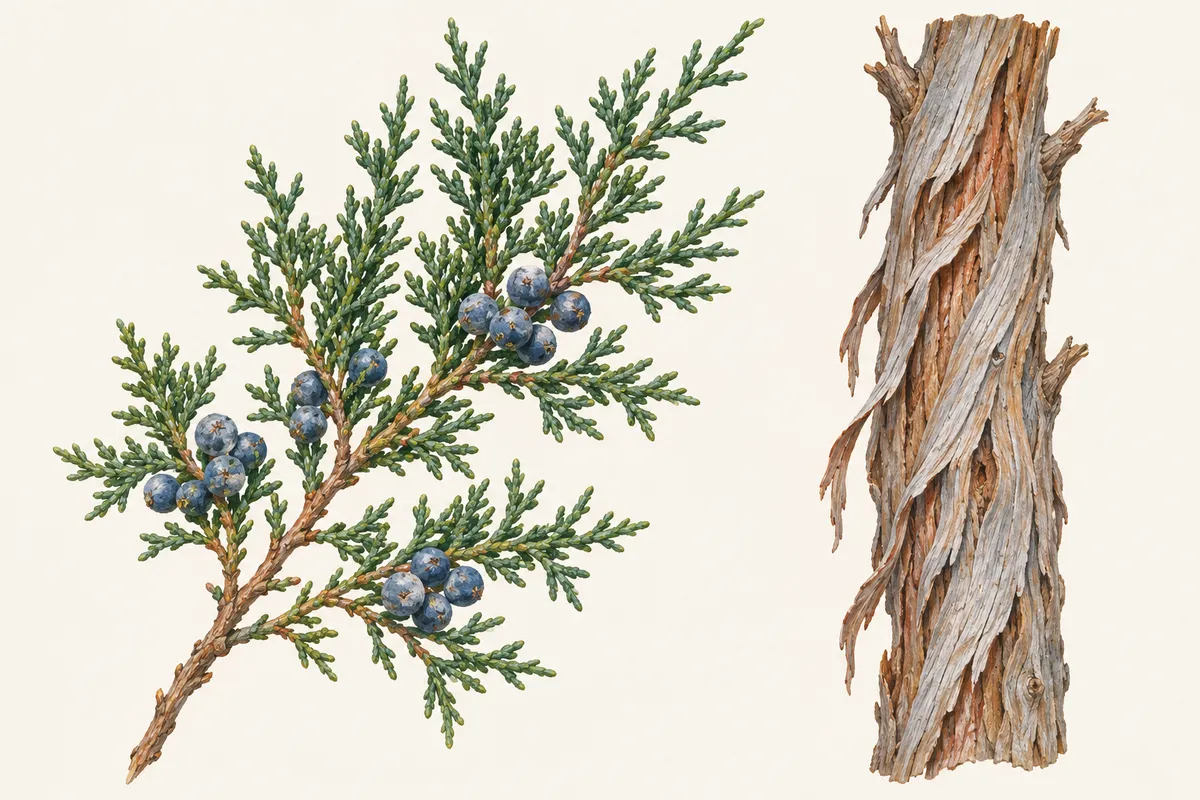
Ashe juniper identification starts with where you are: on the limestone hills of Central Texas, a bushy evergreen with tiny green scale leaves, several stems forking near the ground, gray to reddish-brown bark peeling in long shaggy strips and dark blue berry-like cones about 1/4 to 3/8 inch on female trees is almost always Ashe juniper, the "mountain cedar".
- Ashe juniper is a juniper, not a cedar; mountain cedar, rock cedar and post cedar are local names for Juniperus ashei.
- Male trees shed clouds of pollen from December to February, the season of cedar fever in Texas.
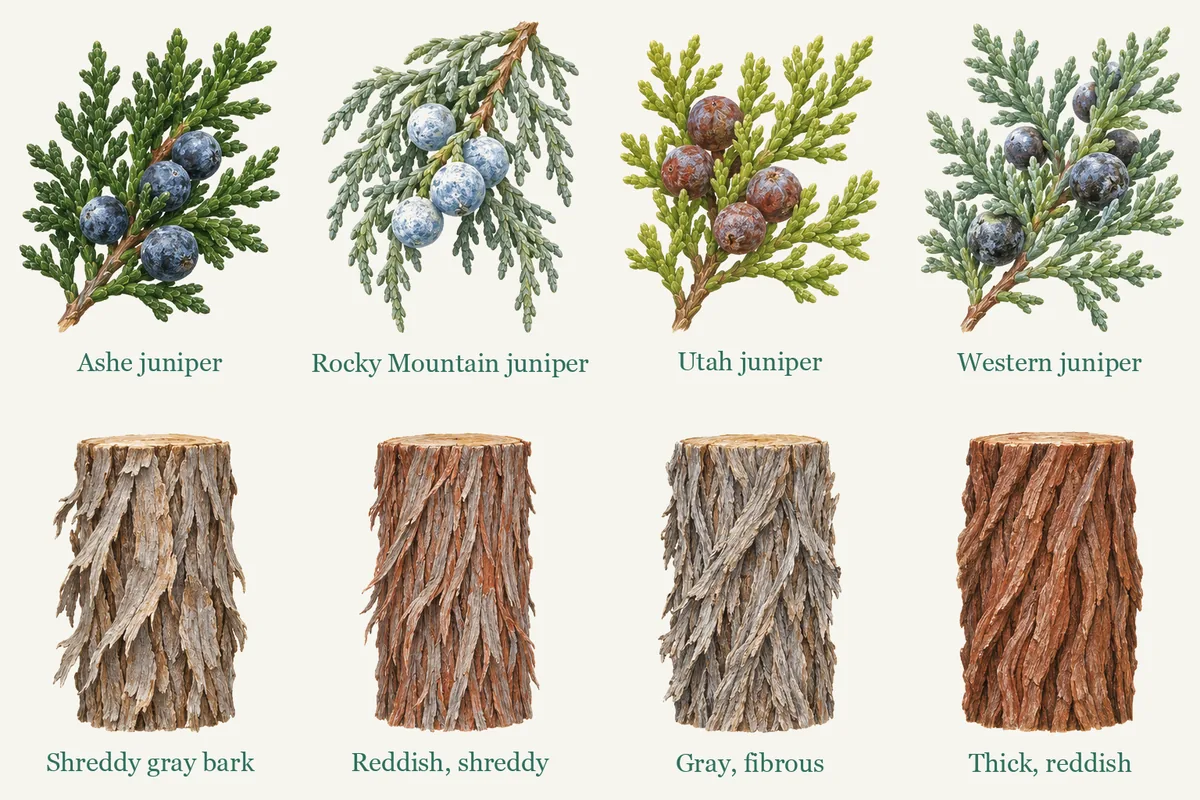
- Dark blue cones mean Ashe juniper; copper-red cones on a shrubby juniper farther west mean redberry juniper.
Field marks at a glance
- Scientific name
- Juniperus ashei
- Family
- Cupressaceae (cypress family)
- Type
- Conifer, evergreen
- Leaves
- Tiny scale leaves about 2 mm long, in pairs or sometimes threes, pressed to the twig; green all year. Shoots are rounded, not flattened. Young shoots and seedlings carry sharp awl leaves up to 12 mm.
- Cones
- Berry-like, dark blue with a whitish film when ripe, about 6.5 to 8 mm (1/4 to 3/8 inch) long, usually one seed; green turning pinkish when unripe; ripe and falling from November to April.
- Sexes
- Dioecious: blue cones only on female trees; male trees carry small pollen cones that ripen from December to February.
- Bark
- Gray to reddish brown, shredding into long, shaggy strips; often patched with a gray-white fungus.
- Form
- Broad, dense, multistemmed shrub or small tree branching near the base, with fluted, twisted stems; usually under 20 feet, up to about 30 feet.
- Range
- Southern Missouri, Arkansas, Oklahoma and Central Texas into northeastern Mexico; most abundant on the eastern and southern Edwards Plateau.
- Habitat
- Shallow, rocky limestone and dolomite soils; open pastures and closed woods, forming dense stands called cedar brakes.
Ask anyone in Austin or San Antonio what the dense, dark evergreens on the limestone hills are, and they will say cedar. They are Ashe juniper, Juniperus ashei, a member of the cypress family and the tree behind the winter "cedar fever". It is one of the most numerous trees in the country: the USDA Forest Service's inventory (EVALIDator) counts about 2.2 billion live Ashe junipers on forest land in the lower 48 states, 45th of all species.
How to identify Ashe juniper
Four checks name most trees in Central Texas.
1. Scale leaves on rounded shoots. The adult leaves are tiny green scales pressed to the twig. Texas A&M's review of Ashe juniper biology by Smeins and Fuhlendorf gives them as about 2 mm long and 1 mm wide, in pairs or sometimes threes. Young shoots and seedlings carry sharp, awl-like leaves up to 12 mm long. The USA National Phenology Network's photo guide points out that the shoots are rounded, not flattened, which rules out arborvitae and other flat-sprayed trees.
2. Dark blue berry-like cones on female trees. Ashe juniper is dioecious, so only female trees fruit. Smeins and Fuhlendorf describe ripe cones as deep blue, 6.5 to 8 mm long and 5.5 to 7 mm wide, usually with one seed and sometimes two. The USA-NPN guide describes unripe cones as green turning pinkish and ripe ones as dark blue or purple, often with a whitish film that rubs off. They ripen and fall from November through April.
3. Shaggy bark. The bark is gray to reddish brown and shreds into long, shaggy strips. The Gymnosperm Database adds that the trunk bark is often patched with a gray-white fungus, a small but handy clue on Hill Country trees.
4. Many stems from the base. Smeins and Fuhlendorf describe a broad, globular, multistemmed shrub or small tree that branches near the ground, with fluted, twisted stems. The Gymnosperm Database also notes that stems usually fork at or near the base, one of its marks against eastern red cedar.
Range does the rest. On the eastern and southern Edwards Plateau, where Ashe juniper is most abundant, a scale-leaved evergreen with blue cones is almost always this tree.
Pollen cones and cedar fever
Male trees are as easy to spot as female ones, but only in winter. The USA-NPN guide says pollen cones reach maturity from December to February; they are small green or brown cones at the twig tips, with overlapping scales that spread apart to release pollen. Smeins and Fuhlendorf give the same December-to-February window for flowering and pollen release, with male cones about 4 mm long.
The USA-NPN calls Ashe juniper "one of the most important causes of seasonal allergies in Texas" and runs a Pollen Trackers campaign so volunteers can help forecast it. If your allergies peak in January in Central Texas, the trees around you are a likely source.
Female trees do not release pollen, so the trees to look at in January are the ones without blue cones.
Ashe juniper vs eastern red cedar, redberry and oneseed juniper
| Juniper | Ripe cone | Leaves | Form | Where in Texas |
|---|---|---|---|---|
| Ashe (J. ashei) | Dark blue with whitish film, 6.5–8 mm, usually 1 seed | Scales about 2 mm, finely toothed margins under a lens | Multistemmed, forks near base, usually under 20–30 ft | Edwards Plateau and Central Texas |
| Eastern red cedar (J. virginiana) | Dark blue with whitish coating, about 1/4 in | Scales about 1/16 in, dark green; needles about 1/4 in on young growth | Usually one trunk, oval to columnar crown, to 60 ft | East and north of Ashe juniper |
| Redberry (J. pinchotii) | Copper to copper-red, about 1/3 in, 1 seed | Scales usually in threes, gland-dotted, yellow- to gray-green | Shrubby tree to 20 ft, open rounded crown | West and northwest of Ashe juniper |
| Oneseed (J. monosperma) | Bluish brown, soft and juicy, about 1/4 in | Scales in opposite pairs, yellow- to gray-green | Shrubby tree to 25 ft | Meets western Ashe juniper populations |
Sources: Virginia Tech's eastern redcedar, redberry juniper and oneseed juniper fact sheets; Smeins and Fuhlendorf for where the species overlap.
Eastern red cedar is the hard one. Both have blue cones and shreddy bark. The Gymnosperm Database separates them by leaf margins (finely toothed in Ashe juniper, visible at 20 to 30x), seeds (usually one in Ashe juniper), stiffer twigs and stems that fork near the base, and by the wood: eastern red cedar's heartwood is red, while Ashe juniper's sapwood is white. Smeins and Fuhlendorf note that hybrids between the two have been suggested where they meet, but chemical analysis has found no evidence of them. Our eastern red cedar page covers that tree in full.
Redberry juniper is quick: look at the cones. Blue means Ashe, copper-red means redberry. Our Texas tree guide sets both in their regions, along with live oak, mesquite and the other trees of the state.
Where Ashe juniper grows
Smeins and Fuhlendorf trace the range from southern Missouri through Arkansas and Oklahoma, across Central Texas and into Mexico; the Gymnosperm Database lists Coahuila, the Ozarks of Arkansas and Missouri, Oklahoma and the Edwards Plateau, at about 150 to 1,550 m (500 to 5,100 feet). In Texas it is most abundant on the eastern and southern Edwards Plateau and extends into the Central Mineral Region, the Grand Prairie, the Cross Timbers and the North Central Prairies.
It grows mostly on shallow, rocky soils over limestone and dolomite, though it also grows on sandy, granitic soils. Early observers described dense "cedar brakes", and the tree still forms closed stands where fire has been kept out. Smeins and Fuhlendorf report that it does not resprout from the base once its top is killed, which is why fire controls small trees, although the Gymnosperm Database says it often resprouts from cut stumps or branch stubs.
Its local names are many: mountain cedar, post cedar, rock cedar, Texas cedar, blueberry juniper and, in Spanish, sabino, enebro and táscate, among others. None makes it a true cedar; the cedar vs juniper page explains why the name stuck to junipers across the country.
Size, age and photographing it
Sources disagree on size. Smeins and Fuhlendorf call it usually under 6 m (20 feet), the USA-NPN gives up to 30 feet, and the Gymnosperm Database 6 to 10 m with rare trees near 15 m and trunks up to 50 cm (20 inches) across. Trees can start bearing cones when only 1 to 1.5 m tall, roughly 10 to 20 years old (Smeins and Fuhlendorf). The Gymnosperm Database cites a documented maximum age of 177 years, with ring counts up to 281 that could not be confirmed.
Never eat juniper cones on the strength of a web page or an app; identification from a photo is not a basis for tasting anything.
For a photo, take one close shot of a shoot with cones or pollen cones and one of the trunk base. Tree Identifier names the tree from one photo of either, with common and scientific names but no confidence score and no list of look-alikes, so confirm the cone color and the many-stemmed base yourself. The app's follow-up chat can answer questions about the species it names, and the juniper overview covers the other junipers of the West.
Look-alikes and how to tell them apart
Eastern red cedar (Juniperus virginiana)
Eastern red cedar overlaps Ashe juniper to the east and north. It usually grows on one trunk into a narrow, oval or columnar crown up to 60 feet, its heartwood is red, and its scale margins are smooth under a hand lens; Ashe juniper forks near the ground, has white sapwood and finely toothed scale margins.
Redberry juniper (Juniperus pinchotii)
Redberry juniper grows to the west and northwest. Its ripe cones are copper to copper-red, about 1/3 inch, where Ashe juniper's are dark blue. Its scales usually sit in threes and are gland-dotted.
Oneseed juniper (Juniperus monosperma)
Oneseed juniper, which meets Ashe juniper in western Texas, has bluish-brown, soft, juicy cones about 1/4 inch. Where it meets Ashe juniper, the western form of Ashe juniper usually has two-seeded cones, which helps; range settles most trees.
What a photo can't settle
- Male Ashe junipers never carry blue cones, so a male tree has to be named from foliage, bark, form and range.
- Telling Ashe from eastern red cedar where they meet may need a hand lens for the scale margins; a phone photo rarely shows them, and hybrids have been suggested though not confirmed.
- Ashe juniper's two varieties (var. ashei and var. ovata) differ mainly in cone width and seed count; a photo app names the species, not the variety.
Questions people ask
Is Ashe juniper the same as mountain cedar?
Yes. Mountain cedar is the most common local name for Juniperus ashei. Texas A&M's review by Smeins and Fuhlendorf also lists post cedar, rock cedar, Texas cedar, blueberry juniper and, in Spanish, sabino, enebro and táscate. It is a juniper, not a true cedar.
When does Ashe juniper release pollen?
In winter. Texas A&M's review gives flowering and pollen release from December through February, and the USA National Phenology Network says pollen cones reach maturity in the same months. Only male trees produce pollen; the USA-NPN calls Ashe juniper one of the most important causes of seasonal allergies in Texas.
How do I tell a male Ashe juniper from a female?
Look in winter. Female trees carry dark blue berry-like cones, frosted with a whitish film. Male trees carry small green to brown pollen cones at the twig tips, whose scales spread apart to release pollen from December to February, according to the USA-NPN photo guide.
How tall does Ashe juniper get?
Sources differ. Texas A&M's review describes it as usually under 6 m (20 feet), the USA-NPN gives up to 30 feet, and the Gymnosperm Database 6 to 10 m with rare trees near 15 m (49 feet). Most Hill Country trees are dense, many-stemmed bushes.
Is Ashe juniper native to Texas?
Yes. Its native range runs from the Ozarks of southern Missouri and Arkansas through Oklahoma and Central Texas into northeastern Mexico, and the species is most abundant on the Edwards Plateau. It has thickened and spread across many pastures, which is why ranchers often treat it as a weed.
Sources
- Juniperus ashei, Ashe's juniper, mountain cedar: Phenophase Photo Guide — USA National Phenology Network
- Biology and Ecology of Ashe Juniper (Smeins and Fuhlendorf) — Texas A&M AgriLife Research, Texas Natural Resources Server
- Juniperus ashei (Ashe juniper) — The Gymnosperm Database
- Redberry juniper fact sheet — Virginia Tech Dendrology
- Eastern redcedar fact sheet — Virginia Tech Dendrology
- Oneseed juniper fact sheet — Virginia Tech Dendrology
- EVALIDator (FIADB-API 2.0): number of live trees on forest land by species, 48 conterminous states — USDA Forest Service, Forest Inventory and Analysis
Keep reading
- Tree profileJuniper trees: how to identify them
- Tree profileEastern red cedar (Juniperus virginiana): how to identify it
- Regional guideTexas tree identification, from the Pineywoods to the Trans-Pecos
- Tree comparisonCedar vs juniper: how to tell the trees apart
- Tree profileLive oak (Quercus virginiana): how to identify it